Team Decision Mistakes Personality Data Can Catch
Use personality signals to spot rushed choices, false consensus, uneven input, and stress-driven conflict—and apply simple meeting rules.
Christian Thomas

Team Decision Mistakes Personality Data Can Catch
Teams often miss the same 4 decision problems before the damage shows up. From what I see in this article, personality data can help me spot them early: rushed choices, false agreement, uneven input, and stress-driven conflict.
The big idea is simple. I should not use personality data to box people in. I should use it to flag process risk and set a few clear meeting rules. That matters even more in high-pressure work, where one study cited in the article found 41% of reported team conflicts had possible effects on patient care, and another linked workload pressure in 822 cancer cases with less problem-focused discussion.
If I want a short takeaway, it is this:
- Fast agreement is not always good judgment
- Silence is not always support
- The loudest voice should not set the whole decision
- Stress can turn normal disagreement into blame
A few simple fixes stand out:
- Ask whether the choice is reversible or not
- Require at least one concern and one other option
- Let junior or quieter people speak first
- Use a short pause to ask, “What hasn’t been said yet?”
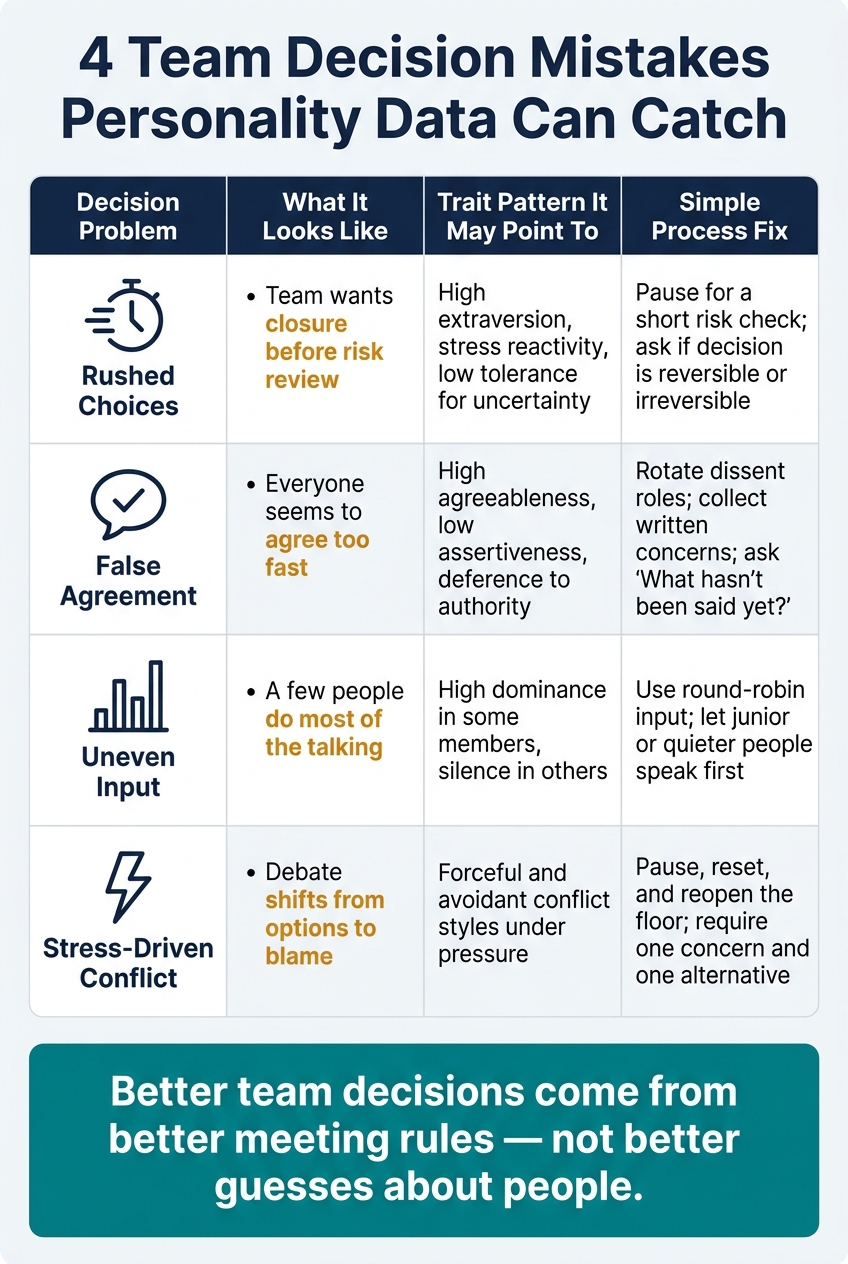
4 Team Decision Mistakes: Personality Signals & Process Fixes
How Teams Should Make Decisions
Understanding these dynamics is essential for strengthening team collaboration and ensuring every voice is heard during the decision-making process.
Quick Comparison
| Decision problem | What it looks like | Trait pattern it may point to | Simple process fix |
|---|---|---|---|
| Rushed choices | Team wants closure before risk review | High extraversion, stress reactivity, low tolerance for uncertainty | Pause for a short risk check |
| False agreement | Everyone seems to agree too fast | High agreeableness, low assertiveness, deference to authority | Rotate dissent roles and collect written concerns |
| Uneven input | A few people do most of the talking | Dominance in some members, silence in others | Use round-robin input |
| Stress-driven conflict | Debate shifts from options to blame | Forceful and avoidant conflict styles under pressure | Pause, reset, and reopen the floor |
For me, the article’s message is clear: better team decisions usually come from better meeting rules, not better guesses about people.
Mistake 1: Rushed Choices That Feel Decisive but Miss Key Risks
Fast decisions can look decisive and still miss key risks. When work feels urgent, speed often means less evidence, weaker accuracy, and more missed concerns [2][3]. That doesn't come from laziness. It comes from pressure. In discharge planning, crisis huddles, and care coordination, that gap between speed and accuracy is often where harm starts. The first clue is usually pace. But under that fast pace, something else is happening: people stop questioning the plan.
Personality Signals That a Team Is Deciding Too Fast
High extraversion can push a group toward fast verbal action. The most outspoken people frame the options early, argue for one path, and create social momentum that's hard to stop. If conscientiousness is lower, "good enough" information can start to feel like enough.
Stress reactivity adds another layer. Some people push to close a decision just to escape the discomfort of uncertainty, even when the risks haven't been clearly named.
At the same time, the people most likely to spot what's missing are often the least likely to jump in early. Team members who are more conscientious, more risk-sensitive, or more introverted may stay quiet until the choice is almost done. When they do speak, they often offer small clarifications instead of stepping back and reframing the issue. Too often, that silence gets treated as agreement.
Then the language in the room starts to shift. Evidence-based questions fade out. Urgency phrases take over. If people start saying things like "we just need to decide" or "we don't have time to go into details", take that as a warning sign. At that point, personality dynamics are starting to overrun risk review.
These patterns tend to show up in the room before they show up in the outcome.
| High-Pressure Pattern | Likely Personality Signals | Rushed-Decision Risk |
|---|---|---|
| Same 1–2 people drive the conversation; others only respond when asked | High extraversion and dominance in leaders; higher introversion and lower assertiveness in others | Options narrowed too early; critical information about client history or resource limits never surfaces |
| Repeated urgency phrases replace evidence review | Elevated stress reactivity, urgency-biased profiles, low tolerance for ambiguity | Truncated risk screening; overreliance on the first available option; weak safety checks |
How to Slow the Process Without Slowing the Team
One simple fix is a reversible-versus-irreversible rule: reversible decisions can move fast, while irreversible ones need a deliberate pause [1]. Before the discussion gets going, the team lead can ask whether the choice can be reversed or whether it locks the team in. That one question can reset the conversation without taking much time.
For irreversible decisions, use a short risk check focused on:
- safety
- legal or ethical exposure
- relationship harm
- capacity
It also helps to make room for quieter, more analytical people before the group closes the discussion. A facilitator can pause after the first proposal and ask what's missing. That small move helps counter the social momentum that high-extraversion profiles can create.
A brief pre-mortem can help too. The team imagines the decision has already failed and asks what went wrong. That approach brings hidden risks to the surface without turning the meeting into a long debate. It gives risk-sensitive members a clear way in, while keeping urgency-driven members engaged because it stays short. Personos can tailor pre-mortem prompts for each trait profile, giving quieter risk-spotters a clear opening without adding friction.
Once speed shuts down review, the next risk is silence.
Mistake 2: Low Dissent That Creates False Consensus
Once speed stops being the main problem, silence often takes its place. In a discharge meeting, case conference, or crisis huddle, silence can look like agreement. But a team can still make the wrong call if people keep their doubts to themselves. Silence gets read as buy-in. Research shows false consensus is more likely when decisions are important, new, time-pressured, or uncertain [6]. That’s why trait patterns matter. They can point to who may hold back before the meeting wraps up.
How Personality Data Can Reveal Hidden Groupthink Risk
False consensus tends to show up around familiar trait patterns. High agreeableness makes it more likely that concerns stay unspoken. People may soften what they mean or say nothing at all when pushback feels risky, especially around authority figures. Low openness adds a second problem. When people lean toward familiar approaches, the group can settle fast on standard solutions and brush past less common options without much discussion. When both patterns show up across a team, harmony starts to win over scrutiny.
Hierarchy makes this even sharper. In steep hierarchies, people who are highly agreeable or very deferential to authority are more likely to decide that speaking up could hurt relationships or status, so staying quiet feels safer [4][5]. A scoping review found that failures to raise concerns about patient harm are linked with errors in medication administration, treatment decisions, and invasive procedures [5]. In helping settings, that makes false consensus more than a meeting problem. It can affect care.
Early signs are usually easy to spot once you know what to watch for. Public agreement may sound cleaner than private opinions. Very few options get raised even when the room includes people from different roles. And dissent shows up only after the meeting ends. Those are the clearest warning signs.
| Warning Sign | Likely Personality Pattern | Intervention |
|---|---|---|
| Quick unanimous decisions on complex issues | High agreeableness, low assertiveness, or conflict avoidance across the team | Rotate a devil's advocate role. |
| Few alternative options raised | Low openness, high preference for routine | Require two documented alternatives. |
| Dissent appears only after the meeting | High deference to authority, high self-consciousness | Collect anonymous input first. |
| Decisions mirror one senior voice | Low dominance among frontline staff, strong authority gradient | Have junior staff speak first; leaders speak last. |
How to Build Dissent Into the Process
Give dissent a role, not a personality. When challenge is built into the process, one person doesn’t have to carry the social risk alone.
One of the simplest fixes is rotating the devil’s advocate. In each meeting, a different team member is asked to name what could go wrong and bring up concerns the group may be missing. The rotation matters. It keeps one person from getting stuck with the “negative” label and spreads critical evaluation across the team [7]. In multidisciplinary helping teams, this also gives frontline staff and peer support workers a clear opening to question plans without it seeming like insubordination.
Personos can flag concentrated conflict avoidance, deference, and low openness so leads can pick the right facilitation method before the meeting starts.
For higher-stakes decisions, anonymous written reservations before open discussion can bring out concerns that quieter or lower-status team members may not say aloud. The facilitator can collect them, group them by theme, and present them without names attached. This works especially well when status gaps are steep, like between a licensed clinician and a peer support worker, or between an executive director and program staff.
A final concern check at the end of every major decision discussion is also a simple habit that can matter. Ask, "What hasn't been said yet?" and then pause. That pause is the whole point. In a study of 86 strategic decision-making teams in U.S. hospitals, dissent improved decision quality when team members perceived strong loyalty, and it improved decision commitment when competence was trusted [8]. The aim isn’t conflict for conflict’s sake. It’s making sure the decision is as solid as it seems. Traits should be framed as signs of interaction risk, not personal flaws, so the focus stays on better decisions.
Mistake 3: Uneven Input and Stress-Driven Conflict That Distort Judgment
Teams can invite dissent and still make bad calls when a few people take over the room. And when pressure kicks in, that problem usually gets worse.
How Dominance and Low Participation Show Up in Team Decisions
In multidisciplinary case conferences, the first person to speak often shapes how everyone else sees the case. If a senior clinician or attorney opens with a strong recommendation, quieter team members may never share key details about family strengths or community supports.
Research on cancer team meetings found that uneven participation and weak information sharing directly hurt recommendation quality [10]. You see the same thing in child welfare and crisis-response huddles. A few dominant voices steer the group toward liability and short-term safety, while the people holding the more nuanced picture never quite get it into the discussion.
Personality data can help spot this pattern early. High extraversion paired with low agreeableness tends to show up as early, frequent speaking and a strong push to wrap things up. High neuroticism paired with high agreeableness tends to look more like deference and silence. If a team has people clustered at both ends, the setup for a dominant/avoidant split is already there.
| Observable Behavior | Likely Personality Pattern | Meeting Design Fix |
|---|---|---|
| One or two people frame the problem; others follow | High extraversion, low agreeableness; steep status gradient | Require each discipline to state its view before open discussion |
| Frontline staff speak only when prompted | High neuroticism, high agreeableness, low assertiveness | Use round-robin input and explicit facilitator invitations |
| Decisions reflect one discipline's risk lens | High-status, risk-averse dominance; quieter voices underheard | Ask each role to name risks, strengths, and alternate options |
| Quieter members disengage mid-meeting | Conflict avoidance, high self-consciousness | Pause for a reset and reopen the floor before deciding |
How Stress Changes Conflict Styles and Decision Quality
Under pressure, people tend to become more extreme versions of their usual conflict style. Personality data can help a team see where each person is likely to go next.
Take a child welfare case conference about a possible removal. The agency attorney and senior supervisor push hard for immediate action because of liability. The family therapist knows the maternal grandmother is a strong protective factor and has offered to take the child for a short period, but stays quiet as the room moves toward removal. The information most tied to the family relationship is the least likely to surface at the exact moment it matters most. That isn't a character flaw. It's a predictable result of clashing conflict styles under stress.
| Conflict Style | Likely Trait Pattern | Stress Behavior | De-escalation Tactic |
|---|---|---|---|
| Competing/Forcing | High extraversion, low agreeableness | Interrupts, reframes dissent as risk, pushes for closure | Take two minutes to hear the full picture before deciding |
| Avoiding | High neuroticism, high agreeableness | Goes silent, defers to authority, agrees publicly | Invite their perspective before moving forward |
Meta-analytic research shows that relationship and process conflict are consistently negatively related to team performance, and conflict asymmetry makes the problem worse by strengthening the negative effect of task conflict on outcomes [11][9].
Process Fixes That Rebalance Voice and Reduce Conflict
The best fix is structural. Change the meeting, not the person.
When the issue is uneven voice, the answer is to shape the meeting so each role speaks before the decision starts to harden. Pre-reads can help. Round-robin input helps too. So does rotating the facilitator. And when stress starts climbing, pause the discussion and reopen the floor to quieter voices.
Personos' Dynamic Reports and conversational AI pair personality profiles with case context to flag likely dominance or withdrawal and suggest the right facilitation move.
Conclusion: Use Personality Data to Improve Decisions, Not Label People
Personality data works best as a process-risk signal, not a label. Traits such as high agreeableness, dominance, low participation, and stress reactivity do not predict failure. But they can point to places where the decision process is more likely to break down. The point is not to read people better. It is to change the process before pressure locks in bad habits.
Use personality data to flag process risk, not define people. One names a process problem. The other turns a pattern into an identity. Labels can become self-fulfilling and weaken psychological safety [12].
Once you can see the risk, the next step is simple: build one rule the team can use again and again. Start with the pattern that feels most familiar, whether that's rushed choices, false consensus, uneven voice, or stress-driven conflict. Then turn it into one concrete norm. For example:
- Require one dissent and one alternative before a final decision
- Test the rule for a few weeks
- Check whether decisions feel more balanced and whether quieter team members say they feel heard
Tools matter only when they turn insight into a routine. Personos can surface group trait patterns and turn them into repeatable decision rules. That makes it a practical option for helping professionals dealing with crisis, high caseloads, and collaboration pressure.
The teams that get the most from this work tie personality data to specific, repeatable decision rules, then revisit those rules as the team changes. Personality data should improve team process, not label people.
FAQs
How can personality data improve decisions without labeling people?
Personality data can help teams make better decisions, but only when the data goes beyond simple personality labels.
Instead of sorting people into fixed “types,” the Five Factor Model looks at 30 traits on an 80-point scale. That gives teams a much more detailed read on how someone tends to think, work, and interact. Put simply, it shows shades of gray, not just black and white.
Tools like Personos build on that data by adding situational context. So the goal isn’t to slap a label on someone and call it a day. It’s to give people better guidance for working together in a given moment, project, or conversation.
Just as important, privacy guardrails help keep this kind of data in check. Detailed scores aren’t broadly shared, and they aren’t meant to be used to make blanket assumptions about a person.
Which team decisions need a pause before moving forward?
Teams should pause before high-stakes decisions made under pressure. That’s usually when bias creeps in and people drift out of sync.
Personality data can help leaders spot those moments early. It also helps them choose an approach that fits how each person tends to think, so the team can make decisions with more clarity and less knee-jerk stress.
What should a manager do if quieter staff rarely speak up?
Managers should build psychological safety and adjust how they communicate based on different personality styles instead of using the same approach with everyone.
That matters because people don't all speak up in the same way. Some team members think out loud. Others need a beat to process, then share. If a manager treats those two people the same, one voice tends to fill the room while the other fades into the background.
Tools like Personos can help here. They offer real-time, situation-specific guidance that can help managers bring quieter staff into the conversation, understand what drives them, learn how they prefer to communicate, cut down on friction, and make sure more team voices are heard.