Team Communication Problems Personality Data Solves
Match your message to each teammate's personality to reduce mixed signals, conflict, and missed follow-through.
Christian Thomas

Team Communication Problems Personality Data Solves
Most team communication problems come down to one thing: people hear the same message in different ways. I’d sum it up like this: if you want fewer mixed signals, less conflict, less shutdown, and better follow-through, you need to match the message to the person, not just the task.
Here’s the short version:
- Mixed signals happen when one person wants detail and another wants the headline.
- Conflict starts when people read style as attitude.
- Shutdown often shows up under stress, especially when a conversation feels tense.
- Missed follow-up happens when ownership, due dates, and confirmation are left unclear.
The article’s main point is simple: generic advice like “communicate better” does not fix these gaps. Personality data gives you a clearer way to adjust tone, level of detail, pace, and channel. That can help teams cut rework and reduce strain in a workday where employees spend 57% of their time in meetings, email, and chat.
If I were putting this into practice today, I’d start with four moves:
- use clear channel rules
- tailor feedback style to the person
- name one owner and one due date for each task
- require a short written confirmation for handoffs
This is not about putting people into boxes. It’s about making everyday communication land better, with less guesswork and less friction.
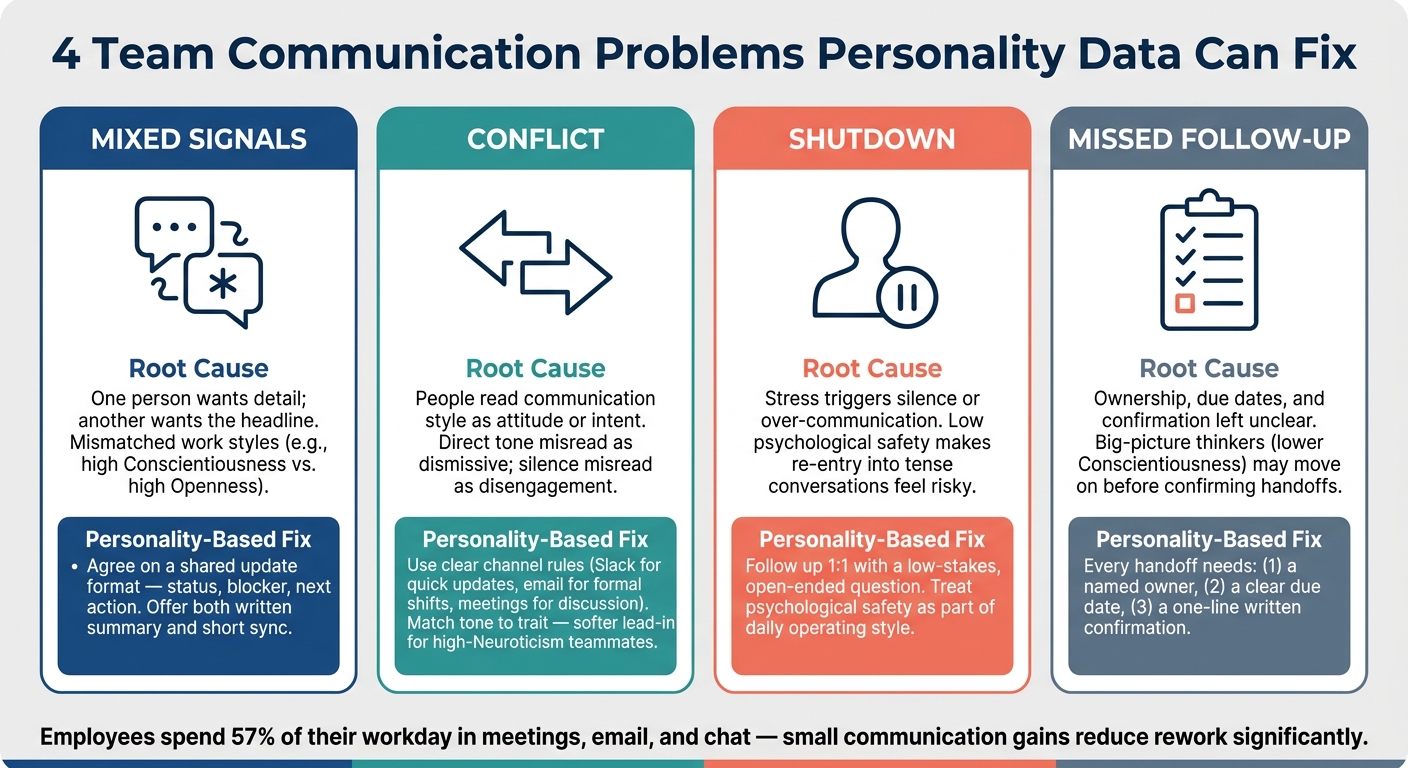
4 Team Communication Problems Personality Data Can Fix
How Personality Types Affect Teamwork And Collaboration w/ Leanne Wyvill
How personality data explains communication patterns at work
The Big Five gives teams a more precise read on how people handle pressure, feedback, detail, and ambiguity. That matters because the same trait differences that shape daily communication also shape misunderstanding, tension, and follow-through.
What the Big Five traits change in day-to-day communication
Extraversion, Conscientiousness, Agreeableness, Openness, and Neuroticism shape how people prefer to speak, listen, and respond at work. In plain English, these traits affect whether someone wants more discussion, more structure, more diplomacy, more room to test ideas, or more reassurance.
That can show up in small ways at first. One person wants to talk things through live. Another would rather get clear notes in writing. One teammate speaks bluntly and moves fast. Another reads that same tone as harsh or careless. Same message, different reaction.
Why trait-based models give more useful guidance than labels alone
Tools like DISC are familiar to most teams, and they do get people thinking about communication differences. But they flatten people into fixed styles and miss a lot of what drives behavior.
Trait-based models measure personality across many more combinations. So two people who both score high in Extraversion can still act very differently in conflict depending on where they land on Agreeableness. One may push hard and enjoy debate. The other may stay outgoing but try to keep the peace.
That makes the guidance more useful. Instead of boxing people into labels, trait-based models help teams think about how to interact. You can adjust tone, level of detail, and even the best channel for the message before a simple misunderstanding turns into a bigger issue.
Those differences usually show up first as mixed signals and conflict.
Problems 1 and 2: Mixed signals and conflict
Why mixed signals happen even when intentions are good
Mixed signals often come from mismatched work styles, not bad intent. A detail-oriented teammate with high Conscientiousness may want specifics, deadlines, and clear ownership. A high-Openness colleague may want to talk through the big picture before the work is fully defined. In a Slack thread, that gap alone can make the same update land in two very different ways.
| Mixed-Signal Scenario | Common Trait Pattern | Personality-Based Fix |
|---|---|---|
| Vague Slack updates with no clear next step | Big-picture style with less preference for structure | Agree on a shared update format: status, blocker, next action |
| One person wants bullet points, another wants to talk it through | Detail-first vs. discussion-first communication styles | Offer both: a brief written summary followed by a short sync |
| Feedback that feels harsh to the recipient | Direct feedback landing poorly with a more sensitive teammate | Add context before critique and adjust tone |
When this keeps happening, it stops feeling like a style gap. It starts to look like conflict, frustration, or quiet withdrawal.
How clashing styles turn into conflict or withdrawal
Problems grow fast once people start reading style as intent. A reserved teammate who needs time to process before replying can look disengaged to someone who expects fast back-and-forth. The reverse happens too. A direct communicator may sound dismissive to a teammate who needs more context before they feel comfortable responding.
Neither read is right, but both can create tension. And that tension adds up. When people mistake style differences for attitude or disrespect, trust starts to slip.
Personality-based fixes for clearer and safer conversations
The best place to start is with clear channel rules. Use Slack for quick updates, email for formal shifts in direction, and a standing meeting slot for anything that needs actual discussion. That cuts down on guesswork about where a conversation belongs and what kind of response it calls for.
Tone matching helps too. High-Conscientiousness teammates often do well with direct, specific feedback. Teammates higher in Neuroticism may need a softer lead-in, with context first and critique second, so the message lands the way it was meant to instead of triggering defensiveness.
Problems 3 and 4: Shutdown behavior and missed follow-up
Why some people go quiet and others over-communicate under stress
When mixed signals start to feel tense, the next problem is often silence or dropped tasks. Some teammates start sending message after message. Others go quiet.
That silence often comes from stress, not from a lack of care or effort. When people don’t feel safe, it gets harder to step back into a tense conversation. Psychological safety gives them a way to re-enter without feeling cornered. Understanding common conflict triggers can help leaders maintain this safety even during high-pressure projects.
How personality affects follow-through, ownership, and closed-loop communication
Once things calm down, another problem can show up: the message never gets confirmed or finished. Closed-loop communication means the message is sent, confirmed, and completed.
Some people are naturally better at follow-through. Teammates who are more conscientious often handle this part with less friction. People who think in broad strokes may move on before they confirm the handoff, especially when navigating diverse personalities in meetings.
The channel matters too. A handoff that feels obvious to one person may land poorly for someone else. That’s why the format should match how the teammate best takes in information.
Simple systems that close the loop without adding more meetings
The answer isn’t more check-ins. It’s better structure right when the task gets assigned. Every handoff should include:
- a named owner
- a clear due date
- a one-line confirmation from the person receiving it
| Follow-Through Failure | Likely Trait Pattern | Practical Fix |
|---|---|---|
| Task agreed to verbally but never written down | Big-picture focus; lower Conscientiousness | Require written confirmation in the project channel |
| Deadline missed without warning | Lower Conscientiousness; comfort with ambiguity | Set a mid-point check-back, not just a final due date |
| Person goes quiet after critical feedback | Higher Neuroticism; low psychological safety | Follow up 1:1 with a low-stakes, open-ended question |
| Recap email sent but no one responds | Mismatch between the message format and the team's communication style | Add one clear ask per action item |
| Ownership unclear after a group discussion | No owner named before the meeting ends | Name the owner out loud and confirm it in writing |
Conclusion: What personality data actually helps teams do
Across mixed signals, conflict, shutdown, and missed follow-up, the same pattern shows up again and again: people communicate in ways that make sense to them, but not always to the person on the other side. Personality data helps you read what someone needs more clearly, and fix things faster when a message lands the wrong way.
The big takeaway is simple: adjust the message to the person, not just the task. When you match your message style to how someone takes in information, day-to-day communication gets smoother. Employees already spend an average of 57% of their workday communicating through meetings, emails, and chats [1]. So even small gains in how those exchanges land can cut down on rework and stop conversations from needing a second round. That’s where personality tools come in. They help teams do this on purpose, not by chance.
Key points to carry into team practice
The core shift is this: stop communicating only the way you prefer, and start communicating the way the other person receives information best. In practice, that means using trait data to analyze personality, not gut instinct or broad labels, to shape your wording, timing, and format. It also means setting up light systems that turn insight into tracked tasks, so follow-through doesn’t rest on memory alone. And it means treating psychological safety as part of the team’s daily operating style, not a nice extra.
Tools like Personos, built on the Five Factor Model across 30 traits, turn personality insight into real-time guidance and tracked next steps. Used well, personality data can reduce mixed signals, ease conflict, help people re-engage, and close the loop on follow-up.
Personality data makes the invisible visible and gives teams a clear next move.
FAQs
How do you collect personality data at work?
Collect personality data at work with standardized questionnaires, such as the scientifically validated Five Factor Model assessment. Tools like Personos make this simple by offering a brief 5-minute assessment during onboarding.
You can get a better read by adding context like job roles, professional goals, and past workplace experience. AI platforms can also sharpen these insights over time by looking at communication patterns, tone, and word choice.
Can personality data be used without boxing people in?
Yes. When it’s grounded in frameworks like the Five Factor Model instead of rigid typing systems, personality data can help guide communication without boxing people into labels.
A scale-based approach, such as 30 traits on an 80-point scale, leaves room for many different combinations. Tools like Personos use that data as a flexible starting point for growth and collaboration, not a final judgment.
What should a team change first to improve follow-through?
Move away from one-size-fits-all management. Shape communication and accountability around each person’s personality, motivations, and level of readiness.
Personality insights, such as the Five Factor Model, can help teams pick words and approaches that fit each coworker better. Tools like Personos can help with this by offering real-time guidance and clear prompts people can act on right away.