How to Tailor Leadership Training by Personality
Keep the standard but vary delivery: use Big Five traits to tailor pacing, practice, feedback and tools for better leadership behavior.
Rachel Johnson

How to Tailor Leadership Training by Personality
If every leader gets the same training, some people will miss the point. I’d keep the leadership standard the same, but change how people learn, practice, and get feedback based on personality.
Here’s the short version:
- I’d start with 4 to 6 leadership behaviors such as feedback, conflict management, coaching, decision-making under pressure, and change communication.
- I’d use the Big Five as the starting point because it links personality traits to work behavior in a clear way.
- I’d change session length, pace, pre-work, and practice format based on trait patterns, not job titles.
- I’d adjust feedback style and follow-up support without changing expectations.
- I’d use tools that support privacy, repeated practice, and behavior tracking after training ends.
A few numbers stand out:
- Poor communication fit can cut efficiency by 20% to 30%
- 62% of leaders say communication breakdowns are a top cause of workplace conflict
- A pilot should be checked at the 60- to 90-day mark
In plain terms, I see the article’s main point like this: one curriculum can still fit different people if the delivery changes. That means less friction, better practice, and a better shot at behavior change across large teams.
Tailoring Leadership: How to Lead Different Personality Types Effectively!
Step 1: Define leadership skills and connect them to personality patterns
Start with a small set of behaviors the team needs to change. Then use personality patterns to shape how people practice those behaviors.
Pick 4 to 6 core leadership behaviors for the program
Before you look at personality data, get clear on the behaviors the organization needs to shift. Long competency lists sound nice, but they make it hard to focus. Keep the program tight and limit it to 4 to 6 behaviors.
A practical place to start is with these five:
- Coaching and performance conversations
- Feedback delivery
- Conflict management
- Decision-making under pressure
- Change communication
These are often the first places things go sideways across big teams. Weak feedback lingers. Conflict takes too long to sort out. Change messages get fuzzy, and confusion spreads fast.
The skill itself may stay the same, but the way people practice it can change. For example, a leader who thinks things through internally may do better with structured reflection before a live role-play. Same skill, different friction.
These behavior targets set up the pacing and practice design in Step 2.
Turn trait scores into training design choices
Trait scores should shape how training is delivered, not what standard leaders are expected to meet. In plain English, use trait scores to adjust format, pacing, and support. Don’t use them to box people in.
| Trait Pattern | Training Design Choice |
|---|---|
| High Conscientiousness | Structured sequences, clear rubrics, detailed SOPs |
| High Openness | Varied formats, brainstorming, cross-team scenarios |
| Lower Extraversion | Pre-work reflection, written responses before group discussion |
| Lower Emotional Stability (more stress-sensitive) | Low-stakes practice first, guided simulations before live role-play |
| High Agreeableness | Direct but supportive feedback, clear human respect |
Treat this as a starting point, not a hard rulebook. Trait scores show tendencies, not limits.
Use these patterns to decide module pacing and practice format next.
Step 2: Build modules with different pacing and practice formats
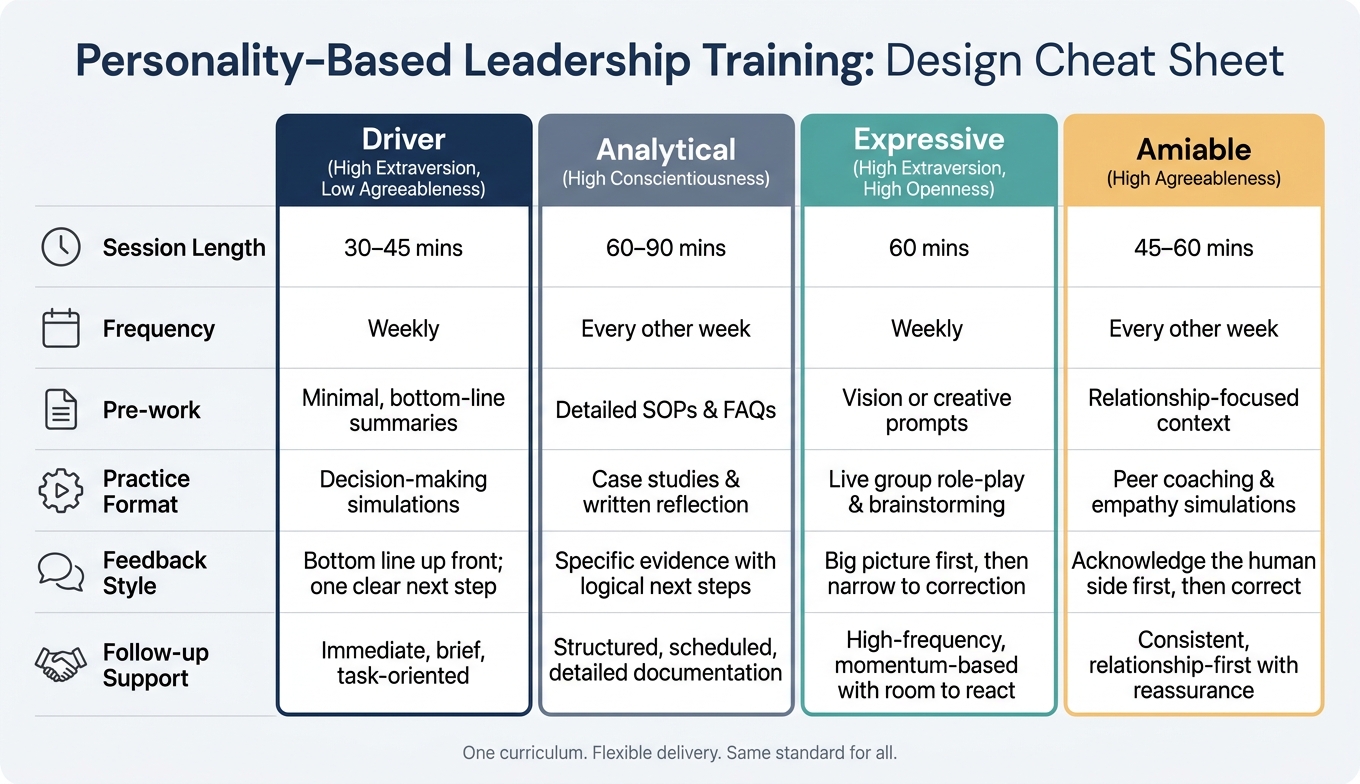
Personality-Based Leadership Training: Design Cheat Sheet
Use the trait patterns from Step 1 to set pacing and practice format. The goal is simple: keep one curriculum, but make pacing and practice flexible.
Set pacing rules for different learners
Pacing is a common place where training falls apart. Reflective, detail-oriented learners often need more time between sessions. They also tend to do better when they have review material they can work through on their own.
Social or action-driven learners usually respond better to shorter, more frequent touchpoints. In many cases, microlearning is a better fit for them.
Match practice formats to trait pattern and comfort level
Practice format matters just as much as the material itself. Leaders high in conscientiousness, or Analytical leaders, tend to do well with structured case studies and written reflection. Leaders high in agreeableness, or Amiable leaders, often get more from peer coaching in smaller groups.
AI simulations also help. They give leaders a safe place to practice hard conversations again and again before they take those conversations live.[2]
Personality-to-training design reference table
Use this table to turn trait patterns into clear delivery choices. It gives program designers a fast starting point for large-cohort rollouts.
| Trait Pattern | Session Length | Frequency | Pre-work | Practice Format |
|---|---|---|---|---|
| Driver (High Extraversion, Low Agreeableness) | 30–45 mins | Weekly | Minimal, bottom-line summaries | Decision-making simulations |
| Analytical (High Conscientiousness) | 60–90 mins | Every other week | Detailed SOPs & FAQs | Case studies & written reflection |
| Expressive (High Extraversion, High Openness) | 60 mins | Weekly | Vision or creative prompts | Live group role-play & brainstorming |
| Amiable (High Agreeableness) | 45–60 mins | Every other week | Relationship-focused context | Peer coaching & empathy simulations |
Keep the content fixed. Change the length, cadence, pre-work, and practice format.
Next, adjust feedback and support so the same standards land differently across personalities.
Step 3: Adjust feedback, coaching, and support without lowering standards
Keep the standard fixed. Change how you deliver it.
Use the same trait map from Step 2 to shape feedback and follow-up, without changing what's expected. In plain English, the bar stays the same for everyone. What changes is how the message lands.
Use different feedback styles for different personalities
Adjust the channel, not the standard.
Driver leaders want the bottom line up front. Start with the conclusion, point to the exact behavior, and give one clear next step.
Analytical leaders want logic and order. Show specific evidence, explain why it matters, and lay out next steps in a way they can check for themselves. Vague feedback won't cut it.
Expressive leaders tend to respond better when you start with the big picture, then narrow into the correction. Give them a moment to react, then guide them back to the task.
Amiable leaders need the human side acknowledged first. Give the correction directly, but don't drop it on them once and vanish. Stay present.
One simple technique works well across all four styles: swap Do you understand? for What's your next step? It checks for alignment without sounding parental, and it gives the leader space to say the next move in their own words. [1]
Once the message is clear, add the kind of support each person needs so they can act on it.
Add support layers for people who need more structure or reassurance
Pair post-session nudges with structured follow-up, and the learning keeps going long after the session ends. These nudges should be brief, timely, and tied to the exact behavior the leader is working on. [2] In large-cohort rollouts, that extra support helps avoid uneven adoption across the team.
| Personality Style | Follow-up Cadence | Support Type |
|---|---|---|
| Driver | Immediate, brief, task-oriented | Clear next steps; minimal context |
| Analytical | Structured, scheduled, detailed | Evidence, SOPs, documentation |
| Expressive | High-frequency, momentum-based | Room to react; then redirect to tasks |
| Amiable | Consistent, relationship-first | Reassurance; consistent follow-up |
For Amiable and Analytical leaders, it can help to add office hours, peer partners, or manager check-ins between sessions. Those support layers don't change the standard. They just make it easier for people to meet it.
Next, use the same personality map to choose tools, protect privacy, and measure behavior change.
Step 4: Choose tools, protect privacy, and measure program results
Pick tools that keep coaching going after the workshop.
Once you know what kind of feedback and support people need, the next step is choosing a platform that can deliver that help at scale.
Pick validated tools for assessment and ongoing coaching
Start with FFM-based tools. Skip fixed-type models that sort people into broad buckets. The FFM measures 30 traits on an 80-point scale, which means two people won’t get flattened into the same profile just because they share a label. [3] That level of detail helps you adjust pacing, practice, and support without lowering the bar.
Assessment quality matters, but it’s only part of the picture. A one-time report can spark a good conversation, then sit untouched. What tends to help more is a tool that gives people support in the moment. Look for platforms that offer real-time guidance tied to what’s happening right now, not just a static snapshot from one assessment.
A tool only earns its place if it keeps personality-aware coaching active after the session ends. Personos combines FFM-based profiles, conversational AI, Dynamic Reports, Prompts, and an ActionBoard to deliver coaching between sessions. [4][3] It also masks identifying information before AI processing, and raw scores stay hidden from colleagues and managers. [3]
Platform comparison table
Compare platforms based on validation, coaching depth, privacy, and scale.
| Feature | Personos | Hogan | DISC / MBTI | CliftonStrengths | Korn Ferry |
|---|---|---|---|---|---|
| Scientific foundation [3] | Five Factor Model - 30 traits on an 80-point scale | Five Factor Model | Type-based | Positive psychology | Competency-based |
| Ongoing coaching [4][3] | Real-time AI prompts and ActionBoard | Periodic reports | Usually a one-time workshop | Self-directed | Consultant-led |
| Team-report capability [4] | Real-time team insights | Static team reports | Static team maps | Strength grids | Competency gap maps |
| Privacy approach [3] | Data masking; raw scores never shared | Scores shared with HR or managers | Scores often shared publicly | Strengths shared openly | Scores shared with HR |
| Scalability [3] | High - integrates with Slack or Microsoft Teams | Moderate - requires debriefs | High - simple to understand | High | Low to moderate |
Use this table to line up each platform’s depth, privacy approach, and scale with what your rollout needs.
Conclusion: Start small, adjust the format, and track behavior change
Run a pilot first. Choose one cohort, use the four-step framework, and review engagement plus manager feedback at the 60- to 90-day mark before you scale. [3]
Focus on behavior, not just survey scores. Are friction points dropping? Is communication getting better? Are leaders changing their tone and approach in real time? [4] Are people acting on the nudges and follow-up prompts? [3]
Use the feedback loops inside your platform to fine-tune the program. If leaders rate the usefulness of coaching prompts or AI-generated guidance, that gives you a clear read on what’s working and what’s falling flat. [3] Then you can adjust pacing, format, or support layers based on what the data shows.
Scale only after the pilot shows better behavior, not just better ratings.
FAQs
How do you tailor training without stereotyping people?
Skip fixed labels like colors or personality “types.” They flatten people into neat boxes that rarely fit in practice.
A better route is to use tested frameworks like the Five Factor Model. It measures 30 traits on an 80-point scale, which gives training a much more personal fit. Instead of pushing someone into a generic archetype, it reflects how that person actually shows up.
Context matters too. Goals, role, and professional history can change how those traits play out on the job. And if you're using these insights at scale, audit results across groups on a regular basis to help cut down on unintentional bias.
Which leadership behaviors should we prioritize first?
Focus first on the behaviors that shape team performance and engagement the most: communication, trust-building, and decision-making.
Leadership works better when it takes personality into account. That can mean adjusting feedback based on how open someone is to it, or changing the pace of a discussion to fit different thinking styles. Small shifts like these can make day-to-day leadership work much better.
If you use Personos, begin with Group Reports. They can help you spot friction points and see how people prefer to communicate. From there, put your energy into high-stakes conversations and clear team-wide communication norms. That’s often where psychological safety and trust start to take root.
How can we measure whether personality-based training works?
Track key indicators over several months. Focus on engagement, team psychological safety, and workplace conflict. A pilot with one team using Personos can show whether the training leads to better communication and smoother collaboration.
It also helps to review AI-generated scores across demographic groups to check for bias. Then compare those scores with what you see day to day, along with direct observation and regular conversations.