Space vs. Silent Treatment in Attachment Conflict
Judge the pattern, not the label: distinguish healthy space from silent treatment by checking communication, intent, duration, follow-through, and safety.
Nick Blasi

Space vs. Silent Treatment in Attachment Conflict
I look for a return plan, not just silence. Healthy space gives you time to settle and a plan to reconnect. Silent treatment uses withheld contact to punish or pressure you. If it’s safe, ask: “When can we check in?”
I weigh 5 things before judging the pattern:
- Communication: Was the pause explained?
- Intent: Was it for calming down or forcing agreement?
- Duration: Was a check-in set, with updates when possible?
- Follow-through: Did the person return, acknowledge harm, and address the issue?
- Safety: Could both people speak freely without fear?
Quick Comparison
| What I check | Healthy space | Silent treatment |
|---|---|---|
| Communication | Explains the pause and contact limits | Withholds contact without a return plan |
| Intent | Aims to reduce tension | Aims to punish or force compliance |
| Duration | Has a realistic check-in | Is unpredictable or depends on giving in |
| Follow-through | Returns to the issue | Avoids repair or shifts blame |
| Safety | Respects boundaries | Uses pressure, threats, or retaliation |
Silence alone doesn’t prove intent. I also consider common conflict triggers, overwhelm, illness, communication access, and what happens afterward. <u>Safety comes before reconnection.</u> If fear or coercion is present, I’d seek private support rather than push for joint repair. AI tools may help organize information, but they cannot determine abuse or replace professional judgment.
Silent Treatment or Just Space? 3 Signs You’re Missing
Space vs. Silent Treatment: 5 Key Differences
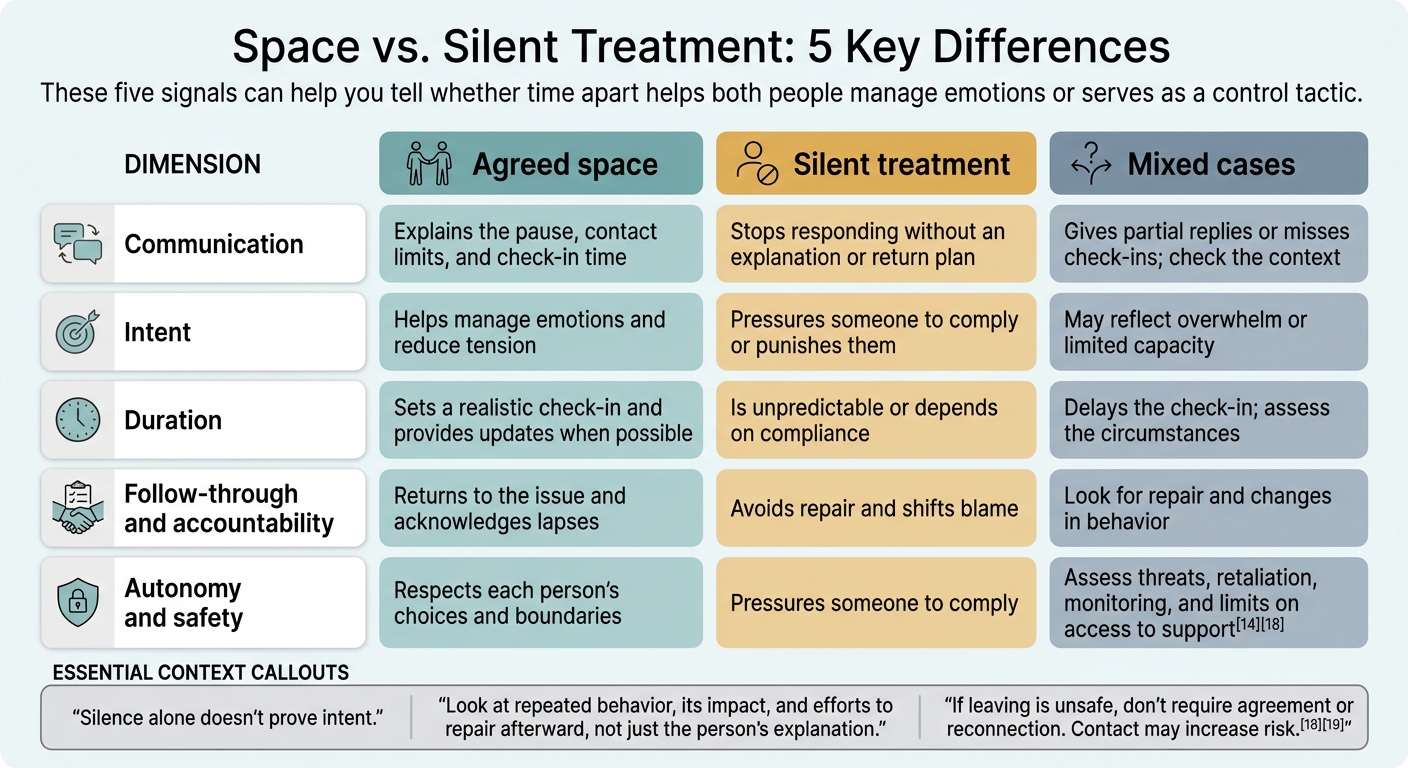
Space vs. Silent Treatment: 5 Key Differences
These five signals can help you tell whether time apart helps both people manage emotions or serves as a control tactic.
| Dimension | Agreed space | Silent treatment | Mixed cases |
|---|---|---|---|
| Communication | Explains the pause, contact limits, and check-in time | Stops responding without an explanation or return plan | Gives partial replies or misses check-ins; check the context |
| Intent | Helps manage emotions and reduce tension | Pressures someone to comply or punishes them | May reflect overwhelm or limited capacity |
| Duration | Sets a realistic check-in and provides updates when possible | Is unpredictable or depends on compliance | Delays the check-in; assess the circumstances |
| Follow-through and accountability | Returns to the issue and acknowledges lapses | Avoids repair and shifts blame | Look for repair and changes in behavior |
| Autonomy and safety | Respects each person’s choices and boundaries | Pressures someone to comply | Assess threats, retaliation, monitoring, and limits on access to support[3][5] |
Healthy Space Includes an Explanation and Return Plan
A healthy pause leaves room for both independence and reconnection. It explains the need without blame, sets contact limits, and offers a realistic check-in time rather than a fixed timeout.
“I’m too overwhelmed to discuss this well right now. I’m going to take some time, and I’ll check in by 7:30 p.m. I can respond only by text until then, and I do want to return to the issue.”
Shared agreements make the pause more predictable, but they don’t override personal boundaries. If the return plan no longer works, send an update when it’s safe and possible.
Silent Treatment Can Punish or Pressure
Deliberate silence can push someone to back down or comply. But silence, brief replies, or withdrawal can also come from overwhelm rather than a wish to control.
Look at repeated behavior, its impact, and efforts to repair afterward, not just the person’s explanation. Distress still matters when harm wasn’t intended.[4]
Mixed Cases Call for Context and Follow-Through
When the line is blurry, look at what happens after the pause, not just the pause itself.
Hypothetical counseling example: In counseling and professional support, Jordan says Casey asked for space until 8 p.m. but did not respond until the next afternoon. Casey reports becoming overwhelmed and falling asleep after a panic episode.
The return time was part of the agreement. Assess whether Casey could have sent an update, acknowledged Jordan’s distress, and returned to the unresolved issue. One missed check-in followed by repair differs from repeated disappearances followed by blame.
Overwhelm, trauma, depression, fear, or learned avoidance may explain withdrawal without excusing harm. Understanding these patterns is central to personality-driven growth and healthier dynamics. If leaving is unsafe, don’t require agreement or reconnection. Contact may increase risk.[5][6]
Assess Attachment Conflict Beyond Labels
After comparing pause and punishment, check the situation against agreements and efforts to repair the relationship. Use personality psychology and attachment language as a lens, not a verdict. Judge the interaction by agreement, behavior, impact, and safety.[7][8]
Ask About Agreements, Patterns, and Repair
Was the break explained? Was contact expected? Did reconnection lead to repair, or did things simply reset? Could either person ask for space? Look for listening, accountability, and a concrete plan for change.[9][10]
Ask privately whether either person feels afraid, trapped, monitored, or punished for speaking. Check for pressure or retaliation involving money, transportation, housing, or necessary communication. Fear and retaliation call for a safety assessment, not an attachment label.[1][9][10]
Separate reported behavior and impact from assumptions about intent. Record the date communication stopped, the agreement, and the reported impact. Mark claims about motives as unverified. If keeping notes could expose someone to monitoring or retaliation, seek confidential support instead.[1][11]
If access or safety limits shaped the silence, assess that context before applying a label.
Check Communication Access and Circumstances
When the pattern is unclear, check whether the person could realistically communicate at all. Access limits and communication needs can affect how someone understands an agreement and responds to it. Text, plain language, extra processing time, or a scheduled written check-in may make communication more accessible.
Check context and access first, then consistency, boundaries, and repair, rather than relying on attachment style alone.
Choose Repair, Boundaries, or Safety Support
Once you see the pattern, choose the next step: repair, a boundary, or safety support.
Set a Check-In and Return to the Issue
If both people can speak freely, explain that you need a break, agree on a return time, and decide how to handle urgent issues.
Example:
I need a break. Can we check in at 7:00 p.m.? Please text if something urgent happens.
Keep the check-in, avoid repeated nonurgent texts, and share a new return time if plans change. If return agreements keep falling through, set a new boundary or seek outside support. Pause joint problem-solving and get individual support. State your boundary, not a punishment.
Put Safety First When Coercion Is Present
If the pause involves coercion, don't treat it as just a communication problem. Threats, intimidation, retaliation, isolation, stalking, monitoring, limits on money or transportation, or fear of speaking honestly call for a private safety assessment with a qualified advocate or professional. The next step is individual safety planning, not confrontation or required joint repair. Professionals should follow agency safety protocols and consult appropriate specialists.
The National Domestic Violence Hotline offers 24/7 crisis support, safety planning, and referrals. Call 800-799-SAFE (7233).[12] Call 911 if you're in immediate danger and it's safe to do so.[13] Online activity may be monitored and cannot be completely erased. When needed, use a safer device, location, or communication channel.[13][14]
Use Personos as Decision Support
For helping professionals, decision support can help organize the next step. It does not replace professional judgment.
Personos offers contextual AI guidance and relationship reports to help organize cases and draft responses. Its Five Factor Model approach is not an attachment assessment. It cannot determine abuse or replace crisis services.
The company says it masks identifying information and does not use data for training. Those claims are company-reported, not independently certified. Before entering client information, verify consent, confidentiality, data handling, and agency requirements. Outputs may be inaccurate, so check them against professional judgment and safety protocols.[15]
Conclusion: Judge the Pattern, Not the Label
Consider communication, intent, duration, follow-through, and safety together. Silence alone doesn’t prove harmful intent, and no single time limit turns a pause into silent treatment. What matters is what happens next: does the pause lead to repair, or does it pressure someone to comply? Can both people voice concerns, acknowledge the impact, and work things through, or must one person give in before they reconnect?
Let safety guide the next step. If both people can participate freely, agree on a check-in and see whether it leads to engagement. If fear or coercion is present, seek confidential support and safety planning rather than trying to repair things together.[1][2]
FAQs
What if we need different amounts of space?
When partners need different amounts of space, agree on what time apart will look like instead of pulling away without discussion. Talk about why you need it and how long it will last, so the distance feels safe rather than like punishment.
If talking this through feels hard, tools like Personos can offer guidance based on each partner’s personality and real-time communication tips tailored to the situation. That support can help you work through differences together and reduce misunderstandings.
How can I manage anxiety during an agreed break?
During an agreed-upon break, focus on self-regulation and intentional self-care to stay grounded. Maintain emotional boundaries and build a well-being plan you can stick with to help manage stress.
Personos, an AI-powered personality psychology platform, offers personalized guidance informed by the Five Factor Model. Its conversational AI can help you work through self-care and stress management options when relationship dynamics feel difficult.
What if my partner calls every pause silent treatment?
If your partner sees your need for time apart as the silent treatment, you may have different communication needs or ways of processing emotions. Explain why you need a pause, set a specific time to reconnect, and reassure them that you’re committed to the relationship.
Personos, an AI-powered personality psychology platform, uses Five Factor Model insights to suggest tailored communication strategies that help connect your needs with how your partner understands them.