Soft Skills in an AI World: Why They’re the New Job Security
Emotional intelligence, adaptability, and communication are the human edge in AI-driven workplaces—use AI to sharpen these soft skills and stay indispensable.
Christian Thomas

Soft Skills in an AI World: Why They’re the New Job Security
AI is changing the workplace fast, automating over half of current tasks. But here’s the takeaway: soft skills are your edge in an AI-driven world. While AI handles repetitive tasks, it can’t replace human emotional intelligence, communication, or decision-making.
Key insights:
- 93% of tech professionals say soft skills are critical for the future.
- Emotional intelligence (EQ) drives 58% of job performance and boosts earnings by $29,000/year.
- 70% of skills employers seek today apply to both human and AI roles.
Soft skills like EQ, flexibility, and communication are what make you stand out. Tools like Personos help professionals refine these abilities by offering tailored feedback for real-world interactions. Whether you’re leading teams, solving problems, or managing AI systems, these skills secure your relevance in the workplace. AI is your partner - not your replacement.
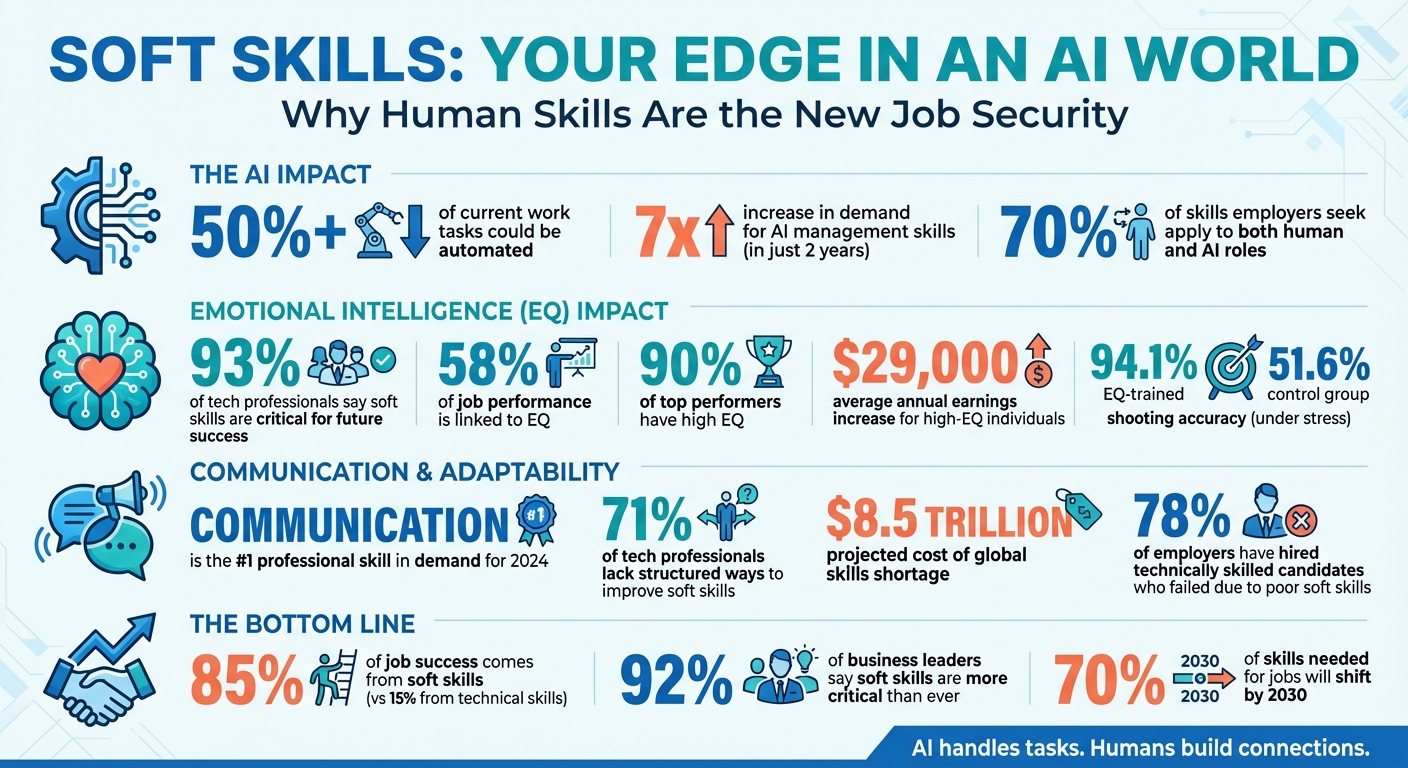
Soft Skills Statistics: Why Human Skills Matter in an AI-Driven Workplace
OpenAI researcher on why soft skills are the future of work | Karina Nguyen
Why Emotional Intelligence Matters When Working with AI
AI is great at crunching numbers and automating repetitive tasks, but it completely misses the emotional layer of human interaction. That’s where emotional intelligence (EQ) steps in. In workplaces where AI takes care of technical tasks, EQ is becoming the skill that sets people apart.
Here’s the impact: 58% of performance across all job types is linked to EQ, and 90% of top performers have high EQ. Even more striking, individuals with strong EQ earn, on average, $29,000 more per year than their low-EQ counterparts [8]. Christoph Riedl, a professor at Northeastern University, shared compelling research in January 2026 showing that people with high "theory of mind" - essentially empathy and social awareness - achieved better results when collaborating with AI. For example, they used prompts like, "Explain this to me as if I’m 12 years old", which nudged AI to deliver clearer, more actionable responses [6].
"Soft skills make humans better at working with humans, they make humans better at working with AI, and it turns out it even makes AI better at working with AI."
- Christoph Riedl, Professor of Supply Chain and Information Management, Northeastern University [6]
Why does EQ matter so much when AI is in the mix? Because AI can’t read the room. It won’t pick up on the nervous tone in someone’s voice during a tense meeting or interpret the hesitation in an email that hints at deeper concerns [9]. These nuances are crucial for resolving conflicts, earning trust, and fostering a sense of safety within teams - things machines just can’t replicate. While AI handles the transactional tasks, humans with strong EQ build the connections that encourage collaboration and creativity.
The 5 Components of Emotional Intelligence
EQ isn’t just one skill - it’s a blend of five abilities that work together seamlessly:
- Self-awareness: Recognizing your emotions and triggers, especially when AI tools fail or deadlines shift unexpectedly.
- Self-regulation: Staying calm under pressure and responding thoughtfully rather than reacting impulsively.
- Empathy: Understanding others’ perspectives and noticing things like burnout that data metrics might overlook.
- Social skills: Building trust, resolving conflicts, and maintaining harmony in hybrid human-AI teams.
- Motivation: Inspiring your team by connecting their technical work to a bigger, more meaningful purpose [11][12].
These skills aren’t just theoretical - they deliver measurable results. A 2026 study involving Australian Special Forces found that soldiers who received 15 hours of EQ training performed far better under stress. During simulated combat, these soldiers achieved 94.1% shooting accuracy, compared to just 51.6% for the control group. They also remembered more mission-critical details under pressure (5.15 items vs. 3.10 items) [10]. The lesson? High EQ helps you excel in high-stakes, fast-paced environments - exactly the kind of workplaces shaped by AI.
How Helping Professionals Use EQ Daily
For social workers, healthcare providers, and nonprofit staff, EQ is not optional - it’s at the heart of what they do. These professionals rely on emotional intelligence in high-pressure situations where AI simply can’t take the lead.
Take healthcare, for instance. According to McKinsey research from January 2026, AI tools can now draft clinical notes and flag irregularities in medical scans. But clinicians are still essential for interpreting those results in the context of a patient’s life and offering the emotional support that treatment often requires [4]. As HR strategist Madeline Mann explains:
"The doctors who are most appreciated and have the lowest rate of litigation have great bedside manner. That’s soft skills. Most people don’t know where their doctor went to school, but they do remember how that doctor made them feel." [1]
In social work and crisis intervention, EQ is critical. Professionals gauge the emotional tone of a situation before deciding how to respond. They adapt their communication based on why a client is reacting a certain way. Ruchir Puri, Chief Scientist at IBM, highlights this approach:
"Put yourself in their shoes and see why they are reacting the way they are. It’s not just what you say; it’s how you say it." [2]
AI might flag concerning language or provide sentiment analysis, but it takes a human with high EQ to deliver bad news with care, sit with someone in their grief, or build the trust needed for a client to open up about trauma. These human connections are irreplaceable and are vital for fostering collaboration and driving progress.
As professionals sharpen their emotional awareness, they also need to stay flexible to keep up with the evolving role of AI in their fields.
Adaptability: Staying Relevant as AI Changes Work
In the same way emotional intelligence is vital for connecting with others, adaptability is key to navigating the rapid changes AI brings to the workplace. The statistics paint a clear picture: tasks that account for over 50% of work hours in the U.S. could theoretically be automated with today’s technology [13][4]. Meanwhile, the demand for skills to manage and use AI tools has skyrocketed - increasing sevenfold in just two years [13][4]. These changes aren’t on the horizon - they’re already here, making it essential to continuously evolve your skills to stay relevant.
Here’s the silver lining: nearly 70% of the skills employers look for today apply to both automatable and non-automatable work [13][4]. Your current abilities aren’t outdated - they just need to be applied in new ways. However, sticking to old methods won’t cut it anymore. As Lareina Yee and Anu Madgavkar from McKinsey Global Institute explain:
"The speed of technological change will make adaptability the ultimate human superpower." [13]
This shift is particularly noticeable in helping professions like healthcare, social work, and nonprofit roles. AI isn’t replacing these professionals - it’s reshaping their daily tasks. The people who excel are those who quickly learn new systems, adjust workflows, and embrace doing things differently. It’s not just about technical upgrades; it’s about rethinking how we interact with technology altogether.
Why You Need Adaptability in the Age of AI
Adaptability goes beyond learning new software - it’s about developing what experts call "digital bilingualism": the ability to bridge human judgment and machine logic [15]. Think of it as becoming an "AI translator" - someone who can guide intelligent systems and turn their outputs into actionable insights [13][15]. This skill is becoming a true differentiator in the workforce.
The workplace is shifting from coding AI systems to managing them effectively - focusing on identifying problems and crafting the right prompts [13][2]. You don’t need to be a programmer, but you do need to understand AI’s capabilities, when to trust its results, and when to rely on human intuition. This is especially important given that 42% of knowledge workers admit to trusting AI outputs without verifying them due to time pressures [7]. That’s risky, especially in fields where mistakes carry serious consequences.
The stakes are high. One in five professionals currently experiences burnout symptoms, including mental fatigue and detachment, often driven by the fast pace of technological change [14]. Resistance to change doesn’t just slow your career - it can lead directly to burnout in AI-driven workplaces [16]. Those who thrive are the ones who see change as an opportunity, not a threat.
Understanding the importance of adaptability sets the stage for practical strategies to manage change effectively, even in demanding work environments.
How to Build Adaptability in High-Stress Jobs
You don’t need a complete overhaul to build adaptability - small, consistent habits can make a big difference, especially when time is tight.
Start with the 15-minute rule: dedicate just 15 minutes a week to learning a new AI feature [14]. This bite-sized approach keeps you up-to-date without adding stress. For instance, one week, you could explore a new feature in your electronic health records system. The next, you might experiment with different prompt styles in a documentation tool. The key is to stay curious.
When you encounter new technology, use the "Awareness–Pause–Reframe" technique [14]. First, notice any physical signs of stress, like tense shoulders or shallow breathing (Awareness). Then, take a moment to breathe and avoid reacting impulsively (Pause). Finally, shift your mindset by asking, "What can I learn from this?" instead of "Why is this happening to me?" (Reframe). This approach helps you stay open, even when change feels overwhelming.
Another strategy is to treat AI as a collaborative partner rather than accepting its first output [7]. Ask it for sources, counterarguments, or alternative perspectives. For example, if AI drafts a case summary, request missing details or challenge its assumptions. This not only sharpens your critical thinking but also prevents over-reliance on AI.
Creating a sense of psychological safety is also crucial. Workplaces where employees feel comfortable experimenting and making mistakes are almost twice as likely to see performance and innovation improvements during AI transitions [15]. If your organization doesn’t naturally foster this, take small steps - partner with a colleague to test new tools or set aside time for your team to experiment with AI prompts. Studies show this can boost creativity by 21% [7].
Finally, try "affect labeling" at the end of each day [7]. Write down what frustrated or energized you about working with new systems. For example, “I felt anxious when the AI suggested a treatment I didn’t understand” or “I felt relieved when the tool saved me 20 minutes.” Naming these emotions helps you process your experiences and reduces stress over time.
The professionals who remain relevant aren’t necessarily the most tech-savvy - they’re the ones who stay curious, ask thoughtful questions, and embrace the opportunity to rethink how they work. As Andrew McCaskill, Career Expert at LinkedIn, puts it:
"We do the skills a disservice by calling them 'soft' skills. These human-centric skills are really game changers as it relates to how we think about the skills you're going to need." [5]
Adaptability isn’t just a nice-to-have - it’s essential for thriving in today’s rapidly evolving workplace.
Communication Skills: Connecting Humans and AI
Communication skills are the glue that holds human-AI collaboration together. As workplaces increasingly divide tasks between humans and AI - AI taking on data-heavy processes while humans focus on building trust and tackling complex problems - effective communication becomes a game-changer. It's not just about talking; it's about translating AI's capabilities into something meaningful for people.
In fact, communication is now the top professional skill in demand for 2024 [1]. Yet, a staggering 71% of tech professionals admit they lack any structured way to improve their soft skills [3]. This gap has real consequences, with the global skills shortage projected to cost over $8.5 trillion in missed opportunities and reduced productivity [20]. The professionals who stand out are those who can take AI insights and turn them into clear, compelling messages [18].
So, what sets apart the best communicators? They don't just rely on AI for drafting - they use it to free up time for what matters most: understanding complex human dynamics and responding with empathy [17][2]. Charles Duhigg, author of Supercommunicators, captures this perfectly:
"AI can give us back the time and space to be our most empathetic selves. Used wisely, it helps us show up as better humans." [17]
As AI tools become more integrated into workflows, the ability to maintain authentic, human connection becomes increasingly valuable [1][3]. Companies are moving beyond simply adding AI tools to their processes - they're redesigning systems to ensure humans and AI work seamlessly together [4]. This shift means communication skills need to operate on two levels: translating between human needs and AI capabilities, while preserving the emotional nuance that fosters collaboration.
Communication Problems in AI-Integrated Workplaces
AI's biggest limitation isn't its processing power - it’s the lack of human touch. While AI can analyze language and detect sentiment, it struggles with "bedside manner." It can't make people feel truly heard or valued [9]. For example, it often misses subtle vocal inflections or hesitant tones in an email that might signal someone is struggling [9].
Another hurdle is the "prompting gap." AI models only deliver results as good as the instructions they’re given [2][4]. If you can't clearly communicate what you need, the AI won't deliver useful outcomes. This extends communication skills beyond just human interaction - now, it’s also about effectively "teaching" machines.
The stakes are high. Seventy-eight percent of employers have hired technically skilled candidates who failed due to poor soft skills or an inability to fit within the team culture [5]. In workplaces reliant on AI, overusing automation can strip away the nuanced judgment that only humans can provide [4].
Using AI Tools to Improve How You Communicate
Interestingly, AI can also help you sharpen your communication skills. Modern tools simulate real-world scenarios - like handling customer complaints or leading tough conversations - and provide instant feedback on your tone, empathy, and delivery [20]. Think of it like a "flight simulator" for leadership: you can practice high-pressure conversations in a risk-free environment [20]. Companies using these tools report impressive results, with productivity gains of up to 40% and sales teams improving win rates by 50% [20].
One standout example is Personos, a platform designed for professionals in high-stress roles like healthcare and social work. Unlike generic tools, Personos tailors its feedback to specific challenges, such as explaining a diagnosis to a worried patient or motivating a burned-out team. It even helps you adapt your communication style to different personality types, ensuring your message resonates.
Here’s a practical tip: when using AI to draft messages, review them carefully to add warmth and empathy. A touch of politeness or small talk can make a big difference in building trust. Ask yourself, "Does this message make the recipient feel valued, not just informed?"
Active listening is another critical skill. Summarize what others are saying and invite further input, especially in remote or hybrid work settings where body language cues are limited. Slowing down and staying present in conversations can make all the difference. As Zack Kass, former Head of Go-to-Market Strategy at OpenAI, puts it:
"Human skills are the moat that AI can't build." [19]
We’re transitioning from the "Knowledge Age" to what some call the "Wisdom Age", where success depends on integrating insights with human wisdom [19]. Asking thoughtful, open-ended questions that go beyond surface-level inquiries builds deeper connections [17]. While AI handles data and analysis, humans excel at inspiring trust, navigating uncertainty, and making others feel genuinely understood. Tools like Personos can help you balance AI's efficiency with the human touch, ensuring your communication skills remain a key to long-term career growth.
Using AI to Strengthen Your Soft Skills
AI isn’t just reshaping the skills we need - it’s also becoming a powerful ally in helping us develop them. Think of AI as your personal training partner. Many professionals struggle to find structured ways to improve their soft skills, but tools like Personos are stepping in to fill that gap. These tools simulate real-world scenarios and provide immediate feedback, making the learning process more practical and engaging [3].
The best way to use AI is as a "co-pilot" for honing your skills [21]. For example, you can rehearse tough conversations - like delivering constructive feedback to a colleague or explaining a complex decision to a client - in a risk-free environment. It’s similar to how pilots use simulators: you get to experiment, learn from mistakes, and fine-tune your approach without facing real-world repercussions [21]. AI coaching tools can analyze your tone, offer suggestions to improve clarity, and even help you adapt your message based on different personality types [22].
The numbers back this up. Research from Harvard University, the Carnegie Foundation, and Stanford Research Center reveals that 85% of job success stems from strong soft skills, while only 15% depends on technical know-how [22]. Additionally, 92% of business leaders agree that soft skills are now more critical than ever [22]. Among the available tools, Personos stands out for how it supports professionals in developing these essential skills.
How Personos Helps You Develop Soft Skills
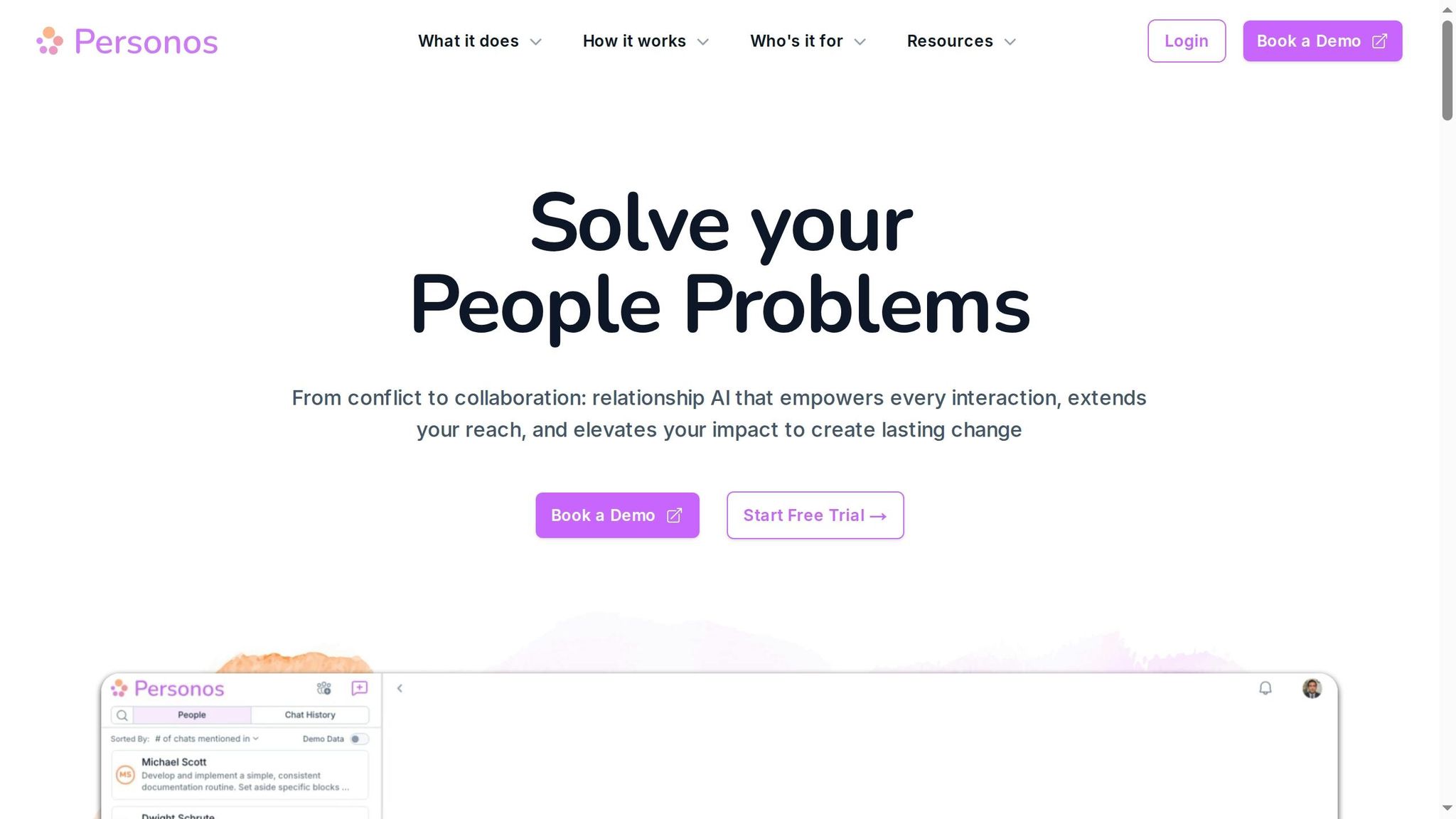
Personos is designed specifically for professionals who deal with complex human interactions daily - like social workers, case managers, coaches, counselors, and nonprofit staff. Unlike generic AI tools that offer broad, surface-level advice, Personos delivers tailored guidance based on the unique challenges you face.
The platform uses a scientifically validated Five Factor Model, which evaluates 30 personality traits on an 80-point scale. When you’re navigating a tricky situation - whether it’s managing a resistant client, resolving a team conflict, or handling a crisis - you describe the scenario to Personos Chat. The AI then provides advice customized to your personality profile, the other person’s traits, and the specific context. This isn’t one-size-fits-all coaching; it’s personalized support that considers how you naturally communicate and how others are likely to respond.
Dynamic Reports offer detailed insights into individuals, relationships, and groups. Transparent Reasoning explains the logic behind each recommendation, helping you build expertise over time. For instance, if you’re a social worker trying to earn a new client’s trust, the report doesn’t just outline their personality - it identifies potential friction points between your communication styles and suggests actionable strategies to overcome them.
Personos also keeps the learning process ongoing with Prompts - bite-sized tips and reminders sent daily, weekly, or monthly to keep personality insights fresh in your mind. Meanwhile, the ActionBoard turns these insights into trackable tasks, ensuring that what you learn translates into real behavior changes. And at just $9 per seat per month, it’s budget-friendly for nonprofits and small teams working with limited resources.
Personos vs. Generic AI Tools: A Comparison
Not all AI tools are equally effective for soft skill development. Here’s how Personos compares to more general platforms like TIMIFY:
| Feature | Personos | TIMIFY |
|---|---|---|
| Customization | Tailored to specific roles and contexts (e.g., social work, coaching, counseling) | General emotional support without role-specific adaptation |
| Privacy | Transparent data handling; personality scores shared only with consent | Limited privacy options |
| Role-Specific Features | Includes tools for crisis intervention and trauma-informed communication | No specialized features for specific fields |
| Contextual Intelligence | Considers case notes, interaction history, and organizational context | Generic advice lacking situational awareness |
| Coaching Relationships | Offers tools for relationship-specific prompts and consent-based profile sharing | No dedicated coaching functionality |
Personos is especially valuable for professionals in high-stress roles. Whether you’re juggling a heavy caseload, managing a crisis, or working with a resistant individual, you need more than generic advice about "listening actively." You need tailored guidance that factors in trauma responses, resource limitations, and the emotional demands of your work. Angela Jackson, CEO of Future Forward Strategies, sums it up perfectly:
"The key is to treat AI as a co-pilot, not a replacement. For small businesses, it's not about big tech - it's about smart tech that actually fits how people work and learn." [21]
Personos fits this description perfectly. It sharpens your judgment without replacing it. By using AI to develop soft skills like communication and emotional intelligence, you’re not just improving your performance - you’re securing your place in an AI-driven world.
How to Master Soft Skills in an AI World
In today’s AI-driven landscape, mastering soft skills means blending cutting-edge tools with timeless human practices. Professionals who excel are those who use AI to refine their judgment while staying rooted in personal reflection, peer feedback, and hands-on experience. According to research, 92% of learning and development leaders have prioritized human skills for 2024, marking an 8-point increase from the previous year [23]. This shift highlights a growing understanding that technical expertise alone is no longer enough.
Using Personos for Skill Development
Personos offers tools that help transform personality insights into actionable growth. For instance, Dynamic Reports monitor how your communication style evolves over time, such as shifting from a directive tone to a more collaborative one. By identifying patterns and tracking progress, these reports make skill development measurable and tangible.
Another feature, Prompts, delivers timely, personalized tips for critical moments. Imagine you’re preparing for a challenging conversation with a client who tends to resist feedback. That morning, you might receive a prompt with specific advice tailored to both your personality and theirs. These quick nudges ensure you’re mindful of communication dynamics, even on busy days.
The ActionBoard simplifies follow-through. If Personos Chat suggests a strategy for resolving a conflict, you can instantly turn that suggestion into a task, ensuring it doesn’t get overlooked in your hectic schedule. What makes Personos stand out is its Transparent Reasoning feature. Every recommendation includes an explanation of the psychological principles and personality traits behind it. This not only helps you understand the “why” behind the advice but also sharpens your judgment for future interactions.
While these AI-driven tools provide a strong foundation, combining them with reflective and collaborative practices is what truly leads to mastery.
Combining AI Tools with Human-Centered Methods
AI excels at providing structure and insights, but it’s the human touch that ensures those insights are applied effectively. After using AI to analyze a situation, take a moment to reflect. Ask yourself: How did that interaction feel? Did the AI’s advice align with my instincts?
Feedback from peers is just as important. Share AI-generated strategies with trusted colleagues and ask if they align with how others perceive your communication style. For example, in 2025, Rosedwell Machinery Ltd introduced an AI dialogue coach for assembly line workers. Over just four weeks, their safety huddle feedback cycles went from days to hours, improving incident-report clarity by 30% and reducing rework caused by miscommunications by 22% [23]. Their success wasn’t just about the AI - it was the combination of real-time feedback from the tool with regular team debriefs where workers validated the AI’s suggestions against real-world experiences. This blend of AI and human collaboration not only reinforced the AI’s recommendations but also improved decision-making on the ground.
Zack Kass, previously head of go-to-market strategy at OpenAI, sums it up perfectly:
"Human skills are the moat that AI can't build." [19]
Let AI handle analytical tasks like mapping friction points, analyzing tone, or simulating difficult conversations. Your role is to make the final call, focusing on trust-building and navigating the complexities of human relationships. By combining AI’s capabilities with your judgment, you can amplify your ability to connect and lead effectively.
Conclusion: Soft Skills Are Your Job Security
Let’s bring it all together: emotional intelligence, adaptability, and communication are the skills that will keep you indispensable in an AI-driven world.
AI is reshaping how we work, taking over repetitive tasks and crunching data. But here’s the thing - it can’t replicate the human touch. By 2030, around 70% of the skills needed for jobs will shift dramatically[24]. And many senior tech leaders are already saying that soft skills will take center stage in this AI-powered future[3].
The most successful professionals don’t see AI as competition - they see it as a collaborator. They let AI handle the technical grunt work while they focus on what machines can’t do: building trust, navigating complex relationships, and making decisions that require nuance and empathy. As Tim King, Executive Editor at Solutions Review, wisely notes:
"AI won't replace you - but lack of soft skills might"[3].
Tools like Personos make this collaboration even more effective. Instead of offering generic tips, it provides personalized advice based on your unique personality. Whether you’re preparing for a tough conversation, managing a high-pressure situation, or trying to connect with a difficult client, Personos turns personality insights into actionable steps. It helps you grow the skills that make you stand out in an AI-integrated workplace.
This balance - human insight paired with AI support - reinforces everything we’ve discussed. Emotional intelligence helps you connect with others. Adaptability keeps you flexible in an ever-changing environment. Communication ensures your ideas resonate. Together, these skills secure your career and make you irreplaceable.
Soft skills aren’t just a nice-to-have - they’re your edge, your safety net, and the key to thriving in a future where human connection and AI efficiency go hand in hand.
FAQs
Which soft skills are most AI-proof?
The most challenging soft skills for AI to replicate include empathy, communication, teamwork, curiosity, resilience, perspective-taking, and humility. These abilities are deeply rooted in human interaction and emotional intelligence, making them critical in workplaces that are becoming more automated. While AI can handle tasks requiring speed and precision, these human-focused skills continue to set people apart.
How can I quickly improve EQ at work?
To boost your emotional intelligence (EQ) at work, start by honing self-awareness, empathy, and social skills. Pay attention to how you react in different situations and strive to understand the emotions of those around you. You can also leverage AI-based tools that offer personality insights or communication coaching to help you better navigate emotions and interactions.
In addition, focus on active listening - truly hearing others without interrupting. Regularly seek feedback from colleagues or mentors to gain perspective on how you come across, and take time to reflect on your daily interactions. If you want to take things further, consider enrolling in coaching or training programs that focus on emotional awareness and building stronger interpersonal connections. These steps can go a long way in improving your workplace relationships and overall EQ.
How do I use AI without over-trusting it?
To make the most of AI responsibly, it's essential to verify its outputs, recognize its limitations, and be upfront about when and how it's being used. AI isn't an all-knowing source, so it's crucial to double-check important details and seek explanations when needed. Treat AI as a tool to help organize ideas, not as the final word on any subject. By engaging thoughtfully, you can ensure AI supports human decision-making rather than taking its place.