Servant Leadership and Innovation in Nonprofits
Servant leadership reshapes nonprofit teams to prioritize psychological safety and empower innovation.
Christian Thomas

Servant Leadership and Innovation in Nonprofits
Servant leadership helps nonprofits thrive by prioritizing team growth and innovation. This leadership style emphasizes serving employees, fostering autonomy, and driving creativity, which aligns well with nonprofit missions. Research shows it improves employee performance, encourages new ideas, and strengthens team dynamics.
Key points:
- Core behaviors: Delegation, integrity, motivation, human resource development, and open communication.
- Impact on innovation: Boosts creativity at both individual and team levels, supported by organizational learning and psychological safety.
- Challenges: Resource constraints, balancing relationships with operations, and measuring indirect outcomes.
- Solutions: Training leaders, creating safe spaces for ideas, and leveraging AI tools for helping professionals to understand team dynamics.
Nonprofits can use servant leadership to overcome challenges, improve team engagement, and deliver better results for their mission.
Transforming Nonprofits through Servant Leadership with Evan Wildstein
Research on Servant Leadership and Innovation
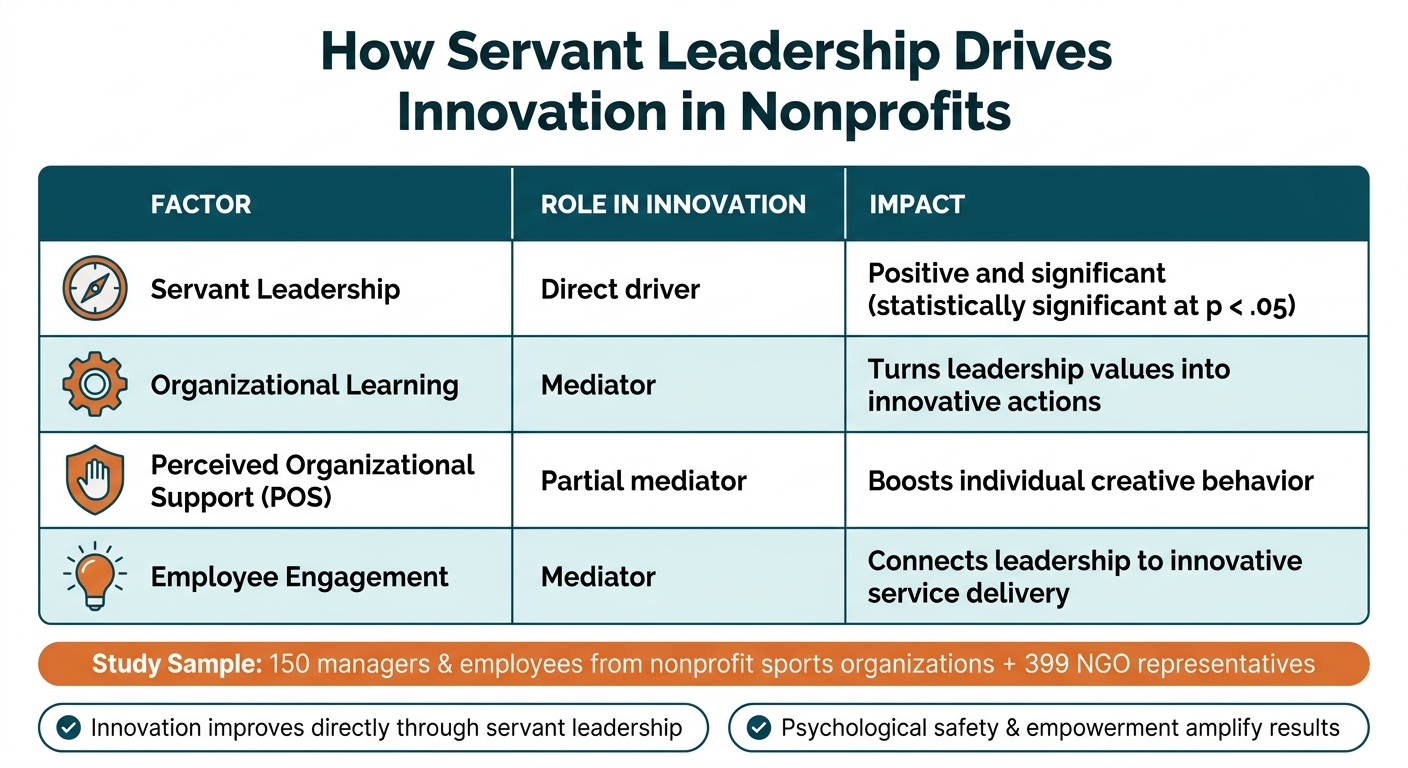
How Servant Leadership Drives Innovation in Nonprofits
Effects on Individual Employees
Studies show that servant leadership plays a key role in boosting Innovative Work Behavior (IWB) - a concept that measures how employees come up with, advocate for, and implement new ideas. This connection is statistically significant at p < .05 [5]. Interestingly, this relationship is partly influenced by Perceived Organizational Support (POS), which enhances individual creativity [5]. Leaders who create strong support systems tend to inspire their employees to think and act more innovatively.
Effects on Teams and Organizations
Servant leadership doesn’t just impact individuals - it also drives innovation across entire teams and organizations. For instance, a study involving 150 managers and employees from nonprofit sports organizations found that servant leadership positively affects innovation directly and by promoting organizational learning [4]. When leaders focus on serving their teams, they encourage behaviors like knowledge sharing, reflective thinking, and applying fresh ideas, all of which contribute to organization-wide innovation.
Here’s a breakdown of how different elements contribute to this process:
| Factor | Role in Innovation | Impact |
|---|---|---|
| Servant Leadership | Direct driver | Positive and significant [4][5] |
| Organizational Learning | Mediator | Turns leadership values into innovative actions [4] |
| Perceived Org. Support (POS) | Partial mediator | Boosts individual creative behavior [5] |
| Employee Engagement | Mediator | Connects leadership to innovative service delivery [4] |
How Servant Leadership Enables Innovation
Servant leadership creates an environment where collaboration thrives, laying the groundwork for innovation. Two key factors - psychological safety and staff empowerment - play a major role. These elements encourage employees to take risks and explore new solutions [4]. Empowerment also leads to shared leadership, where decision-making is distributed across the team. This allows new ideas to emerge naturally from the group, rather than relying on a single leader to drive innovation [4].
Practical Ways to Build Servant Leadership in Nonprofits
Training, Mentorship, and Role Modeling
Servant leadership isn’t something people are born knowing - it’s a skill that takes time, effort, and intentional practice to develop. According to Social Learning Theory, when leaders demonstrate ethical and altruistic behaviors, they inspire their teams to follow suit [1].
One effective approach is training leaders in interactional justice, which focuses on treating employees with fairness, dignity, and respect in every interaction. Research involving 399 nonprofit representatives revealed that interactional justice plays a key role in linking servant leadership with improved task performance and organizational citizenship behavior [1]. To guide leadership development, nonprofits can utilize frameworks like “Heart, Head, Hands, and Habits” by Blanchard and Hodges, and tools such as the Servant Leadership Behavior Scale (Sendjaya et al.). These resources help assess and track leadership growth while creating an environment where fresh ideas can thrive [4].
Building Psychological Safety for New Ideas
Psychological safety is crucial for fostering innovation within nonprofit teams. It’s the belief that team members can share ideas or admit mistakes without fear of judgment or punishment [4].
"The effect of servant leadership on the nature of innovation both directly and through organizational learning in non-profit sports organizations is positive and significant." - Salar Abedi, Mohsen Behnam, & Seyed Mohammad Kashef, Urmia University [4]
Leaders can encourage psychological safety by reframing failure as a learning opportunity rather than a personal flaw. When staff feel safe to take risks without fear of harsh consequences, they’re more likely to experiment and innovate. Additionally, training in inclusive leadership - where every team member’s voice is actively sought and valued - has been shown to boost psychological empowerment and drive innovative behavior in nonprofit settings [4].
Using AI and Personality-Aware Tools
Technology is becoming an important ally in developing servant leadership. Amanda Nelson and John Robichaux of The Nonprofit Alliance explain the shift:
"The question for nonprofit organizations has shifted from whether to use AI to how it can be used effectively and responsibly." [7]
AI tools are helping leaders strengthen their teams by offering insights into individual needs and preferences. For example, personality-aware platforms enable leaders to tailor their feedback and communication styles, improving interactional justice and team performance [1].
A standout example is Personos, an AI-powered platform based on the Five Factor Model. This tool provides nonprofit leaders with real-time insights into team dynamics and individual personalities. Features like Dynamic Reports offer actionable suggestions for better collaboration, while the ActionBoard turns these insights into trackable goals. What’s more, its affordability makes it accessible even for nonprofits with limited resources, allowing them to demonstrate measurable progress to funders and stakeholders.
Challenges of Applying Servant Leadership in Nonprofits
Budget and Workload Pressures
Servant leadership can bring many advantages, but it also requires a significant investment of time, energy, and resources - commodities that nonprofits often lack. The sector faces a leadership gap, making it difficult to find individuals who naturally possess the qualities of a servant leader. This challenge often forces organizations to focus on cultivating these traits internally.
"Servant leadership affords an organization many benefits. However, servant leaders are often not easy to find." - Seth-Aaron Martinez [6]
Rather than opting for costly external hires, nonprofits are better off channeling their efforts into training programs that nurture altruism and ethical decision-making within their existing teams [6]. However, even with strong leadership, resource shortages can create barriers. A study involving 150 managers and employees revealed that limited structural resources often hinder the effective implementation of servant leadership practices [4]. When capacity is stretched thin, even the most capable leaders may struggle to achieve their goals. These constraints ripple through an organization, affecting everyday operations and creating additional hurdles.
Balancing Relationships and Day-to-Day Operations
Another challenge lies in managing the balance between fostering strong relationships and maintaining efficient operations. Servant leadership, while focused on empowering others, can sometimes lead to over-dependence on the leader. Rocco Palumbo from the University of Salerno points out that this reliance can create bottlenecks, as staff wait for direction instead of acting independently. This not only increases the leader’s workload but also slows the organization’s overall progress [3].
The solution isn’t to scale back servant leadership but to implement it in a way that promotes autonomy. Leaders should encourage team members to take initiative and become self-reliant, which can reduce operational delays and improve efficiency [3].
Measuring Servant Leadership and Its Outcomes
Measuring the success of servant leadership presents yet another challenge. Unlike metrics such as fundraising totals, the impact of servant leadership is often indirect. It shows up in areas like organizational learning, psychological safety, and behaviors that go beyond basic job responsibilities [4][1].
Tools like the SL-28 and SLBS-6 scales are designed to assess specific servant leadership behaviors, while questionnaires such as the Prasad and Jouni organizational innovation survey help track outcomes related to innovation [4][1]. Additionally, real-time feedback systems can capture daily leadership behaviors, offering valuable insights into team dynamics [8]. Although direct results may be hard to pinpoint, focusing on these mediating factors - such as interactional justice and organizational learning - provides a clearer understanding of how servant leadership translates into tangible benefits [1][4]. By monitoring these underlying elements, nonprofits can better evaluate the broader impact of servant leadership on their mission and goals.
Conclusion: Servant Leadership as a Driver of Nonprofit Innovation
Key Findings and Takeaways
Research highlights that servant leadership plays a crucial role in driving innovation within nonprofits. Studies involving 150 managers from nonprofit sports organizations and 399 NGO representatives demonstrate that this leadership style positively influences innovation - both directly and through organizational learning. Interactional justice also emerges as an essential link that enhances performance outcomes [4][1].
"The effect of servant leadership on the nature of innovation both directly and through organizational learning in non-profit sports organizations is positive and significant." - Salar Abedi, Mohsen Behnam, and Seyed Mohammad Kashef [4]
Servant leadership impacts more than just daily operations; it reshapes team dynamics and creates a fertile ground for innovation. It influences how teams learn, how colleagues interact, and how motivated individuals are to go beyond their basic duties. These elements collectively nurture an environment where innovation thrives and organizational values are reinforced.
Next Steps for Nonprofit Leaders
To build on these findings, nonprofit leaders can adopt strategies that align with servant leadership principles. Prioritizing five key behaviors - delegation, integrity, motivation, human resource development, and open communication - can help create a culture that supports innovation [2].
Tools like Personos offer practical ways to implement these behaviors effectively. Using the Five Factor Model as its foundation, Personos provides tailored, situation-specific guidance for nonprofit settings. Unlike general HR software, it focuses on understanding team dynamics, fostering psychological safety, and encouraging autonomy. By embedding these practices, nonprofits can turn servant leadership into a consistent driver of innovation and mission success.
FAQs
How is servant leadership different from being 'too nice' as a leader?
Servant leadership isn't about being "too nice." It's about leading with a purpose that prioritizes ethics, service, and empowering others. Instead of being overly accommodating - which can sometimes create dependency or passivity - this leadership style encourages proactive behavior. By focusing on shared growth and collaborative problem-solving, servant leaders inspire innovation and build strong organizational commitment.
What are some low-cost ways to boost innovation with servant leadership?
Encouraging innovation doesn't have to break the bank. By focusing on servant leadership principles, organizations can spark creativity and collaboration without significant financial investment. Here are a few approaches to consider:
- Open Communication: Creating an environment where team members feel comfortable sharing ideas builds trust and fosters collaboration. When people know their voices are heard, they're more likely to contribute fresh perspectives.
- Delegating Responsibilities: Handing over key tasks to team members not only empowers them but also boosts their motivation. It shows trust in their abilities and encourages them to take ownership of their work.
- Supporting Team Development: Prioritizing the growth and well-being of your team helps create a supportive and innovative atmosphere. When people feel valued and encouraged, they’re more likely to think creatively and take initiative.
By focusing on integrity, motivation, and fostering a culture of support, these strategies rely on leadership-driven changes rather than financial resources. This makes them particularly effective for nonprofits looking to spark innovation on a tight budget.
How can a nonprofit measure servant leadership’s impact on innovation?
Nonprofits can evaluate how servant leadership influences innovation by looking at key mediators like self-efficacy, organizational learning, and employee-focused corporate social responsibility. These factors often bridge the gap between leadership style and innovation. Additionally, examining outcomes such as task performance, proactive behaviors, and organizational citizenship behaviors (OCB) can highlight innovative progress within the organization.
To dig deeper into these connections, tools like structural equation modeling (SEM) are invaluable. SEM allows nonprofits to analyze how leadership approaches, mediators, and innovation outcomes interact, offering a clear picture of whether leadership strategies are driving measurable advancements.