The Science Behind Personality Compatibility and Trust
How Big Five traits—especially agreeableness and emotional stability—shape trust in relationships and workplaces.
Nick Blasi

The Science Behind Personality Compatibility and Trust
Trust in relationships - whether personal or professional - depends heavily on personality traits. Research shows that 69% of conflicts stem from personality differences, making understanding these traits essential for better communication and stronger connections. The Five Factor Model (OCEAN) explains how traits like Agreeableness and Neuroticism directly impact trust. For example:
- Agreeableness fosters cooperation and harmony, making individuals more likely to be trusted.
- Neuroticism often leads to misinterpreted actions and conflict, damaging trust.
In therapy, the workplace, or personal relationships, aligning personalities can help manage differences and avoid miscommunication. Tools like Personos use these insights to provide actionable strategies for building trust, offering assessments for just $9 per month. By understanding personality dynamics, you can improve relationships and create stronger bonds.
The Five Factor Model: Understanding Personality Traits
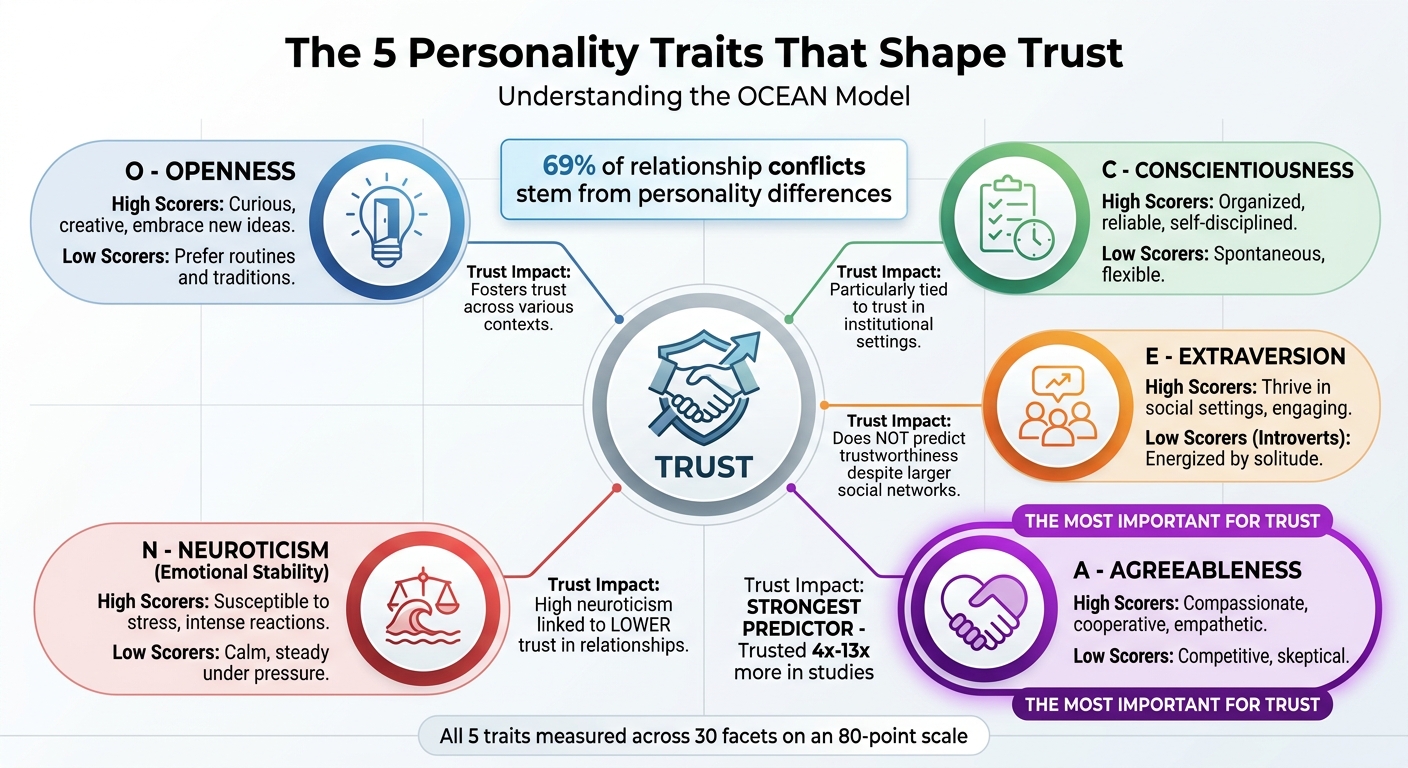
How the 5 Personality Traits Impact Trust in Relationships
The 5 Core Personality Traits
The Five Factor Model categorizes personality into five broad dimensions, easily remembered using the acronym OCEAN:
- Openness: Individuals scoring high here are curious and creative, embracing new ideas and experiences. On the other hand, those with lower scores often prefer routines and familiar traditions.
- Conscientiousness: This trait reflects self-discipline and reliability. High scorers tend to be organized and dependable, while lower scorers lean toward spontaneity and flexibility.
- Extraversion: People who score high thrive in social settings and enjoy engaging with others. Those with lower scores, often introverts, feel more energized by solitude and quiet reflection.
- Agreeableness: This measures compassion and cooperation. High scorers are empathetic and helpful, while lower scorers may appear more competitive or skeptical.
- Neuroticism: Sometimes referred to as Emotional Stability (when viewed in reverse), this trait measures susceptibility to stress and negative emotions. High scorers often experience intense reactions to stress, whereas low scorers tend to remain calm and steady.
These traits provide a foundation for understanding how personality impacts trust.
Research Linking Personality Traits to Trust
Studies based on the Five Factor Model highlight how personality traits influence trust. Among these, agreeableness stands out as the most reliable predictor of interpersonal trust. Research shows that agreeable individuals were trusted over four times more frequently in experimental trust games and nearly 13 times more often in follow-up studies [2]. Their warmth and cooperative nature likely contribute to this perception of trustworthiness.
In contrast, high levels of neuroticism are linked to lower trust - both in personal relationships and in institutions [3]. Openness tends to foster trust across various contexts, while conscientiousness is particularly tied to trust in structured, institutional settings [3]. These findings emphasize the role of personality alignment in building trust.
Platforms like Personos use these insights to measure all five traits across 30 specific facets on an 80-point scale. This helps professionals better understand how personality traits influence trust in different relationships and environments.
How Personality Compatibility Affects Trust Development
Why Agreeableness Predicts Trust
Research in experimental trust games reveals that agreeable individuals are significantly more likely to be trusted - over four times more in one study, and 12.93 times more in a follow-up study [2]. This stems from the perception of agreeable people as warm, cooperative, and helpful, traits that naturally signal dependability and safety. In workplace dynamics, agreeable team members consistently earn higher levels of trust compared to their peers. Interestingly, extraversion, despite its connection to larger social networks, doesn't translate into greater trustworthiness. As highlighted in Personality and Social Psychology Bulletin:
People do not trust extraverts more than introverts. Instead, people's trust decisions are guided by their partner's level of agreeableness [2].
Though extraverts may enjoy popularity, their relationships often lack depth. This makes agreeableness a key factor in contexts where dependable, long-term trust is essential.
How Emotional Stability Maintains Trust
Emotional stability - or the opposite of neuroticism - plays a vital role in preserving trust during tough times. High neuroticism, which is strongly linked to dissatisfaction in relationships, often leads individuals to misinterpret neutral behaviors as threats. This can trigger harmful cycles of rejection and defensiveness. In conflicts, low emotional stability correlates with destructive behaviors often referred to as the "Four Horsemen" of relationship breakdown: criticism, contempt, defensiveness, and stonewalling. These patterns gradually erode trust. On the other hand, emotionally stable individuals are better at managing their feelings and handling conflicts in a constructive way [1]. This distinction highlights how personality compatibility can influence trust differently across personal and professional settings.
Trust Across Different Relationship Types
Personality compatibility also impacts trust in various relationship contexts. In romantic relationships, shared traits - especially emotional stability and agreeableness - are linked to greater satisfaction and fewer conflicts. This is supported by research involving over 3,700 couples from different countries [1]. In professional environments, agreeableness remains a key driver of trust. Teams working on high-stakes projects benefit from having agreeable members, as this trait fosters cooperation. Interestingly, sharing agreeableness scores within teams has been shown to enhance collaboration. Conscientiousness also plays a role in workplace trust by ensuring reliability and commitment to tasks [1][2].
While the trustee's traits are crucial, the trustor's characteristics - like their general tendency to trust - can often have an even greater impact on trust outcomes. Recent studies suggest that factors such as a trustor's own disposition and access to contextual information can help bridge trust gaps, particularly in professional settings [4].
Applying Personality Insights in Professional Practice
Building Trust with Clients Through Personality Understanding
Understanding a client's personality can be a game-changer when it comes to building trust, especially with individuals who are resistant or have experienced trauma. Different personality types rely on distinct "trust currencies." For example:
- High-Conscientiousness clients: These individuals value competence and reliability. They need to see clear evidence of your expertise and consistent follow-through before they feel comfortable opening up emotionally.
- High-Agreeableness clients: For these clients, warmth and genuine care matter most. Building a personal connection often takes priority over diving into task-related goals.
- High-Openness clients: These clients appreciate intellectual honesty. They’re more likely to trust someone who acknowledges complexity and admits uncertainty rather than oversimplifying situations [5].
Some clients, especially those with specific personality traits, respond better to practical support and presence rather than abstract discussions or moralizing [5]. Additionally, understanding a client's level of Neuroticism is critical. High levels of Neuroticism often predict dissatisfaction and can lead to negative behaviors during conflicts [1]. For such clients, creating a calm, stable environment and using emotional regulation techniques can make a significant difference. These strategies naturally align with efforts to prevent miscommunication.
Preventing Miscommunication with Compatibility Awareness
Miscommunication can derail even the best intentions, but being aware of personality differences helps reduce misunderstandings, especially in high-pressure situations. Research shows that 69% of relationship problems stem from personality differences that can’t be fully resolved - they can only be managed [1]. The focus, then, is on managing communication patterns rather than attempting to change personality traits.
One effective approach is identifying "The Four Horsemen" of relationship breakdown: criticism, contempt, defensiveness, and stonewalling. These behaviors are strong predictors of relationship failure, with over 90% accuracy, and are often linked to personality traits like high Neuroticism or low Agreeableness [1]. For example:
- High Neuroticism: Often leads to criticism and defensiveness.
- Low Agreeableness: Commonly associated with contempt.
Spotting these patterns early allows practitioners to step in before trust is permanently damaged.
Another critical factor is ensuring clients feel informed. Research highlights the importance of "Contextual Information (CI) availability" in fostering trust. When clients fully understand their situation and the professional process, they’re more likely to engage constructively and extend trust [4]. Reducing information gaps can significantly enhance communication and collaboration.
Using Personos for Trust and Compatibility Assessment
To put these insights into practice, tools like Personos have emerged as valuable resources for professionals. Personos is an AI-driven platform based on the Five Factor Model, designed to help assess personality compatibility and refine trust-building strategies. Unlike traditional assessments, it evaluates 30 personality traits on an 80-point scale and provides real-time guidance during challenging client interactions.
For instance, when dealing with a resistant, high-Conscientiousness client, Personos might suggest focusing on clear demonstrations of competence and reliable deliverables before attempting to build emotional rapport [5]. Similarly, with high-Openness clients in a crisis, the platform could recommend acknowledging uncertainties, as oversimplification might erode trust [5].
The platform also offers Dynamic Reports, which provide tailored insights for practitioner-client relationships. These reports pinpoint potential friction points and propose communication strategies, explaining the psychological principles behind each recommendation. At $9 per seat per month, Personos is a practical solution for professionals juggling high caseloads and emotionally demanding work, particularly when working with vulnerable populations.
Conclusion: Applying Personality Science to Build Trust
Research highlights that trust isn't just about good intentions - it's about understanding the psychological patterns that shape how we connect and communicate. The Five Factor Model serves as a reliable framework for decoding these patterns. For instance, Conscientiousness lays the groundwork for dependability, Agreeableness fosters emotional safety, and Neuroticism signals how relationships may falter under stress. Since personality differences often fuel recurring relationship challenges, professionals benefit from tools that help them address these issues constructively rather than resisting them.
These insights are especially relevant for those working in high-pressure environments. For helping professionals managing vulnerable populations, heavy workloads, or crisis situations, personality science isn't just theoretical - it’s a practical tool. For example, understanding that a trustor’s access to context often outweighs the trustee’s traits can reshape how practitioners approach communication and transparency [4]. Similarly, knowing that destructive conflict patterns can predict relationship breakdowns with over 90% accuracy provides early intervention opportunities before trust erodes [1].
Platforms like Personos make these insights actionable. By offering real-time guidance, detailed reports, and actionable prompts for just $9.00 per seat monthly, Personos helps professionals apply personality science in their daily interactions.
Rooted in the Five Factor Model, personality science provides a clear path for addressing relationship challenges. Whether you're managing team dynamics, therapeutic relationships, or client care, understanding personality can reshape how you handle conflict and build trust. Applying these principles enables professionals to create deeper connections and drive meaningful change in every interaction.
FAQs
Can two people with very different personalities still build trust?
Yes, trust can absolutely grow between individuals with contrasting personalities. Studies indicate that personality similarities play a minor role in determining relationship satisfaction. What truly counts are the qualities each person contributes to the relationship and how they demonstrate those traits in everyday interactions. Trust is built through mutual understanding and consistent behavior, not necessarily through shared personality traits.
How can I tell if low trust comes from my traits or the other person’s?
Low trust might be influenced by personality traits, like low agreeableness or high neuroticism, either in yourself or the other person. Tools like Personos, which rely on the Five Factor Model, can provide a clear assessment of both profiles. This understanding helps pinpoint whether trust challenges stem from individual characteristics or the dynamics of the relationship, making it easier to tackle them effectively.
How can I use personality insights to prevent conflict before it escalates?
Understanding personality insights, like those offered by the Big Five model, can help predict how someone might respond in various scenarios. This means you can adjust how you communicate to minimize potential misunderstandings. Tools such as Personos offer real-time guidance based on personality traits, helping you address potential friction before it becomes a problem. By recognizing personality tendencies, you can improve communication, prevent conflicts, and establish trust early on.