ROI Metrics for AI Mediation Tools
Measure cost savings, time-to-resolution, success rates, and employee impact to calculate ROI for AI mediation—includes rework and inference costs.
Nick Blasi

ROI Metrics for AI Mediation Tools
AI mediation tools are reshaping dispute resolution by delivering faster results, cutting costs, and improving outcomes. By 2026, 60% of enterprise organizations are expected to use AI-powered mediation, up from 35% in 2023. These tools save time, reduce expenses, and even enhance client and employee experiences. Key benefits include:
- Cost Savings: Flat-fee models replace costly hourly rates, with ROI often ranging from 3x to 6x.
- Time Efficiency: AI resolves disputes in minutes or hours, compared to months with traditional methods.
- Improved Outcomes: Higher success rates, better client satisfaction, and stronger relationships post-resolution.
- Employee Impact: Reduced burnout and increased retention for professionals using these tools.
For example, in 2025, an AI mediator settled a Fortune 500 employment dispute in 50 minutes, saving $20,000 in legal fees. Tools like Personos, priced at $9 per seat per month, further improve efficiency by automating tasks and providing actionable insights, making them a smart investment for organizations of all sizes.
How We Calculate the ROI of Our AI Solutions (Anatomy of an $80K AI Project)
Quantitative ROI Metrics for AI Mediation Tools
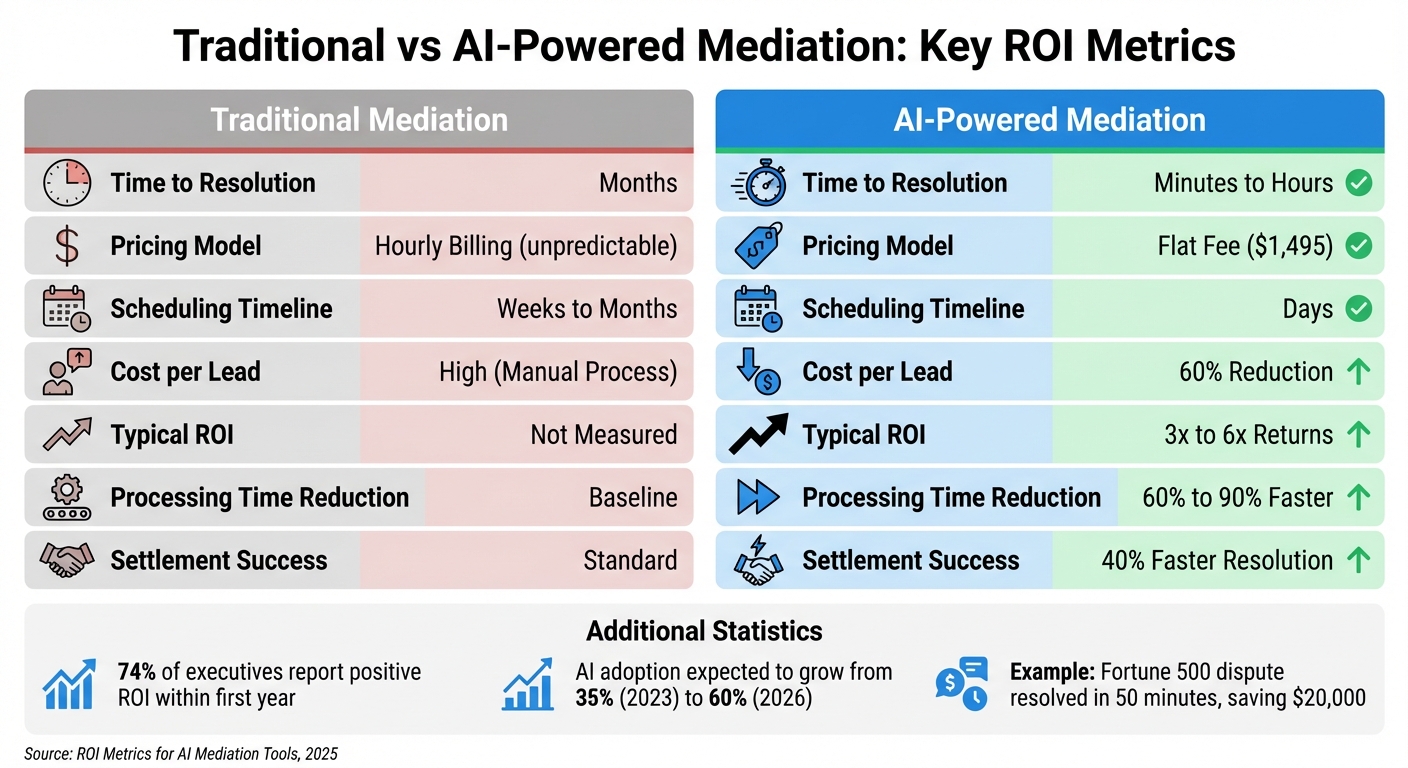
Traditional vs AI-Powered Mediation: ROI Metrics Comparison
AI mediation tools are evaluated through metrics like cost savings, time efficiency, and success rates. As Jamin Mahmood-Wiebe, Founder of IJONIS, puts it:
"80% of organizations report measurable economic impact from AI. The challenge is not whether AI works - it is whether you are measuring the right things" [3].
Cost Savings from Automation
AI mediation platforms significantly reduce costs in multiple ways. One standout feature is flat-fee pricing models, which replace the uncertainty of hourly billing with predictable costs. Traditional mediators often charge by the hour without guaranteeing results.
Automation slashes labor costs. Tasks like data gathering, document summarization, and initial case intake are handled by AI, allowing professionals to concentrate on more critical work. This shift often results in returns of 3x to 6x on AI investments, with 74% of executives reporting positive ROI within the first year [3]. Additionally, AI can cut cost per lead by up to 60% and reduce customer acquisition costs by 30% through automated processes like outreach and lead qualification [6].
That said, hidden expenses like rework (which can consume up to 40% of saved time) and high inference fees (accounting for 76%-100% of AI budgets) must be considered [3][7]. To calculate net benefits, use this formula: (Total Hours Saved × Fully-loaded Hourly Wage × Automation Rate) – (Total AI Costs + Rework Costs) [7].
Next, let’s explore how these cost savings correlate with faster dispute resolutions.
Time Efficiency and Faster Resolutions
Beyond cost reductions, AI dramatically speeds up dispute resolutions. AI tools can cut processing times by 60% to 90% [3]. For supply chain disputes, AI mediators resolve conflicts 40% faster than traditional methods [2].
Time savings ripple across the entire process. AI eliminates scheduling delays, enabling parties to arrange mediations within days instead of weeks, and settlements often occur in under an hour instead of months [1]. AI chatbots, available 24/7, further streamline responses and lead qualification [6].
To quantify these time savings, multiply the weekly hours saved by the hourly rate of the professionals involved [6]. For legal professionals, AI tools used in research, drafting, and summarization often yield ROI in as little as one to three months [4][8]. To measure these improvements accurately, organizations should track baseline data like time spent per task and cost per case before implementing AI [4].
Success Rates and Improved Outcomes
Settlement rates and reduced escalations are key indicators of AI’s effectiveness. However, success isn’t just about quick resolutions. Dr. Sarah Chen, Chief AI Officer at Resolution Partners, highlights how AI can strengthen relationships:
"Beyond swift resolutions, AI builds valuable relationship equity through emotional intelligence" [2].
For example, in June 2025, a SaaS supply chain platform adopted an AI mediator to resolve disputes between suppliers and distributors. Initially, using a 3% success fee model, disputes were resolved 40% faster, but repeat transactions dropped by 27%. After switching to a hybrid pricing model that incorporated relationship health scores, post-mediation transactions not only recovered but exceeded pre-dispute levels by 12% [2].
B2B SaaS companies report a 67% higher Customer Lifetime Value (CLV) for accounts where disputes were resolved amicably compared to those with one-sided outcomes [2]. Companies known for fair conflict resolution also secure 41% better terms in future negotiations [2]. This means ROI calculations should account for factors like post-resolution satisfaction and future transaction volumes, not just immediate settlement figures. For professionals looking to scale these results, specialized platforms can help prove ROI through personality-driven guidance.
PayPal’s experience offers a striking example. Under the leadership of CISO Assaf Keren, PayPal used transformer-based deep learning to reduce fraud and disputes. Between 2019 and 2022, while annual payment volumes doubled to $1.36 trillion, PayPal halved its loss rate and achieved an 11% reduction in losses in Q2 2023 alone through improved AI-driven risk management [9].
| Metric Category | Traditional Mediation | AI-Powered Mediation |
|---|---|---|
| Time to Resolution | Months | Minutes/Hours |
| Pricing Model | Hourly Billing | Fixed/Flat Fee ($1,495) |
| Scheduling | Weeks/Months | Days |
| Cost per Lead | High (Manual) | 60% Reduction [6] |
| Typical ROI | N/A | 3x to 6x [3] |
These measurable benefits lay the groundwork for broader improvements in user satisfaction and long-term value.
Qualitative Benefits and Long-Term Value
AI mediation tools don't just save time and money - they also bring long-term improvements that are harder to measure but just as important. These tools enhance user satisfaction, reduce burnout, and improve overall client outcomes, creating value that extends far beyond the initial implementation.
User Satisfaction and Client Outcomes
AI mediation tools excel at creating a better user experience by eliminating emotional bias and offering data-driven solutions. Unlike human mediators, who may unintentionally bring personal biases into the process, AI systems focus on the facts. They identify key areas of disagreement and suggest compromises based on real-world case data, fostering trust in the fairness of the outcomes [1].
Research shows that fair resolutions don’t just solve the immediate problem - they often lead to better long-term results for clients [2]. Dr. Sarah Chen, Chief AI Officer at Resolution Partners, highlights this point:
"The most sophisticated implementations we're seeing don't just solve the immediate dispute - they build relationship equity for future interactions" [2].
For example, tools like Personos provide real-time, personality-aware guidance, boosting client engagement by an impressive 67% [10].
In November 2025, Bot Mediation demonstrated the power of AI by resolving an employment dispute between a plaintiff and a Fortune 500 company in just 50 minutes. This case, which could have been delayed by 18 months in court, left both sides highly satisfied with the efficient and data-driven process [1]. Cases like these show how AI solutions can deliver fast, fair, and effective results.
But the benefits aren’t just external. These tools also make a big difference for practitioners themselves.
Reducing Burnout and Improving Retention
AI tools don’t just help clients - they also make life easier for the professionals using them. Burnout is a major issue for social workers, case managers, and mediators, often caused by repetitive tasks like documentation, scheduling, and intake. AI addresses this by automating these time-consuming tasks, allowing practitioners to focus on more meaningful and impactful work [6].
The results speak for themselves. A staggering 90% of behavioral health providers reported lower job-related stress after using AI tools [10]. Nearly 80% said these tools would encourage them to stay longer in their current roles [10]. Organizations that prioritize relationship-building through AI tools also saw a 24% boost in employee retention for internal disputes compared to outcome-focused systems [2].
Specific examples show how these tools are making a difference:
- The Family Counseling Center and WellPower reduced documentation times by over 60%, leading to a 9% improvement in clinician retention [10].
- Between 2022 and 2024, Integrity Staffing Solutions used "Recruiter Jamie", an AI virtual recruiter, to handle high-volume candidate outreach. Over 18 months, the AI contacted 66,000 candidates, cutting time-to-engagement to under 15 minutes. This efficiency allowed the company to grow 80% year-over-year without increasing staff, while their Net Promoter Score (NPS) skyrocketed from 55 in Q1 2024 to 90 in Q1 2025 [11].
At just $9 per seat per month, Personos offers features like real-time guidance and automated progress tracking through its ActionBoard. These capabilities are particularly valuable for nonprofits and social services, where reducing burnout and retaining staff are critical.
| Metric | Impact of AI Implementation | Source |
|---|---|---|
| Practitioner Stress | 90% reported reduction in job-related stress | [10] |
| Employee Retention | 24% increase in retention for internal disputes | [2] |
| Client Attendance | 67% increase in patient/client attendance | [10] |
| Documentation Time | Reduced from 10 minutes to ~3.5–4.8 minutes per session | [10] |
These results highlight how AI tools are transforming the way organizations operate, benefiting both clients and practitioners in meaningful ways.
Case Studies and Industry Examples
High-pressure legal disputes and nonprofit case management reveal how AI mediation tools can cut costs, speed up resolutions, and enhance outcomes.
Finance and Legal Dispute Resolution
In November 2025, Payne & Fears LLP and West Coast Trial Lawyers used Bot Mediation to resolve a Fortune 500 employment dispute in just 50 minutes. Initially set for an 18-month trial delay, the case was settled within a week of scheduling, saving an estimated $25,000 in legal fees [1].
Bot Mediation charged a flat fee of $1,495 per side and offered a "no-settlement, no-invoice" guarantee for first-time users [1]. A partner at Payne & Fears LLP shared:
"The process was fast, efficient, and a fraction of the cost of traditional mediation" [1].
This straightforward pricing structure removes the budget unpredictability that often plagues traditional legal mediation.
While these examples from the legal world emphasize cost and time efficiency, customized AI tools are also transforming nonprofit operations.
Personos in Nonprofits and Social Services
Unlike its legal counterpart, Personos addresses challenges in social services by improving staff engagement and reducing burnout among social workers. At just $9 per seat per month, Personos focuses on increasing retention and client engagement rather than cutting billable hours.
The platform uses personality-aware guidance to help organizations connect more effectively with clients, making programs more impactful. For nonprofits reporting to funders, these qualitative gains translate into better results for every dollar spent. Features like the ActionBoard track client progress and staff development, offering concrete data that stakeholders can rely on.
What sets Personos apart from generic AI chatbots is its use of full personality profiles based on the Five Factor Model. This enables it to provide tailored advice for crisis intervention, managing resistant clients, and fostering team collaboration - issues that often lead to burnout and high turnover if not handled well. By addressing these challenges, Personos not only improves staff satisfaction but also enhances client outcomes, delivering a strong return on investment for organizations that adopt it.
Measuring ROI for Personos
Key Metrics for Evaluating Personos
When it comes to evaluating Personos' return on investment (ROI), the platform’s impact goes beyond just saving money. The benefits are seen across three main areas: financial returns, operational efficiency, and strategic value [5].
A good place to start is by calculating Return on Efficiency (ROE). The formula is straightforward: (Hours Saved Per Week × Number of Weeks × Number of Users) / Total AI Investment Hours (including training and rework) [5]. For example, documentation efficiency improvements with Personos have been shown to increase job satisfaction by 35% and reduce employee turnover by 60% [5]. These gains directly lower hiring and training costs. The platform’s ActionBoard simplifies tracking these metrics by consolidating client progress and practitioner development goals in one place.
Next, there’s Return on Employee (ROE²), which focuses on the impact on staff. This metric captures changes in task satisfaction, employee retention, and reduced burnout from repetitive tasks [5]. Unlike generic AI chatbots - which can lose 40% of productivity gains to rework [5] - Personos leverages full Five Factor Model profiles to provide contextually accurate advice, minimizing error correction and enhancing outcomes.
To measure ROI effectively, start by recording baseline metrics like processing times, error rates, and employee satisfaction. Allow for a 90-day calibration phase before making assessments [3][5]. For instance, in January 2026, a mid-sized nonprofit with a $3 million budget spent $6,400 on AI-assisted grant writing. The result? They saved 288 hours annually (valued at $14,400) and submitted six additional grants, leading to a 125% ROI based on efficiency alone - and a staggering 1,072% ROI when factoring in $75,000 in additional funding secured [5]. These numbers highlight how Personos enhances both efficiency and strategic outcomes, which are crucial for nonprofits and social service organizations.
For organizations needing to report to funders, Personos’ ActionBoard and Dynamic Reports offer clear, measurable data. With 53% of funders requiring proof of AI value within six months [5], these tools provide the evidence stakeholders need.
How Personos Compares to Competitors
Personos stands out by offering a broader value framework compared to traditional AI mediation tools. While most AI platforms focus on cutting labor costs, Personos takes a more comprehensive approach by addressing financial, operational, and strategic dimensions [5].
| Feature/Metric | Traditional AI Mediation Tools | Personos |
|---|---|---|
| Primary Focus | Labor cost reduction only [3] | Financial, Operational, and Strategic [5] |
| Rework Management | Often ignored; loses 40% of gains [5] | Contextual guidance minimizes rework [5] |
| Employee Impact | Focus on headcount reduction [5] | Prioritizes ROE² to reduce burnout [5] |
| Measurement Timeline | Evaluates too early (under 4 weeks) [3] | Uses a 90-180 day period for stable data [5] |
| Cost Tracking | Subscription fees only [5] | Total Cost of Ownership (includes training and rework) [3][5] |
Unlike generic AI platforms that only track subscription costs, Personos accounts for inference expenses - ongoing costs per AI request - which many companies overlook. In fact, 46% of companies spend between 76% and 100% of their AI budgets on inference costs [3]. Personos eliminates this uncertainty with transparent pricing at $9 per seat, covering all features without hidden charges.
The platform also tackles the "rework problem" that plagues other AI tools. Research from One Hundred Nights found:
"40% of AI productivity gains disappear to rework. Staff report saving 1-7 hours weekly... but nearly half that time gets consumed correcting errors" [5].
Personos avoids this pitfall by using personality-driven guidance based on validated psychology, ensuring more accurate and actionable responses.
For mission-driven organizations, Personos focuses on what truly matters: productivity. While 74% of executives report positive ROI from AI agents within the first year [3], nonprofits and social services prioritize tools that enhance efficiency over profitability. With features like the ActionBoard, tailored reports, and coaching tools, Personos positions productivity as the key driver for success in 2026 [5].
Conclusion
In the rapidly changing world of AI mediation, measuring ROI isn't just helpful - it’s essential for proving both efficiency and the ability to strengthen relationships. Jamin Mahmood-Wiebe, Founder of IJONIS, highlights this perfectly:
"If you cannot measure your AI agents, you cannot scale them. And if you do not scale, you lose the advantage" [3].
The numbers back this up: 74% of executives report positive ROI from AI agents within the first year, often seeing returns between 3x and 6x their initial investments [3].
But ROI isn’t just about dollars and cents. It also reflects broader benefits like cost savings (in labor and time), revenue growth (through faster processes and better conversions), improved quality (fewer errors), and strategic gains (like stronger employee retention and healthier relationships) [3]. For mediation and conflict resolution professionals, this means focusing on more than just quick resolutions - it's about maintaining relationships that last. For instance, B2B companies see a 67% higher Customer Lifetime Value when disputes are resolved amicably instead of through forced settlements [2].
Personos tackles all these areas head-on, offering a transparent $9-per-seat pricing model without hidden inference costs. Unlike traditional AI mediation tools that often zero in on cutting labor costs - only to lose 40% of those savings to rework [5] - Personos uses personality-driven insights to reduce errors and build stronger relationships.
For professionals juggling heavy caseloads and emotional challenges, Personos transforms AI into a powerful business tool. Features like ActionBoard and Dynamic Reports provide the data funders need - 53% of whom now require proof of ROI within six months [5] - ensuring that productivity gains lead to better outcomes for clients and less burnout for staff.
When evaluated correctly, AI mediation tools can deliver real, measurable results. Personos demonstrates this by offering practical solutions to the complex challenges professionals face every day.
FAQs
What ROI metrics should we track first for AI mediation?
When evaluating the return on investment (ROI) for AI mediation, start with these key metrics: cost savings, time efficiency, and resolution success rates. These metrics give a clear picture of the tangible benefits AI brings to the table. For instance, focus on measurable results such as shorter dispute resolution times and a noticeable drop in grievances. Tools like Personos emphasize how AI-driven insights can streamline conflict resolution, enabling professionals to achieve outcomes more effectively and efficiently.
How do we include rework and inference costs in ROI?
To accurately calculate ROI, it's important to include costs like rework and inference. These might involve learning curves, integration efforts, training expenses, and potential inefficiencies during implementation. At the same time, ensure that the benefits are properly attributed to AI to get a clear understanding of its value. By considering both variable costs and the more complex benefits, you'll gain a well-rounded view of ROI.
How can we measure relationship and retention gains from AI?
You can gauge the impact of AI on relationships and retention by looking at specific improvements. For example, check for better conflict resolution, fewer disputes, and increased retention rates. To dig deeper, use real-time data and metrics to evaluate the quality of relationships. These tools can provide a clear picture of how AI contributes to creating stronger, more enduring connections.