Research on AI, Personality, and Emotion
Personality-aware, question-led AI improves routine emotional support but isn’t suited for crisis care; privacy, boundaries, and human judgment matter.
Nick Blasi

Research on AI, Personality, and Emotion
AI can help with routine emotional support, but it should not handle crisis care or replace human judgment. From what I see in this research, the clearest pattern is this: personality-aware, question-led AI works better than generic empathy or tone copying, and safe use depends on privacy, boundaries, and user self-control.
Here’s the short version:
- AI works best in low-risk support, like stress check-ins, routine guidance, and reflective prompts
- Personality matters because people react to the same message in different ways
- Question-led systems beat tone-mirroring for safety and professional fit
- Personalization can help engagement, but too much can blur the line between tool and relationship
- Trust, privacy, and clear limits matter more than a warm tone alone
- Helping professionals should use AI as support, not as a stand-in for care, ethics, or judgment
A few numbers stand out:
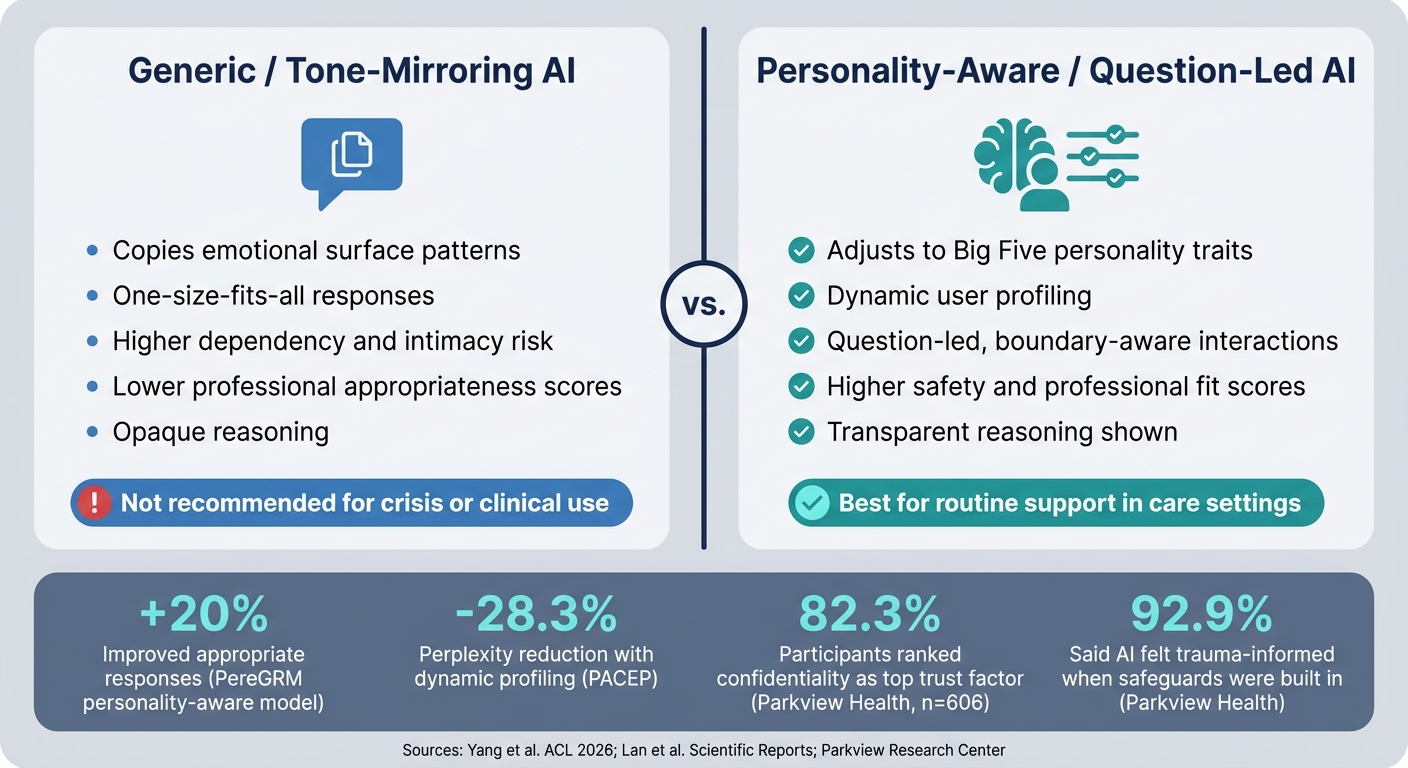
- Personality-aware support improved appropriate responses by 20%
- Dynamic profile systems cut perplexity by 28.3%
- In one study of 1,006 people, stronger AI attachment weakened healthy-use patterns
- In a Parkview Health study with 606 participants, 82.3% said confidentiality was the top factor for trust, and 92.9% said the chatbot felt trauma-informed when key safeguards were built in
If you work in social services, counseling, case management, or nonprofit care, I’d read this research one way: use AI to reduce routine load and sharpen communication, but keep people in charge, especially when risk is high.
Affective Use of AI
What Studies Show About Emotionally Adaptive AI
AI Tools for Emotional Support: Personality-Aware vs. Generic Systems
How AI Recognizes and Responds to Emotion
Emotionally adaptive AI can infer emotion from text, voice, or facial cues. But accuracy is all over the map. It changes based on context, the people being studied, and the quality of the data.
A big issue keeps showing up in the research: stereotype-driven emotional mimicry. In plain English, some large language models (LLMs) copy the look of emotion through surface patterns instead of reasoning through a response. They can sound emotional without using deeper logic when simulating emotional reactions.
"Most affective computing research treats emotion as a static property of text... This approach ignores how individual personalities lead to diverse emotional appraisals of the same event." - Yuqin Yang et al., ACL 2026 [4]
That point matters. The same message can hit two people in very different ways. Personality shapes how people read tone, intent, and meaning. When researchers added Big Five traits, support for new users got better. PereGRM improved appropriate support by 20% compared with generic empathy models [8]. So the next step is pretty clear: figure out which personality cues lead to better guidance.
Where AI Helps Communication and Where It Falls Short
AI tends to do best with routine emotional support, not high-stakes judgment. Systems that use dynamic user profiling can keep support prompts and reflective feedback more steady across long conversations. Profile-aware tools like PACEP improved response quality, cutting perplexity by 28.3% and increasing BLEU-4 by 110.0% in open-source models [7]. That points to better consistency in multi-turn conversations.
Still, the weak spots are hard to ignore. Many systems struggle with limited context windows. That can lead to shallow replies and uneven strategy choices over the course of a longer exchange [7].
There is also a documented personalization paradox. The more an AI tailors itself to one user, the more the risk grows that the user becomes dependent on it or starts to blur the line between tool and relationship [2]. In a study of 1,006 participants, stronger AI attachment weakened the link between healthy technology use and perceived psychological support [3]. Warmth, by itself, is not enough.
Research also draws a sharp line between tone-mirroring and question-led approaches. Tone-mirroring means the AI copies the user's emotional style. Question-led systems guide the exchange by asking the right questions. In evaluations of mental health chatbots, including Replika, Wysa, Youper, and Dr.CareSam, question-led systems scored higher for professional appropriateness and safety [2].
"Perceived warmth primarily functions as an interactional cue rather than a direct therapeutic mechanism." - Yanling Lan et al., Scientific Reports [3]
For helping professionals, the takeaway is simple: emotionally adaptive AI is most useful in low-risk, routine support, not crisis response or clinical decisions. Use it for everyday support, not crisis escalation. The main issue is not just whether AI can sound empathic. It is whether it can adjust guidance to fit the user's personality. That is why personality-aware guidance matters more than generic empathy scripts.
What Research Says About Personality-Aware AI Guidance
How Personality Traits Shape Tailored Communication
This gets even stronger when AI adjusts to personality, not just emotion. Research shows that AI guidance tends to work better when it lines up with the user's personality. Big Five traits affect trust in different ways: agreeableness, openness, and extraversion often increase trust, while neuroticism tends to lower it [1]. Someone high in neuroticism may want connection but still need careful, privacy-aware communication. By contrast, highly agreeable users often respond better to warm, collaborative engagement [1].
Style matching matters because people don't hear the same message the same way. High openness tends to respond better to experiential language. Low openness often prefers practical, familiar wording. Conscientious users usually want structure. Agreeable users lean toward collaboration. Neurotic users need caution and validation. The key point is simple: keep the core message fixed and adjust the tone to fit the person's traits. In a study of 618 participants, anchoring the core content was needed for steady trait-matching effects. Without that anchor, tailored messages drifted off course [10].
"Aligning technology with personality traits can significantly boost user satisfaction and promote well-being." - Springer Nature [1]
What Tailored Guidance Can Change in Practice
This pattern shows up in experiments too. A large field experiment found that personality-matched AI pairs improved ad performance, including a 55% click-through lift when neurotic humans were paired with neurotic AI [9]. In other words, pairing is not a small detail. Some matches improve results, and some can weaken them.
When a practitioner knows a client's personality profile, personality-based interventions can be tuned to the client's trust level, pacing, and motivational frame instead of falling back on a one-size-fits-all script. Studies on therapeutic AI show a strong link between personalization and engagement (r = .85) [2]. That's a strong signal that trait-matched guidance can shape whether someone stays engaged or checks out.
In care work, this is about calibration, not imitation. The aim isn't intimacy. It's fit. Research backs question-led guidance and brief summaries over affective mimicry. Those methods help keep professional boundaries in place while still giving guidance that fits the individual [2].
AI, Human Connection, and Use in Social Service and Care Work
Where AI Can Support Social Workers, Counselors, and Care Teams
In care work, AI makes the most sense when it cuts routine load without taking over human judgment. Research suggests these tools help most when they handle repetitive tasks, so social workers, counselors, and care teams can spend more time on direct support. That can ease routine communication and decision-support pressure and help reduce burnout [5].
In day-to-day support settings, the best results come from systems that respond to the person in front of them, not from a generic script. Personality-aware support can improve fit by adjusting to someone’s traits and current state instead of treating everyone the same [8].
Tools that keep context over time can also make conversations more consistent. PACEP reduced perplexity by up to 28.3% and increased BLEU-4 by up to 110.0% in open-source LLMs [7]. But better language alone doesn’t solve the whole problem. A good response can still fall flat if the person using it doesn’t trust the system.
Research points to the same idea: perceived support depends more on trust and healthy use than on a warm tone by itself [3]. That matters in care settings, where trust protects the practitioner-client relationship in ways AI engagement metrics simply can’t match.
These tools fit routine support, not crisis response. Current research places them in everyday situations such as academic stress, work pressure, and interpersonal tension, while warning against use in suicidality or self-harm scenarios [7]. Just as important, safe care tools should not imitate intimacy or encourage dependency.
Ethics, Privacy, and Professional Safeguards in U.S. Settings
In U.S. settings, this work needs trauma-informed design and plain, clear privacy controls. U.S.-based research points to the SAMHSA Trauma-Informed Care principles as a useful frame for AI in care work: safety, trustworthiness, peer support, collaboration, empowerment, and cultural sensitivity [11]. In a study of 606 participants at Parkview Health in Fort Wayne, Indiana, 92.9% said their AI interaction felt trauma-informed when those areas were built into the experience [11].
Privacy sits near the center of this. In the same study, 82.3% of participants said information confidentiality was the top feature for building trust [11]. Trust was also the strongest predictor of whether users saw the interaction as trauma-informed, with an odds ratio of 3.89. Empowerment followed at 1.97 [11].
"A trauma-informed chatbot would not only protect user privacy and emotional safety, but also communicate its capabilities and limitations clearly, support user autonomy over how and when to engage, and avoid language or interaction patterns that may be experienced as coercive, dismissive, or triggering." - Xintong Lu et al., Parkview Research Center [11]
AI can help with routine communication only when its boundaries are clear, privacy is protected, and its place within human care is spelled out in plain terms [2][7][11]. That’s the bar professional tools should meet.
What This Means for AI Tools Like Personos
How Personos Fits the Research on Personality and Emotional Communication
In practice, these findings point toward tools that blend stable trait data, context, and clear recommendations. Personos speaks to a known gap in AI: it relies on validated trait profiles and context, not surface-level personality mimicry.
That matters because personality-aware systems with dynamic profiles tend to give more consistent guidance than generic options [7]. Personos is built on a 30-trait Five Factor Model. Its chat, reports, and prompts turn trait data into guidance people can use. Transparent Reasoning shows why each recommendation was made, which helps with trust calibration [6].
Comparison with Coaching and Clinical AI Tools
Viewed this way, Personos sits between companion chatbots and clinical documentation tools. The table below is a design comparison, not an outcomes comparison.
| Feature | Personos | Companion / Coaching Chatbots | Clinical / Documentation Tools |
|---|---|---|---|
| Personality Model | Five Factor Model (FFM), 30 traits | Often surface-level or undefined | Typically absent |
| Emotional Adaptation | Context-aware, dynamic profiling [7] | Intimacy-focused; higher dependency risk [2] | More safety-focused; lower engagement for some users [2] |
| Transparency | Reasoning shown for every recommendation | Often opaque | Data accuracy over interaction clarity |
| Boundary Approach | Question-led, boundary-aware [2] | Simulated intimacy; dependency risk [2] | Functional, not relational |
Companion bots lean toward intimacy. Clinical tools lean toward safety. Personos is built for structured, personality-aware guidance.
Conclusion: The Clearest Findings from Current Research
The takeaway is simple: use AI to extend personality-aware judgment, not replace it. For U.S. helping professionals and nonprofit leaders, the tools worth using are the ones built to support your expertise, helping it go further session after session without burning out the people doing the work.
FAQs
What counts as low-risk AI support?
Low-risk AI support usually fits tasks that need strong skill, but not deep personal connection. People are often more at ease using AI for objective analysis or goal-focused help than for emotionally close roles like relationship counseling.
Safer use also depends on clear boundaries. That means avoiding simulated intimacy and sticking to reflective summaries and strategic questions, instead of trying to mimic human emotional warmth.
Why is question-led AI safer than tone-mirroring?
Question-led AI is often seen as safer because it leans on context and well-placed questions, not emotional mimicry or simulated closeness.
Research suggests that tone-mirroring can blur professional boundaries. It may also reflect unsafe disclosures back to users. A question-led approach tends to hold those boundaries more firmly, which can lower risks like dependency and the reinforcement of maladaptive behaviors.
How can teams personalize AI without creating dependency?
Teams can tailor AI without pushing users into dependency by using Boundary-Aware Therapeutic Personalization (BTP). The idea is simple: lean on context, ask smart questions, and keep boundaries clear. That means not relying on simulated closeness or emotional mimicry.
For social workers and counselors, Personos supports this approach with personality-aware, goal-focused guidance based on the Five Factor Model. It helps professionals build trust and handle complex dynamics while avoiding patterns that could encourage unhealthy reliance on AI.