Research: AI Empathy Maps and Emotional Intelligence Growth
AI empathy maps analyze emotions to boost EQ and guide professionals, noting benefits plus privacy and bias limits.
Rachel Johnson

Research: AI Empathy Maps and Emotional Intelligence Growth
AI empathy maps are reshaping how professionals understand emotions and improve communication. These tools use advanced AI models like BERT to analyze massive data sources - social media posts, interviews, and more - organizing insights into categories like Says, Thinks, Does, Feels, Pains, and Gains. Platforms like Personos even integrate personality psychology to provide tailored, actionable guidance for emotionally complex roles.
Key Takeaways:
- AI Empathy Maps: Automate emotional insights with up to 98.61% accuracy in sentiment analysis.
- Emotional Intelligence (EQ): Linked to better performance (+80%), team collaboration (+50%), and engagement (+76%).
- Applications: Used in counseling, social work, UX design, and leadership to reduce burnout and improve outcomes.
- Challenges: Issues like long-term accuracy, cultural sensitivity, and overemphasis on certain emotions remain.
AI empathy mapping tools, like Personos, are becoming essential for roles requiring emotional awareness, offering features like real-time guidance and privacy-focused data processing at $9/month per user. These tools help professionals navigate communication challenges, reduce conflicts, and improve team dynamics.
Market Research with ChatGPT: Prompts and Tools for Empathy Mapping and Netnography
Recent Research on AI Empathy Maps and Emotional Intelligence
Recent studies reveal an interesting contradiction: while people say they prefer receiving empathy from humans, they often rate AI-generated empathetic responses as more effective and better at making them feel understood[4]. For instance, a 2025 study that analyzed 585 healthcare cases found that 78.6% of participants preferred AI-generated responses over those from physicians. These AI responses were also rated as more compassionate[4]. This phenomenon, dubbed the "AI Empathy Choice Paradox", highlights a gap between what people claim to prefer and what actually feels supportive. Another key finding from this research is the "label effect": when responses are explicitly labeled as AI-generated, they tend to be perceived as less empathetic - even if the content is identical to human responses[4]. These findings have spurred further exploration into how AI empathy mapping can be applied across various fields.
Stanford Research: Empathetic Robot Tutors
In 2025, Stanford researchers introduced the EMPA Framework, a system designed to view empathy as a continuous process rather than a collection of isolated responses[5]. Using multi-agent sandboxes, the framework evaluates interactions based on their alignment and stability within a psychological framework over time. Co-author Shiya Zhang explained:
"EMPA distills real interactions into controllable, psychologically grounded scenarios... to support reproducible comparison and optimization of long-horizon empathic behavior."[5]
This approach shifts the focus from how "real" AI responses appear to whether they genuinely make people feel supported, validated, and comforted[4].
Terac's AI-Driven Empathy Mapping
Building on these findings, Terac has focused on automating empathy mapping to improve accuracy and reduce human bias. By analyzing conversational data, such as interview transcripts and client interactions, Terac's approach generates empathy maps that allow professionals to focus on applying insights rather than manually analyzing data. This automation streamlines the process, making it easier to use in practical settings.
Humantic AI's Personality-Driven Empathy Tools
Humantic AI takes a different route, using personality-based tools to enhance sales communication. By analyzing prospect behavior, it provides tailored outreach strategies designed for transactional interactions. However, this contrasts with Personos' more comprehensive 360° methodology, which assesses personal, relationship, and group traits across 30 dimensions measured on an 80-point scale[1].
Personos goes a step further by offering role-specific guidance for professionals like social workers, counselors, and coaches, who often navigate emotionally complex situations. Marcus Lee, JD, Reentry Program Director, shared his perspective:
"It predicts behavior in a way that still catches me off guard... I've never seen results like it."[1]
At $9 per user per month, Personos Pro includes features like conversational AI chat, an ActionBoard, dynamic reports, and clear explanations for every recommendation. It outlines which traits were considered and explains the psychological reasoning behind them[1]. This makes it particularly useful for nonprofits and high-stakes environments where communication challenges often stem from personality differences[1].
How AI Empathy Maps Are Used in Professional Settings
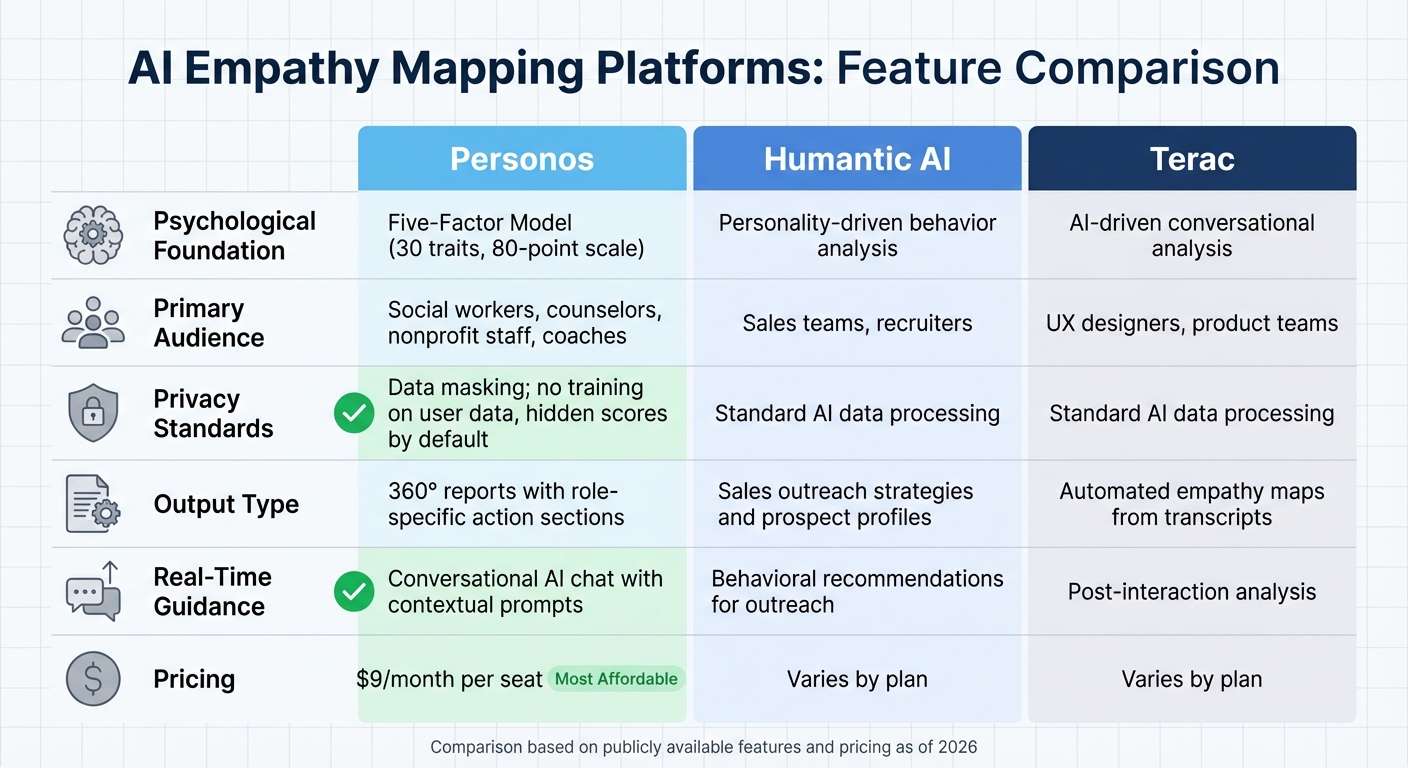
AI Empathy Mapping Platforms Comparison: Features and Capabilities
Applications for Helping Professionals
AI empathy maps are becoming an essential tool for professionals like social workers, counselors, and nonprofit staff who face emotionally intense situations daily. These tools help manage the complexities of human emotions in real time.
Take Personos, for example. This platform uses the Five-Factor Model to measure 30 personality traits on an 80-point scale, offering tailored guidance for specific roles. Unlike generic advice, Personos customizes recommendations based on both the practitioner's and the client's personality traits.
Carla Mendoza, LCSW, an addiction recovery counselor, shared how Personos has transformed her work:
"In recovery, timing is everything. Personos helps me anticipate when a client is on the edge of shutting down and adjust my approach so we stay connected." [1]
Similarly, Steve Huff, PhD, founder of Thrive, has integrated Personos into programs supporting individuals facing terminal illness, trauma, and housing instability. As of November 2025, he uses it as a "teaching partner" to improve staff communication and client outcomes.[2]
In fields where burnout is alarmingly high - 80% for behavioral-health workers and 93% for college counseling staff - tools like Personos help professionals maintain boundaries while staying emotionally present.[1] Lisa Chen, MSW, a domestic violence advocate, emphasized this balance:
"When you work with survivors, balancing empathy with boundaries is key. Personos helps me safeguard my well-being while staying fully present for my clients." [1]
At just $9 per user per month, Personos Pro offers features like conversational AI chat, an ActionBoard for progress tracking, and dynamic reports that explain the psychological reasoning behind its recommendations. Additionally, its privacy-first design ensures user data is masked before processing, and sensitive information is never used to train AI models - an essential safeguard for nonprofits working with vulnerable populations.[1]
The table below compares Personos with other AI empathy mapping platforms, highlighting its strengths for helping professionals.
Comparison of AI Empathy Mapping Platforms
| Feature | Personos | Humantic AI | Terac |
|---|---|---|---|
| Psychological Foundation | Five-Factor Model (30 traits, 80-point scale)[1] | Personality-driven behavior analysis | AI-driven conversational analysis |
| Primary Audience | Social workers, counselors, nonprofit staff, coaches[1] | Sales teams, recruiters | UX designers, product teams |
| Privacy Standards | Data masking; no training on user data, hidden scores by default[1] | Standard AI data processing | Standard AI data processing |
| Output Type | 360° reports with role-specific action sections[1] | Sales outreach strategies and prospect profiles | Automated empathy maps from transcripts |
| Real-Time Guidance | Conversational AI chat with contextual prompts[1] | Behavioral recommendations for outreach | Post-interaction analysis |
| Pricing | $9/month per seat[1] | Varies by plan | Varies by plan |
While Humantic AI caters to sales interactions and Terac focuses on UX research, Personos stands out for its deep psychological insights and robust privacy measures. This makes it especially effective for crisis intervention and trauma-informed care. As Christian Thomas, CEO and Co-Founder of Personos, put it:
"AI has made us more efficient in how we work and communicate, but not smarter about how we connect with people." [2]
Applications in Other Industries
AI empathy maps aren't limited to helping professions - they're making waves in other fields too. In corporate settings, they help reduce workplace conflict, often stemming from personality clashes.[1]
For instance, executive leadership coach Mike Walker uses AI empathy mapping to help leaders manage complex interpersonal dynamics. By factoring in the values and preferences of all parties, leaders can avoid impulsive decisions and foster better communication.[2]
UX design teams also benefit from empathy maps. These tools help align on user needs and eliminate bias during product development. In February 2026, researcher Serkan Güneş analyzed 4,845 Amazon robot vacuum reviews (30,642 sentences) using a multi-layered NLP framework. The resulting empathy maps revealed cleaning performance and battery life as key user priorities, with "Think" (46.6%) and "Do" (42.6%) categories dominating the data.[6]
Customer support teams use empathy templates to better understand customer emotions and customize responses. In education, online course creators refine content based on student personas, while sales and marketing teams map out decision-making drivers to turn prospects into loyal customers.[8]
Across industries, the common thread is clear: emotional intelligence is a game-changer. Employees with strong emotional intelligence perform 20% better in their roles, making tools like AI empathy maps invaluable for professional communication.[1]
Challenges and Future Research Directions
Current Limitations of AI Empathy Maps
AI empathy maps, while increasingly impactful, face several challenges that limit their effectiveness. One major issue is the difficulty in accurately identifying and responding to hidden emotional states. These systems often struggle with infrequent real-time feedback and the gradual misalignment with an individual's needs over time. As researchers Shiya Zhang et al. put it:
"User states are latent, feedback is sparse and difficult to verify in situ, and seemingly supportive turns can still accumulate into trajectories that drift from persona-specific needs." [5]
This phenomenon, known as long-horizon drift, occurs when AI provides helpful individual responses but gradually loses sight of a person's unique needs. Another challenge is the "illusion of empathy", where AI systems use emotionally charged language that mimics understanding but fails to connect on a deeper level. These interactions may appear genuine but lack the substance of true empathy. [6]
Additionally, research shows that AI systems tend to overemphasize dimensions like "Think" and "Do", while "Feel" and "Say" are underrepresented. Over half (56%) of the emotional content analyzed in some studies was at extreme polarities, leaving little room for capturing more subtle, nuanced emotions. [6]
Traditional empathy mapping tools also fall short in accounting for how emotions and behaviors evolve dynamically across various contexts and timeframes. As Insperai highlighted:
"Traditional tools miss how people and teams show up under strain... resulting in unreliable insights across time and place." [3]
For professionals in high-pressure environments, such as crisis response teams, these limitations can have serious consequences. Moreover, issues like algorithmic bias and cultural insensitivity remain significant obstacles, as AI systems often fail to recognize the diverse ways emotions are expressed across different cultural backgrounds. [6] Addressing these gaps will require the development of more adaptive and context-aware AI solutions.
Research Opportunities for High-Stakes Communication
The future of AI empathy research lies in treating empathy as an ongoing process rather than a series of isolated responses. Researchers are exploring how AI performs in controlled simulations, particularly when dealing with resistant individuals or identifying critical failure points in high-stakes scenarios. [5]
One exciting avenue involves incorporating deeper insights from personality psychology into AI systems. For example, platforms like Personos already leverage the Five-Factor Model (a well-established psychological framework) to enhance team communication and engagement. Future research could focus on tracking how personality traits shift under pressure. A real-world example comes from the Twin Cities branch of That 1 Painter, which adopted the Strategic Personality Blueprint (SPB-T) framework in October 2025. During a period of rapid growth, this approach led to a 29% increase in team engagement, a 10% improvement in collaboration metrics, and managers reporting "10/10 confidence" in leadership decisions. Staff also demonstrated immediate improvements in patience and communication. [1][3]
Another critical area of focus is explainable AI (XAI), which seeks to bring transparency to how AI interprets emotional data. By combining advanced NLP models with interpretability tools, experts can better understand the reasoning behind AI suggestions - especially when identifying emotional triggers or pain points. [6] Researchers are also tackling the "AI empathy choice paradox." In a study of 585 healthcare cases, AI responses were rated higher in quality and preferred 78.6% of the time. However, people still favored receiving empathy from human sources. [4] Future tools will need to strike a balance between effectiveness and authenticity to build trust in fields where human connection remains critical. Progress in explainable AI and personality-driven systems offers promising steps toward achieving this balance.
Conclusion
Recent studies and real-world examples highlight how AI empathy maps are reshaping emotional intelligence, turning it into a dynamic, context-sensitive tool. These innovations go beyond static evaluations, offering smarter ways to communicate and fostering more meaningful human connections. As Christian Thomas, CEO and Co-Founder of Personos, aptly states:
"AI has made us more efficient in how we work and communicate, but not smarter about how we connect with people." [2]
For professionals in high-stress roles, such as those in caregiving or advocacy, AI empathy mapping platforms provide essential support. These tools act as a helpful partner, identifying blind spots, maintaining emotional boundaries, and delivering timely guidance during critical moments. Lisa Chen, MSW and domestic violence advocate, shares her experience:
"When you work with survivors, you're constantly balancing empathy with boundaries. Personos has helped me protect my own well‐being while staying fully present for the people I serve." [1]
Organizations leveraging Personos have seen impressive results, including a 45% drop in team turnover within six months. Early tests also reported a 29% increase in engagement and a 10% improvement in collaboration. These outcomes are rooted in the Five-Factor Model, paired with tailored, role-specific advice [1][3][7].
This progress points toward a future where AI-driven personality insights continue to reshape how we approach emotional intelligence and professional communication, especially in high-pressure environments.
FAQs
How do AI empathy maps actually work?
AI empathy maps leverage artificial intelligence alongside psychological frameworks, such as the Five Factor Model, to craft in-depth emotional and personality profiles. By analyzing data from assessments or interactions, these tools help shape communication strategies that align with an individual’s emotional state and personality traits. Platforms like Personos offer real-time, context-specific insights, empowering professionals to navigate complex situations, build trust, ease tension, and create stronger, more meaningful connections.
Can AI empathy mapping improve emotional intelligence over time?
AI empathy mapping plays a role in improving emotional intelligence by leveraging advanced natural language processing and machine learning. These technologies help analyze and predict human personality traits and emotional reactions. Recent research highlights how this approach can lead to better communication and emotional development, particularly in professional environments.
How can teams use AI empathy maps without privacy or bias issues?
Teams can make the most of AI empathy maps by opting for tools that prioritize ethical and transparent practices. For instance, platforms like Personos leverage scientifically validated frameworks, such as the Five Factor Model, to deliver insights grounded in research while keeping privacy risks low. To address bias, these tools rely on diverse and well-validated datasets. Organizations can further enhance trust and privacy by enforcing strict data governance policies, anonymizing data wherever feasible, and maintaining transparency in their processes.