How Real-Time Personalization Transforms Communication
Real-time personalization uses AI and live data to tailor messages in milliseconds, boosting engagement, retention, revenue and improving team communication.
Rachel Johnson

How Real-Time Personalization Transforms Communication
Real-time personalization is changing the way businesses communicate by delivering messages tailored to live user behavior. Unlike static, outdated methods, this approach uses AI to analyze actions in milliseconds, ensuring responses are immediate and relevant. Companies using these techniques have seen measurable success, such as a 40% revenue boost and increased engagement. For example, Panera Bread achieved a 5% rise in customer retention by generating over 4,000 unique offers in real-time.
Key benefits include:
- Improved engagement: Personalized messages lead to higher click-through rates and user satisfaction.
- Efficiency gains: Automation saves time and resources.
- Stronger team collaboration: Tailored updates and conflict resolution tools improve workplace dynamics.
Real-time personalization relies on AI, machine learning, and event-driven data systems like Apache Kafka. Tools like Personos even analyze personality traits to provide live coaching tips, enhancing communication further. By aligning personalization efforts with business goals and tracking metrics like retention and conversion rates, companies can refine their strategies for better results. This method isn’t just about better messaging - it’s about creating meaningful connections that drive success.
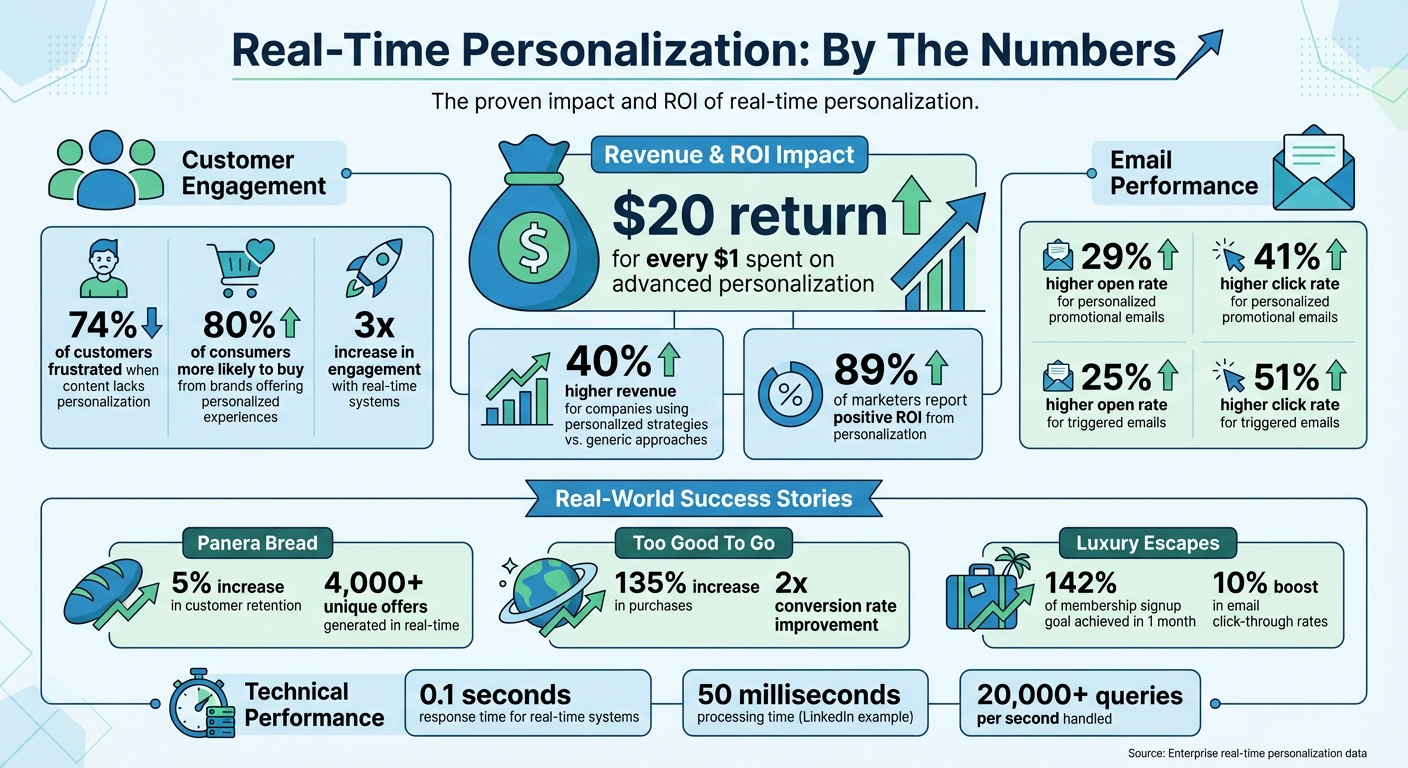
Real-Time Personalization Impact: Key Statistics and ROI Metrics
What Real-Time Personalization Means for Communication
Defining Real-Time Personalization
Real-time personalization involves tailoring messages and experiences based on live, continuously updating data [1][3]. Unlike traditional approaches that rely on historical data, this method adapts instantly to a user’s current actions - whether they’ve clicked a link, opened an app, or reached a specific milestone.
The concept is built around the 4 D's: Data (capturing live behavior across systems), Decisioning (using AI to determine the best next message), Design (creating content that adjusts dynamically for each individual), and Distribution (delivering the message through the right channel at the right moment) [1]. This method shifts communication from broad demographic-based messaging to personalized, one-on-one interactions driven by real-time intent and behavior [1].
The speed here is a game changer. While traditional systems process data in batches or on fixed schedules, real-time systems analyze and respond to incoming data within 0.1 seconds - ensuring the experience remains seamless [3]. By breaking down data silos, this approach creates a unified, proactive communication experience across all touchpoints [1][3]. These advancements significantly improve the effectiveness of communication.
Benefits of Real-Time Personalization
Real-time personalization offers tangible benefits, especially for enterprise communication. It’s not just about innovation - it drives results. For instance, advanced personalization techniques can deliver returns as high as $20 for every $1 spent [3]. Moreover, 74% of customers express frustration when content lacks personalization [3], a sentiment that holds true for employees receiving generic internal communications as well.
Tailored, immediate messaging can dramatically improve engagement and efficiency. For example, Too Good To Go used behavioral triggers to send notifications when Surprise Bags became available nearby, leading to a 135% increase in purchases. Their conversion rate doubled compared to their earlier strategy [1]. Similarly, Luxury Escapes linked their data warehouse to display real-time membership benefits based on subscriber status. This effort resulted in achieving 142% of their membership signup goal in just one month, alongside a 10% boost in email click-through rates [1].
For enterprise teams, the impact is equally striking. Real-time systems can drive up to a 3x increase in engagement by responding instantly to challenges, milestones, or support needs [3]. When communication feels more conversational and less automated, it builds trust, fosters collaboration, and strengthens relationships across the organization. These personalized interactions make people feel genuinely understood, creating a more connected and efficient workplace.
Technologies That Power Real-Time Personalization
AI and Machine Learning for Personalization
Real-time personalization hinges on machine learning models that can make split-second predictions based on immediate user behavior. Tools like TensorFlow Serving and AWS SageMaker deploy algorithms such as Contextual Bandits, which analyze live user context and generate recommendations in milliseconds. These models go beyond historical data by responding dynamically to current behavioral signals.
Take LinkedIn, for instance. Their system processes user actions and computes features in under 50 milliseconds, all while managing over 20,000 queries per second. Achieving this level of speed and efficiency requires specialized tools. In-memory databases like Redis and Hazelcast store session data for rapid access, while analytical databases such as Apache Pinot handle queries in under 100 milliseconds, enabling real-time feature computation from recent activity.
A growing trend in this field is "agentic" personalization. Rather than relying on pre-defined responses, AI systems now analyze real-time sentiment and interaction history to deliver adaptive, human-like communication. Salesforce's Agentforce is a prime example, leveraging live data to craft optimal responses instantly. Similarly, platforms like Personos (https://personos.ai) take this further by analyzing personality traits and relationship dynamics in real time. This allows the AI to provide tailored communication prompts that evolve with the flow of a conversation.
These advancements in AI pave the way for seamless integration of data, ensuring every personalized interaction feels natural and immediate.
Data Integration and Real-Time Processing
While AI drives decision-making, robust data integration frameworks ensure no interaction goes unnoticed or unprocessed.
At the heart of real-time personalization lies event streaming platforms like Apache Kafka, AWS Kinesis, and Apache Flink. These systems capture user actions - whether it’s a click, a message, or a completed task - as they happen and feed them into systems that trigger responses in as little as 0.1 seconds. This event-driven architecture ensures every user action is treated as a signal for immediate personalization.
Consolidating data from various sources is made possible through Customer Data Platforms (CDPs). These platforms bring together behavioral data, transaction records, and demographic details into a single, constantly updated user profile. For instance, Luxury Escapes utilized Braze Cloud Data Ingestion to sync their data warehouse in real time. The result? They surpassed their membership signup goal by 142% within a month and saw a 10% boost in email click-through rates [5].
Handling sudden traffic spikes - such as those caused by enterprise campaigns - requires advanced infrastructure. Campaigns can lead to a 10x surge in demand, and systems rely on Kubernetes auto-scaling and multi-layer caching strategies to manage the load. A two-layer caching approach combines per-node caching to reduce processing costs with global distributed caching to prevent backend overload. Additionally, a "stale-while-revalidate" strategy ensures that users receive cached data instantly while the system updates in the background. This approach keeps personalization fast and reliable, even during high-demand situations, supporting thousands of users simultaneously.
How Enterprises Use Real-Time Personalization
Improving Team Collaboration
Real-time personalization tailors updates to match each team member's current tasks, ensuring they receive information that's relevant right when they need it. Instead of bombarding everyone with generic updates, these systems track individual workloads and deliver targeted insights. For instance, when a team hits a project milestone, the system might automatically trigger celebratory notifications or surface useful resources to keep the momentum going.
A great example of this in action is SimpliSafe, which tackled organizational data silos by integrating survey responses and call data into unified user profiles. This approach saved them roughly one week of development time per system connected - totaling about four weeks. With this streamlined process, their team could roll out personalized experiences much faster [1].
These tailored updates not only enhance collaboration but also pave the way for more personalized approaches to conflict resolution.
Conflict Resolution and Coaching
Interpersonal conflicts can be a major productivity drain, especially when generic advice fails to address the unique dynamics of a team. Real-time personalization steps in by analyzing personality traits and relationship patterns in real-time, offering coaching tools that adapt as interactions evolve. For example, Personos (https://personos.ai) merges AI with personality psychology to deliver proactive communication tips during live conversations. By continuously evaluating both individual and team dynamics, the platform provides actionable insights to help resolve conflicts effectively.
This kind of immediate, customized feedback boosts team communication and keeps productivity on track. By addressing challenges as they arise, enterprises create an environment where feedback feels timely and meaningful.
Better Engagement and Feedback Processes
Real-time insights also improve engagement by triggering instant follow-ups, like scheduling support sessions or sending recognition messages. This creates a feedback loop that evolves alongside team sentiment. Internally, these strategies mirror the measurable benefits seen in external user engagement, where enterprises adapt to behaviors in the moment, driving both retention and satisfaction.
Best Practices for Implementing Real-Time Personalization
Building a Scalable Personalization System
To make real-time personalization work effectively, you need a strong infrastructure. Start by implementing an event ingestion system that captures interactions as they happen - whether it’s someone opening a message, joining a meeting, or updating a task. This data flows into a real-time processing layer, allowing instant behavior analysis instead of relying on slower, batch updates. To handle large volumes of data efficiently, ensure your system integrates this information into scalable storage solutions [6].
Using a modular content architecture is another key step. Break your interface into smaller, independent components - like hero modules, value proposition blocks, and call-to-action panels. This way, you can update only the parts that need to change based on live user behavior.
Keep personalization rules separate from creative assets by storing them in a central decisioning layer, such as a Customer Data Platform (CDP) or a rules engine. Avoid hard-coding these rules into individual pieces of content. Also, ensure all tools - your CRM, marketing automation platform, and website - remain synchronized. This shared state prevents conflicting messages and creates a consistent user experience [7].
Focus on tracking meaningful behaviors that indicate decision-making, like revisiting a pricing page multiple times or exploring specific content in depth, rather than just counting page views. Start simple by A/B testing elements like email subject lines or product recommendations. Once you’ve mastered these basics, you can move on to more complex personalization efforts, such as dynamic pricing or tailored landing pages [6].
These foundational steps help you build a system that supports precise, real-time decisions tied directly to your business outcomes.
Aligning Personalization with Business Goals
For real-time personalization to deliver value, it must align with your organization’s core objectives. Start by identifying whether your primary focus is on driving revenue, increasing customer engagement, or improving long-term retention [2][8].
Create a unified intent state - a single, live source of truth that updates based on user behavior, sales activity, and customer lifecycle changes. This ensures consistent messaging across all channels and avoids the fragmented experiences caused by data silos [7].
Next, map your customer journey to identify the moments where real-time personalization can make the biggest impact. For instance, if a team member frequently visits a conflict resolution resource, you could provide proactive coaching prompts. On the other hand, recognizing milestones with instant feedback can strengthen engagement. Your calls to action should adapt as buyer intent evolves - for example, shifting from "Learn More" to "Request Demo" once high-intent signals are detected [7].
Finally, use outcome data to refine your personalization strategy. Track metrics like progression velocity and stage advancement to understand what’s working. Feeding this data back into the system creates a feedback loop that improves your approach over time. Notably, faster-growing companies tend to derive 40% more of their revenue from personalization compared to slower-growing competitors [8].
For organizations aiming to improve communication and team dynamics, tools like Personos can be a game-changer. By leveraging real-time personality insights, Personos enables proactive coaching and conflict resolution, making personalization efforts even more impactful. When personalization aligns with clear business goals, it transforms communication from generic messaging into meaningful exchanges that foster collaboration and deliver measurable results.
sbb-itb-f8fc6bf
Measuring the Results of Real-Time Personalization
Key Performance Indicators to Track
Tracking the right metrics is essential when measuring the impact of real-time personalization. This involves monitoring both leading indicators (like click-through rates and time on page) and lagging outcomes (such as revenue growth and retention rates). Comparing personalized experiences against a control group helps you understand the true impact. It’s also important to break down your KPIs by segment - what works for new prospects might not resonate with existing customers. Evaluating performance across different lifecycle stages and team roles ensures a more complete picture [9].
Data quality metrics, such as Match Rate and Profile Completeness, are equally important. These metrics ensure that the information driving your real-time triggers is accurate. Jacqueline Woods, CMO of Teradata, emphasizes this point:
"AI is nothing if it doesn't have clean data to essentially build intelligence off of, particularly when you talk about generative AI" [10].
This concern is shared by many - 61% of companies worry that inaccurate data could hinder their AI-driven personalization efforts [10].
Here’s a breakdown of key KPI categories and their significance:
| KPI Category | Specific Metrics | What It Tells You |
|---|---|---|
| Engagement | Open rates, CTR, time on page, depth of visit | Measures immediate interest and relevance |
| Commercial Impact | Conversion rate, pipeline growth, win rate, deal size | Links personalization to sales outcomes |
| Customer Outcomes | Retention rate, net revenue retention, CSAT/NPS | Evaluates loyalty and relationship health |
| Operational Health | Match rate, profile completeness, valid tests per quarter | Ensures accuracy and testing efficiency |
Personalized promotional emails, for example, achieve a 29% higher open rate and a 41% higher click rate. Triggered emails perform even better, with a 25% higher open rate and a 51% higher click rate. Companies using personalized strategies report 40% more revenue compared to generic approaches, and 89% of marketers confirm that personalization yields positive ROI [4].
For platforms like Personos, tracking metrics such as conflict resolution success rates and team collaboration improvements offers a unique way to measure how personality-based personalization affects workplace dynamics. By continuously testing and refining these strategies, you can ensure that your personalization evolves alongside changing user behaviors.
Using A/B Testing for Continuous Improvement
A/B testing takes the guesswork out of personalization by relying on data to guide decisions. Real-time A/B testing, powered by AI, allows for rapid adjustments based on user behavior, eliminating the need to wait weeks for results [11].
Before launching a test, start with a clear hypothesis. For example: "Personalizing onboarding messages based on personality type will increase feature adoption by 15%." Run the test until it reaches statistical confidence - usually 95% - before declaring a winner. Don’t stop prematurely, even if one variant seems promising early on [9].
Segment your tests by audience characteristics such as device type, geographic location, or lifecycle stage. A great example comes from Too Good To Go, which used Braze Catalogs to send real-time notifications about surplus food nearby. This approach led to a 135% increase in purchases attributed to CRM efforts and doubled their message conversion rate [1].
To maximize efficiency, integrate your testing platform with CRM and analytics tools using APIs or webhooks. This ensures your tests use up-to-date data. Run tests over a full business cycle (typically a week) to account for daily and weekly variations. Documenting test results in a shared knowledge base helps avoid redundant experiments [11].
For platforms like Personos, A/B testing can reveal which coaching prompts or conflict resolution strategies work best for specific personality combinations. This ongoing refinement ensures that personalization becomes increasingly precise, transforming each interaction into an opportunity for growth. These insights not only enhance personalization but also pave the way for continuous system improvements in enterprise communication.
Unlocking Real Time Personalization Through Data, AI, and Communication
Conclusion
Real-time personalization is reshaping the way organizations communicate, shifting from merely reacting to proactively engaging with their audiences. By using live data, businesses can deliver messages that align perfectly with a person's current intent, turning interactions into ongoing, meaningful conversations across multiple channels. This ensures every touchpoint feels tailored and authentic.
This approach doesn’t just enhance customer engagement - it also improves how internal teams work together. With centralized data, teams can collaborate more efficiently and seize opportunities as they arise. Companies adopting personalized strategies have reported 40% higher revenue compared to those sticking with generic methods, and 80% of consumers say they’re more inclined to buy from brands offering personalized experiences [4][12].
For internal team management, tools like Personos bring a new dimension to collaboration. By combining AI with personality psychology, these platforms offer real-time prompts for conflict resolution, coaching, and teamwork. This allows every interaction to become a chance to deepen relationships and achieve better outcomes by aligning with how people think and work.
Treating real-time data as a form of active listening is the cornerstone of success. It mirrors what users express through their actions and helps businesses respond in ways that build trust and loyalty [12].
Ultimately, real-time personalization goes beyond improving communication - it’s about fostering deeper connections, encouraging collaboration, and driving shared success.
FAQs
How does real-time personalization enhance communication and engagement?
Real-time personalization transforms communication by tailoring experiences to match individual behaviors and preferences as they happen. By leveraging live data - like browsing habits or recent interactions - businesses can craft messages and recommendations that feel immediate and relevant.
This approach does more than just improve customer satisfaction; it builds stronger, lasting relationships by showing customers they’re truly understood. From customized product suggestions to timely communication prompts, real-time personalization ensures every interaction feels purposeful, creating deeper connections and driving meaningful results.
What technologies power real-time personalization in communication?
Real-time personalization hinges on cutting-edge technologies that respond instantly to user behavior. Here's how it works:
- Data streaming tools like Apache Kafka and AWS Kinesis handle user interactions in real time, ensuring data flows smoothly as events occur.
- In-memory databases such as Redis or Hazelcast provide lightning-fast access to user session and profile data, enabling quick, low-latency responses.
- Machine learning platforms like TensorFlow Serving or AWS SageMaker empower algorithms to make real-time predictions, crafting personalized experiences on the fly.
An event-driven architecture, often powered by microservices and tools like WebSockets, ensures that every user action triggers an immediate, tailored response. Together, these technologies form the backbone of dynamic, real-time communication, delivering experiences finely tuned to individual preferences.
How can businesses evaluate the impact of real-time personalization?
Businesses can measure the success of real-time personalization by tracking key performance indicators (KPIs) that focus on engagement, customer satisfaction, and overall business performance. Metrics like click-through rates (CTR), conversion rates, customer lifetime value (CLV), retention rates, and customer satisfaction scores (CSAT) offer clear insights into how personalization impacts user behavior, loyalty, and business growth.
For a more detailed understanding, companies can use A/B testing to compare personalized experiences against non-personalized ones. This approach helps pinpoint how well personalization strategies are working. Additionally, pairing these metrics with qualitative feedback - like customer surveys or interviews - paints a fuller picture of how personalization improves interactions and drives meaningful outcomes.