Real-Time Client Signals with Personality Data
Client cues mean different things—use Big Five personality data to read the person, not just the signal.
Rachel Johnson

Real-Time Client Signals with Personality Data
The main point is simple: the same client cue can mean different things, and personality data helps you choose a better response.
As I read this piece, I see a clear ranking of tools for live client communication. Cue-only reading is the weakest option when a client goes silent, pushes back, sounds urgent, or seems confused. It often turns one surface signal into one fixed meaning. But the article shows that those 4 cues can point to very different needs based on Big Five traits.
Here’s the short version:
- Silence may mean stress, careful thinking, or low trust
- Pushback may mean fear, a need for control, standards concerns, or distrust of change
- Urgency may mean panic, duty, social energy, or a last-minute scramble
- Confusion may mean overload, low comfort with gray areas, weak subject knowledge, or curiosity
The article also compares 4 tool types:
- Personos
- Generic CRM or communication playbooks
- Big Five assessment tools such as Hogan or NEO-based tools
- Text-only personality inference AI tools
My takeaway: if the interaction is low-risk, simple systems may be enough. If the moment involves trust, de-escalation, or risk, a live tool tied to a measured Big Five profile gives you a better read.
4 Customer Personality Types | Customer Service
Quick Comparison
| Tool type | What it does well | Main gap | Best use |
|---|---|---|---|
| Personos | Connects live cues to a trait profile and gives next-step guidance | Needs setup and profile data | High-risk or tense client moments |
| Generic CRM / playbooks | Handles reminders, routing, and admin work | Reads cues at the surface only | Routine follow-up |
| Big Five assessments | Gives trait scores with research support | Hard to use in the moment | Intake, planning, supervision |
| Text-only inference AI | Helps with message drafting and tone shifts in writing | No steady profile and weak read on silence | Low-stakes written exchanges |
What stands out most is this: the article is not just about spotting signals. It is about matching the response to the person behind the signal.
How the Same Client Signal Changes Meaning Across Personality Patterns
The same cue can mean very different things depending on the trait behind it. So instead of reacting to the cue alone, use it to figure out the likely need, then respond from there.
Silence
Silence is not one thing. For one client, it may mean stress. For another, it may mean they’re thinking carefully. For someone else, it may mean they don’t feel safe enough to speak up yet.
| Silence Pattern | Underlying Need | Common Misread | Response Strategy |
|---|---|---|---|
| Anxious processing (High Neuroticism) | Safety & regulation | Lack of intelligence | Reassure and slow down |
| Reflective processing (High Conscientiousness) | Time & space | Lack of engagement | Wait and allow processing |
| Guarded withdrawal (Low Agreeableness) | Trust & empathy | Agreement or compliance | Soften tone and invite input |
Pushback
Pushback also shifts in meaning depending on the trait pattern. Sometimes the person is protecting themselves. Sometimes they want more control. Sometimes they think your reasoning doesn’t hold up.
| Pushback Pattern | Underlying Driver | Response Style to Reduce Escalation |
|---|---|---|
| Self-protection (High Neuroticism) | Fear of failure or blame | De-escalate with empathy and "we" language |
| Autonomy defense (Low Agreeableness) | Need for independence | Offer choices and collaborative decision-making |
| Standards-based disagreement (High Conscientiousness) | Accuracy and quality concerns | Provide data, logic, and detailed reasoning |
| Low-trust resistance (Low Openness) | Fear of the unknown | Focus on familiar benchmarks and incremental change |
Urgency
Urgency can come from stress, duty, momentum, or a need for instant relief. If you treat all urgency the same way, you’ll miss what’s driving it.
| Urgency Pattern | Underlying Driver | Recommended Response |
|---|---|---|
| Threat sensitivity (High Neuroticism) | Anxiety and risk avoidance | Validate: Acknowledge the stress and prioritize |
| Deadline-driven responsibility (High Conscientiousness) | Duty and reliability | Escalate: Provide clear timelines and milestones |
| High-energy urgency (High Extraversion) | Excitement and influence | Slow down: Channel energy into a structured plan |
| Immediate relief-seeking (Low Conscientiousness) | Immediate relief | Clarify: Set boundaries while solving the immediate block |
Confusion
Confusion can mean overload, discomfort with gray areas, weak subject knowledge, or plain curiosity. That’s a big spread. The right move depends on which one you’re dealing with.
| Confusion Pattern | Underlying Driver | Recommended Response |
|---|---|---|
| Overload (High Neuroticism) | Cognitive and emotional saturation | Simplify: Reduce variables and offer reassurance |
| Low tolerance for ambiguity (Low Openness) | Need for concrete facts | Sequence: Provide a step-by-step linear path |
| Low domain familiarity (Low Conscientiousness) | Lack of foundational knowledge | Clarify: Define terms and decision points clearly |
| Exploratory questioning (High Openness) | Intellectual curiosity | Expand: Engage in deeper conceptual discussion |
Trait-by-Signal Matrix
The table below maps all five trait dimensions, at both high and low levels, across the four client signals. Use it as a fast cross-trait reference when you need to make a call in the moment.
| Trait Level | Silence | Pushback | Urgency | Confusion |
|---|---|---|---|---|
| High Neuroticism | Internalized stress; safety | Defensive; empathy | Panic-driven; validate | Overwhelmed; simplify |
| Low Neuroticism | Calm reflection; space | Objective critique; logic | Calculated priority; data | Logical gap; specific info |
| High Agreeableness | Hesitation to offend; permission | Rare; major value breach | Helping others; social context | Harmony worry; reassurance |
| Low Agreeableness | Passive resistance; engagement | Direct challenge; autonomy | Competitive drive; results | Skepticism; proof of concept |
| High Extraversion | Rare; deep upset | Performance-based; audience | Socially contagious; focus | Thinking out loud; sounding board |
| Low Extraversion | Natural state; no intervention | Quiet disagreement; invitation | Internal pressure; recognition | Private processing; written follow-up |
| High Conscientiousness | Deep thinking; time | Process-based; standards | Goal-oriented; efficiency | Detail-oriented; precision |
| Low Conscientiousness | Distraction; re-focusing | Resistance to structure; flexibility | Last-minute rush; boundaries | Lack of prep; basic orientation |
| High Openness | Conceptualizing; patience | Intellectual debate; novelty | Innovation-driven; vision | Abstract curiosity; exploration |
| Low Openness | Confusion/shock; familiarity | Change-resistance; tradition | Practical necessity; utility | Ambiguity stress; concrete steps |
This is why real-time guidance has to match both the cue and the client profile. The job isn’t just to react to what shows up on the surface. It’s to read the person underneath it, then match your response to that person, not just the signal.
1. Personos
Personos is the clearest example of live, personality-aware response design. It was built for helping professionals. The goal isn't just to flag a client signal. It's to explain what that signal may mean for a specific client and elevate client relationships by suggesting the next step.
Signal Interpretation and Real-Time Response
Personos uses a 30-trait Big Five profile on an 80-point scale. That matters because the same silence can mean very different things. For one client, it may point to distraction. For another, it may point to perfectionism, fear, or guarded reflection.
Personos adds live, trait-based interpretation that static tools don't offer. A social worker or case manager can describe a situation in plain language, like "Client canceled three times, then apologized by text at 2:00 a.m.", and the platform returns a trait-grounded explanation of what is likely driving that behavior, along with a suggested response.
That guidance is tied to both the cue and the client. For a client high in Neuroticism who goes silent after a conflict, Personos might suggest sending one low-pressure message instead of several follow-ups. For a client low in Agreeableness who pushes back on a plan, it might suggest framing the talk around choice and collaboration instead of compliance. As new details come in, the guidance changes with them.
Transparent Reasoning
Transparent Reasoning shows which traits drove the recommendation. That helps with documentation and supervision.
Fit for Helping-Professional Workflows
Personos is designed for short bursts of use. You can use it before a session, right after a hard exchange, or while writing notes. Dynamic Reports can generate client-specific sections such as "What silence usually signals for this person", and Prompts deliver micro-nudges between sessions, like a reminder that a specific client responds better to one clear option than to multiple choices.
In practice, that means a worker can choose the right response to silence, pushback, urgency, or confusion in seconds.
That trait-and-context depth sets the baseline for the lighter tools that follow.
2. Generic CRM or Communication Playbooks
By contrast, tools like Salesforce, HubSpot, and Zoho are built for sales and service workflows, not helping-professional relationships. That difference shows up fast when you look at how they handle client signals.
Signal Interpretation Depth
Generic CRMs read signals at the surface. Silence turns into "no activity" or "no response." Pushback gets logged as an objection or churn risk. Urgency becomes a high-priority ticket. Confusion may appear as repeated questions or a support request.
The problem is simple: the system still doesn't know what the signal means. A silent client still looks like no response, whether that silence comes from reflection, anxiety, or disengagement. The label is there, but the human read is still missing. This gap is especially evident when trying to read personality types in meetings or high-stakes sessions.
Real-Time Response Adaptation
In a generic CRM, adaptation is rule-based, not personality-based. If someone doesn't reply within a set window, the system sends a follow-up template. If a ticket is marked urgent, the case gets routed faster.
That kind of automation helps with scheduling and compliance. But it can't tell a practitioner whether this is a moment to wait, soften, or escalate. That call still depends on human judgment.
Personality Model Support
Most CRMs don't use formal personality models. When personality-related notes do show up, they're usually custom tags such as "prefers phone" or "needs extra reassurance."
That's useful as shorthand, but it's not the same as a consistent model like the Big Five. Without a measurable framework, it's hard to compare clients, track change over time, or build a shared language across a team.
Fit for Helping-Professional Workflows
Generic playbooks are written for sales or service settings. Helping professionals usually have to rewrite the script on their own. And when you try to force a generic CRM into care workflows, the workarounds start piling up.
For scheduling, logging, referrals, and compliance, generic CRMs do the job well. But when a client goes quiet after a hard conversation or pushes back on a plan, the system gives you a template, not a read on the person.
Traditional assessments fix the measurement issue, but not the live-response issue.
3. Traditional Personality Assessments (for example, Hogan or NEO-based tools)
Traditional assessments like NEO- or Hogan-based tools give you validated Big Five profiles. The issue isn't the measurement itself. The issue is what happens next. These tools are strong on model clarity because the Big Five framework is explicit and backed by research. The gap shows up when silence, pushback, urgency, or confusion hits in the moment.
Signal Interpretation Depth
The main question isn't whether the profile is valid. It's whether it helps shift the response fast enough.
Tools like the NEO produce rich trait data. A practitioner can review scores for emotional volatility, assertiveness, trust, or openness and form a reasonable hypothesis about what silence or pushback may mean. But that still leaves one hard step: turning trait data into action.
As personality science notes, predictable mismatches still happen. An extroverted practitioner may read a reflective client's silence as disengagement when it's actually careful processing, or a conflict-averse person may see direct feedback as hostility [1].
Real-Time Response Adaptation
This is the clearest weak spot.
These assessments are built for pre-session planning and post-session reflection, not for the moment when a client shuts down or escalates mid-conversation. There is no live dashboard or instant alert that helps turn the profile into an in-the-moment response. The practitioner still carries that translation burden.
Fit for Helping-Professional Workflows
In helping work, timing matters as much as accuracy.
These tools fit well for intake, planning, and supervision. They fall short when a client goes quiet, pushes back, or escalates mid-conversation.
Text-only AI inference tools take a different route, but they come with their own trade-offs.
4. Text-Only Personality Inference AI Tools
Text-only inference tools look at emails, chats, or notes and try to infer traits from language alone. That’s different from Personos or validated assessments, which rely on a stable Big Five profile. So the comparison is pretty direct: stable trait data versus language-based hints.
Signal Interpretation Depth
In day-to-day use, the gap shows up most when the signal is indirect or incomplete. These tools are usually better at reading clear language, which is why they tend to do a better job with pushback and urgency than with silence or confusion.
Silence and confusion are weak text signals. Fewer messages could point to disengagement, overload, or even a tech problem. Clarifying questions might mean confusion, but they can also reflect language barriers or low familiarity with the topic.
Real-Time Response Adaptation
When a client’s tone changes in the middle of a thread, these tools can suggest small tweaks like:
- softer wording
- shorter replies
- validation
- step-by-step instructions
That can help in low-stakes written exchanges. The tougher part is consistency. These tools usually don’t keep a durable profile across sessions, so the guidance resets with each thread. As a result, the read can shift from one message to the next.
The next question is simple: is the model clear enough to trust?
Personality Model Explicitness
Many tools use loose labels or don’t say whether they map to the Big Five. That makes the output hard to check and even harder to explain. Without explicit trait scores or psychometric validation, it’s tough to tell a supervisor or funder how the tool is influencing communication choices.
Fit for Helping-Professional Workflows
These tools can help with drafting client-facing messages or coaching newer staff on tone. But in U.S. agencies, pasting client text into outside tools can create HIPAA and data-governance problems. Many teams simply can’t use that setup unless there’s a clear policy and a BAA in place.
There’s also the workload issue. For practitioners handling 50 to 100+ active cases, the copy-paste-interpret process can add time instead of saving it.
In practice, these tools fit best as drafting aids. That trade-off sets up the next pros-and-cons comparison.
Pros and Cons of Each Personality-Aware Signal Response Approach
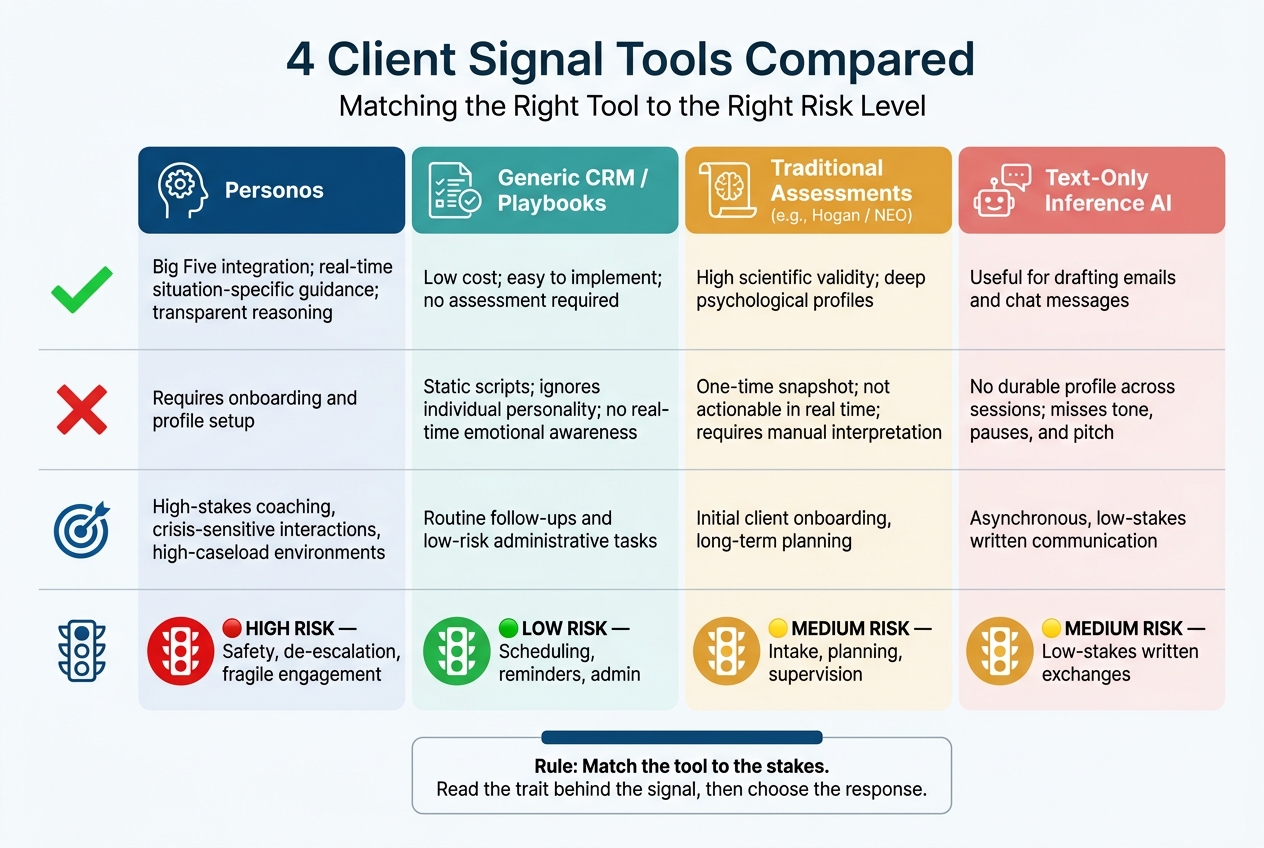
4 Client Signal Tools Compared: Personality-Aware vs. Generic Approaches
Each approach solves a different problem. The right fit comes down to case complexity, interaction risk, and what your team can actually handle.
### Where Reading Personality Types Helps Most
The right tool depends on what the interaction calls for: precision, speed, or simple administration. Measured personality data helps most when getting silence, pushback, or urgency wrong could lead to real harm. Traits matter most when those four signals are fuzzy enough to support more than one reading.
Where Lighter-Weight Systems May Be Enough
Lighter tools work well for routine, low-risk interactions like reminders, scheduling, and standard check-ins. They tend to break down when the exchange turns ambiguous, emotionally charged, or resistant.
Trade-Offs Across the Four Approaches
The table below gives a quick side-by-side view of the main differences.
| Approach | Advantages | Limitations | Best-Fit Use Case |
|---|---|---|---|
| Personos | Five Factor Model integration; real-time, situation-specific guidance; transparent reasoning; role-specific customization | Requires onboarding and profile setup | High-stakes coaching, crisis-sensitive interactions, high-caseload environments |
| Generic CRM / Playbooks | Low cost; easy to implement; no assessment required | Static scripts; ignores individual personality; no real-time emotional awareness | Routine follow-ups and low-risk administrative tasks |
| Traditional Assessments | High scientific validity; deep psychological profiles | One-time snapshot; not actionable in real time; requires manual interpretation | Initial client onboarding, long-term leadership development planning |
| Text-Only Inference AI | Useful for drafting emails and chat messages; text-only | No durable profile across sessions; misses tone, pauses, and pitch, which makes emotional context easier to misread | Asynchronous, low-stakes written communication |
The next question is not which tool is most advanced. It’s which one matches the risk level of the communication.
Conclusion
Key Comparison Takeaway
Spotting a client signal is the easy part. The harder part is figuring out what that signal means for this client, at this moment, and deciding what to say next.
The same cue can point to reflection, resistance, overload, or risk. So the response shouldn't be based on the signal alone. It should fit the client's trait pattern.
The four approaches compared in this article each handle a different part of that job. None of them are wrong across the board, but they are not interchangeable, especially when the stakes are high. And that distinction matters. It shapes which approach fits routine work and which one belongs in high-stakes moments.
Matching Approaches to Low-, Medium-, and High-Risk Communication
At this point, the issue shifts from meaning to fit: which tool makes sense at each level of risk?
Use signal-only tools for low-risk admin tasks. Use static assessments or text-only inference for moderate-risk communication. Use live personality-aware guidance for safety-sensitive, resistant, or crisis-prone interactions.
Practical Next Step for Helping Professionals
The rule is simple: match the tool to the stakes.
Use lighter tools for scheduling and routine outreach. Use measured personality data and real-time guidance when the conversation involves safety, de-escalation, or fragile engagement. Personos can support that higher-risk work by surfacing situation-specific response options fast.
The rule stays the same: read the trait behind the signal, then choose the response.
FAQs
How do I tell which trait is driving a client signal?
Look at how the client’s behavior lines up with known personality frameworks like the Big Five. Verbal and nonverbal cues, such as tone, speech pace, word choice, and response timing, can hint at the trait behind the behavior.
Platforms like Personos can review these patterns in real time against a client’s personality profile. That helps you spot which trait is driving the signal and adjust your response on the spot.
When is personality-aware guidance worth using?
Use personality-aware guidance when you need to deal with tense human dynamics, get past communication roadblocks, or build trust in hard conversations.
It works especially well when personalities clash, messages get muddy, or people start to disengage. A one-size-fits-all approach often misses those moments. Tools like Personos can offer real-time, situation-specific insight to help de-escalate conflict, tailor feedback, and improve outcomes.
Can personality data reduce misreads in tense conversations?
Yes. Personality data can cut down on misreads in tense conversations because it helps you see how each person tends to communicate. That gives you a better read on signals like silence, pushback, or confusion, so you’re less likely to take them as a personal slight when they may just reflect that person’s style.
Tools like Personos help with this in real time. For example, it might suggest calmer wording for someone under stress or a more structured approach for a methodical client.