Predicting Team Outcomes with Behavioral Data
Compare static personality tests with AI behavioral models that deliver real-time, bias-reduced team insights and actionable guidance.
Christian Thomas

Predicting Team Outcomes with Behavioral Data
Managers often struggle to predict team performance accurately. Research shows only 34% can identify their team's working style, leading to missed deadlines and high turnover. Traditional tools like DISC and Hogan provide static insights but fall short in predicting future challenges and adapting to team dynamics.
AI-driven behavioral models, such as Personos, offer a dynamic solution by analyzing real-time behavioral signals. These models predict team dynamics, minimize bias, and provide actionable recommendations. Personos, for example, costs $9 per seat per month and delivers evolving insights, helping teams address conflicts and improve performance.
Key Takeaways:
- Traditional tools rely on static data and are costly ($40–$250+ per assessment).
- AI models like Personos use psychological frameworks for real-time, actionable insights.
- Personos helps reduce turnover and improve team outcomes with affordable and scalable solutions.
| Feature | Traditional Tools | AI Models (e.g., Personos) |
|---|---|---|
| Cost | $40–$250+ per assessment | $9/seat/month |
| Output | Static reports | Real-time, evolving insights |
| Actionability | Limited guidance | Context-driven recommendations |
| Bias Risk | High | Lower with data masking |
| Scalability | Low | High |
AI tools like Personos bridge the gap, offering managers practical tools to anticipate and solve team challenges effectively.
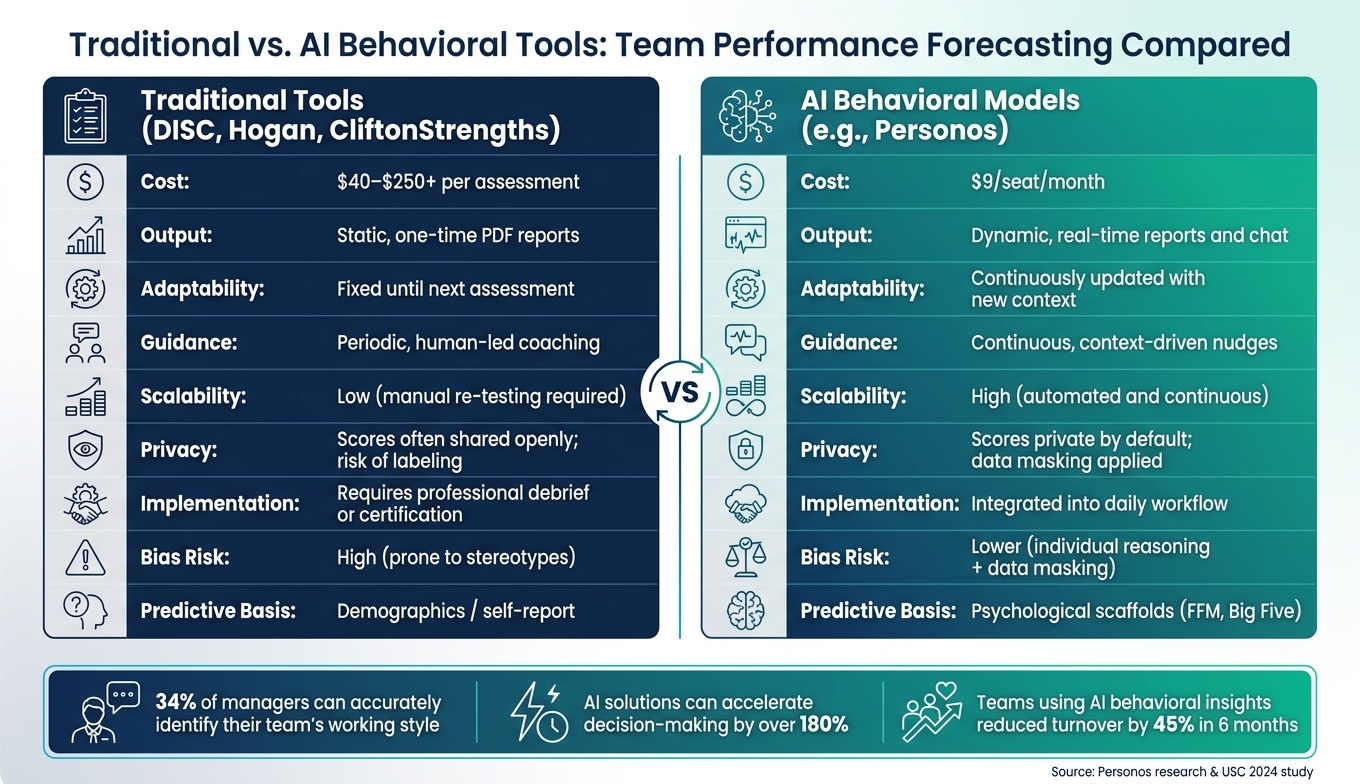
Traditional vs. AI Behavioral Tools: Team Performance Forecasting Compared
Predicting human decisions with behavioural theories and machine learning
1. Traditional Team Outcome Forecasting Methods
Before diving into the capabilities of emerging AI models, it’s important to understand how traditional forecasting methods work and where they fall short.
Traditional approaches often rely on personality assessments like DISC, Hogan, and CliftonStrengths. These tools have been widely used to evaluate individual working styles and team strengths, but they primarily offer static snapshots. While they’ve been staples in organizational assessments for years, they struggle to predict how teams will perform in the future. This gap highlights the need for AI’s role in building winning teams by translating personality into performance.
Predictive Accuracy
One major drawback is their inability to adapt over time. For instance, a DISC profile created during an employee's onboarding might not accurately reflect how they handle high-pressure situations months later. Studies on team dynamics show that traits like conscientiousness and agreeableness strongly influence teamwork quality (p < 0.001) [2]. However, traditional tools often fail to translate these insights into predictive, actionable strategies.
Bias and Fairness
Bias is another issue. Tools like DISC rely on self-reported data, which can lead to fixed labels that don’t evolve as an individual’s behavior changes. Hogan Assessments attempt to counter this by incorporating external perceptions, but this method requires certified professionals for interpretation - introducing another layer of potential subjectivity.
Actionability
Static reports from these assessments offer limited real-time value. For example, they rarely provide managers with actionable guidance during critical team moments, such as resolving conflicts in a high-stakes meeting [3].
Scalability
Scaling these tools can be both expensive and time-consuming. Costs range from $40 to over $250 per person, and most assessments use a one-size-fits-all framework that doesn’t account for the unique dynamics of diverse teams [2].
| Feature | DISC / Insights | Hogan Assessments | CliftonStrengths |
|---|---|---|---|
| Model | DISC Theory / Jungian | Five Factor Model | 34 Talent Themes |
| Output Type | Static Report / Color Wheel | Normative Business Report | Personalized Talent Profile |
| Requirement | Periodic coaching | Professional debrief required | Suggests specific activities |
| Limitation | Self-perception focus | High cost / professional dependency | Ignores daily dynamics |
In the next section, we’ll look at how AI-driven behavioral data models tackle these challenges and offer more dynamic, real-time solutions.
2. AI Behavioral Data Models (e.g., Personos)
Traditional forecasting tools often fall short because they rely on static data. AI behavioral models, like Personos, bring a more dynamic approach. These models are grounded in validated psychological frameworks, such as the Five Factor Model (FFM), which assesses 30 personality traits on an 80-point scale. This level of detail is especially useful when predicting team dynamics under stress [6].
Predictive Accuracy
One standout feature of AI models like Personos is their use of "psychological scaffolding." Instead of merely analyzing surface-level data, these models apply structured Big Five theories to explain behavior. A 2024 University of Southern California study found that AI models enhanced with psychological reasoning "consistently outperform those conditioned only on demographics or prior judgments", even matching the quality of human-written rationales [5]. This capability allows Personos to detect potential interpersonal conflicts and offer proactive solutions.
Bias and Fairness
Forecasting methods based solely on demographics often lead to biased or stereotypical outcomes. As Brihi Joshi et al. from the University of Southern California put it:
"Relying solely on demographics often results in stereotypical and biased responses from LMs." [5]
Personos addresses this issue with data masking techniques, using generic names like "Jane Doe" and "John Smith" during analysis. Additionally, it keeps individual personality scores private by default. Each recommendation comes with Transparent Reasoning, which explains the specific personality traits and psychological principles behind the output [1][6]. This approach ensures fairer, more actionable insights.
Actionability
Personos excels in delivering real-time, practical solutions. It offers language cues tailored to specific interactions and features an ActionBoard for tracking tasks immediately. For example, Sarah Mitchell, MBA and VP of Operations, used Personos to identify personality-driven conflicts within her team. By equipping managers with targeted communication strategies, her team reduced turnover by 45% in just six months [1].
Scalability
At a cost of $9 per seat per month, Personos makes advanced behavioral insights affordable for organizations of all sizes. Its Group-level Memory tracks team norms, key decisions, and role changes, ensuring that predictions stay relevant as team dynamics evolve. As Christian Thomas, CEO and Co-Founder of Personos, noted:
"AI has made us more efficient in how we work and communicate, but not smarter about how we connect with people. We built Personos to change that." [4]
The table below outlines the key differences between traditional forecasting tools and AI behavioral models like Personos:
| Dimension | Traditional Tools | AI Behavioral Models (e.g., Personos) |
|---|---|---|
| Predictive Basis | Demographics / self-report | Psychological scaffolds (FFM, Big Five) |
| Bias Risk | High (prone to stereotypes) | Lower (individual reasoning + data masking) |
| Actionability | Static, one-time reports | Real-time cues + ActionBoard for task tracking |
| Scalability | High cost, limited reach | $9/seat/month with evolving group memory |
Pros and Cons
When comparing traditional and AI-driven behavioral forecasting methods, it's clear that each comes with its own set of advantages and challenges. Understanding these differences is key to determining which approach aligns best with your needs.
Traditional assessments, such as DISC and Hogan, typically cost between $40 and $250+ per assessment. These tools generate static reports that don’t evolve over time. On the upside, they require no technical setup and are familiar to most HR teams. However, once the insights are shared during debriefing sessions, they often remain locked in those static reports, leaving a gap in ongoing, actionable guidance.
AI behavioral models, on the other hand, tackle these limitations head-on. Platforms like Personos provide real-time, dynamic guidance that evolves alongside team dynamics. Unlike traditional tools, AI models offer features like the ActionBoard, which turns behavioral insights into actionable tasks. This allows managers to make proactive decisions that can directly improve team performance. For example, Sarah Mitchell, MBA, VP of Operations, shared:
"We reduced team turnover by 45% in six months. Personos helped us understand why certain team dynamics weren't working and gave managers the exact words to fix it." [1]
That said, AI models aren’t without their challenges. Their effectiveness depends heavily on the quality of input data and the context provided by users. Additionally, there may be a learning curve for teams less familiar with personality psychology frameworks.
Here's a quick comparison of the two approaches:
| Factor | Traditional Methods (DISC, Hogan, etc.) | AI Behavioral Models (e.g., Personos) |
|---|---|---|
| Cost | $40–$250+ per assessment | $9/seat/month |
| Output | Static, one-time PDF reports | Dynamic, real-time reports and chat |
| Adaptability | Fixed until next assessment | Continuously updated with new context |
| Guidance | Periodic, human-led coaching | Continuous, context-driven nudges |
| Scalability | Low (manual re-testing required) | High (automated and continuous) |
| Privacy | Scores often shared openly; risk of labeling | Scores private by default; data masking applied |
| Implementation | Requires professional debrief or certification | Integrated into daily workflow |
Each method has its place, but the choice ultimately depends on your team’s specific needs, budget, and willingness to embrace newer, tech-driven solutions.
Conclusion
Traditional assessments and AI-driven models each serve unique purposes when it comes to predicting team outcomes. Tools like DISC and Hogan offer a dependable starting point during hiring and onboarding, helping to establish a baseline understanding of team behaviors. On the other hand, AI-powered platforms such as Personos take things further by turning static insights into ongoing, context-sensitive guidance that adapts alongside your team.
The best strategy combines both approaches: use traditional assessments to build a foundational understanding of your team, then enhance that with AI tools to provide real-time, actionable insights. This blend connects the stability of traditional methods with the adaptability of AI, addressing key factors like predictive accuracy, bias, scalability, and practical application. As David Kim, PCC, Executive Leadership Coach, explains:
"I've coached C-suite executives for 15 years, and Personos changed my practice overnight. It surfaces blind spots I would have taken months to uncover." [1]
Studies show that AI solutions can accelerate decision-making by over 180% [1]. Additionally, applying personality insights consistently can lead to notable improvements in team performance and retention.
FAQs
What behavioral signals does an AI model use to predict team outcomes?
AI models process a mix of data types, including visual and audio signals, gaze direction, spatial distance, and conversational dynamics like turn-taking. They also consider personality traits, team setups, and timelines, using sophisticated frameworks. Tools such as Personos leverage the Five Factor Model to provide real-time, personality-based guidance, helping professionals enhance teamwork and address conflicts more effectively.
How do AI behavioral models reduce bias without using demographics?
AI behavioral models aim to reduce bias by shifting the focus away from demographics, which often perpetuate stereotypes, and instead emphasizing personality traits, values, and behavioral patterns. By utilizing frameworks such as the Five Factor Model, these models build detailed psychological profiles that enhance prediction accuracy while avoiding demographic biases. Tools like Personos leverage this methodology to deliver tailored, context-specific recommendations, ensuring decisions are grounded in individual characteristics rather than generalized assumptions.
What data do I need to get reliable, real-time recommendations?
To get accurate and timely recommendations, share your personality profile with Personos based on the Five Factor Model. Include relevant background details and the specific context of your situation. Personos combines this information with consented data from involved parties to provide personalized, research-supported advice for teamwork, decision-making, and communication.