Perspective Taking In Therapy: 5 Key Uses
Perspective taking helps therapists build trust, defuse crises, repair ruptures, and plan personality-informed communication.
Nick Blasi

Perspective Taking In Therapy: 5 Key Uses
Perspective taking helps you make fewer bad calls in therapy. At its core, it means I pause and ask: What is this client seeing, feeling, fearing, or trying to protect right now?
In this article, I’d boil it down to five main uses:
- Build trust early
- Lower tension in crisis or conflict
- Help clients see their own patterns
- Repair breaks in the working relationship
- Plan how to say hard things so they land better
The big point is simple: behavior often has a reason that is easy to miss. A missed session, short answer, or silence may reflect fear, shame, overload, trauma, or mistrust, not “resistance.”
A few facts help put this in context:
- About 1 in 5 U.S. adults lives with a mental illness in a given year
- Many clients enter care under stress, with limited time, money, or support
- In high-pressure settings, one wrong read can weaken trust fast
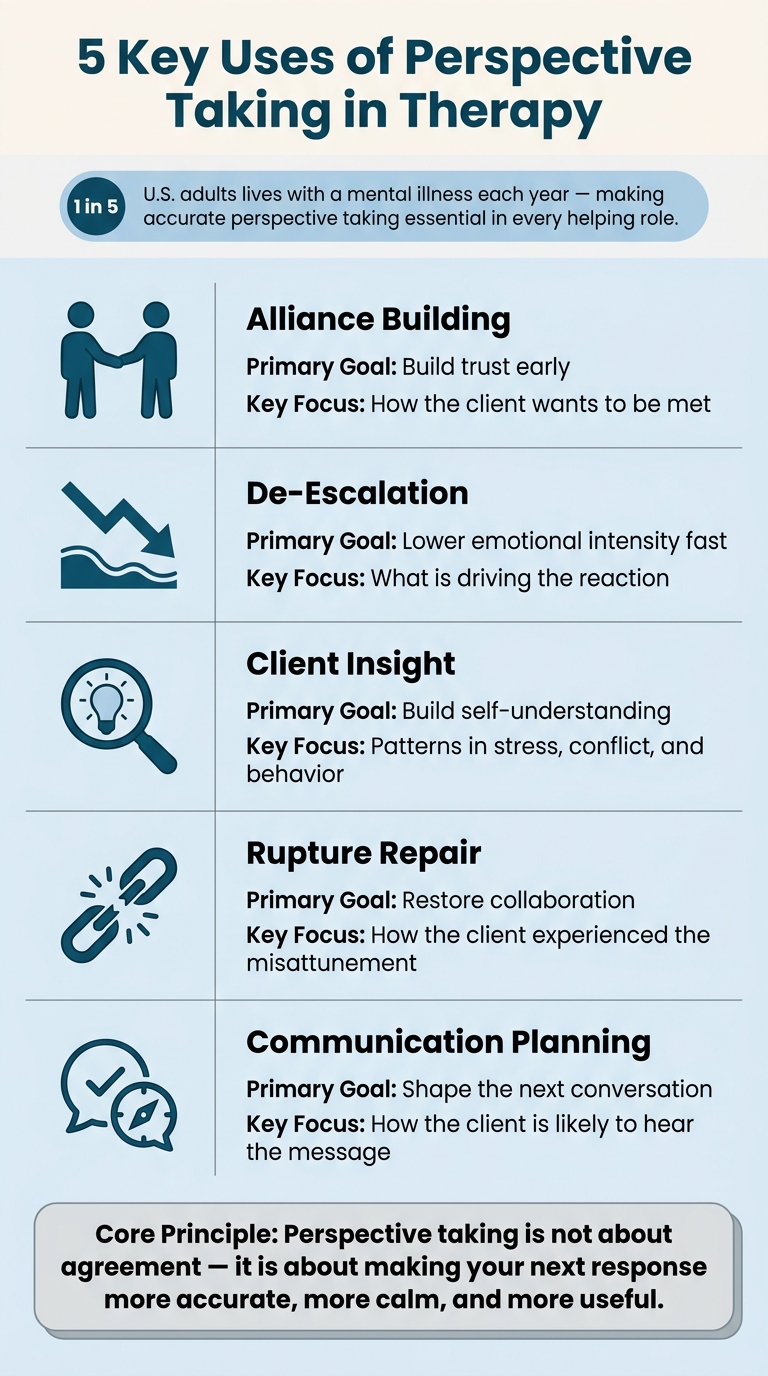
5 Key Uses of Perspective Taking in Therapy
Therapy Exercise for Perspective Taking to Enhance Communication & Connection w/ Dr. Kate Truitt
Quick comparison
| Use | Main goal | What I focus on |
|---|---|---|
| Alliance building | Build trust | How the client wants to be met |
| De-escalation | Lower intensity | What is driving the reaction |
| Client insight | Build self-understanding | Patterns in stress, conflict, and behavior |
| Rupture repair | Restore collaboration | How the client experienced the misattunement |
| Communication planning | Shape the next conversation | How the client is likely to hear the message |
Bottom line: perspective taking is not about agreement. It is about making your next response more accurate, more calm, and more useful.
Why Perspective Taking Matters in Helping Work
Perspective taking is a practical tool in helping work. When practitioners understand how clients see their situation, collaboration tends to improve, defensiveness often drops, and goals become clearer. That matters a lot in U.S. helping systems, where many clients show up cautious, stressed, or unsure whether they can trust the process.
You can see this across community mental health, schools, hospitals, and justice settings. In each of these spaces, trust may be thin, time is short, and one bad read can throw care off track. At the system level, the same skill shapes how practitioners build alliance, lower the chance of escalation, and decide which intervention fits the moment.
Cognitive perspective taking helps practitioners decide how to frame a goal, when to push, and when to step back. In day-to-day work, that lens shows up in five core uses.
1. Alliance Building
Primary clinical goal
The aim is to help the client feel understood early, so trust has a chance to form. When trust forms sooner, engagement often starts sooner too, with less pushback at the start.
How perspective taking is applied
In practice, this goes past polite rapport. It means using personality data to personalize counseling and the client’s life context to shape your tone, pace, and goals.
A practitioner who understands a client’s traits can frame goals in concrete, specific language instead of vague, generic language. That small shift can change a lot. It can be the difference between a client who leans in and a client who checks out.
Common risk if omitted
Without this lens, practitioners often fall back on generic advice that feels off to the client and slows engagement. And when personality is reduced to broad, simplified types, the problem gets worse. Nuance gets lost, and the result is weaker insight.
This shows up across counseling, coaching, social work, case management, and crisis support.
When trust is thin and emotion is high, the same perspective-taking skill stops being mainly about alliance building and starts doing another job: de-escalation.
2. De-Escalation in Crisis and Conflict
Primary clinical goal
Here, the goal changes from building trust to lowering emotional intensity fast. When a client is in crisis or a conflict starts heating up, the practitioner's job is to move the interaction away from friction and toward something more workable.
That takes more than noticing that someone is upset. You need to understand why this person is reacting this way. When the intensity comes down, that same skill can also help the client make sense of what set things off in the first place.
How perspective taking is applied
In a crisis, context shapes the response. Sometimes the right move is to slow the pace. Sometimes it's to set limits. Other times, it's better to shift into collaboration.
Personality-informed perspective taking helps with that. Trait-level data helps helpers get past broad labels and respond with more precision. Personos adjusts guidance to fit both the person and the situation, which makes de-escalation more exact.
For example, noticing openness vs. other traits may point to a collaborative next step instead of a rigid directive.
Common risk if omitted
Without a personality-informed lens, practitioners may fall back on broad labels that don't give enough detail in high-stakes moments. Then the response misses the person's actual drivers, and the conflict can get worse instead of calmer.
Once the interaction settles, that same perspective can also support reflection rather than reactivity.
This matters in crisis response, counseling, case management, and team leadership, where the wrong read can escalate tension.
3. Building Client Insight and Self-Understanding
Primary clinical goal
Once the conversation settles, perspective taking can help clients make sense of their own patterns. The aim is simple: help them see why they react the way they do, what shapes those reactions, and how those patterns keep showing up. That way, they can make actual changes instead of falling into the same cycle again and again.
How perspective taking is applied
Personality data can make that kind of reflection more concrete. It helps clients spot patterns in stress, communication, and relationships in a way that feels easier to name and discuss. Tools like Personos can turn that data into a clear, practical picture. When used well, this kind of insight helps clients connect self-knowledge to day-to-day behavior change.
Common risk if omitted
Without this lens, clients can stay stuck in "people problems" without seeing what's driving them underneath. Communication gaps and relationship friction can slow progress, and clients may understand the issue on some level without changing it. The same lens can be used across roles like social work, but the aim stays the same: clearer self-understanding.
4. Repair After Alliance Rupture
When the alliance breaks, perspective taking stops being just about understanding. It becomes a repair tool.
Primary clinical goal
When a rupture happens, the main goal is to restore collaboration and keep the client from pulling away. Perspective taking helps the practitioner see how the client lived through the rupture, so the repair effort can help rebuild the alliance.
How perspective taking is applied
Repair starts with context. Before responding, review the client's history and conflict pattern. Then look again at the client's Five Factor profile so your acknowledgment, pace, and language fit what happened.
This matters because personality data can shape the repair to the client's style. Use the client's personality profile to match how you acknowledge the rupture, how fast you move, and the kind of language you use. Name the mismatch, validate the client's experience, and adjust your approach. A tailored acknowledgment can lower defensiveness and help reopen dialogue.
Once repair is in motion, that same profile can guide the next conversation too.
Common risk if omitted
Without perspective taking, repair efforts can turn generic. They don't adjust to the client's context, and that's where things start to stall. The result is weaker repair, slowed progress, and a higher risk of dropout.
5. Personality-Informed Communication Planning
Primary clinical goal
The goal is to shape communication around how a client is most likely to hear it and use it. Personality traits affect how people respond to feedback and different communication styles, so the point is to let those traits guide the message.
After alliance, de-escalation, insight, and repair, perspective taking becomes the planning step that guides what comes next.
How perspective taking is applied
This planning starts with a simple idea: think about how the client is likely to hear the message before you deliver it. At this stage, perspective taking means asking: "Given what I know about this person's traits and context, how will they likely hear what I'm about to say?"
That one question can change a lot. It can shape word choice, pacing, tone, and the order in which concerns come up. In many cases, it also helps to think about the personality of the other person in the interaction, so the plan fits the exact situation on both sides [1].
Use the Five Factor Model as the base. Then adjust based on the client's history, goals, and relationship dynamics.
Common risk if omitted
Without this kind of planning, practitioners can slip into a one-size-fits-all approach. With resistant or high-conflict clients, that often creates friction instead of movement.
There’s another problem too. Practitioners may draw the wrong conclusions if they apply personality scores without the skill to interpret them well [1]. Tools like Personos can turn those traits into practical guidance [1].
Relevant helping settings
This approach fits therapy, coaching, case management, and crisis work. The same message may need different pacing, tone, and timing depending on the person and the moment.
That’s why personality data helps with more than interpretation. It can shape the next conversation in a way that lands better.
Using Personality Data to Sharpen Perspective Taking
Knowing a client’s personality traits helps. But the hard part is the space between knowing those traits and deciding what to say next. That’s where personality data starts to matter. It becomes useful when it shapes the next sentence, not when it just sits in an assessment summary.
Personos is built for that job. It uses the Five Factor Model and measures 30 traits on an 80-point scale [1], which goes past broad type labels. From there, the next move is turning the profile into a real conversation plan. Before a session where you need to set a limit or give critical feedback, you can describe the situation in Personos Chat and get guidance shaped by the client’s history, relationship dynamics, and your goals. ActionBoard then turns that plan into trackable tasks, so the communication plan stays in view after the session.
The tables below show how the same approach shifts across roles and settings.
Two Reference Tables for Practitioners
Use the tables below as a quick guide for de-escalation and rupture repair. They turn the earlier sections into something you can scan and use in the moment. When personality data is available, these moves can be more precise.
Table 1: De-escalation Strategies
| De-escalation Strategy | How Perspective Taking Helps | Potential Risk If Absent |
|---|---|---|
| Validation | Helps you reflect the client's emotion with accuracy, based on their personality and context. | The client may feel gaslit, talked down to, or misunderstood, which deepens distrust instead of easing it. |
| Clarification | Helps you see what you still don't understand before jumping to conclusions. | Assumptions slip in, which can lead to clinical errors or make the client feel you're completely out of touch. |
| Pacing Adjustments | Helps you notice overload and slow the interaction when needed. | The client may shut down, pull back, or become more agitated under continued pressure. |
| Task Renegotiation | Brings barriers into view, like fear of failure, that can make a task feel impossible. | The practitioner may read the client as resistant or uncooperative, which can spark conflict and wear down the alliance. |
| Meta-communication | Helps you talk about the interaction itself in a shared, nonblaming way. | The client may hear the comment as blame, become guarded, and the rupture can grow instead of shrink. |
Table 2: Rupture Resolution Steps
| Rupture Resolution Step | Perspective-Taking Focus | Example |
|---|---|---|
| Noticing Cues | Detecting small shifts in nonverbal behavior that differ from the client's usual pattern. | Noticing that a usually talkative client suddenly becomes terse and avoidant. |
| Naming the Rupture | Framing the tension as a shared moment you want to understand from the client's point of view. | The practitioner notes a shift in the room and asks whether something important happened. |
| Exploring Meaning | Putting the client's interpretation of what happened ahead of the practitioner's intent. | The practitioner asks what the homework comment brought up and how it landed. |
| Taking Responsibility | Acknowledging how the practitioner's own style or misstep added to the disconnect. | The practitioner recognizes that pushing for a solution too early may have felt dismissive. |
| Rebuilding Collaboration | Using the client's perspective to shape a revised path forward together. | The practitioner and client adjust progress tracking so it feels supportive. |
These same patterns also show up in role-specific work across helping settings.
How the 5 Uses Apply Across U.S. Helping Roles
These five uses can look different across helping roles in the U.S., but the core skill stays the same. That matters most in places where mistrust of institutions runs high.
Institutional mistrust changes everything. For many clients across the U.S., especially people from communities shaped by redlining, the school-to-prison pipeline, or past harmful experiences with Child Protective Services or the legal system, a helping professional may be seen as part of the same system that did the damage. Perspective taking treats guardedness as a survival response, not resistance. Saying that plainly is often what makes alliance building possible in the first place.
That same pattern shows up differently depending on the setting. In housing services, perspective taking can help staff meet eviction-related aggression with calm limits and practical options. In peer support, it stays mutual instead of top-down. In coaching, it helps surface hidden barriers. In care coordination, it keeps attention on system failures instead of blame, recasting rupture repair as an acknowledgment of institutional failure rather than a defense of process.
Across roles, perspective taking reframes "noncompliance" as an unseen barrier and asks, "What barrier is this client responding to?"
Conclusion
Perspective taking sits at the heart of good clinical work. It helps practitioners build trust, lower tension, and respond to what clients actually need. These five uses, building alliance, de-escalating conflict, deepening insight, repairing ruptures, and planning personality-informed communication, all come back to the same skill: staying curious about the client’s experience.
Before a hard session, take a moment and ask what the client is likely seeing, feeling, and trying to protect. That brief pause can help you respond instead of react.
Sometimes, though, a pause alone isn’t precise enough. In those moments, personality psychology can enhance client communication and sharpen your next move. When you need more precision, structured personality data can sharpen perspective taking; Personos turns that data into real-time guidance for helping professionals. Better perspective taking leads to better care.
FAQs
How is perspective taking different from agreeing with a client?
Perspective taking means understanding a client’s inner experience, triggers, communication style, and situation, then adjusting your approach to fit what they need.
Agreeing, on the other hand, just means backing their point of view. That can miss how they feel and why they feel that way. It can also blur clarity and boundaries.
Personos helps with de-escalation and trust-building by giving guidance based on personality and situational context, without requiring you to simply agree.
When should a therapist use personality data in session planning?
Therapists can use personality data to shape session plans around the person in front of them. That turns insight into action.
This can be especially helpful before hard conversations, or when a client seems guarded, overwhelmed, or low on motivation. In those moments, personality data can help guide timing, tone, and approach so the therapist can build trust and cut down on avoidable conflict.
Tools like Personos can help by offering real-time, context-aware guidance.
What are the signs that a rupture in therapy needs repair?
Signs often show up as a hard session, a client shutting down, or motivation starting to slip. Those moments can signal a crack in the therapeutic alliance, and that can slow progress.
When that happens, tools like Personos can help in real time with personality-aware guidance. That can include prompts for validation, reframing, and de-escalation to help repair trust and rebuild connection.