Personalizing Onboarding with AI: A Guide
AI-driven onboarding uses personality, behavior, and role data to speed ramp-up, boost engagement, and reduce turnover.
Nick Blasi

Personalizing Onboarding with AI: A Guide
AI is transforming onboarding from generic processes into tailored experiences. By analyzing personality traits, communication styles, and user behavior, AI customizes tasks, training, and communication for new hires. This leads to faster integration, stronger engagement, and improved retention.
Key insights:
- Gallup reports: Only 12% of employees feel their organization excels at onboarding.
- AI benefits: Reduces repetitive tasks by 40%, boosts new hire productivity by 62%, and cuts turnover by up to 50%.
- Real-world examples: Zenchef reduced onboarding time from 30 to 14 days; Customer Alliance increased feature adoption by 970% using AI tools.
AI tools like Personos use personality models to tailor onboarding, helping managers communicate effectively. For remote teams, AI ensures timely support and task completion, reducing attrition rates.
This guide explores how AI-driven onboarding works, its tools, and actionable steps to integrate AI into your process.
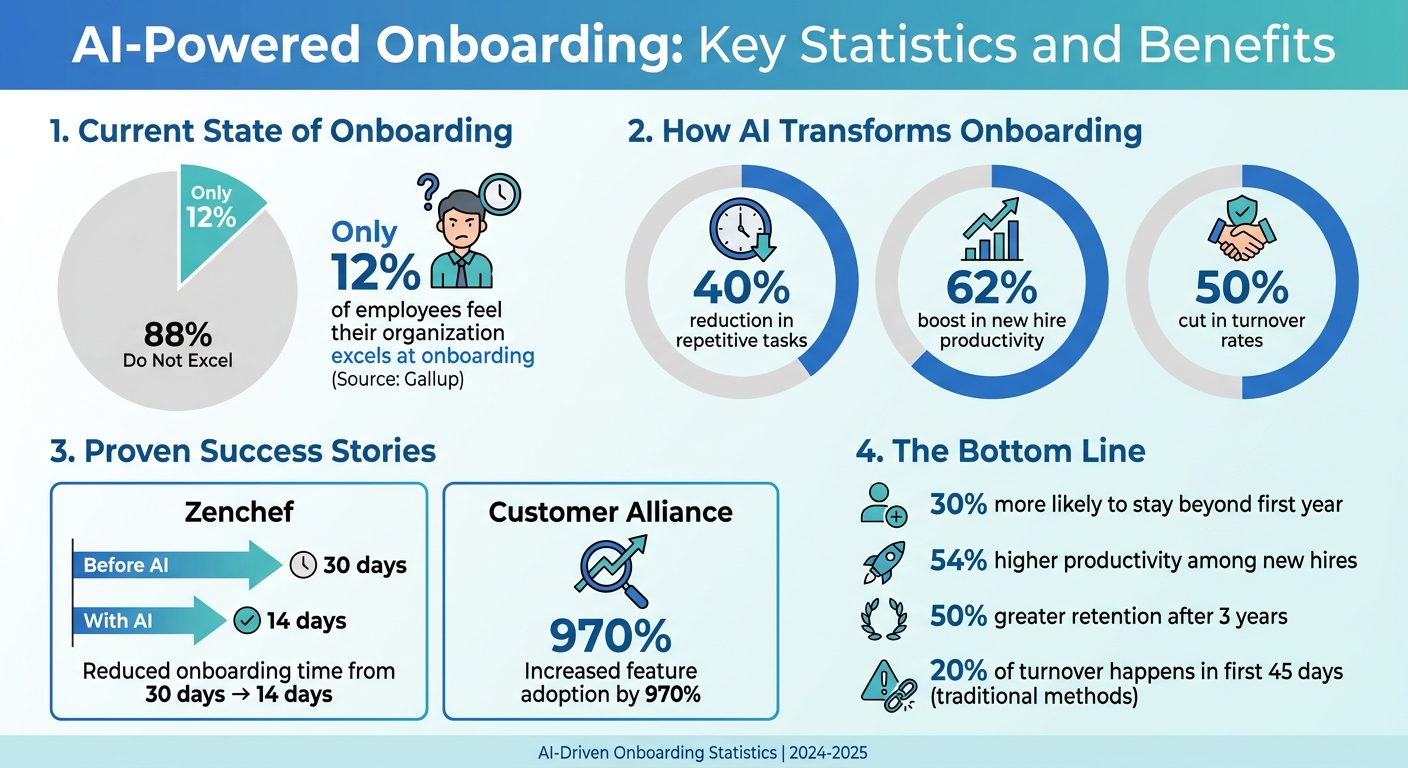
AI-Powered Onboarding: Key Statistics and Benefits
AI-Powered Personalized New Employee Onboarding Guides (🇺🇸 🇬🇧]
How AI Analyzes Personality for Onboarding
AI isn't just about automating processes - it’s about understanding how people think, communicate, and absorb information. Instead of applying a one-size-fits-all approach, AI platforms analyze personality traits to craft tailored onboarding experiences. This shift from focusing solely on behaviors to leveraging psychographic insights makes communication feel more natural and less mechanical [3].
Here’s how it works: AI gathers data from various sources like HRIS fields (e.g., job role, department, location), resumes, LinkedIn profiles, pre-hire assessments, and even early interactions with chatbots [1][7][9]. Through natural language processing, it evaluates the types of questions new hires ask [9]. At the same time, behavioral tracking monitors navigation habits, such as pauses or repeated searches, to identify potential friction points [5]. The collected data is then cross-referenced with psychometric models to determine communication preferences - whether someone is data-driven, visionary, or prefers a step-by-step approach [3][4]. This layered analysis helps AI tools measure personality traits with precision.
How AI Tools Measure Personality Traits
AI onboarding platforms integrate firmographic and psychographic data to identify communication styles. Take Customer.io, for example. In late 2024, they conducted an experiment with 440 marketing-qualified leads per month, using a two-agent AI system to segment users into six communication categories: Data-Driven Concise, Visionary Inspirational, Formal Traditional, Collaborative Relational, Friendly Informal, and Technical Detailed. By tailoring onboarding emails to these categories, they achieved a 9% boost in "a-ha moment" completion rates within just 14 days [3].
Another standout example is Personos, which uses the Five Factor Model - a scientifically validated framework - to measure 30 personality traits on an 80-point scale. This detailed approach provides real-time, context-specific recommendations. For instance, a social worker onboarding a challenging client would receive a different strategy than a coach working with a high-performing executive. The platform’s Transparent Reasoning feature also explains which traits influenced each recommendation, giving users clarity on why specific suggestions are made.
Why Personality-Based Onboarding Works
By tailoring onboarding to individual personalities, AI reduces cognitive overload by delivering information in a way that aligns with each person's learning style and priorities [7][1]. It also allows HR teams to scale personalized experiences across large organizations without adding extra work [7][1]. Research shows that employees who experience AI-driven onboarding are 30% more likely to stay beyond their first year [4]. On top of that, such programs can enhance productivity by 62% and cut turnover rates by up to 50% [1].
"Personalization shifts onboarding from a transactional checklist to a strategic talent development tool." - Miriam Connaughton, Co-author, Simpplr [1]
Rather than treating onboarding as a generic process, AI-driven personalization ensures new hires feel understood from the start. When communication aligns with how someone naturally processes information, trust builds faster, adaptation becomes smoother, and engagement stays high during those crucial first 90 days. Up next, we’ll explore how to use these insights to design personalized onboarding plans with AI tools.
Building Personalized Onboarding Plans with AI
AI has revolutionized how onboarding strategies are crafted, turning raw data into actionable communication plans. Instead of relying on rigid, time-based email sequences, AI tools now enable workflows that adapt to user behavior. For instance, these platforms can segment users dynamically and trigger specific actions based on what the user does - or doesn’t do - during the onboarding process [3]. This allows for more tailored experiences, such as role-specific content or branching paths that address unique needs.
Modern AI platforms take this further by grouping new hires into micro-segments and fine-tuning onboarding materials accordingly. For example, someone who logs in multiple times but fails to complete a key task might receive a targeted message with additional guidance. Similarly, an administrator might see entirely different steps compared to an end-user. AI even personalizes communication styles, offering ROI-focused content to analytical thinkers while delivering visionary, big-picture messaging to creative personalities [2][11][12].
AI Tools for Personalized Communication
AI tools are not just about automation - they’re about creating meaningful, role-specific interactions. Take Personos as an example. This platform offers a suite of features designed to make onboarding deeply personal and actionable:
- Personos Chat: Provides real-time, situation-specific guidance tailored to both the new hire’s personality and the manager’s communication style. For example, a social worker onboarding a hesitant client might receive different strategies than a coach working with a highly motivated executive.
- Dynamic Reports: Delivers insights at three levels - personal, relationship, and group - helping managers better understand individuals and how to work with them effectively.
- Prompts: Sends short, actionable nudges on a set schedule (daily, weekly, or monthly) to keep personality insights front and center, even between formal interactions.
What makes Personos stand out is its Transparent Reasoning feature. This tool explains which personality traits influenced each recommendation and the psychological principles and personality-driven growth behind them. Over time, this builds a manager’s expertise without creating over-reliance on the AI. Additionally, Personos prioritizes privacy - personality scores are only shared when explicitly permitted, avoiding the stigma often associated with traditional assessments.
AI Onboarding Tools Compared
Different AI platforms take unique approaches to onboarding. Here’s a quick comparison of three leading tools:
| Tool | Strengths | Weaknesses |
|---|---|---|
| Personos | Real-time, personality-driven guidance using the Five Factor Model; privacy-focused design; coaching-specific tools; contextual intelligence that integrates case notes and interaction history | Primarily geared toward professionals like social workers and coaches, rather than general corporate onboarding |
| Humantelligence | Focuses on team emotional intelligence and group dynamics; integrates seamlessly with HR systems | Lacks depth in individual onboarding; more team-oriented than one-on-one |
| Openmind | Offers insights into relationship dynamics with a user-friendly interface | Designed more for personal development; limited role-specific features for workplace settings |
"The marketer's job shifts from writing one perfect email to orchestrating a system that writes multiple good emails, each tuned to the reader's perspective." - Customer.io [3]
When choosing the right tool, it’s important to consider whether the platform is AI-native or AI-bolted-on. AI-native tools are built from the ground up to use AI as their core, enabling adaptive conversations and capturing the intent behind user behaviors. In contrast, AI-bolted-on tools simply add smart features, like chatbots, to existing systems. For truly personalized onboarding that adapts to individual personalities and behaviors, AI-native platforms tend to deliver superior results [10].
Adding AI to Your Onboarding Process
Now that we understand how AI can personalize onboarding, the next step is figuring out how to integrate it into your workflow. The good news? It doesn’t require major overhauls. Start with high-volume workflows where you'll see the biggest time savings and fastest return on investment. According to research, about 40% of onboarding time is spent on repetitive tasks that AI can automate, allowing your team to focus on building real connections with new hires [6].
A smart way to roll out AI is through a pilot-and-iterate approach. Begin with one specific group - like sales hires or remote employees - and test the value of AI before expanding it across your organization [6][13]. This method works: companies purchasing AI solutions see a success rate of 67%, compared to just 20% for internally built systems [13].
Let’s break it down into actionable steps to turn AI insights into onboarding improvements.
Steps to Use AI Insights in Onboarding
First, identify the manual tasks and bottlenecks that slow down onboarding [6][13]. For example, smart digital forms can reduce data entry errors by up to 90% [6].
Once you’ve pinpointed the problem areas, set clear milestones for new hires at 7, 30, 60, and 90 days. These goals should be specific and measurable, like mastering a tool, completing a client meeting, or finishing a project [7]. This ensures AI isn’t just automating tasks but driving meaningful results.
Next, integrate data to create a dynamic intent model. This means combining internal policies with AI’s analysis of role-specific behaviors, like repeated visits to certain pages or stalled actions [6][2]. Instead of triggering generic reminders (e.g., "Day 7"), AI can send prompts based on user activity, improving activation rates by 15 to 35 percentage points [2].
You can also collect personality profiles during preboarding. Tools like Personos’ Five Factor Model assessment offer insights that managers can turn into actionable tasks through platforms like ActionBoard. This allows managers to track progress in real time and make quick adjustments. For instance, Zenchef, a restaurant management platform, cut its onboarding time from 30 days to just 14 by using adaptive guidance to improve feature adoption and satisfaction scores [2]. Similarly, AB Tasty shortened its feature launch cycle from three months to two weeks by tailoring guidance to user readiness, reaching over 2,000 users in the first week without manual input [2].
"AI is not the strategy, the business is. Too many proofs of concept fail to scale because they didn't tie directly to outcomes that mattered."
- CIO Advisor [13]
Of course, humans still play a critical role. While AI can handle logistics and routine tasks, important decisions and regulated processes should always involve human oversight [13][15]. Use AI to prepare and organize, but leave final calls to people.
AI for Remote and Hybrid Onboarding
Remote and hybrid onboarding comes with its own set of challenges, but AI is well-equipped to address them. For instance, 38% of remote workers say they don’t know where to seek help during their first weeks [14]. AI can monitor communication patterns and engagement levels to flag potential issues early. By tracking incomplete tasks, login activity, and interactions, AI can alert managers when a remote hire might be struggling, enabling timely intervention [6][14]. A healthcare startup used this approach in 2025, reducing its 90-day attrition rate by 27% through early action based on AI-driven sentiment analysis [14].
Automated provisioning is another area where AI shines. It ensures remote employees have access to the right tools and resources from day one. For example, a mid-sized tech company implemented automated preboarding in 2025, sending personalized welcome videos and first tasks within 15 minutes of offer acceptance. This resulted in 95% of new hires completing compliance tasks before their official start date [14].
Adaptive pacing is also key for remote teams. AI can adjust the depth of guidance based on how quickly or slowly a user navigates tasks, preventing information overload while ensuring support is available when needed [2][7]. Platforms like Personos support this with features like automated check-ins at 30, 60, and 90 days. These check-ins ask targeted questions like, "How was your first team meeting?" to maintain engagement across time zones [14]. Additionally, conversational AI provides real-time guidance tailored to both the hire’s personality and the manager’s communication style - critical when face-to-face coaching isn’t an option.
"AI doesn't replace human connection - it amplifies it. By automating repetitive tasks... AI frees up managers and HR teams to focus on what matters most: building relationships."
- AgentiveAIQ [14]
The best remote onboarding strategies use AI to deliver just-in-time learning. Micro-modules are offered exactly when a user encounters a challenge or tries something new [14][2]. This approach can reduce support tickets by up to 80%, easing the load on remote support teams [2].
Measuring Results and Best Practices
Once you've implemented AI-driven onboarding, it's crucial to measure its impact and adjust strategies based on the results.
Metrics for Evaluating AI Onboarding
Start by analyzing retention rates, particularly at the 90-day and one-year marks. Research from Microsoft highlights that employees satisfied at 90 days are twice as likely to stay with the company for 18 months[1]. Another key metric is time-to-productivity, which measures how quickly new hires contribute meaningful work. For AI-native tools, "60-seconds-to-value" is a common benchmark, but for onboarding, this could mean tracking how quickly employees deliver their first project or demonstrate essential skills[7].
Also, monitor onboarding completion rates to ensure tasks and modules are being completed. Use employee satisfaction scores - like CSAT or eNPS - and incorporate real-time sentiment analysis to catch signs of confusion or disengagement early, preventing potential turnover[1][16]. Additionally, evaluate reductions in manual workload through automation metrics, allowing HR teams to spend more time building relationships[6].
For platforms like Personos, tools such as the ActionBoard provide a Kanban-style view of AI insights turned into actionable tasks. This feature is particularly useful for nonprofits and social service organizations, helping them demonstrate to funders how AI alleviates staff burnout while improving client outcomes.
These metrics serve as a foundation for fine-tuning your onboarding approach and adopting best practices.
Best Practices for AI-Powered Onboarding
Once you’ve gathered measurable results, focus on these best practices to improve your AI-driven onboarding process.
Set clear, outcome-focused goals. For example, aim to reduce onboarding time by 40% or cut manual follow-ups by 60%.
"AI is not the strategy, the business is. Too many proofs of concept fail to scale because they didn't tie directly to outcomes that mattered."
- CIO Advisor, Moxo Blog [13]
Keep human oversight central. While AI excels at handling repetitive tasks and analyzing data, key decisions still require human judgment[13][16]. Use AI to enhance personalization by uncovering unique insights about each employee, but don’t let it replace meaningful human interaction.
Prioritize data governance. Collect only the data necessary for decision-making and use pseudonymized IDs to safeguard employee privacy[2]. Make sure all AI-driven actions have clear audit trails to ensure compliance and transparency from the start[7][2].
Adopt an iterative approach. No-code AI tools make it easier to test new onboarding strategies quickly. Run small pilots for specific roles or departments, gather feedback, and refine your methods before scaling them across the organization[2]. Data shows that companies using external AI solutions succeed 67% of the time, compared to a 20% success rate for internal builds. Following the 80/20 rule - buy 80% from established vendors and build 20% for custom needs - can be an effective strategy[13].
Conclusion
AI-driven onboarding is reshaping the way companies welcome new employees, moving beyond rigid checklists to create tailored, dynamic experiences. These personalized approaches align with each hire's role, learning style, and personality. The results speak volumes: companies using personalized onboarding report 54% higher productivity among new hires and 50% greater retention after three years[8]. Considering that up to 20% of employee turnover occurs within the first 45 days[8], traditional, one-size-fits-all methods simply don't cut it anymore.
The key to success lies in blending technology with human interaction. AI takes care of the administrative tasks - like managing paperwork, tracking compliance, and answering common questions - giving managers more time to focus on fostering connections and building a strong workplace culture.
"You're not replacing the human side of onboarding; you're multiplying it. Managers spend less time chasing logistics and more time building relationships."
- Ameya Deshmukh, EverWorker [7]
For helping professionals - such as social workers, case managers, and nonprofit staff - personality-based onboarding is even more critical. These roles require deep empathy and understanding from day one, often in high-pressure environments. Platforms like Personos address this challenge by using personality-driven onboarding to reduce burnout and improve outcomes for both employees and the communities they serve.
The shift to adaptive onboarding isn't just a passing trend - it represents a fundamental change in how organizations integrate new talent. By 2028, Gartner predicts that over 20% of digital workplace applications will leverage AI-driven personalization to deliver adaptive worker experiences[7]. Companies that adopt these tools now position themselves for a clear edge in retention, engagement, and productivity. Platforms like Personos, which transform personality insights into actionable strategies, exemplify how AI can drive meaningful improvements.
FAQs
What data does AI need to personalize onboarding?
AI thrives on data to deliver personalized onboarding experiences. It leverages information like behavioral signals (think click patterns or moments of hesitation), role-specific details (such as job function or experience level), and contextual insights to craft tailored journeys.
For employees, data about their skills and preferences helps streamline training and ensure they have quick access to the tools they need. On the customer side, insights from previous interactions and engagement patterns enable AI to anticipate their needs, creating dynamic onboarding processes that drive both activation and retention.
How can we use AI without compromising employee privacy?
To ensure AI is used responsibly while safeguarding employee privacy, it's crucial to prioritize privacy-first practices. This means focusing on secure data storage, anonymizing information, and steering clear of collecting sensitive data unless absolutely necessary. Tools like Personos are designed with confidentiality in mind - they never share individual personality data and provide secure, real-time guidance.
Equally important is being transparent about how data is used. Obtaining clear user consent and strictly following privacy regulations are essential steps to strike the right balance between leveraging AI's capabilities and protecting privacy.
How can we prove AI onboarding is effective?
To show that AI onboarding is effective, focus on measurable outcomes like user satisfaction scores, completion rates, and time-to-proficiency. Keep an eye on behavioral trends too - look for things like higher resource usage, fewer support tickets, and positive feedback from users. Comparing metrics from before and after implementation, such as retention rates and engagement levels, can also reveal progress. Platforms like Personos provide real-time insights, which can help reduce burnout and boost satisfaction, making it easier to measure the benefits of personalized onboarding.