How Personality Types Shape Team Collaboration
How Big Five and MBTI traits shape communication, task fit, trust, and conflict resolution to improve team performance.
Christian Thomas

How Personality Types Shape Team Collaboration
Poor collaboration is the top reason workplace projects fail. In fact, 86% of employees and executives agree communication breakdowns cause most issues. But the real problem? Misunderstanding personality differences within teams.
Here’s what you need to know:
- Personality traits like conscientiousness, agreeableness, and extraversion directly influence communication, conflict resolution, and team success.
- Teams with high conscientiousness and agreeableness perform better, while too much variability in these traits can hurt outcomes.
- Tools like the Big Five and MBTI help identify how personalities impact teamwork.
- Tailoring tasks and communication styles to personality strengths improves productivity, resolves team conflicts, and builds trust.
Understanding personality differences isn’t just about avoiding conflict - it’s about building teams that work smarter together. Platforms like Personos even provide AI-driven insights to help teams thrive.
Keep reading to learn how personality-driven strategies can transform your team’s collaboration and performance.
The Power of Personality: MBTI in Leadership and Team Building
Personality Types and Team Dynamics: What Research Shows
How Personality Traits Impact Team Performance: Key Research Statistics
Key Personality Frameworks Explained
Two major frameworks dominate the conversation when it comes to understanding personality in teams: The Big Five (OCEAN: Openness, Conscientiousness, Extraversion, Agreeableness, Neuroticism) and the Myers-Briggs Type Indicator (MBTI). Both offer valuable insights into how team members collaborate, handle stress, and work toward shared goals.
The Big Five is widely regarded in academic research, providing a solid foundation for analyzing personality traits scientifically. On the other hand, the MBTI is a favorite in the corporate world, often used to explore communication styles and interpersonal dynamics. While each has its strengths, both frameworks emphasize that personality differences can be seen as opportunities to create stronger, more balanced teams.
These tools are essential for connecting personality traits to team performance and understanding how individual differences can enhance collaboration.
Research Connecting Personality Types to Team Performance
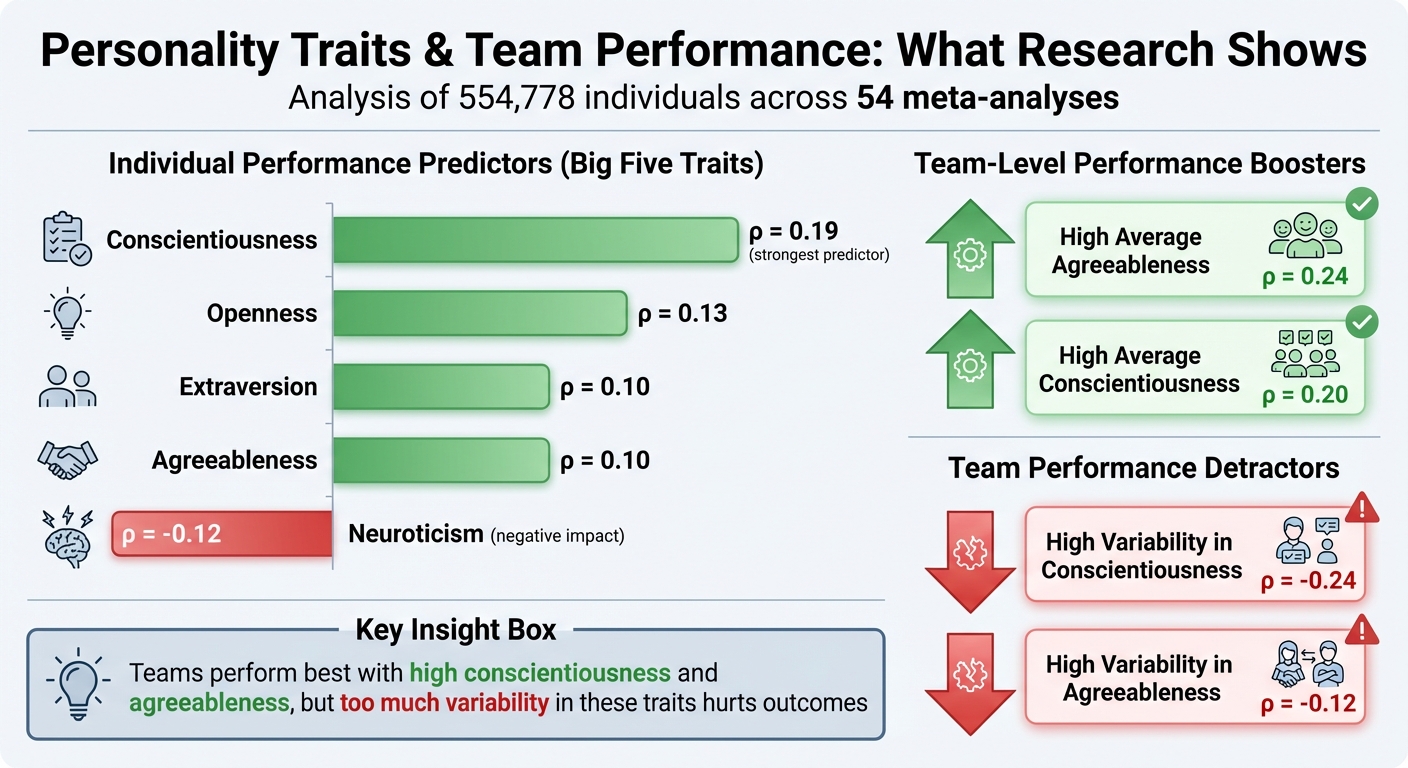
A comprehensive analysis of 54 meta-analyses, involving 554,778 individuals, revealed that Conscientiousness is the most reliable predictor of performance, showing a correlation of ρ = 0.19[7]. Teams with conscientious members - those who are dependable, organized, and goal-driven - consistently outperform others. Other Big Five traits also influence performance, though to a lesser degree: Openness (ρ = 0.13), Extraversion (ρ = 0.10), Agreeableness (ρ = 0.10), and Neuroticism (ρ = -0.12)[7].
When looking at teams as a whole, a high average level of Agreeableness (ρ = 0.24) and Conscientiousness (ρ = 0.20) tends to enhance team performance. However, too much variability in these traits within a team can have the opposite effect, with variability in Conscientiousness (ρ = -0.24) and Agreeableness (ρ = -0.12) negatively impacting outcomes[3].
"Whereas conscientiousness yielded the strongest effect (ρ = 0.19), the remaining Big Five traits yielded comparable effects."
– Ethan Zell, Department of Psychology, University of North Carolina at Greensboro [6]
Extraversion, while beneficial for fostering social cohesion and communication, requires balance. A mix of introverted and extroverted team members often works best, reducing leadership conflicts and ensuring fair participation[4][5]. On the other hand, Neuroticism consistently undermines team performance, as even one highly neurotic member can disrupt interdependent tasks[5].
A well-functioning Transactive Memory System (TMS) - essentially a shared understanding of "who knows what" in a team - can significantly improve coordination. Traits like Openness and Agreeableness, combined with strong communication, are particularly important for building effective TMS, especially in remote or virtual teams[1][2].
How Personality Types Affect Communication and Conflict Resolution
Communication Styles Based on Personality
Personality plays a big role in shaping how people communicate within teams and helps reduce misunderstandings. For example, direct communicators - often analytical or dominant personalities - prefer straightforward, fact-based conversations. They skip small talk and focus on results, which can come across as blunt but is undeniably efficient. On the other hand, functional communicators, who tend to be conscientious, thrive on detailed processes and often ask a lot of questions to ensure clarity.
Then there are collaborative communicators, who put people first. They aim for consensus and excel at seeing the bigger picture, though their desire to ensure everyone feels heard can sometimes slow down decision-making. Finally, influencers focus on building relationships and prefer informal discussions. They’re more interested in exploring "the why" behind decisions than diving into "the how." Studies even show that Extraversion is linked to higher communication levels in teams, while Agreeableness helps reduce conflict and boosts task cohesion [8].
"Understanding the communication styles of team members can help us account for differences in personality and the impact those differences have on team performance." – Gretchen Macht, Postdoctoral Scholar, Penn State University [8]
Adjusting your approach to fit these styles is key. When dealing with direct communicators, keep your points concise and to the point. For functional communicators, offer detailed explanations. With collaborative communicators, active listening is essential - make sure they feel heard before offering directives. And for influencers, create opportunities for teamwork and set short deadlines to maintain momentum. These communication tendencies also influence how individuals approach conflict resolution.
Conflict Resolution Strategies Using Personality Insights
Just as personality affects communication, it also shapes how people handle conflict. The Thomas-Kilmann Conflict Model categorizes conflict behaviors based on assertiveness and cooperativeness into four approaches: Competing, Collaborating, Avoiding, and Accommodating. Personality traits, like those in the Big Five model, help predict these tendencies. For instance, Extraversion often correlates with assertiveness in conflicts, while Agreeableness aligns with a cooperative mindset [9].
Tailoring conflict resolution methods to personality types can significantly boost team performance. Conscientious individuals are natural stabilizers, using problem-solving strategies like task planning and goal tracking to prevent emotional disputes from escalating. Their tendency to stay focused on goals helps buffer the negative effects of relationship-based conflicts on teamwork quality [10]. Interestingly, a study of 377 virtual teams found that pairs with lower levels of agreeableness showed the greatest improvement in performance during collaboration [1].
To resolve conflicts effectively, assign conscientious team members to roles that involve tracking progress and ensuring accountability. For individuals high in neuroticism, non-judgmental strategies that encourage perspective-taking can help defuse tension. Meanwhile, extraverts often channel their energy outward to address and change situations, whereas introverts are more likely to adjust their own behavior to meet team demands [9]. Research using multilevel modeling even revealed that 17.9% of the variance in how team members perceive teamwork quality comes from group-level dynamics, emphasizing the collective impact of personality on team success [10].
sbb-itb-f8fc6bf
Applying Personality Insights to Improve Team Collaboration
Assigning Tasks Based on Personality Strengths
When tasks align with individual personality strengths, productivity and engagement naturally improve [12]. The secret lies in understanding what motivates each team member and assigning responsibilities that play to their unique abilities.
Tools like Insights Discovery can help categorize personalities into behavioral types, making it easier to delegate tasks effectively. For instance, individuals with a Fiery Red energy thrive in roles requiring quick decisions and strategic planning, making them ideal for leadership positions. Meanwhile, Sunshine Yellow personalities excel in brainstorming and inspiring others, making them perfect for innovation projects or client-facing roles. On the other hand, Earth Green types, known for their relationship-building skills, shine in team support and conflict resolution, while Cool Blue personalities are most effective in detail-oriented roles like data analysis and meticulous planning [12].
The benefits of this approach are tangible. Teams that utilize personality-based role assignments report a 40% improvement in communication effectiveness. Companies that incorporate regular personality assessments see a 15% boost in employee engagement and a 25% decrease in turnover rates [13]. For example, adding a decisive, results-driven individual to a team of relationship-focused members can provide the structure and direction needed to meet critical deadlines.
"When team members are placed in roles that suit their personalities, they're more likely to excel and feel fulfilled." – TeamDynamics [12]
Avoid mismatching tasks with personality traits. For example, don’t expect detail-oriented Cool Blue types to make snap decisions without adequate data, or ask Sunshine Yellow personalities to handle repetitive, detail-heavy tasks. Analytical introverts often prefer written briefs, while extroverts thrive in verbal and collaborative problem-solving settings. By thoughtfully aligning tasks with natural tendencies, teams not only enhance individual performance but also achieve stronger collaboration overall.
Building Trust and Understanding in Teams
Trust within a team doesn’t just happen - it’s built through deliberate actions that respect personality differences. Employees at high-trust companies report 50% higher productivity and 76% greater engagement [12], highlighting the value of fostering understanding among diverse personalities.
One effective strategy is developing a Transactive Memory System (TMS) - a shared understanding of "who knows what" within the team. This involves recognizing each member’s expertise, understanding their specializations, and coordinating how knowledge is shared [1]. For virtual or hybrid teams, digital tools and shared knowledge repositories can bridge gaps in face-to-face interactions, making individual skills and expertise more visible.
"A transactive memory system (TMS) is developed through team members' perceptions of others' credibility (who is a trustworthy source of expertise), each member's knowledge specialization (who is an expert in what knowledge domains), and knowledge coordination within the team." – Nature [1]
Tailoring communication to personality types also strengthens trust. For instance, altruistic team members often thrive in "Team Builder" roles, where they help establish norms and provide emotional support during tense situations [11]. For Sentinel types like ISTJs and ISFJs, clear instructions, structured hierarchies, and well-defined goals are essential for building trust [14]. Interestingly, while 73% of Consuls (ESFJ) and 68% of Campaigners (ENFP) report performing their best work in collaborative environments, only 12% of Logisticians (ISTJ) feel the same [14]. Designing workflows that respect these preferences ensures everyone can contribute effectively.
Pairing experienced team members with those who are less seasoned encourages reciprocal learning. This dynamic not only improves problem-solving but also fosters mutual respect [1]. With the help of modern tools, these personality insights can be seamlessly integrated into daily team practices.
Using Personos for Better Team Collaboration
Modern platforms like Personos turn personality insights into actionable strategies. Personos (https://personos.ai) offers dynamic personality reports and AI-driven coaching, providing real-time advice tailored to individual team members, relationships, and group dynamics.
The platform’s relationship and group analysis tools help managers understand how different personalities interact. When conflicts arise, Personos suggests tailored communication approaches. For example, it may recommend detailed written explanations for analytical team members, while addressing emotional concerns for those who are more intuitive. These prompts ensure that communication remains effective and considerate of individual needs.
Personos also supports adaptive management by helping leaders adjust their style to suit each team member. For instance, some employees may need closer supervision, while others thrive with more autonomy [15]. Its task tracking feature ensures that assignments align with personality strengths, keeping everyone on track. This is especially helpful for types like "Logicians" (INTP) or "Entertainers" (ESFP), who might benefit from deadline reminders. At $9 per seat per month for Personos Pro, teams gain access to privacy-focused insights that enhance collaboration and create an environment where both personal and professional growth can thrive.
Conclusion
Grasping personality differences is a game-changer when it comes to building successful teams. Research shows that poor communication and collaboration gaps often lead to workplace failures, highlighting the importance of understanding individual traits and how they shape team dynamics [2].
The key to team success lies in blending individual strengths effectively. Matching roles to personality traits and building trust can unlock a team's full potential. For example, conscientious team members excel at keeping things organized, while those with high openness bring fresh ideas and innovation to the table. Communication also improves when you recognize that some team members thrive in verbal discussions, while others prefer structured, written exchanges. When teams respect these natural working styles and understand "who excels at what", trust grows, and engagement soars.
The future of collaboration leans heavily on personalized leadership and data-driven approaches to team building. Moving away from one-size-fits-all management, organizations that embrace personality insights can create environments where every team member feels valued and contributes meaningfully. Tools like Personos (https://personos.ai) make it easier to turn these insights into practical strategies for success. By focusing on individual strengths and fostering a culture of trust, teams can achieve remarkable results together.
FAQs
How do traits like conscientiousness and agreeableness influence teamwork?
Conscientiousness plays a crucial role in teamwork by driving reliability, precision, and a strong sense of responsibility. Team members who exhibit this trait are more likely to stick to deadlines, uphold quality standards, and contribute effectively, particularly in environments where accountability is non-negotiable.
On the other hand, agreeableness enhances the social fabric of teams by promoting collaboration, minimizing conflicts, and fostering open dialogue. Individuals with high levels of agreeableness help nurture trust and unity, both of which are vital for seamless teamwork and resolving disagreements in a constructive manner.
Recognizing these traits can empower managers to build well-rounded, high-performing teams. Tools like Personos leverage AI-driven insights to tap into these strengths, enhancing communication, trust, and overall team dynamics.
How do the Big Five and MBTI personality frameworks differ?
The Big Five and MBTI take different approaches to understanding personality. The Big Five outlines personality as a spectrum across five traits: Openness, Conscientiousness, Extraversion, Agreeableness, and Neuroticism. Each person exhibits these traits to varying degrees. On the other hand, MBTI divides people into 16 distinct personality types, determined by four binary preferences, like Introversion versus Extraversion.
Since the Big Five uses a continuous scale to measure traits, it provides more flexibility and is often seen as more scientifically reliable with better accuracy in predicting behavior. MBTI, despite its popularity, relies on fixed categories, which can sometimes oversimplify the complexity of individual personalities. Both models serve different purposes, and tools like Personos integrate elements from these frameworks to improve teamwork and communication.
How does Personos use personality insights to improve team collaboration?
Personos uses personality data and AI to improve team collaboration by delivering insights that adapt to both individual and group dynamics. Building on established frameworks like the Big Five, DISC, and MBTI, it creates detailed personality profiles that evolve based on real-world interactions, such as how team members communicate and approach tasks.
With these profiles, Personos offers practical, real-time suggestions. For example, it might recommend rephrasing a message to avoid misunderstandings, suggest roles that match individual strengths, or provide group analysis reports to fine-tune team chemistry. Teams that adopt Personos often see tangible benefits, including higher productivity, fewer conflicts, and notable cost savings per employee each year. By turning personality traits into actionable strategies, Personos helps teams communicate better, collaborate more effectively, and achieve stronger outcomes.