Personality Types and Conflict: What Practitioners Should Know
How Big Five traits shape conflict responses and practical, personality-tailored de-escalation strategies for practitioners.
Rachel Johnson

Personality Types and Conflict: What Practitioners Should Know
Understanding personality traits is key to managing conflict effectively. People respond to disagreements based on their personality, with traits like Neuroticism, Agreeableness, and Conscientiousness playing a major role. For instance:
- Neuroticism: Leads to emotional reactions, avoidance, or escalation.
- Agreeableness: Drives conflict avoidance or accommodation to maintain relationships.
- Conscientiousness: Encourages structured problem-solving but can lead to rigidity.
Tailored communication and strategies can help de-escalate conflicts and prevent issues from escalating. Tools like AI-based platforms (e.g., Personos) offer real-time insights into personality-driven conflict patterns, helping practitioners respond more effectively and track progress over time.
Masterclass: Strategies for Handling Personality Differences at Work
Key Personality Traits That Drive Conflict
Personality plays a big role in how people perceive, react to, and escalate conflicts. Among the Big Five personality traits, Neuroticism, Agreeableness, and Conscientiousness are particularly influential.
How Neuroticism Affects Emotional Reactions in Conflict
Individuals with high levels of Neuroticism often experience emotional instability and are more prone to negative feelings. In conflicts, this can make them more likely to either escalate situations quickly or withdraw entirely. Research shows that Neuroticism is linked to a preference for avoiding conflict and a lower likelihood of adopting collaborative, win-win approaches [3]. These individuals also tend to judge themselves more harshly than others do. On the other hand, Agreeableness, another key trait, shapes conflict behavior in a very different way.
How Agreeableness Relates to Conflict Avoidance
Agreeableness is deeply tied to concerns about relationships, making it one of the strongest predictors of conflict style [1]. People high in Agreeableness often find conflict uncomfortable because they fear harming relationships. As a result, they are more likely to avoid or accommodate during disagreements, even when standing their ground might be in their best interest. Studies show a moderate correlation (0.14 to 0.21) between high Agreeableness and conflict avoidance [1]. In contrast, those low in Agreeableness are less concerned about relational fallout and are more likely to adopt competitive or dominating styles. For practitioners, the challenge lies in helping high-Agreeableness individuals advocate for themselves while guiding low-Agreeableness individuals to better understand the relational consequences of their actions.
How Conscientiousness Shapes Rule-Based Disagreements
Conscientious individuals bring structure and discipline to conflict resolution. They tend to favor problem-solving and negotiation over avoidance or aggression [3][4]. In one study of 259 young adults, observers noted that highly conscientious individuals used more problem-solving strategies and fewer negative behaviors than they themselves reported [4]. However, their preference for structure can sometimes lead to rigidity, particularly in disagreements over rules or processes. As researcher John Barbuto explained:
"Conscientiousness was the best predictor of effectiveness among all variables studied in this research, accounting for 10 percent of the variance." [3]
This effectiveness, though, depends on the context. While high Conscientiousness is beneficial in structured, rule-driven conflicts, it can slow things down in more ambiguous or flexible situations.
| Trait | Preferred Conflict Styles | Avoided Conflict Styles |
|---|---|---|
| High Agreeableness | Integrating, Accommodating, Compromising, Avoiding | Dominating, Competing |
| Low Agreeableness | Competing, Dominating | Accommodating, Avoiding |
| Conscientiousness | Integrating, Competing, Compromising | Avoiding, Accommodating |
| High Emotional Stability | Integrating, Compromising, Collaborating | Aggressive Competition, Withdrawal |
Common Conflict Patterns by Personality Profile
Understanding how personality traits play out during conflicts can help move from theory to practical solutions. The same disagreement can unfold in completely different ways depending on the personalities involved.
Conflict Patterns in Highly Emotionally Reactive Individuals
People with high levels of Neuroticism often display emotional reactions that seem out of proportion to the situation. This behavior is typically fueled by attachment anxiety and insecurity, making them see conflict as a personal threat rather than a problem to solve [5]. It’s important to remember that these reactions are more of an automatic response than a conscious decision.
How People-Pleasers Behave in Conflict
Some individuals mask their discomfort with conflict by avoiding it altogether or by quickly agreeing to whatever minimizes tension. Highly agreeable people often exhibit these behaviors, prioritizing harmony over resolution. While this approach may ease immediate discomfort, unresolved issues can later surface as passive resistance [1].
"Those who are compliant or anxious seem to prefer minimizing negative emotions and preserving their relationships by either yielding to the other person or by evading conflicts altogether." [1]
Key signs include deflecting attention to others, agreeing too quickly without meaningful discussion, or repeatedly delaying tough conversations. While their actions may reduce short-term strain, deeper issues often linger, leading to disengagement over time.
How Dominant and Assertive Individuals Engage in Conflict
On the other end of the spectrum, some approach conflict with a level of assertiveness that can verge on aggression. Individuals with lower Agreeableness and higher Extraversion often push hard to achieve their desired outcomes, sometimes coming across as overly forceful.
"A competitor is always pushing the envelope and prone to taking risks. They often have the reputation of being aggressive, but their urgency comes from a place of wanting to solve problems completely and quickly." [2]
The distinction between healthy assertiveness and aggression is crucial. Assertiveness involves open communication - explaining reasoning, sharing ideas, and persuading others. Aggression, on the other hand, skips meaningful dialogue and focuses on demanding outcomes [6]. Tailored conflict strategies should address this fine line to ensure productive engagement.
Matching Conflict Strategies to Personality Traits
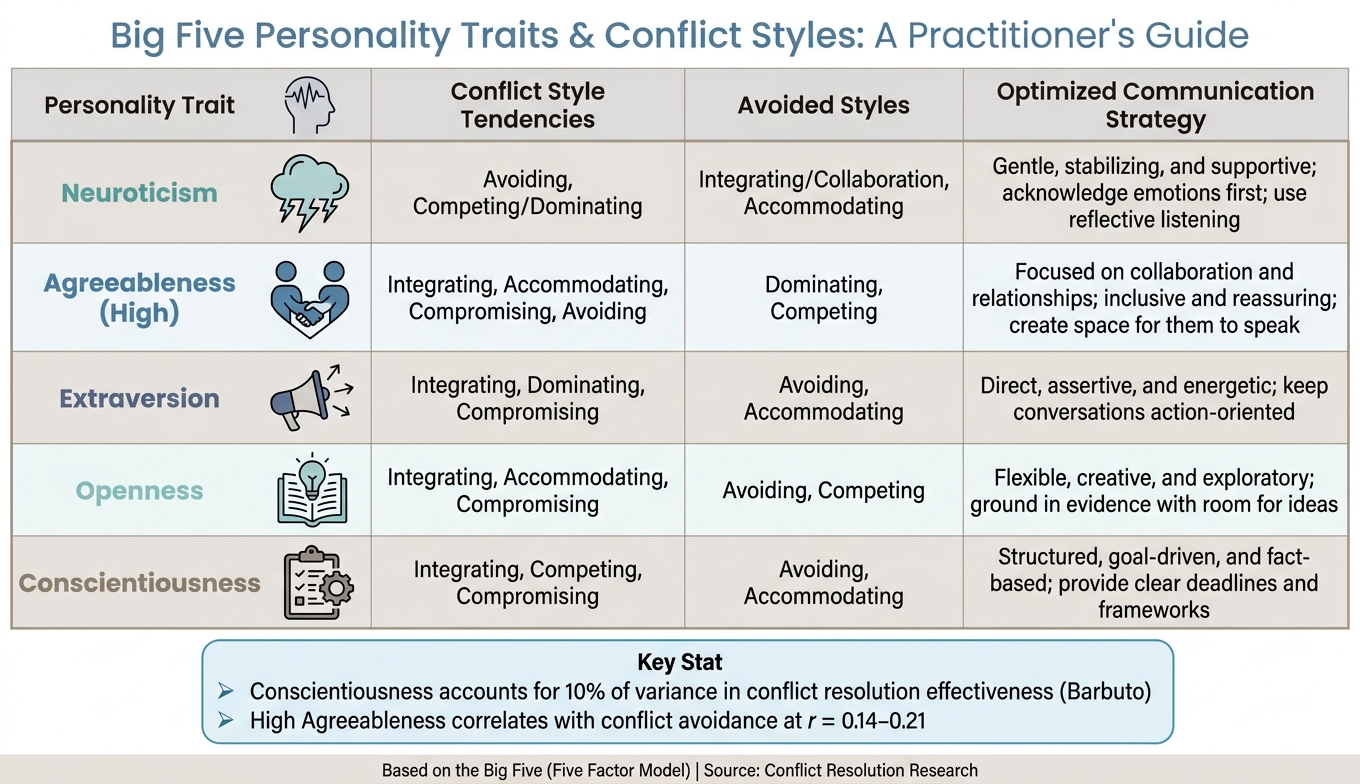
Big Five Personality Traits & Conflict Styles: A Practitioner's Guide
This section delves into how communication and de-escalation strategies can be aligned with individual personality traits, building on observed conflict patterns.
Adjusting Communication Style to Fit the Person
Once you've identified a conflict pattern, it's crucial to tailor both your message and its delivery. A one-size-fits-all approach often backfires, and mismatched communication can escalate tension instead of resolving it.
The table below links each Big Five personality trait to a conflict style and suggests an optimized communication strategy:
| Personality Trait | Conflict Style | Optimized Communication Strategy |
|---|---|---|
| Neuroticism | Avoiding, Competing | Gentle, stabilizing, and supportive |
| Agreeableness | Integrating, Accommodating | Focused on collaboration and relationships |
| Extraversion | Integrating, Dominating | Direct, assertive, and energetic |
| Openness | Integrating, Compromising | Flexible, creative, and exploratory |
| Conscientiousness | Integrating, Competing | Structured, goal-driven, and fact-based |
Beyond these general guidelines, it's important to consider specific conflict profiles. For instance, avoiders dislike wasting time, so keep conversations brief and to the point, skipping unnecessary small talk. Analyzers need time to process and prefer discussions grounded in evidence and flexibility. Meanwhile, collaborators thrive when they feel included - ensure they feel heard before shifting the focus to individual needs [2].
These tailored communication approaches create a solid foundation for applying specific de-escalation techniques.
De-escalation Techniques for Different Personality Types
De-escalation strategies vary depending on the individual's personality. What calms one person might trigger another.
- For individuals high in Neuroticism, start by acknowledging their emotions. Reflective listening, paired with a brief pause, can help prevent further escalation.
- When dealing with low-Agreeableness competitors, use straightforward and direct language. Offering a small concession can reduce defensiveness and pave the way for constructive dialogue. Avoid vague phrasing or open-ended deadlines, as these can be seen as indecisive [2].
- High-Agreeableness accommodators require inclusive and reassuring communication. Make space for them to share their thoughts, as the real risk lies in silent disengagement rather than overt conflict [2].
While these manual adjustments are effective, technology now offers tools to enhance conflict resolution in real-time.
How AI Tools Like Personos Support Conflict Resolution
Even seasoned professionals can feel overwhelmed during high-stakes situations or heavy caseloads. AI tools like Personos provide much-needed support in these moments.
Built on the scientifically validated Five Factor Model, Personos assesses 30 personality traits using an 80-point scale. This allows it to offer highly personalized guidance, tailored to an individual's unique profile rather than a broad trait category. Unlike static tools such as 16Personalities or Crystal, which provide fixed personality descriptions, Personos delivers dynamic, real-time advice that evolves as conflict dynamics shift. While traditional instruments like the TKI or ROCI-II offer helpful baseline data, they often lack the situational specificity needed for immediate conflict resolution.
With Personos' AI chat, you can describe an active conflict and receive customized advice based on the individual's full personality profile and the context. Its Dynamic Reports feature continuously updates recommendations for individuals, relationships, or groups as situations develop. Additionally, the integrated ActionBoard helps turn insights into actionable steps, ensuring strategies are implemented and progress is tracked. This not only enhances accountability but also provides measurable results to share with funders and supervisors.
Using Personality Insights to Prevent Conflict Early
Preventing conflict before it escalates is key, and understanding personality traits can give practitioners a valuable edge.
Spotting Early Warning Signs of Conflict
Conflict rarely happens without warning. Individuals with high Neuroticism and low Agreeableness are more likely to engage in conflict. On a group level, teams with multiple dominant, low-Agreeableness members are naturally more prone to relationship conflicts [7].
The table below outlines how the Big Five personality traits align with different conflict styles. This can help identify potential friction points in group dynamics:
| Personality Trait | Preferred Conflict Styles | Avoided Conflict Styles |
|---|---|---|
| Neuroticism | Avoiding, Competing/Dominating | Integrating/Collaboration, Accommodating |
| Agreeableness | Integrating, Accommodating, Compromising, Avoiding | Dominating/Competing |
| Extraversion | Integrating, Dominating, Compromising | Avoiding, Accommodating |
| Openness | Integrating, Accommodating, Compromising | Avoiding, Competing |
| Conscientiousness | Integrating, Competing, Compromising | Avoiding, Accommodating |
For instance, if a team includes high-Extraversion dominators alongside high-Neuroticism avoiders, conflict may be inevitable unless addressed early. Recognizing such patterns allows for timely interventions and adjustments to group expectations.
Setting Personality-Aware Boundaries and Agreements
Generic conflict resolutions often fall short because people interpret expectations differently. Tailoring agreements to personality types can make a big difference. For example:
- Set clear deadlines for competitive personalities.
- Give analytical individuals enough time to process information.
- Ensure collaborative types feel included in discussions [2].
Timing is equally important. Introverts, for instance, often need extra time to reflect before engaging in conflict resolution. Rushing them could lead to withdrawal or responses they may later regret [8].
Once these boundaries are in place, it’s important to keep an eye on how dynamics shift over time and adapt strategies accordingly.
Tracking and Adjusting Conflict Strategies Over Time
Tools like Personos provide ongoing insights, making it easier to adjust conflict prevention strategies as team dynamics evolve. While personality traits remain stable, external factors like workload, relationships, and group roles can change quickly. A strategy that worked a few months ago might need updating as circumstances shift.
Practitioners can upload team agreements and working styles into Personos to ensure guidance stays relevant. Its Dynamic Reports automatically refresh to reflect updated relationship dynamics - offering an advantage over traditional tools like the TKI or ROCI-II.
Additionally, the ActionBoard turns insights into actionable tasks, tracks progress, and documents outcomes. This not only helps with accountability but also allows practitioners to show measurable results to supervisors or funders.
Conclusion: Putting Personality Insights to Work
Key Takeaways for Practitioners
Understanding personality traits can significantly improve how conflicts are managed. Here are a few essential principles to keep in mind:
- There's no universal de-escalation strategy. For example, slowing down and focusing on emotional validation may work wonders for anxious clients with high Neuroticism. However, that same approach might frustrate someone with low Agreeableness who prefers direct communication and clear options.
- Setting expectations based on personality reduces crises. From intake processes to team charters, tailoring approaches to individual traits can help prevent conflict before it escalates.
- Systematic tools beat relying on intuition. Especially when handling heavy caseloads, structured methods ensure consistency and reduce the risk of errors.
These principles provide a solid foundation for making meaningful adjustments to your practice.
Next Steps for Applying What You Have Learned
Start small and build from there. Identify two clients or team members and consider their likely conflict styles based on your observations. In your next interaction, tweak one aspect - perhaps offering more emotional validation for a nervous client or providing a clearer framework for someone more assertive - and see how they respond.
Over the next month, you could refine your process further by adding a simple conflict-style question to your intake forms, such as: "When you disagree with someone, do you usually speak up, stay quiet, or withdraw?" Additionally, implement personality-aware guidelines for recurring high-stakes scenarios, like mediating roommate disputes in shelters or facilitating family meetings in child welfare settings.
For those looking to deepen their approach, Personos offers a practical solution. This platform provides personality-specific guidance using the Five Factor Model, breaking down 30 traits on an 80-point scale. You can describe real scenarios in its AI chat feature and receive tailored advice. Its Dynamic Reports highlight conflict risks for individuals, client-practitioner dynamics, and even entire teams, while the ActionBoard helps you track and document progress - ideal for supervisors or funders. At just $9 per seat per month, it’s an accessible way to make conflict management more precise and less time-intensive.
"Move from crisis to stability faster with insights that help you understand what truly motivates change in each individual." - Personos for Nonprofits [9]
FAQs
How can I tell which personality trait is driving a conflict?
To figure out which personality trait might be fueling a conflict, start by observing behavior and how people approach disagreements. Tools like the Big Five personality framework can shed light on this. For instance, someone with a dominant personality might come across as highly assertive, while a person who values steadiness may prioritize keeping the peace. Platforms like Personos use AI to analyze these traits, offering customized advice to help you handle tricky situations with clarity and ease.
What should I say to de-escalate someone who’s highly emotional?
To help calm someone who is highly emotional, it's important to use language that soothes and acknowledges their feelings. This approach can be particularly helpful for individuals who tend to experience strong emotional reactions, such as those with higher levels of neuroticism. Personos offers real-time, customized advice rooted in the Five Factor Model, empowering professionals to navigate emotional situations effectively. By using these tailored strategies, you can move from conflict to collaboration, addressing the unique dynamics of each interaction.
How can Personos help in a conflict that’s happening right now?
Personos offers real-time, AI-powered guidance that's customized to the personalities in play. By using @ in the chat, you can integrate context and individual profiles, receiving instant advice tailored to the situation. It doesn’t just offer solutions - it explains them, so you can handle conflicts with confidence. Features like proactive prompts help avoid misunderstandings before they escalate, while dynamic reports highlight areas of tension. This allows you to make immediate adjustments and encourage smoother collaboration.