What Research Says About Personality and Trust Cues
Research shows personality shapes trust impressions, not reliable behavior—use clear communication and accountable follow-through.
Christian Thomas

What Research Says About Personality and Trust Cues
I use personality to guide communication, not to decide who deserves trust. My starting point: ask how someone prefers to communicate, explain privacy limits, and agree on a next step you can keep.
A 2018 study found that Big Five traits predicted trust beliefs and intentions, but not trusting behavior. That’s the key distinction: feeling trust and acting on it are not the same thing.
Here’s what I take from the research:
- Personality is not an honesty test. Agreeableness has the clearest link to willingness to trust, but no trait proves reliability.
- First impressions have limits. Confidence, eye contact, and a smooth speaking style don’t prove skill or honesty.
- Follow-through needs context. Missed contact may reflect stress, disability, language needs, or access barriers.
- Clear commitments help. I record the action, owner, deadline, update method, and backup plan, then address mistakes directly.
- AI has a narrow role. I would use Personos for communication planning, with consent, privacy checks, and human review, never to score honesty or decide access to services.
My rule: <u>judge patterns of action, not personality labels</u>.
What Big Five Research Says About Trust
Trait Findings Vary by Trust Measure and Setting
Agreeableness has the most consistent link to willingness to trust, not actual reliability. A peer-reviewed review found positive associations in earlier interpersonal and workplace studies, but results vary by measure and setting.[6] Use these findings to adjust communication, not label people as trustworthy or untrustworthy.
| Trait | Measured outcome and study context | Direction and evidence limits | Practical meaning |
|---|---|---|---|
| Agreeableness | Trust propensity in workplace and interpersonal studies; trust-game transfers in a 2021 face-rating experiment | Generally positive; faces rated more agreeable received larger transfers.[6][12] | May help build rapport, but does not prove trust or follow-through. |
| Conscientiousness | Trust-game transfers toward faces rated conscientious | Positive only among people deciding whether to trust who had high anxiety.[12] | Use clear timelines and reminders; do not assume dependability. |
| Extraversion | Perceived extraversion in facial-impression research | Associated with judgments of approachability or trustworthiness.[10] | Do not give outgoing clients more credit than quiet clients. |
| Emotional stability / neuroticism | Facial impressions and interpersonal trust findings | Emotional stability associated with approachability; neuroticism findings mixed and context-dependent.[6][10] | Respond to distress or caution with questions, not character judgments. |
| Openness | Facial impressions and trust in AI | Mixed or indirect evidence; generally positive associations in trust-in-AI research, which may not transfer to helping relationships.[8][9][10] | Openness may support flexibility, not immediate disclosure. |
These studies measure different things. You cannot combine their findings into one trust score or treat them as proof of reliability. For counselors, case managers, nonprofit staff, and coaches, use personality-informed structure rather than labels: set clear expectations, follow up, and repair the relationship after missed contact.
Trait ratings tell only part of the story. Behavior may tell another.
Reported Trust Is Not the Same as Trusting Behavior
In 2018, Alarcon and colleagues studied personality alongside trust beliefs, intentions, and behavior. Big Five traits predicted beliefs and intentions, but not behavior. General trust propensity predicted all three.[6][13]
In a 2020 experimental trust game, personality helped explain the decisions of the person deciding whether to trust. The person being trusted responded more to the other person’s action.[11] These associations do not show that changing a trait causes trust.
| Method | What it measures | Main limits | Use in helping relationships |
|---|---|---|---|
| Self-report questionnaires | Self-reported trust beliefs or willingness | Answers depend on wording, interpretation, and social desirability.[6][13] | Discuss preferences and expectations rather than predict follow-through. |
| Laboratory trust games | Incentivized choices under risk | Results depend on the task’s rules and incentives. | Do not assume the task reproduces service-related risks, confidentiality concerns, or power imbalances. |
| Follow-through in daily life | Responsiveness, cooperation, and commitments kept over time | Behavior also reflects stress, opportunity, role, culture, and practical barriers. | Record actions and circumstances separately; look for patterns over time. |
In service settings, understanding follow-through means asking what barriers affect it. Application to high-stakes services remains limited. Workplace, facial-rating, and laboratory findings do not establish predictions for trauma-exposed clients facing confidentiality concerns, mandated reporting, or dependence on scarce services.[6][10][11]
Ask what makes relying on others difficult: past harm, risk, or access barriers. Assess patterns over time. Before treating missed contact as low trust, check for access barriers and recent stressors. Use those answers to clarify timelines, plan follow-up, and adjust communication.
The Big Five: Agreeableness
How Communication Cues Shape Trust
Clients judge whether to trust you through visible cues, not personality traits alone. How you communicate helps them decide whether working with you feels safe and worthwhile. They read ability through signs of skill, benevolence through care for their interests, and integrity through clear principles and actions that match your commitments.[15][16][18] These judgments don’t always line up: someone can seem caring without having the skills to help.
First Impressions and Repeated Actions
Research finding: People form fast impressions of warmth and competence.[17] Tone, confidence, fluency, and similarity can make someone seem approachable or capable. But none of these proves honesty or skill. Early judgments change as people observe more behavior.[14] Repeated follow-through matters more than a polished first contact.
Practice suggestion: Make your actions easy to check. Keep your communication consistent, explain your limits openly, and respond to concerns.
| Observable communication or action | Dimension it may support | Practical action | Risk of misreading |
|---|---|---|---|
| Accurate explanation of referral limits | Ability; transparency | Verify eligibility and explain what the referral can and cannot provide. | Clear wording does not guarantee accuracy. |
| Acknowledging uncertainty | Integrity; transparency | Check funding availability before promising assistance. | Hesitation may be mistaken for a lack of skill. |
| Completing agreed follow-up | Integrity; predictability | Deliver the promised information at the agreed time. | One success does not prove a pattern. |
| Attention to client priorities | Benevolence; responsiveness | Connect available options to the client’s stated needs. | Caring questions matter only when followed by action. |
| Clear confidentiality boundaries | Integrity; predictability | Explain what remains private and what must be reported. | Unexplained boundaries can feel uncaring. |
Ask Clients How They Prefer to Communicate
Ask whether the client wants an overview or more detail, verbal or written follow-up, or a slower pace. Match the format to the client, not your default style.
Trauma, culture, disability, language, stress, and professional power can affect communication and how people send and read trust cues. Eye contact, expressiveness, accent, hesitation, and emotional composure are not honesty tests. Apparent agreement may reflect pressure rather than understanding.
Offer interpreters, accessible formats, captions, or extra time. Explain confidentiality limits before discussing sensitive topics, and ask what needs clarification before you proceed.
Put the Research Into Client Practice
Build Client Trust Through Accountable Follow-Through
Trust grows from what people do, not personality labels. Once you identify trust cues, turn them into clear commitments and follow-up.
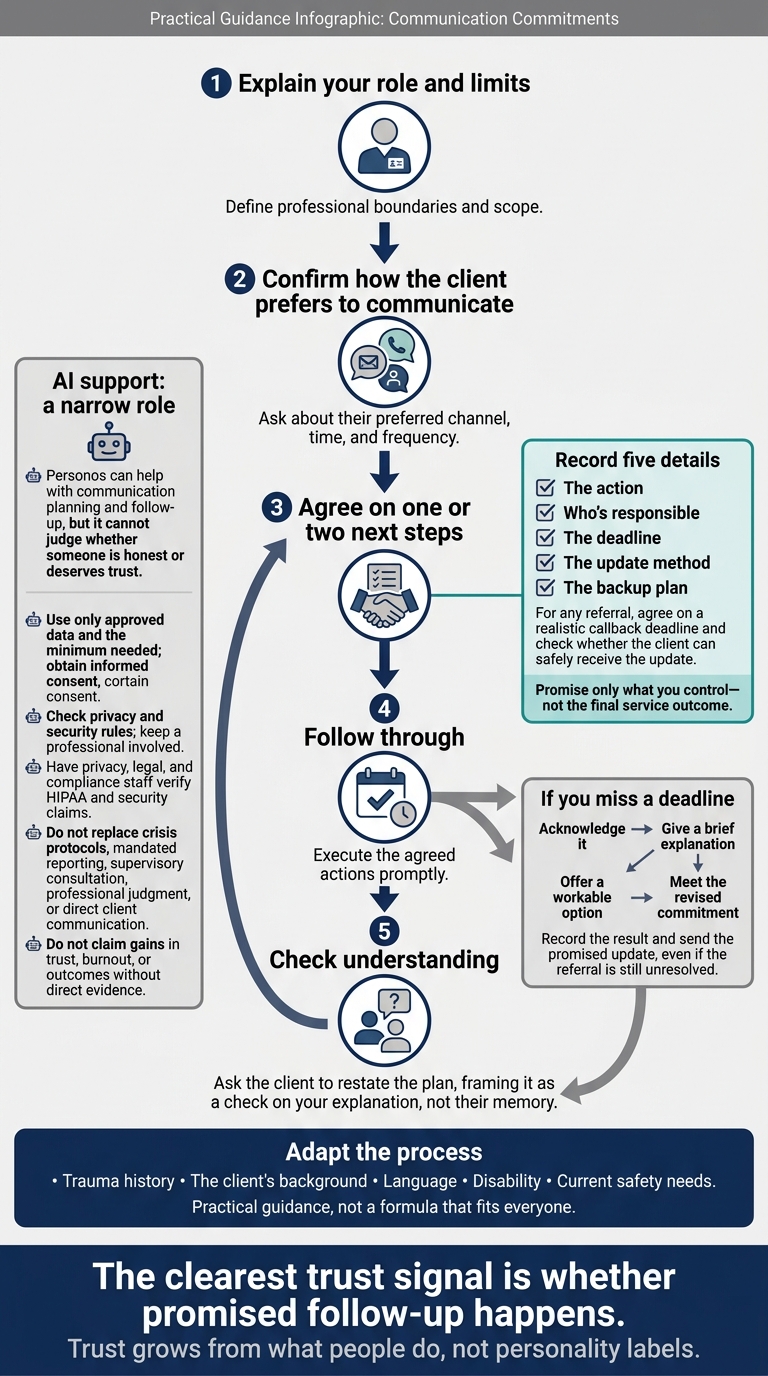
Start with a simple workflow: explain your role and limits, confirm how the client prefers to communicate, agree on one or two next steps, follow through, and check understanding. Ask the client to restate the plan, framing it as a check on your explanation, not their memory. Adjust the process for trauma history, the client’s background, language, disability, and current safety needs. Treat this as practical guidance, not a formula that fits everyone.[19][20][21] The clearest trust signal is whether promised follow-up happens.
Set Commitments and Address Missed Follow-Up
Record five details: the action, who’s responsible, the deadline, the update method, and the backup plan.
For any referral, agree on a realistic callback deadline and check whether the client can safely receive the update. Promise only what you control - not the final service outcome.[19][20]
If you miss a deadline, acknowledge it, give a brief explanation, offer a workable option, and meet the revised commitment. Record the result and send the promised update, even if the referral is still unresolved.[19][20]
Use Personos for Support, Not Trust Scores
Keep AI support tied to the same human workflow. Personos can help with communication planning and follow-up, but it cannot judge whether someone is honest or deserves trust.[1] Don’t claim gains in trust, burnout, or outcomes without direct evidence.
Use only approved data, keep it to the minimum needed, and obtain informed consent. Check privacy and security rules, and keep a professional involved. Have your privacy, legal, and compliance staff verify HIPAA and security claims. Personos must not replace crisis protocols, mandated reporting, supervisory consultation, professional judgment, or direct client communication.[1][19][20][22][23][24]
Conclusion: Build Trust Through Accountable Actions
The research points to one rule: use personality to tailor communication, not to assign trust. Personality may shape trust, but results vary by setting and measure.[5][7][25] Communication cues shape first impressions. Repeated actions show whether care, fair treatment, and reliability hold up.[26][31]
Trust grows less from profile labels than from accountable follow-through. Leave room to adjust the relationship: ask about preferences, explain limits, honor commitments, and treat disagreement or refusal as information, not bad faith.[28][29][30]
Do not use personality scores or AI guidance, including Personos suggestions, as honesty tests, risk labels, eligibility rules, or substitutes for the client’s voice.[27]
Trust is earned and can be revised. A profile cannot assign it.
FAQs
How can I assess reliability without personality bias?
Look for clear, research-backed reasoning, not simplistic personality categories [1][2]. Personos uses the Five Factor Model to measure 30 personality traits on an 80-point scale without assigning preset categories [1][3]. It explains the reasoning, psychological principles, and situational details behind its guidance, so you can assess the evidence yourself instead of relying on assessments that haven’t been validated or don’t explain how they work [1][4][5].
How do I distinguish access barriers from broken commitments?
Start by looking at what’s getting in the way of follow-through. Access barriers often stem from outside constraints or system-level hurdles. Broken commitments may be tied to motivation, readiness, or personality-driven responses to stress [1][2].
Personos offers real-time, personality-aware guidance on communication patterns and motivation triggers. This helps you assess whether a client needs practical support to work through obstacles or a tailored approach to help them recommit [1][2][3][4].
How can I use Personos if a client declines profiling?
If a client declines profiling, you can still use Personos to create a private profile without their participation [1][2]. Use what you already know, and, if you choose, complete a short questionnaire to generate a personality matrix for tailored guidance [1][2].
Add details about your professional history, past interactions, and relationship goals [3][4][5]. The data stays private to you, helping Personos provide personality-aware guidance while respecting the client’s boundaries [1][2].