Study: Personality Traits and Team Role Success
Align Big Five traits to team roles to boost performance, cut conflict, and improve collaboration through complementary strengths.
Nick Blasi

Study: Personality Traits and Team Role Success
Personality traits are critical for team success. Research shows that Aligning individual traits with specific team roles improves collaboration, reduces conflicts, and boosts performance. A study of 70,000 participants revealed that traits like Conscientiousness, Extraversion, and Openness influence how people excel in roles such as Drivers, Innovators, Connectors, and Analysts.
Key Takeaways:
- Conscientiousness predicts success in task-focused roles (e.g., Organizers, Doers).
- Extraversion drives energy and collaboration in social roles (e.g., Team Builders, Connectors).
- Openness fosters creativity in idea-driven roles (e.g., Innovators, Challengers).
- Balancing diverse traits in teams leads to better outcomes, but overemphasizing one trait can create challenges.
Tools like Personos use personality insights to match people with roles, improving communication and reducing burnout. This approach helps teams thrive by leveraging complementary strengths instead of focusing solely on technical skills.
How Personality Traits Connect to Team Roles
What Each Trait Means for Team Roles
The Five Factor Model identifies five key personality traits that influence how individuals contribute to a team. Among these, Conscientiousness is the strongest predictor of task performance across all roles. Those with high conscientiousness excel in roles like Organizers and Doers - they stick to timelines, hold themselves and others accountable, and ensure projects are completed [3].
Extraversion influences how individuals interact with others and energize group efforts. Highly extraverted people thrive as Team Builders and Connectors, bringing energy to meetings and broadening networks [3]. Interestingly, extraverted leaders perform better with more passive team members, while introverted leaders shine when working with proactive teams [3].
Openness to Experience fuels creativity and innovation. People high in openness challenge norms and develop fresh ideas, making them natural Innovators [3]. However, they often need conscientious teammates to bring their ideas to life [3] [5].
Agreeableness is essential for maintaining team harmony. Those scoring high in agreeableness are effective Connectors, skilled at resolving conflicts and fostering consensus [3]. A 2022 meta-study even linked agreeableness to 93% of job performance variables [5]. That said, highly agreeable individuals may shy away from necessary confrontations, potentially leading to groupthink. In roles like management or sales, lower agreeableness can sometimes be an asset for handling tough conversations [3] [4].
These insights highlight why the Five Factor Model remains a trusted tool for understanding how personality shapes team dynamics.
Why the Five Factor Model Works
The Five Factor Model offers a time-tested framework for aligning individual traits with team roles. Unlike tools focused solely on communication styles, this model has decades of validation for predicting workplace performance and leadership potential [1]. As Marc Fogel, Director of Product at Talent Select AI, explains:
"The Big Five personality traits do not measure how well you're going to perform in any particular job, but they do measure characteristics that either help or make it harder to be successful in a given role" [2].
One of the model's strengths is its stability. Personality traits tend to remain consistent over time, making them reliable predictors of behavior under pressure. This stability often outperforms resumes or technical skills in forecasting long-term performance [1]. A meta-analysis of 42 studies found that team personality composition is a strong predictor of success across industries [3].
The model also supports strategic team building by encouraging complementary traits. Teams that balance all four functional roles - Driver, Innovator, Connector, and Analyst - consistently outperform those missing even one [3]. For example, the Canadian banking firm Tangerine adopted personality assessments based on this model in 2025. This reduced their interview volume by 33% and improved their final interview-to-job-offer ratio from 3:1 to 2:1 [1].
For those navigating complex team environments, tools like Personos apply the Five Factor Model to provide real-time, practical advice on team collaboration. These applications demonstrate how aligning personality traits with roles can lead to measurable improvements in team performance.
Facilitating a Team Building Session with the 5 Factor Model
Using these insights can help in solving team conflicts by identifying the root causes of friction.
Study Results: Which Traits Match Which Roles
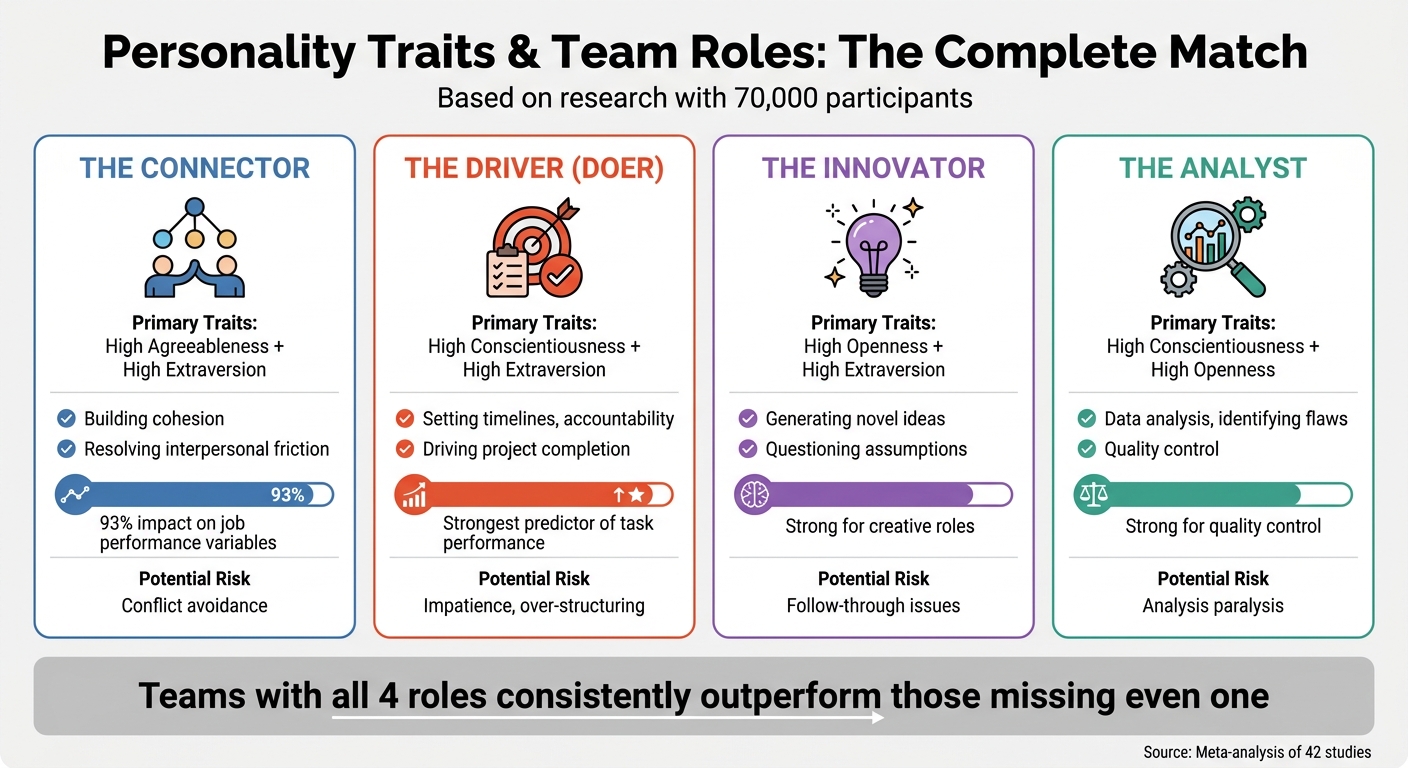
Personality Traits and Team Roles: A Complete Matching Guide
Team Builder and Connector Roles
People with high levels of Agreeableness and Extraversion thrive in Team Builder and Connector roles [3]. These traits enable them to foster team unity, smooth over interpersonal conflicts, and create an inclusive environment. A meta-analysis of 42 studies found that team personality dynamics play a crucial role in predicting overall team performance [3]. When paired with high Extraversion, these individuals bring energy and enthusiasm to group settings, actively engaging quieter team members and bridging diverse perspectives.
Organizer and Doer Roles
For roles that focus on task execution, Conscientiousness emerges as the strongest predictor of success [3]. Individuals with this trait excel as Organizers or Doers, taking charge of timelines, ensuring accountability, and driving projects to completion. When combined with high Extraversion, these individuals often become effective managers, balancing organizational duties with social interaction [4]. Research also shows that managers typically score high in Conscientiousness and low in Neuroticism [4].
Challenger and Innovator Roles
In roles that emphasize creativity and change, Openness to Experience - especially when combined with moderate-to-high Extraversion - is a key trait [4]. Challengers and Innovators excel at generating fresh ideas, questioning norms, and connecting diverse concepts to spark innovation [3]. Professions like artists, writers, and designers often show particularly high levels of Openness [4]. However, these individuals may struggle with follow-through unless they also have strong Conscientiousness. This explains why successful innovation teams often pair creative thinkers with detail-oriented collaborators to ensure ideas are fully realized [3].
| Team Role | Primary Traits | Key Functions | Potential Risk |
|---|---|---|---|
| Connector | High Agreeableness + High Extraversion | Building cohesion and resolving interpersonal friction | Conflict avoidance |
| Driver (Doer) | High Conscientiousness + High Extraversion | Setting timelines, accountability, and driving project completion | Impatience; over-structuring |
| Innovator | High Openness + High Extraversion | Generating novel ideas and questioning assumptions | Follow-through issues |
| Analyst | High Conscientiousness + High Openness | Data analysis, identifying flaws, and ensuring quality control | Analysis paralysis |
How to Apply These Findings in Your Team
Matching People to Roles Based on Personality
Using personality insights to align individuals with the right roles can improve communication and reduce burnout. The key is accurately measuring personality traits. A study involving nearly 70,000 participants found that common assumptions about personality traits tied to specific job roles are often supported by science [4].
There are tools available to help put this into action. For example, Thomas Assess streamlines candidate selection effectively [1]. For roles like social workers, case managers, or nonprofit staff, Personos offers a tailored solution. Built on the Five Factor Model, Personos uses AI to provide real-time guidance for team collaboration and role alignment. Unlike one-size-fits-all assessments, it generates Dynamic Reports that predict how two team members might interact, highlighting potential friction and offering communication strategies.
When building teams, aim to combine complementary traits rather than just similar ones [1]. For instance, if your team lacks high Openness profiles in innovation-driven departments, consider recruiting or reassigning members to fill this gap. Proper role assignments not only enhance efficiency but also create an environment for smoother and less stressful communication.
Better Communication and Less Burnout
Matching roles to personality traits also lays the groundwork for better communication. To ensure all voices are heard, consider structured turn-taking during meetings and encourage asynchronous brainstorming. This approach helps introverted or high Openness team members contribute without being overshadowed by more extraverted colleagues [3].
For teams with a mix of Judging and Perceiving types, establish clear decision points. Judging types prefer closure, while Perceiving types thrive on flexibility and iteration [3]. Separating critique from brainstorming phases can also help, especially for highly conscientious team members who might otherwise evaluate ideas prematurely [3].
It’s essential to monitor team members with low Adjustment or high Neuroticism for signs of stress [1][5]. These individuals may benefit from mindfulness routines, structured check-ins, or additional support in roles with high uncertainty. Recent research highlights a decline in Conscientiousness among employees aged 16–39 since the pandemic, which underscores the importance of proactive stress management [5].
AI tools can also play a role in improving team dynamics. For instance, Thomas Connect offers "Thom", an AI coach that provides managers with advice tailored to specific psychometric profiles [1]. Similarly, Personos enhances communication by offering chat features that leverage full personality profiles. Whether it’s manager-to-direct-report or peer-to-peer, these tools suggest strategies to minimize conflict and prevent burnout with AI. Additionally, its Prompts feature delivers quick, personality-based tips to keep teams aligned, even during high-pressure times.
Quick Reference: Traits, Roles, and Tips
| Team Role | Key Traits | Correlation Strength | Practical Strategy |
|---|---|---|---|
| The Driver | High Conscientiousness + High Extraversion | Strong predictor of task performance [3] | Use structured turn-taking; monitor for impatience |
| The Innovator | High Openness + Moderate Extraversion | Strong for creative roles [4] | Allow asynchronous brainstorming; pair with a conscientious partner for execution |
| The Connector | High Agreeableness + High Extraversion | 93% impact on job performance variables [5] | Leverage for mediation; ensure participation in tough decisions |
| The Analyst | High Conscientiousness + High Openness | Strong for quality control [3] | Provide detailed briefs and time for analysis; guard against overanalyzing |
For complex tasks like strategy or innovation, diverse teams tend to excel. However, for execution-heavy projects, a more focused and homogeneous team can help minimize coordination challenges [3].
Study Limitations and Non-Linear Effects
When More Isn't Always Better
Having high scores on certain personality traits can often predict success, but there’s a tipping point where too much of a good thing becomes a problem. Take Conscientiousness, for instance. While it’s usually linked to strong performance, excessive levels can lead to behavioral rigidity, making it hard to adapt to change [1]. Similarly, high levels of competitiveness can drive results, but when paired with low emotional stability (referred to as "Adjustment" in research), it often results in burnout and can harm the overall organizational culture [1]. As Thomas.co explains:
"Extremes of any [trait] can carry risk too. For example, too much conscientiousness can lead to rigidness, while high competitiveness without adjustment can lead to burnout or culture damage" [1].
Even traits like Agreeableness, which are generally seen as positive, can cause problems when taken to extremes. Overly agreeable individuals may avoid necessary confrontations or tough decisions, which can hinder progress [3]. On the flip side, lower Agreeableness is often associated with success in roles that require handling conflict, such as management, law, or sales [4]. These examples highlight not just the limits of personality traits in predicting success but also the difficulty in capturing how these traits translate into behavior.
What the Study Couldn't Measure
The study also faced some limitations that impacted its findings, particularly when it came to measurement challenges. A major issue was the reliance on self-reported data, where participants rated their own traits. This method introduces bias, as people often present themselves in a more favorable light, aiming to appear more capable or leadership-oriented [1]. For example, someone might score high on Conscientiousness during an assessment but fail to maintain that level under real-world stress. While validated assessment tools can help identify inconsistent responses, the gap between self-perception and actual behavior remains a significant hurdle [1].
Another limitation was the inability to account for external factors that influence how traits play out in team settings. For instance, task complexity plays a big role - diverse personalities may be advantageous for creative, ambiguous tasks but can cause unnecessary friction in straightforward, execution-focused work [3]. Additionally, factors like psychological safety, team dynamics, and industry-specific pressures weren’t fully incorporated, which narrows the scope of the study. While personality traits can highlight tendencies that affect success in certain roles, they don’t provide a direct measure of job performance [2].
Conclusion
Strategic complementarity - not similarity - is what sets high-performing teams apart. By aligning specific personality traits with essential team roles, organizations can create teams that consistently achieve better results than those lacking well-rounded functional profiles [3]. Research shows that Team Conscientiousness is the most reliable predictor of task performance, while blending introverts and extraverts enhances decision-making. This balance allows for proactive idea generation alongside thoughtful analytical processing [3].
The real challenge lies in applying these insights to everyday management. Traditional assessments often provide static data, missing the dynamic nature of team interactions.
This is where innovative tools come into play. For example, Personos offers a modern approach by delivering real-time, actionable insights based on the scientifically validated Five Factor Model. It measures 30 personality traits on an 80-point scale, turning abstract personality data into practical guidance. Imagine a scenario where a high-Conscientiousness team member is focused on wrapping up a task, while a high-Openness colleague wants to explore more possibilities. Personos steps in to provide immediate advice on managing this dynamic, helping managers navigate potential friction effectively. Its Dynamic Reports offer tailored insights at the individual, relationship, and group levels, while the ActionBoard ensures these insights translate into measurable changes in behavior.
"Skills and experience explain where someone has been, while personality explains how they'll operate when the conditions change" [1].
The impact of such tools is evident. In 2025, Tangerine, a Canadian banking firm, used personality assessments to streamline their hiring process. They reduced the number of interviews by 33% and improved their interview-to-offer ratio from 3:1 to 2:1 [1].
Aligning roles with personality traits isn’t just theoretical - it’s a practical way to reduce burnout, improve communication, and achieve tangible results. Personality-driven management is proving to be a game-changer.
FAQs
How do I find my Big Five traits?
To learn about your Big Five traits, you can take a personality assessment rooted in the Big Five model. Tools like Personos use AI to evaluate 30 traits on an 80-point scale, employing methods grounded in scientific research. These assessments can offer valuable insights into your personality and how it might shape your effectiveness in team settings.
What if my traits don’t fit one role?
Personality is complex, with most team roles demanding a mix of traits rather than just one. For example, a "Driver" might blend Conscientiousness with Extraversion, while an "Innovator" could lean on Openness paired with Extraversion. Tools like the Big Five model or Personos can offer insights into your strengths, helping you navigate different roles. The focus here is on flexibility and self-awareness rather than sticking to fixed role definitions.
Can personality matching reduce burnout?
Yes, personality matching can play a role in reducing burnout, especially in team environments. By recognizing individual traits and aligning them with suitable roles, teams can improve dynamics, boost satisfaction, and build resilience. Tools like Personos, which are grounded in established psychological models, offer personalized strategies to handle challenges, encourage engagement, and help prevent stress. When personality insights are applied thoughtfully, they can strengthen team cohesion, minimize conflicts, and support overall well-being.