Research: Personality Traits and Team Innovation
Aligned personalities, especially extraversion and conscientiousness, boost team innovation; agreeableness and openness shape creativity.
Christian Thomas

Research: Personality Traits and Team Innovation
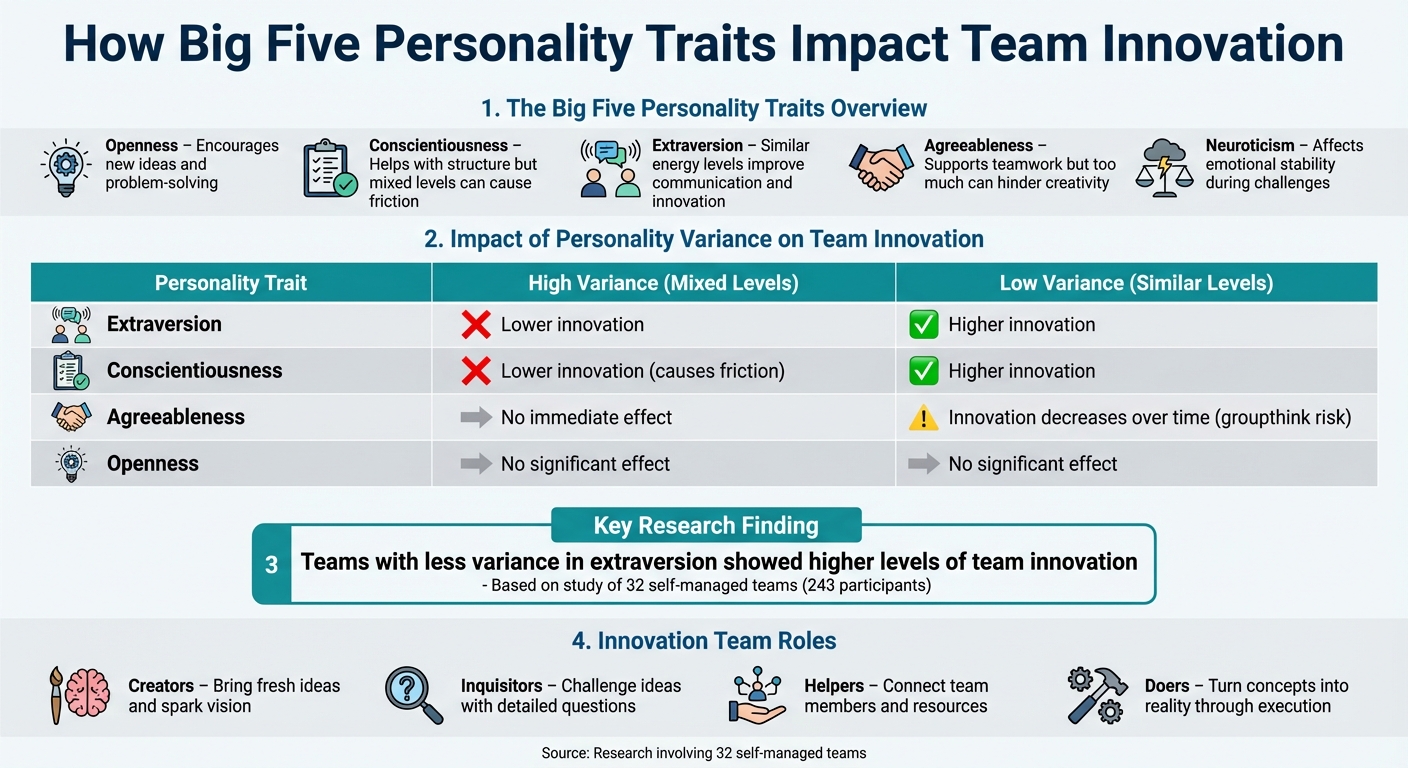
Personality impacts how teams perform under pressure, solve problems, and collaborate. Traits like openness, conscientiousness, extraversion, agreeableness, and neuroticism - defined by the Big Five model - shape team dynamics and innovation. Here's what you need to know:
- Openness: Encourages new ideas and problem-solving.
- Agreeableness: Supports teamwork but too much can hinder creativity.
- Conscientiousness: Helps with structure but mixed levels in a team can cause friction.
- Extraversion: Similar energy levels improve communication and innovation.
- Neuroticism: Affects emotional stability during challenges.
Teams with aligned traits in extraversion and conscientiousness perform better, while those with varied agreeableness may avoid groupthink. Tools like Personos analyze these dynamics, offering tailored recommendations to improve collaboration and results.
How Big Five Personality Traits Impact Team Innovation
How Each Big Five Trait Affects Team Innovation
Openness to Experience Drives Creative Thinking
Openness to experience plays a crucial role in fostering creativity within teams. Employees who score high in this trait consistently thrive in roles that demand innovation and originality [2]. Characterized by an inventive mindset, imagination, and willingness to explore new ideas, these individuals excel at tackling complex challenges. They’re quick to adapt strategies and embrace unconventional problems, often finding excitement in discovering new solutions [3].
"Employees who exhibit openness impact the productivity of their diverse teams at work." – Harzer and Ruch [2]
In fields like social services, having team members with high openness can lead to breakthroughs that challenge traditional methods. Their ability to think outside the box is especially valuable in overcoming obstacles and driving creative success.
Agreeableness Builds Collaboration
While openness sparks creativity, agreeableness lays the foundation for collaboration. People with high agreeableness are known for being polite, supportive, and approachable - qualities that help create a positive and cooperative team environment [2]. These traits encourage engagement and teamwork, making them essential for innovation in settings where interpersonal relationships are key, such as nonprofit organizations or case management [2].
"Agreeable workers encourage teamwork, [and] they are more likely to be engaged than unagreeable workers." – Journal of Innovation and Entrepreneurship [2]
Interestingly, research shows that teams with little variation in agreeableness may experience a stagnation in innovation over time. A mix of different levels of agreeableness can spark constructive debates and prevent teams from falling into a pattern of groupthink [1]. Organizations can use personality-based insights to balance these traits and strengthen team collaboration.
Conscientiousness: Benefits and Drawbacks
Conscientiousness, often associated with organization and discipline, can be both a strength and a challenge for team innovation. Highly conscientious individuals excel at structuring problems and allocating resources efficiently, which can enhance innovation when the team shares a common approach [3].
However, studies involving 32 teams reveal that a wide range of conscientiousness levels within the same group can lead to friction and coordination issues, ultimately hindering progress [1]. For example, mixing highly disciplined members with more flexible, unstructured individuals can create tension that disrupts the flow of innovation. Teams with similar levels of conscientiousness, on the other hand, tend to collaborate more effectively. In high-pressure environments like crisis intervention, having members with aligned approaches to planning and structure is critical for seamless coordination and creative problem-solving.
Team Composition: How Personality Mix Affects Innovation
Does Personality Variety Help or Hurt Teams?
A study of 32 self-managed teams (243 participants) reveals that teams with similar personality traits often outperform more diverse groups when it comes to innovation. For instance, teams with comparable levels of extraversion tend to develop more creative solutions than those blending extraverts and introverts. Why? Shared energy levels and communication styles minimize friction. The same trend holds for conscientiousness - teams with members who share similar approaches to organization and discipline are better at innovating. As the study highlights:
"Teams with less variance in extraversion showed higher levels of team innovation." – SC den Hartog, JM Runge, G Reindl, and JWB Lang [1]
Interestingly, teams with uniform agreeableness perform well initially but may experience a decline in creativity over time. This suggests that while politeness and harmony can boost short-term results, they might lead to complacency in the long run. On the other hand, differences in openness to experience don’t seem to have a notable impact on team innovation.
How Personality Interacts with Other Types of Diversity
Personality traits don’t exist in a vacuum - they interact with other forms of diversity, such as professional expertise, education, and cultural backgrounds. For multidisciplinary teams, understanding these dynamics is key to fostering collaboration and creativity. Research shows that personality alignment, particularly in extraversion and conscientiousness, becomes even more critical as teams mature. For example, when assembling teams of professionals like social workers, counselors, and health workers, shared levels of extraversion and conscientiousness help ensure smoother communication and better coordination - even when team members come from different educational or cultural backgrounds.
By balancing personality alignment with diverse professional perspectives, teams can strike the right mix for innovation.
| Personality Trait | Impact of High Variance | Impact of Low Variance |
|---|---|---|
| Extraversion | Lower innovation | Higher innovation |
| Conscientiousness | Lower innovation | Higher innovation |
| Agreeableness | No immediate effect | Innovation decreases over time |
| Openness | No significant effect | No significant effect |
Source: Research involving 32 self-managed teams [1].
Applying Research Findings to Real Teams
Building Teams with Complementary Personalities
Research shows that structuring teams with complementary personalities can directly improve innovation. While personality diversity often gets attention, aligning personalities with specific roles tends to have a bigger impact on team performance. This approach focuses on matching personality traits to the needs of each role.
Think of innovation as a team sport where each role requires unique traits [5]. For instance:
- Creators bring fresh ideas and spark the initial vision.
- Inquisitors challenge ideas with detailed questions to refine them, avoiding the influence of "corporate antibodies" - those who reject ideas simply to maintain the status quo [5].
- Helpers connect team members, resources, and knowledge to overcome hurdles.
- Doers turn concepts into reality by focusing on execution.
These roles demonstrate how personality compatibility can drive innovation. For example, teams in fields like social work, case management, or counseling benefit when members share traits like extraversion and conscientiousness, which reduce friction in communication and workflows. However, it’s important to avoid teams with uniformly high agreeableness, as this can stifle innovation over time [1]. Including individuals who constructively disagree ensures weak ideas are filtered out without creating unnecessary conflict [4].
"Innovation is like a multi-act play, with different personalities playing crucial roles." – Hutch Carpenter, HYPE Innovation [5]
Using Personos to Understand Team Dynamics
To make these insights actionable, tools like Personos provide a way to analyze and optimize team dynamics. Personos (https://personos.ai) uses personality data to map team interactions, offering Dynamic Reports that highlight group strengths, potential blind spots, and areas of friction. These reports are based on the Five Factor Model, breaking down 30 personality traits on an 80-point scale.
What makes Personos stand out is its contextual intelligence. It doesn’t just look at personality traits in isolation - it factors in your team’s goals, past interactions, and professional roles. For example, in a nonprofit team managing heavy caseloads, Personos might reveal that while the group’s low variance in conscientiousness supports innovation, too much similarity in agreeableness could hinder long-term creativity.
The platform goes further by offering practical advice through its conversational AI chat. It might suggest assigning specific team members to Inquisitor roles during brainstorming or structuring meetings to encourage constructive disagreements. It also helps balance personality alignment with diverse professional viewpoints.
To turn insights into action, the ActionBoard feature creates trackable tasks. This ensures teams don’t just understand their dynamics but actively improve how they collaborate. For professionals dealing with high-stakes challenges, this tool bridges the gap between personality science and real-world results - something increasingly valued by funders and stakeholders.
Personality Poker: The Key to High Performing Innovation Within Your Teams
Comparing Personality Tools for Team Assessment
When it comes to fostering team innovation, having the right personality assessment tool can make all the difference. The key lies in choosing one that provides actionable insights rather than just static data.
Personos vs. Standard Big Five Tests
Traditional Big Five tests often fall short by offering static scores without practical recommendations. These assessments, which typically involve answering over 120 questions, describe personality traits but leave users to figure out how to apply the results. For professionals managing high-pressure teams, this lack of actionable guidance can be a major drawback.
Personos, on the other hand, builds on the Five Factor Model but takes things further. It evaluates 30 personality traits on an 80-point scale and incorporates contextual intelligence. Unlike traditional tests, Personos doesn’t just deliver scores; it analyzes how traits interact within a specific work environment. For example, research indicates that teams with low variability in extraversion and conscientiousness tend to be more innovative [1]. Personos identifies such patterns and suggests tangible adjustments, like tweaking roles or changing meeting formats, to enhance team performance.
Another challenge with standard assessments is social desirability bias - where individuals answer in ways they think sound good rather than being truthful [6]. Personos tackles this using an AI-powered chat feature that analyzes patterns across interactions and contextual data, reducing reliance on self-reported answers. Its Transparent Reasoning feature further empowers users by showing exactly how recommendations are derived, helping professionals build expertise over time instead of treating the tool as a mysterious black box.
With this comparison in mind, let’s see how Personos stacks up against another widely known tool, Myers-Briggs.
Personos vs. Myers-Briggs
The Myers-Briggs Type Indicator (MBTI) is popular but has significant limitations. Unlike the Big Five model that underpins Personos, MBTI lacks strong scientific support. Studies show the Big Five is nearly twice as accurate as MBTI in predicting various outcomes like job satisfaction and performance [7]. Additionally, MBTI’s reliability is questionable - about 50% of participants receive a different personality type when retaking the test after just a few months [7].
The way each tool structures personality analysis also impacts its usefulness for teams. MBTI categorizes people into one of 16 binary types, while the Big Five views personality as a spectrum - an approach that captures more nuance in team dynamics. MBTI completely overlooks Neuroticism, a critical factor in understanding stress sensitivity and mental well-being, especially during high-stakes projects [7].
"MBTI feels like a friend telling you who you are. Big Five feels like a mirror showing you your strengths, weaknesses, and everything in between."
– Fozan Ahmed, Computer Science & Psychology Researcher [7]
For professionals aiming to improve team dynamics, the difference is striking. MBTI offers general personality labels with broad behavioral descriptions, whereas Personos provides tailored, situation-specific insights. For instance, if a social worker struggles to understand why two team members frequently clash in meetings, Personos goes beyond identifying personality types. It explains how solving team conflicts with personality insights works by identifying root causes and suggesting specific communication strategies. This focus on actionable insights makes Personos a powerful tool for building effective, innovative teams.
Conclusion: Using Personality Science to Build Better Teams
Research highlights that personality traits influence team innovation in complex and sometimes surprising ways. Teams with less variation in extraversion and conscientiousness tend to innovate more, while traits like openness and agreeableness are closely tied to creative output [1][8]. Interestingly, while conscientiousness is often viewed as a workplace strength, it can hinder innovation in younger firms where strict adherence to structure may stifle creative flexibility [8]. These insights pave the way for practical strategies.
For professionals in social services, nonprofits, and community-focused organizations, these findings can guide staffing and team-building decisions. For example, emphasizing proactive personality as a key selection criterion for creative projects can help foster a "team climate for innovation", which directly supports individual creativity [9]. Additionally, keeping an eye on trait variance within teams is essential for maintaining long-term creative health [1].
"Employers can improve employee engagement, job happiness, and overall performance by matching individual personality profiles with job positions and workplace expectations."
- Journal of Innovation and Entrepreneurship [2]
However, turning these insights into actionable steps isn't always straightforward. Traditional personality assessments often provide static scores that lack real-world application. This is where tools like Personos come in. By analyzing team-level metrics - such as the mean, minimum, maximum, and standard deviation of personality traits - Personos predicts team climate and innovation potential [9]. It also offers tailored recommendations, like adjustments to meeting formats or role assignments, to enhance collaboration and creativity.
For professionals managing complex team dynamics, personality science offers a practical toolkit to build teams that collaborate effectively and innovate consistently. Leveraging these insights, along with advanced tools, can lead to measurable improvements in team performance and creative outcomes.
FAQs
What’s the best personality mix for an innovative team?
An inventive team flourishes when it combines a strong openness to new experiences with a variety of demographics, educational paths, and professional expertise. Striking a balance between traits like agreeableness and extraversion helps nurture both creativity and collaboration. This mix allows for fresh perspectives while ensuring the team works effectively together.
How can a team avoid groupthink without creating conflict?
To avoid groupthink while keeping things harmonious, it's important to bring together different personality types - like introverts, extroverts, and analytical thinkers. This mix ensures a variety of viewpoints. At the same time, creating an environment of psychological safety is key. When team members feel safe, they're more likely to share their ideas without fear of judgment.
Building trust, practicing active listening, and encouraging open dialogue are practical ways to achieve this. Tools like Personos can also be helpful. They allow teams to adapt their interactions, making it easier to include diverse perspectives in a constructive way. This approach not only sparks creativity but keeps the team dynamic balanced.
How do I use personality data to assign roles and run better meetings?
To make the most of personality data, zero in on traits such as extraversion, agreeableness, openness, and conscientiousness. These traits can help align roles with individual strengths and improve how teams work together. Tools like Personos provide targeted insights, making it easier to assign roles and encourage collaboration.
For instance, you could assign detail-oriented tasks to conscientious team members or pair extroverted, agreeable individuals to spark lively and productive discussions. Structuring meetings to take advantage of these personality traits can lead to more effective and engaging outcomes.