5 Personality Traits That Shape Empathy
How five Big Five traits—agreeableness, openness, emotional stability, conscientiousness, and extraversion—shape empathy, relationships, and conflict resolution.
Rachel Johnson

5 Personality Traits That Shape Empathy
Empathy isn't just about understanding emotions - it’s about connecting with others on a deeper level. Research shows that personality traits significantly influence how empathetic you are. Here’s a quick breakdown of the five traits that shape empathy:
- Agreeableness: Strongly tied to empathy, it helps in understanding and sharing emotions. High agreeableness fosters harmony but may lead to struggles with assertiveness.
- Openness to Experience: Encourages curiosity and perspective-taking, aiding in understanding others' thoughts and emotions.
- Emotional Stability: Helps regulate personal distress, allowing focus on others’ needs during tough situations.
- Conscientiousness: Drives thoughtful, dependable actions, ensuring consistent empathetic behavior.
- Extraversion: Promotes emotional connections through sociability and warmth, though it may clash with introverted partners.
These traits not only influence personal relationships but also improve teamwork and communication in professional settings. By understanding your personality, you can strengthen your empathy and build better connections.
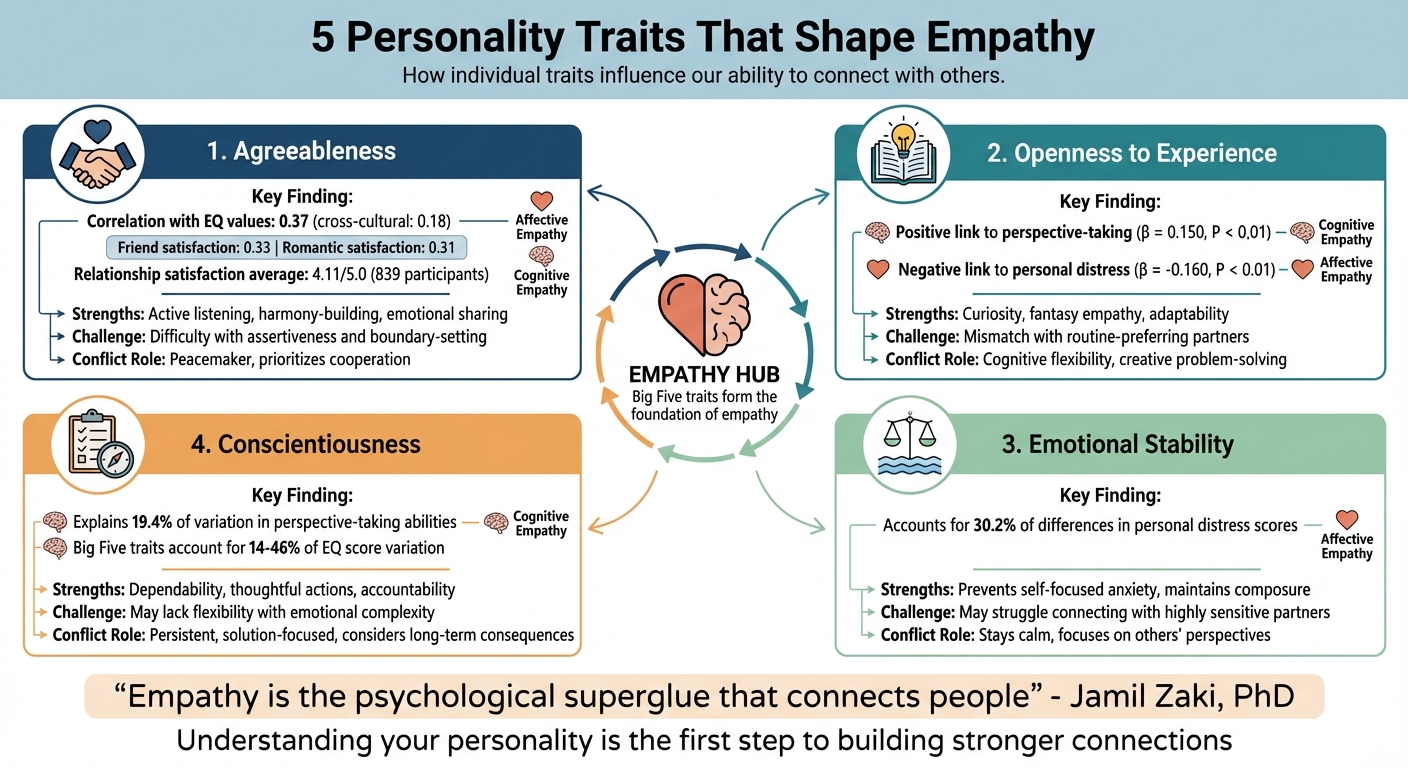
5 Personality Traits That Shape Empathy: Impact on Relationships and Conflict Resolution
How is Empathy Correlated with the Big 5 Personality Traits?
1. Agreeableness
Agreeableness is a key personality trait that strongly predicts empathy. People who score high in agreeableness tend to care deeply about others and prioritize maintaining harmony. This trait is made up of six core components: trust, straightforwardness, altruism, compliance, modesty, and tender-mindedness [6].
Impact on Empathetic Interactions
Agreeable individuals excel in two aspects of empathy: understanding others' thoughts (cognitive empathy) and sharing their emotions (affective empathy) [1][3]. A study conducted in June 2016 by Y. Song and M. Shi at China Medical University explored this connection among 530 clinical medical students. Their findings revealed that agreeableness was the strongest predictor of empathic concern, with a standardized coefficient of 0.477, and also significantly influenced perspective-taking at 0.349 [3]. They concluded:
"Agreeableness is the most important personality factor to explain perspective taking and empathic concern." [3]
This link even extends to brain activity. In March 2015, Brian W. Haas from the University of Georgia used fMRI scans to study 50 adults during an empathic accuracy task. He found that individuals high in warmth and altruism showed increased activation in the temporoparietal junction and medial prefrontal cortex - areas of the brain essential for processing emotions [2].
These findings highlight how agreeableness shapes the way we connect with others on an emotional level.
Manifestation in Relationships
In daily life, highly agreeable people often build strong connections by practicing active listening and assuming positive intentions. Whether in romantic or professional settings, this creates open communication and fosters environments where others feel valued and understood.
However, this trait isn’t without its challenges. Agreeable individuals may struggle with assertiveness, have difficulty making tough decisions, or find it hard to advocate for their own needs [5]. For instance, you might hold back your opinions to keep the peace or hesitate to set boundaries, which can lead to burnout or being taken advantage of [5].
Role in Conflict Resolution
When conflicts arise, agreeable people often take on the role of peacemakers. They lean toward cooperation, compromise, and prioritizing relationships over confrontation [6]. This ability to manage negative emotions and focus on preserving connections makes them skilled at de-escalating tense situations [6].
But there’s a downside. Avoiding necessary confrontations or struggling with decisiveness during tough conversations can sometimes undermine their own needs or goals [5]. If you’re low in agreeableness, practicing active listening and trying to see situations from others’ perspectives can help you build empathy [5]. On the other hand, if you’re highly agreeable, learning to set boundaries and assert yourself can protect you from being overextended or exploited [5].
2. Openness to Experience
Openness plays a key role in cognitive empathy - the ability to understand and interpret others' thoughts and emotions. A study involving 530 medical students found that openness was slightly positively linked to perspective-taking (β = 0.150, P < 0.01) and slightly negatively linked to personal distress when encountering others' emotions (β = -0.160, P < 0.01) [3].
Impact on Empathetic Interactions
People with high levels of openness often show a strong curiosity about different ideas and perspectives. Song Y. puts it this way:
"Those who have high scores on openness to experience are open to new ways of thinking and changes in their environment, thus having the sensitivity and insightfulness to understand other people and the ability to grasp the emotional and personal conditions of others." [3]
This openness also enhances what is known as "fantasy" empathy - the ability to imagine scenarios beyond personal experience, which can broaden understanding in everyday situations [1]. This intellectual curiosity often translates into behaviors that enrich interactions with others.
Manifestation in Relationships
In relationships, openness shows up as genuine interest in others' experiences and viewpoints. People who score high in openness are more likely to ask thoughtful questions, explore new perspectives, and adapt to changes in their relationships [7] [8]. This adaptability can strengthen connections, helping to reduce feelings of loneliness and boost relationship satisfaction. However, challenges may arise when one partner values novelty and change while the other prefers routine. Such mismatches in openness can sometimes lead to marital dissatisfaction [7]. Still, when used thoughtfully, openness can deepen empathy and strengthen bonds.
Role in Conflict Resolution
Openness is particularly useful during conflicts. It fosters cognitive flexibility, encouraging individuals to explore alternative perspectives and engage in creative communication rather than sticking to rigid approaches [9] [11]. For instance, research with medical students highlights that those with higher empathy also tend to score higher in openness (mean sten score of 7.12) [11].
To make the most of this trait during disagreements, try asking open-ended questions to uncover the underlying needs of others [12]. Avoid jumping to conclusions and instead dig deeper into the reasons behind someone's stance [10] [12]. This approach can help you propose creative solutions that address everyone's concerns [9] [11].
3. Emotional Stability
Emotional stability is all about staying calm and composed, especially in stressful situations [13]. Interestingly, this trait doesn't amplify emotional sensitivity but instead helps prevent what researchers call "personal distress." Personal distress occurs when someone becomes overwhelmed by their own anxiety while witnessing another person's suffering, turning the focus inward rather than toward the person in need. Studies on medical students reveal that neuroticism - the opposite of emotional stability - is the strongest predictor of this self-focused reaction [4][3].
Impact on Empathetic Interactions
Low emotional stability often leads to poor emotion regulation, where individuals become preoccupied with their own discomfort. Song and Shi explain:
"Personal distress... reflects the self-centered feelings of discomfort and anxiety when others are distressed and the inability to regulate one's emotions in an effective way." [3]
Research on Chinese medical students found that personality traits, particularly emotional stability, accounted for 30.2% of the differences in personal distress scores [3]. When you manage your own anxiety effectively, you’re better equipped to focus on others’ perspectives without being sidetracked by your own emotional turmoil. This ability to stay regulated not only improves one-on-one interactions but also lays the groundwork for healthier relationships overall.
Manifestation in Relationships
Emotional stability plays a key role in shaping daily relationship dynamics. By keeping personal distress in check, emotionally stable individuals create relationships marked by consistency and balance. They tend to remain even-tempered and optimistic, even during tough times [13]. For example, they handle criticism gracefully and maintain steady, open communication, fostering a sense of safety and trust. However, a potential challenge arises when emotionally stable individuals struggle to connect with highly sensitive partners, as their experiences of negative emotions differ in intensity [13].
Role in Conflict Resolution
In conflict situations, staying calm is a game-changer for resolving issues empathetically. Emotional stability allows you to take a step back, understand the other person's perspective, and respond without stress clouding your judgment. Research shows that emotionally stable people are less likely to fear judgment or worry about making mistakes during social interactions [9]. By regulating their emotions, they can shift their focus from internal anxieties to genuine care and concern for others, making conflict resolution more constructive and meaningful.
sbb-itb-f8fc6bf
4. Conscientiousness
While emotional stability helps keep emotions in check, conscientiousness drives the purposeful actions that make empathetic engagement possible. This trait is tied to organization, dependability, and careful decision-making. Studies show it strongly predicts both emotional and cognitive empathy across a variety of countries, including China, Germany, Spain, and the United States [1]. Its connection to cognitive empathy, in particular, enhances the ability to understand others' perspectives [1]. For instance, research with 471 nurses found a positive link between empathy and conscientiousness [15]. Additionally, studies reveal that the Big Five personality traits, with conscientiousness as a key factor, account for 14% to 46% of the variation in Empathy Quotient (EQ) scores [1]. These findings highlight how this trait influences day-to-day interactions and conflict resolution.
Impact on Empathetic Interactions
Conscientious people excel at managing their emotions and focusing on others' needs, thanks to their self-discipline and impulse control [15][16]. They carefully consider how their words and actions might affect others emotionally [14]. A study involving medical students found that the Big Five personality traits, including conscientiousness, explained 19.4% of the variation in perspective-taking abilities [3]. This stems from the dutifulness aspect of conscientiousness, which ensures individuals take their responsibilities toward others seriously. This sense of duty often translates into consistent and dependable empathetic behavior [15].
Manifestation in Relationships
In relationships, conscientious individuals earn trust by consistently showing up, keeping promises, and paying attention to important details about others' lives. This dependability plays a crucial role in fostering strong connections, whether in personal or professional settings [15]. Their reliability creates an environment where others feel comfortable sharing their thoughts and concerns. Tools like calendars and reminders often help them remember key dates or follow up on a friend's worries, turning good intentions into actionable support [14][16]. However, their preference for structure and order can sometimes make it challenging to approach complex emotional issues with flexibility [14].
Role in Conflict Resolution
When conflicts arise, conscientious individuals bring a level of persistence and focus that increases the likelihood of resolution. They don’t shy away from difficult conversations and work through issues until they find a solution [15]. They carefully weigh pros and cons, considering the long-term consequences of their actions [16]. Additionally, their willingness to take accountability for problems in relationships helps them approach disagreements with a focus on mutual understanding rather than trying to "win" the argument. This thoughtful approach often leads to more productive and meaningful resolutions.
5. Extraversion
Extraversion brings a lively, outward energy to the mix, complementing traits like agreeableness, openness, emotional stability, and conscientiousness. It’s characterized by sociability, assertiveness, and warmth, which naturally enhance empathetic connections. Studies highlight its link to higher Empathy Quotient (EQ) values, showing a correlation of 0.37 [1]. A large-scale cross-cultural study further revealed a partial correlation of 0.18 between extraversion and EQ [1]. Extraverts often excel in emotional connections because their focus tends to be outward, helping them stay grounded during emotionally charged situations [11].
Impact on Empathetic Interactions
Extraverts have a knack for reading emotional cues, thanks in part to the "Warmth" aspect of extraversion. This trait is tied to increased gray matter volume in the medial prefrontal cortex, a brain region essential for empathy [2]. Their open and expressive communication style creates a sense of emotional closeness [17]. Jessica Koehler, Ph.D., from the University of Arizona Global Campus, explains:
"Extroverts enhance their relationships by engaging in social activities and fostering vibrant social networks. Their communication style tends to be open and expressive, contributing to emotional intimacy" [17].
Manifestation in Relationships
In personal relationships, extraversion plays a key role in satisfaction levels. Research shows a correlation of 0.33 with friend satisfaction and 0.31 with romantic life satisfaction [20]. For instance, a study involving 839 participants found that relationship satisfaction, positively influenced by extraversion, averaged 4.11 on a 5-point scale [18]. Extraverts often use their natural warmth to celebrate their partners' successes and organize social activities that strengthen emotional bonds [17]. However, it’s worth noting that their high social energy may sometimes clash with partners who prefer quieter moments to recharge [19].
Role in Conflict Resolution
When conflicts arise, extraverts bring unique strengths to the table. They’re less likely to become overwhelmed by personal emotions during disagreements, as their focus remains outward [11]. Barbara Bętkowska-Korpała from Jagiellonian University Medical College highlights:
"Extravert people, who are more focused on external world rather than emotions, and who seek contact with others - are less susceptible to personal distress, as they are less concentrated on their 'self'" [11].
Their preference for direct, open discussions helps prevent unresolved tensions from festering [21]. This proactive approach often leads to meaningful conversations that pave the way for mutual understanding [9][10]. Extraverts also thrive in leveraging digital tools like Personos, which utilize personality insights to promote empathetic communication in various interactions.
How Personos Uses Personality Insights to Build Empathy
Personos taps into personality science to create more empathetic interactions, whether in personal relationships or professional environments. By leveraging these insights, the platform helps individuals and teams better understand and connect with one another.
At the heart of Personos's approach is the Big Five (OCEAN) personality model, which generates detailed personality reports. These reports shed light on how people naturally think, feel, and act. Traits such as Warmth and Altruism are highlighted, providing a clear picture of someone's empathetic strengths and areas for improvement. Research even suggests that combining empathy with conscientiousness can significantly improve communication outcomes [9].
One standout feature is the platform's personalized communication prompts. These prompts are tailored to an individual’s personality profile, offering practical advice. For instance, someone with lower emotional stability who might feel anxious about making mistakes can receive confidence-boosting guidance. As Barbara Bętkowska-Korpała from Jagiellonian University Medical College notes:
"Discussion of individual results with students, gives an opportunity to talk about how their empathy and personality characteristics may influence their everyday medical practice" [11].
For teams, group analysis reports uncover shared personality patterns, helping foster mutual support and manage conflicts effectively. This insight can be a game-changer when navigating tense situations, enabling teams to work together with greater understanding.
Personos also integrates an AI-powered conversational interface that provides real-time advice. This feature is discreet - visible only to the user - and offers situational guidance for challenges like difficult conversations, conflict resolution, or coaching. With tools available at $9 per seat per month, Personos equips teams with actionable insights to improve both their personal and professional interactions.
Conclusion
The five personality traits we’ve discussed - Agreeableness, Openness to Experience, Emotional Stability, Conscientiousness, and Extraversion - play a vital role in shaping how we relate to others. Research highlights that these traits form the foundation of empathy, influencing how we connect on deeper levels [3]. This insight opens doors for personal growth and stronger connections.
Empathy isn’t a fixed trait - it’s something you can nurture and develop. As psychologist Jamil Zaki, PhD, eloquently explains:
"Empathy is the 'psychological superglue' that connects people and undergirds co-operation and kindness" [22].
Think of empathy like a muscle - it strengthens with practice. Whether you naturally lean toward Agreeableness or are working on becoming more open, understanding where you stand is the first step toward growth.
Small, intentional changes can make a big difference. For example, practicing perspective-taking can help reduce burnout and deepen your empathy. Simple actions, like asking open-ended questions or immersing yourself in character-driven stories, have been shown to improve your ability to understand and share others’ emotions [22].
FAQs
How can my personality traits help me become more empathetic?
Your personality traits have a big impact on how you connect with others and develop empathy. The Big Five traits - Openness, Conscientiousness, Extraversion, Agreeableness, and Neuroticism - shape your ability to understand and relate to other people. For instance, being high in Agreeableness and Openness often means you're naturally more empathetic, while emotional stability (lower Neuroticism) can make active listening easier. Traits like Conscientiousness and Extraversion also contribute by encouraging thoughtful preparation and active engagement.
If you want to strengthen your empathy, start by understanding your own personality. For those high in Agreeableness, focus on asking open-ended questions and truly listening to others. If Openness is one of your strengths, explore new perspectives through books, films, or other experiences. High Conscientiousness can be used to set specific empathy goals, such as reflecting on others' emotions after conversations. If you're less extroverted, try initiating small social interactions to build confidence. And if you lean toward higher Neuroticism, mindfulness exercises or journaling can help manage your emotions and keep you present during interactions.
To make this process more manageable, platforms like Personos can be a helpful resource. This AI-driven coaching tool offers tailored guidance based on your personality, including conversation prompts, reminders to pause and reflect, and ways to track your progress toward empathy-building goals. By combining your natural strengths with intentional habits, you'll be better equipped to form meaningful connections in both your personal and professional life.
What difficulties do highly agreeable people face in relationships?
Highly agreeable people are often warm, cooperative, and driven by a desire for harmony. While these traits make them great at fostering positive relationships, they can also create certain challenges. For instance, they might find it hard to set boundaries or say "no", frequently putting others' needs ahead of their own. Over time, this can leave them feeling overlooked or even taken for granted. Their natural aversion to conflict may also lead to unresolved issues, which can quietly build up into frustration or resentment.
Another common struggle is asserting themselves during key decisions. When a situation calls for a firm stance, they might hesitate, leaving them feeling unheard or powerless. This imbalance can impact the dynamics of their relationships. Tools like Personos can be incredibly helpful, offering real-time advice on how to communicate assertively. By using such resources, highly agreeable individuals can learn to advocate for themselves while still showing care and understanding toward others.
How does emotional stability help in resolving conflicts?
Emotional stability, often linked to lower levels of neuroticism, plays a crucial role in handling conflicts with care and effectiveness. People who possess this trait tend to manage stress gracefully, experience fewer overwhelming negative emotions, and bounce back from challenges more quickly. This resilience helps them stay calm and focused during disagreements, steering clear of impulsive reactions and concentrating on practical solutions.
Those with emotional stability are also more likely to rely on constructive coping strategies. Instead of avoiding issues or reacting with emotional outbursts, they lean toward brainstorming solutions or negotiating compromises. This ability to regulate emotions paves the way for clearer communication, minimizes misunderstandings, and helps preserve cooperative relationships - even in high-pressure moments.
Tools like Personos can further support these efforts by offering real-time, AI-powered prompts that encourage empathetic and effective communication. This ensures that conflicts are approached with thoughtfulness and resolved productively.