How Personality Traits Shape Leadership Styles
Explore how the Big Five shape leadership, assess your profile, and use AI tools to turn traits into effective behaviors.
Christian Thomas

How Personality Traits Shape Leadership Styles
Personality traits significantly influence leadership styles by shaping how leaders think, communicate, and respond to challenges. Research highlights the Big Five personality model - openness, conscientiousness, extraversion, agreeableness, and emotional stability - as key predictors of leadership success. For example:
- Extraversion aids assertiveness and social influence.
- Conscientiousness supports reliability and goal-setting.
- Openness encourages creativity and adaptability.
- Agreeableness enhances cooperation and empathy.
- Emotional stability helps manage stress effectively.
Studies show personality traits affect leadership emergence and effectiveness, with companies leveraging personality insights reducing turnover by up to 45%. Tools like Personos provide actionable recommendations based on these traits, helping leaders align their natural tendencies with effective behaviors. By understanding and refining their personality-driven leadership styles, leaders can better navigate role fit in teams, decision-making, and long-term success.
Becoming the Ultimate Leader: Aligning Personality Traits with Leadership Traits - Dr. Jim Collins
Personality Models That Apply to Leadership
Understanding these models helps leaders align their natural traits with effective leadership practices.
The Big Five Personality Traits and Leadership
The Big Five Model, also called the Five Factor Model, is a widely recognized framework for exploring how personality influences leadership. It evaluates five core traits: Extraversion, Conscientiousness, Openness, Agreeableness, and Neuroticism, with each trait existing on a spectrum.
| Big Five Trait | Leadership Implications |
|---|---|
| Extraversion | Encourages assertiveness, energy, and social influence in group settings |
| Conscientiousness | Supports reliability, goal-setting, and consistent follow-through |
| Openness | Promotes creativity, intellectual curiosity, and adaptability to change |
| Agreeableness | Enhances cooperation, empathy, and effective team relationship management |
| Neuroticism | Reflects emotional stability and the ability to handle stress and pressure |
Studies confirm that these traits are strongly linked to leadership performance [3], though their effects can vary depending on the context [2]. While the Big Five Model offers valuable insight, it’s not meant to be a strict formula for leadership success.
Trait Theory of Leadership
Building on the Big Five, Trait Theory explores which stable personal characteristics predict leadership emergence and effectiveness. Research highlights extraversion as the strongest predictor of transformational leadership, especially in terms of charisma [3].
"Extraversion was the strongest and most consistent correlate of transformational leadership." - Bono, J. E., & Judge, T. A. [3]
Charisma - marked by the ability to inspire confidence and motivate others - often stems from natural personality traits. For introverted leaders, this means they may need to intentionally work on communicating their vision to their teams. Trait Theory is particularly helpful for identifying personal blind spots, allowing leaders to compare their natural tendencies with traits commonly associated with successful leadership. This comparison can guide areas for self-improvement.
By applying these theories, AI tools now provide leaders with personalized strategies tailored to their unique traits.
AI-Powered Tools for Leadership Personality Insights
Modern AI tools have taken these personality models and transformed them into practical resources for leadership development.
Personos is an example of an AI platform grounded in the Five Factor Model. It measures 30 traits on an 80-point scale, offering more precision than simple high/low classifications. Instead of static reports, Personos uses conversational AI to deliver real-time, context-specific advice - whether you’re navigating a team conflict, preparing for a tough conversation, or analyzing a challenging relationship. Its Dynamic Reports provide tailored insights not only about your personality but also about how your traits interact with those of your team members, enhancing both individual and group dynamics.
Other platforms, like Crystal Knows, rely on DISC profiling and public data but lack the scientific grounding of Personos. What sets Personos apart is its foundation in the research-backed Five Factor Model. Every recommendation includes a clear explanation of the traits and psychological principles involved, making it a valuable tool for leaders who want to grow their expertise and improve their leadership style over time.
Matching Leadership Styles to Personality Traits
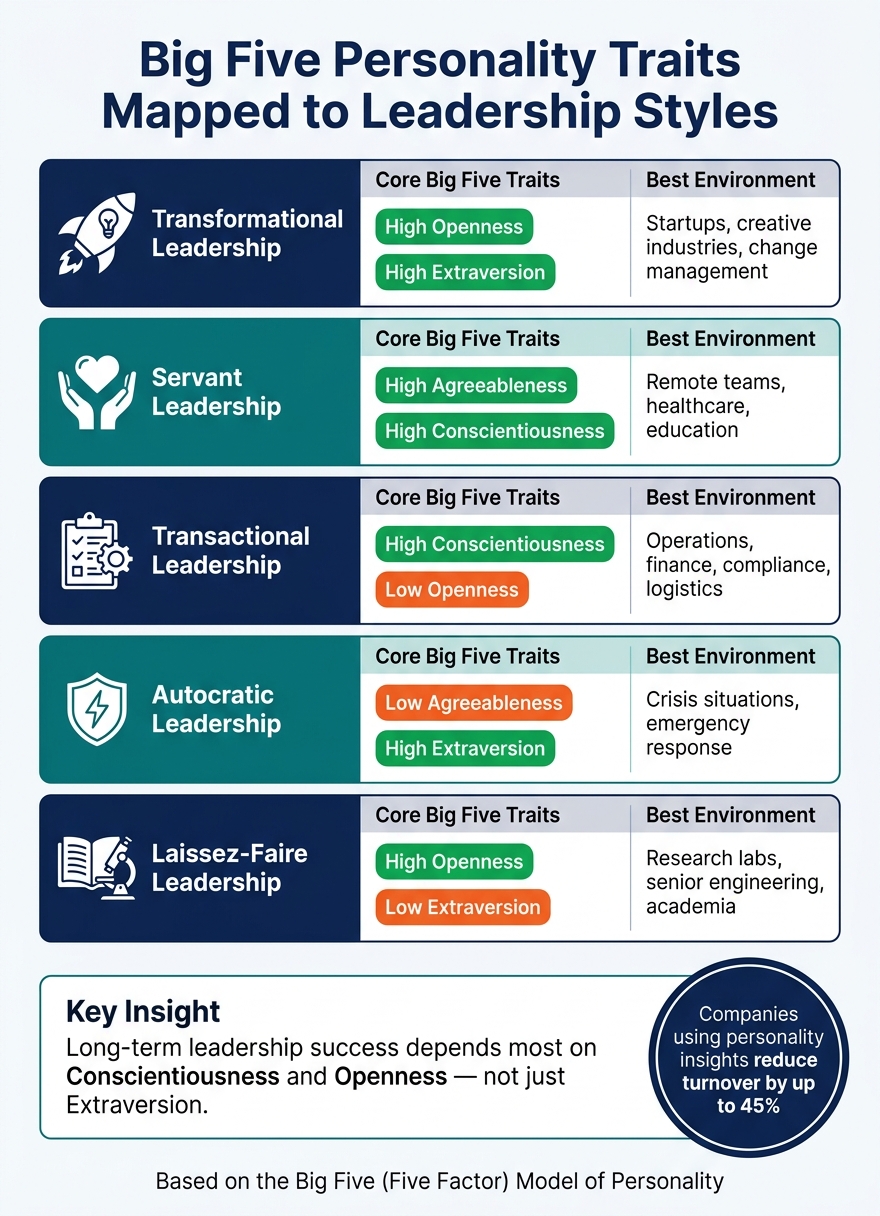
Big Five Personality Traits Mapped to Leadership Styles
How Personality Traits Map to Leadership Styles
Your personality doesn’t just shape how you lead - it often determines which leadership style feels most natural to you. By understanding this connection, you can stop working against your instincts and start aligning with them.
| Leadership Style | Core Big Five Traits | Best Environment |
|---|---|---|
| Transformational | High Openness, High Extraversion | Startups, creative industries, change management |
| Servant | High Agreeableness, High Conscientiousness | Remote teams, healthcare, education |
| Transactional | High Conscientiousness, Low Openness | Operations, finance, compliance, logistics |
| Autocratic | Low Agreeableness, High Extraversion | Crisis situations, emergency response |
| Laissez-Faire | High Openness, Low Extraversion | Research labs, senior engineering, academia |
Transformational leaders excel in environments that demand new ideas and shared vision, thanks to their high scores in both Openness and Extraversion. Servant leaders, driven by Agreeableness and Conscientiousness, focus on team well-being and reliability. Transactional leaders, on the other hand, thrive on structure and proven methods, relying on their high Conscientiousness and lower Openness to maintain order and efficiency.
It’s worth noting that while Extraversion might help someone step into a leadership role, maintaining long-term success often depends on Conscientiousness and Openness [4][5]. Leading effectively over time requires more than charisma - it demands consistency and adaptability.
Next, let’s dive into how assertiveness, a key element of Extraversion, plays into leadership success across different situations.
Dominance and Assertiveness in Leadership
Assertiveness, a critical aspect of Extraversion, affects how leaders communicate, make decisions, and project authority. However, its effectiveness depends heavily on the situation.
For example, high assertiveness is ideal in crisis scenarios, safety-critical operations, or emergency responses, where quick, decisive action is more important than consensus. In such cases, hesitation can lead to confusion or delays. That said, research highlights a "too-much-of-a-good-thing" effect: excessive assertiveness can turn into micromanagement, damaging trust and morale [4].
"Low Agreeableness enables tough decisions without being paralyzed by concern for others' feelings. High Extraversion provides the assertive energy to command." - JobCannon [4]
Interestingly, introverted leaders often outperform highly assertive ones when managing proactive, self-driven teams [4]. In these cases, a leader who listens more than they direct gives team members the space to contribute their best ideas. Assertiveness, therefore, isn’t inherently better - it’s a tool that works best when applied thoughtfully to the situation.
Adjusting Your Leadership Style for Different Teams
No single leadership style fits every team or situation. The most effective leaders develop a primary style that aligns with their natural traits while also cultivating one or two secondary styles to adapt when needed.
"The most effective leaders leverage their natural strengths rather than performing a leadership persona that drains their energy and undermines their authenticity." - Peter Kolomiets, Founder, JobCannon [4]
For instance, a Servant leader might embrace Transformational techniques, like inspiring bold visions, during periods of significant organizational change. Similarly, a Transactional leader managing a team of senior engineers might loosen rigid processes and adopt a Laissez-Faire approach to foster innovation and autonomy. For remote or distributed teams, combining Servant and Transformational leadership methods has been shown to increase engagement and maintain psychological safety across distances [4].
Regardless of your default style, Emotional Intelligence (EQ) serves as a universal enhancer [4]. It helps assertive leaders gauge the room before speaking and enables empathetic leaders to set boundaries when accountability is required. Developing EQ doesn’t mean altering your personality - it’s about making the most of your natural strengths.
How to Assess Your Own Personality Traits for Leadership
Using the Big Five for Self-Assessment
Understanding your leadership style begins with taking a closer look at your personality traits.
A great way to start is by using a well-regarded psychometric tool. The NEO Personality Inventory (NEO-PI-R), with its 240 prompts, is often considered the most thorough option. If you're looking for a free alternative, the IPIP-NEO (120-item version) is an excellent choice, closely aligned with the NEO-PI-R with a correlation of .94, and backed by data from over 619,000 participants [7]. For leadership purposes, the 120-item version is worth the extra effort, as shorter versions with only 10–20 questions lack the depth needed to evaluate all 30 subfacets accurately [7].
The Big Five framework stands out because it measures traits on a continuous scale, ensuring consistency with test-retest reliability above .80. This is a sharp contrast to the MBTI, which categorizes personality into binary types and shows about 50% inconsistency when retaken within five weeks [7].
When analyzing your results, focus on subfacets that are especially relevant to leadership. These include Assertiveness (under Extraversion), Achievement Striving (under Conscientiousness), and Vulnerability (under Emotional Stability, where lower scores indicate stronger stress resilience) [7]. These specific traits offer a clearer picture of how you function as a leader.
To refine your leadership skills further, consider pairing self-assessment with external feedback. Remember, personality can evolve over time. Research shows that traits like Conscientiousness and Emotional Stability often grow as leaders gain experience. Retaking these assessments every 12–24 months can help you track your personal development [7].
Using Feedback and AI Tools to Deepen Self-Awareness
While self-assessment is a valuable starting point, external feedback adds depth to your understanding.
Your own perspective provides a baseline, but it’s only part of the story. 360-degree feedback, which gathers insights from peers, direct reports, and supervisors, can reveal how others perceive your leadership traits. This comparison between self-assessment and team feedback can highlight areas for growth. For example, you might ask targeted questions like, "Do I create enough space for others' ideas before making decisions?" to better evaluate your assertiveness.
AI tools can take this process a step further by offering objective insights through data-driven coaching. Platforms like Personos bring the Five Factor Model into real-world leadership scenarios. Unlike static test results, Personos provides Dynamic Reports tailored to your relationships and team dynamics. It also uses conversational AI to offer situation-specific advice when you need it most. For leaders navigating complex team environments, this kind of personalized, real-time guidance can make a big difference.
"Your personality is your superpower. The first step to using it is understanding it." - AIMind360 [6]
The use of AI in personality assessments has grown significantly. As of 2026, AI-based tools have reached an accuracy level of 94.2%, and 78% of companies now include AI-driven personality screening in their processes [9]. These tools analyze workplace communication, speech patterns, and digital interactions for continuous profiling, going far beyond traditional annual surveys. What sets Personos apart from other AI tools is its focus on relationships. Instead of viewing your traits in isolation, it shows how they interact with the people you lead, turning abstract insights into actionable strategies.
Turning Personality Traits into Leadership Behaviors
Putting Your Traits to Work as a Leader
The key to effective leadership lies in translating your personality traits into visible, actionable behaviors.
For example, if you're high in Conscientiousness, focus on setting clear goals and consistently following through. If you rank high in Extraversion, channel that energy into leading dynamic meetings and advocating for your team externally. Those with high Openness can leverage their comfort with new ideas by encouraging innovative thinking and helping their team embrace challenges as opportunities.
But what about lower scores? They can guide growth just as much. A leader with a lower Agreeableness score isn't doomed to struggle with collaboration. Instead, they might need to work on building trust intentionally. This could mean asking more questions before making decisions or taking the time to acknowledge a team member's efforts before offering constructive feedback.
"Awareness and understanding of where clients fall within each element of the five-factor model can support more personalized development plans. Each trait can become a strength." - Jeremy Sutton, Ph.D., Psychologist and Coach [8]
By tailoring your actions to your personality, you create a foundation for fostering trust and psychological safety within your team.
Building Team Norms and Psychological Safety
Great leaders don't just manage their own traits - they actively shape the environment their team operates in. Creating psychological safety, where team members feel free to voice ideas without fear, requires consistent and intentional effort. By aligning your leadership style with personality insights, you can establish team norms that encourage trust and collaboration.
For instance, if your team's personality data shows several members with low Extraversion, consider setting up structured opportunities for written input before group discussions. This ensures quieter team members have their voices heard without being overshadowed by more outspoken personalities.
Connecting team goals to individual motivators is another game-changer. When people see how a goal aligns with their values and work style, they're more likely to commit wholeheartedly. This is where personality-aware leadership moves beyond theory and starts delivering real results.
While strong norms provide stability, AI tools can help reinforce these behaviors and make them stick over time.
Using AI to Develop Your Leadership Behaviors
Insight is only valuable when it leads to action.
Platforms like Personos are designed to bridge the gap between understanding and application. Its ActionBoard transforms personality insights into actionable, trackable tasks, ensuring that behavioral goals don't fade away after a workshop. As Personos explains:
"The science is sound... but all of that only matters if it turns into measurable outcomes. That's where the ActionBoard comes in, the solution to the 'Insight-Action Gap'." - Personos [10]
Personos also offers bite-sized Prompts that you can schedule daily or weekly, providing gentle nudges to help you stay on track with your behavioral goals. And when you're dealing with a complex situation, its conversational AI steps in. You can describe the scenario you're facing, and it will use personality profiles, research, and context to offer tailored guidance. As Personos puts it: "The core of Personos allows you to describe any situation or problem you're facing and it will leverage all relevant personality profiles, contextual information, the research, and situational details to give you the answer or guidance you need." [10]
This kind of personalized, situation-aware support ensures that leadership development becomes an ongoing process, not just a one-time exercise.
Conclusion: Using Personality Awareness to Lead Better
Your personality traits aren't set in stone - they're a starting point for growth. Research shows the Big Five traits account for 28% of leadership emergence and 15% of leadership effectiveness. While these numbers highlight their importance, they also show there's plenty of room to develop and refine your abilities.
The key is embracing continuous self-awareness. Interestingly, while 95% of people think they're self-aware, only 10–15% actually are. This gap presents a huge opportunity for leadership growth. By using structured feedback, regular reflection, and consistent practice, you can sharpen your decision-making, improve communication, and build trust. This ongoing self-awareness helps you adjust your behavior in real time, making you a more effective leader.
Take a closer look at your traits - figure out which ones are your strengths and which ones might become blind spots if overused. Then, make thoughtful adjustments to align with your team's needs. For instance, an assertive leader might slow down during brainstorming sessions to encourage fresh ideas, while a highly agreeable leader could set firmer boundaries during a crisis to earn respect. The goal isn't to stay the same but to stay flexible. By playing to your strengths and addressing your blind spots, you create a leadership style that leaves a lasting impact.
To make this process even smoother, consider using AI tools like Personos. These tools turn personality insights into actionable steps with features like Dynamic Reports, role-specific guidance, and an ActionBoard. Executive coach David Kim, PCC, shares his experience:
"I've coached C-suite executives for 15 years, and Personos changed my practice overnight. It surfaces blind spots I would have taken months to uncover. It's like having a co-pilot who never misses a detail." [1]
While personality awareness won't solve every leadership challenge, it provides a clearer understanding of your tendencies, deeper insights into your team, and a more thoughtful way to navigate tough situations. This intentional approach can make all the difference in how you lead.
FAQs
Can introverts be great leaders?
Yes, introverts can thrive as leaders. Their natural abilities - like empathy, active listening, approachability, and remaining calm under pressure - are incredibly effective in leadership positions. These qualities help them establish trust, encourage teamwork, and make well-considered decisions, showing that leadership is not exclusive to extroverted individuals.
Which Big Five trait matters most for leadership?
Extraversion stands out as a key trait within the Big Five personality framework when it comes to leadership. Studies repeatedly highlight that individuals with high levels of extraversion are particularly effective at connecting with others, fostering teamwork, and motivating people to take action. This makes them especially successful in both emerging as leaders and performing effectively in leadership roles.
How can I change my leadership style without changing my personality?
You can adjust your leadership style without changing who you are at your core by using your natural strengths in different ways. For instance, you might tweak how you communicate or make decisions based on the situation. Tools like AI-driven personality platforms, such as Personos, offer personalized insights to help you fine-tune your approach. This allows you to remain authentic while being more adaptable and effective in various scenarios.