5 Personality Traits That Impact Team Dynamics
How the Big Five—openness, conscientiousness, extraversion, agreeableness, emotional stability—shape collaboration, conflict, and team performance.
Nick Blasi

5 Personality Traits That Impact Team Dynamics
Personality shapes teamwork. The Big Five traits - Openness, Conscientiousness, Extraversion, Agreeableness, and Emotional Stability - play a significant role in how teams collaborate, solve problems, and meet goals. Understanding these traits helps managers and team members work better together.
Here’s a quick breakdown of how each trait impacts teams:
- Openness to Experience: Encourages new ideas but can challenge deadlines if not balanced.
- Conscientiousness: Drives reliability and task completion but may cause friction with less structured team members.
- Extraversion: Energizes group discussions but can overshadow quieter voices.
- Agreeableness: Promotes harmony but may avoid necessary debates.
- Emotional Stability: Maintains calm under pressure but varies in handling stress.
AI tools like Personos provide real-time insights into these traits, helping teams improve communication, resolve conflicts, and align on goals effectively. By leveraging this understanding, teams can turn personality differences into strengths.
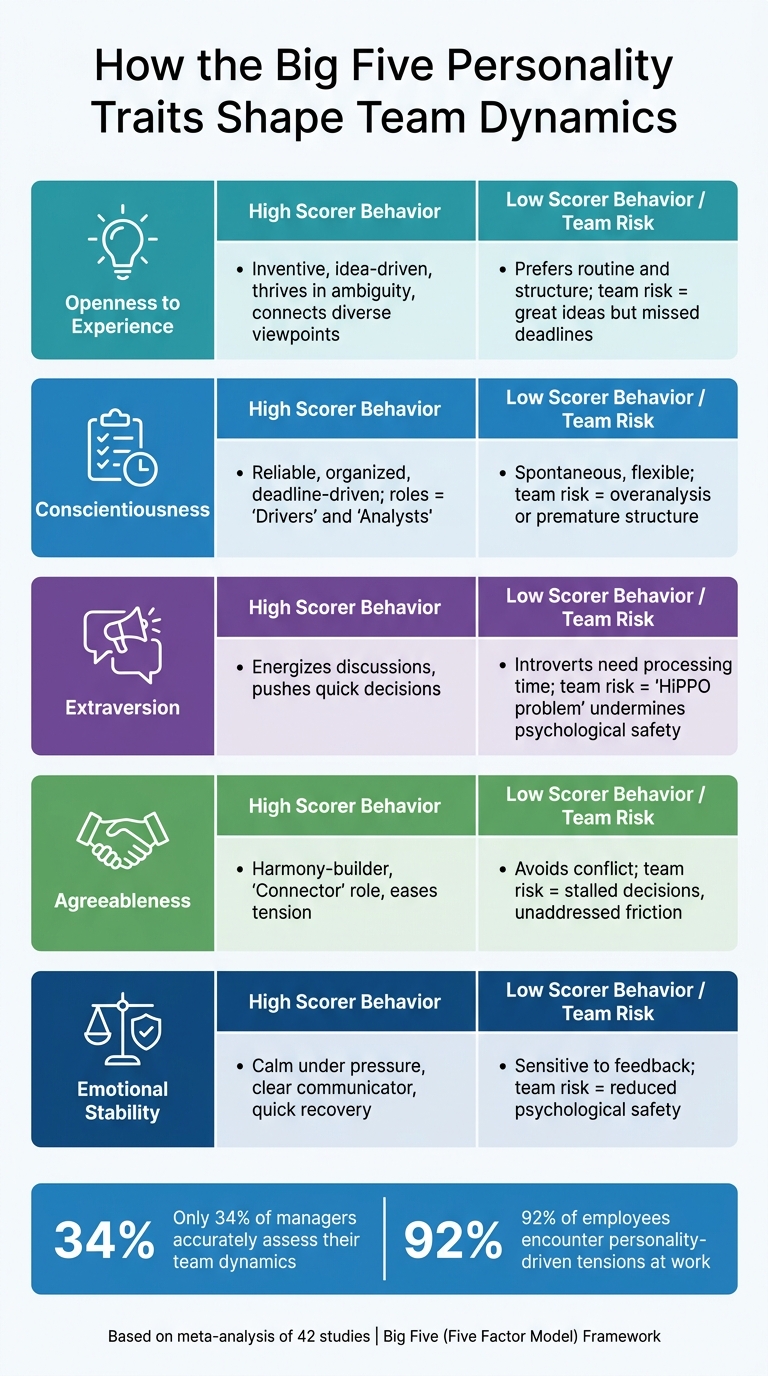
Big Five Personality Traits & Their Impact on Team Dynamics
Unlocking Personalities: Understanding the Big Five Model
1. Openness to Experience
Openness to experience reflects how curious and willing someone is to explore new ideas and perspectives. This trait influences how individuals approach brainstorming and handle unexpected challenges.
People who score high in openness often come up with inventive solutions, question existing assumptions, and find ways to connect ideas from different areas. They thrive in complex and uncertain situations, often acting as connectors between diverse viewpoints. Low scorers, however, lean toward tried-and-true methods, structured processes, and familiar routines. They excel in tasks that require precision and consistency but may find it challenging to adapt or take creative risks.
Peter Kolomiets, Founder of JobCannon, puts it well: "The best team design isn't maximum similarity - it's strategic complementarity." [1] Neither high nor low openness is inherently better - it’s about the right balance for the team. A group full of high-openness individuals might generate groundbreaking ideas but struggle with deadlines. On the other hand, a team dominated by low-openness members could deliver reliably but falter when faced with shifting market demands. Here's a quick breakdown of these dynamics:
| Team Pattern | Composition | Primary Risk |
|---|---|---|
| Innovation-heavy | High Openness, Low Conscientiousness | Great ideas but missed deadlines |
| Execution-heavy | Low Openness, High Conscientiousness | Strong delivery but poor adaptability |
| Balanced high-performer | Varied Openness, High Conscientiousness | Harder to build; needs active management |
To get the most out of both styles, it’s helpful to separate the idea-generation phase from evaluation. For example, using asynchronous tools before meetings allows high-openness individuals to develop creative ideas without pressure, while giving low-openness team members a clear framework to assess and refine those ideas. Tools like Personos can take this further by providing Dynamic Reports. These reports offer insights into how team members with different openness scores communicate, where potential friction might arise, and how to address it effectively in real time.
Balancing innovation with execution is key, setting the stage for the next factor: conscientiousness, which further shapes team performance.
2. Conscientiousness
Conscientiousness describes how organized, reliable, and disciplined someone is. On a team, this trait plays a central role in ensuring tasks get done effectively. In fact, a meta-analysis of 42 studies found that team conscientiousness consistently predicts task performance across industries [1]. A team with higher levels of conscientiousness tends to execute tasks more reliably.
Individuals with high conscientiousness often fall into two key roles. First, there are the "Drivers" - those who combine conscientiousness with high extraversion. They focus on meeting deadlines and holding others accountable. Then, there are the "Analysts" - those who pair conscientiousness with high openness. Analysts excel at quality control and spotting potential issues. Both roles are essential, but each comes with challenges: Drivers may overly structure processes before creative ideas are fully explored, while Analysts can get stuck in overanalyzing [1]. These differences can sometimes lead to clashes in work styles.
For instance, when team members with varying levels of conscientiousness collaborate, friction can arise. A meticulous planner may seem overly rigid to a spontaneous colleague. This tension can be amplified when conscientiousness interacts with traits like openness or extraversion, as discussed earlier in this article.
To ease these conflicts, it helps to separate brainstorming sessions from critique phases. This approach prevents premature judgment while giving deliberate thinkers the structure they need to feel satisfied. Setting clear decision points also ensures that flexible team members aren't forced to commit too early [1]. Tools like Personos can support teams in managing these differences. By mapping conscientiousness levels and identifying potential friction points, Personos provides actionable insights through its Dynamic Reports, helping teams navigate work-style challenges in real time. You can learn more about their platform at Personos.
3. Extraversion
Extraversion plays a key role in determining how much energy someone gains from social interactions - it influences who actively engages and who tends to hold back. Research shows that teams with a mix of introverts and extraverts often make better decisions compared to groups dominated by extraverts. This is despite the fact that extravert-heavy teams might seem more confident. This phenomenon, sometimes referred to as the "HiPPO problem", can undermine psychological safety. Google's 2016 Project Aristotle highlighted psychological safety as the strongest predictor of team success. Without it, introverted or agreeable members may hesitate to share their ideas, potentially leading to missed opportunities for valuable input [1].
There are practical ways to ensure balanced participation within teams. For example, structured turn-taking can give everyone a chance to speak, while asynchronous brainstorming allows introverts to organize their thoughts before meetings. Another useful method is steelmanning, where someone is tasked with presenting an opposing perspective, encouraging deeper analysis and critical thinking. These strategies help create an environment where both introverts and extraverts can contribute effectively.
Personos offers a way to map team members' extraversion levels using the Five Factor Model. Their Dynamic Reports highlight potential communication challenges - like when a high-extraversion "Driver" pushes for quick decisions while a low-extraversion "Analyst" needs more time to process information. These reports provide real-time, actionable insights to address such friction and improve collaboration.
Up next, we’ll dive into how agreeableness influences team dynamics.
4. Agreeableness
Agreeableness plays a key role in how team members collaborate, resolve disputes, and build trust. Research, including a meta-analysis of 42 studies, highlights that a team's overall level of agreeableness strongly influences performance, particularly in areas like cooperation and managing conflict [1]. This trait is crucial in determining how teams navigate friction and disagreements.
Team members with high agreeableness often take on the "Connector" role, promoting harmony, easing interpersonal tensions, and giving quieter team members a voice. While this can be a major asset in collaborative environments, it also comes with challenges. For instance, in teams where low agreeableness intersects with high extraversion, agreeable individuals might hesitate to voice dissent, potentially harming psychological safety. On the flip side, teams with uniformly high agreeableness may avoid necessary but uncomfortable debates, prioritizing harmony over progress. These dynamics are reflected in different team patterns:
| Team Pattern | Typical Composition | Core Risk |
|---|---|---|
| Harmony-heavy | High mean agreeableness | Avoiding conflict can hinder tough decision-making |
| Balanced high-performer | Diverse extraversion, high-average conscientiousness, varied openness | Harder to build but ideal for tackling complex challenges |
The goal isn’t to reduce agreeableness but to create structured ways for dissent to be expressed. For example, assigning a team member to "steelman" an opposing perspective can encourage respectful debate while maintaining collaboration.
To address these challenges, structured interventions can make a big difference. Tools like Dynamic Reports from Personos provide AI-driven insights into team dynamics. These reports can flag when a team’s agreeableness leans too heavily toward harmony, helping managers pinpoint the roots of stalled decisions or unaddressed conflicts. By offering tailored, personality-aware communication strategies, Personos helps teams strike the right balance between collaboration and critical thinking.
5. Emotional Stability
Emotional stability - essentially the ability to stay composed under pressure - plays a big role in how team members handle stress, setbacks, and uncertainty. It’s crucial for keeping a team cohesive. People with high emotional stability tend to stay calm, recover quickly from challenges, and communicate clearly even in tough situations. On the other hand, those with lower emotional stability might react more intensely to setbacks, be more sensitive to unclear signals, or view neutral feedback as negative. While neither approach is inherently "wrong", these differences can quietly disrupt a team's sense of safety if they’re not addressed.
Google’s Project Aristotle highlighted that psychological safety is key to team success [1]. If some team members respond to mistakes with defensiveness or anxiety, it can lead others to hold back their ideas or avoid bringing up potential problems. This lack of open communication can ultimately hurt the team’s performance.
"Psychological safety is a belief that one will not be punished or humiliated for speaking up with ideas, questions, concerns, or mistakes." - Amy Edmondson, Researcher [4]
To reduce these risks, teams can adopt strategies that lower vulnerability. Instead of focusing on screening for emotional stability, create systems that encourage open dialogue. For instance, replace vague questions with specific prompts that actively invite differing opinions. Collecting anonymous input before meetings can also give quieter or more sensitive team members a way to share their thoughts without the pressure of speaking up in front of everyone [4]. These small adjustments can make a big difference in improving team dynamics.
AI tools can also help managers navigate these challenges. Platforms like Personos, which uses the Five Factor Model, provide insights into team members’ stress triggers and communication preferences, helping managers approach tough conversations more effectively. For example, in February 2026, Kraft Heinz introduced an AI coaching tool called "Nadia" to support managers. One factory manager even used it at 3:00 AM to prepare for a critical crisis meeting when HR wasn’t available [3]. Tools like these show how technology can empower managers to handle high-pressure situations with greater confidence and understanding.
Using AI to Navigate Personality Traits in Teams
Understanding personality traits is one thing - putting that knowledge into action when it matters is something else entirely. This is where AI tools are making a real impact for team leaders and professionals. By connecting insights with practical application, AI tools provide a more dynamic solution than traditional assessments.
The problem with traditional assessments is that they often deliver static results that lose relevance over time. AI platforms like Personos address this issue by using conversational AI to offer real-time, situation-specific guidance. For example, before a tough one-on-one meeting, Personos can provide a tailored guide that outlines the other person's communication style, stress triggers, and motivators. It even follows up between meetings with brief, actionable prompts - all based on the Five Factor Model, a scientifically validated framework that evaluates 30 personality traits on an 80-point scale.
Personos takes this a step further with its Dynamic Reports, which generate insights at three levels: individual, relationship, and group. This gives leaders a comprehensive view of their team's personality makeup. Research backs up the importance of this approach - a meta-analysis of 42 studies found that team personality composition is a strong predictor of performance across various industries [1]. In other words, having accurate, up-to-date personality data isn’t just helpful - it can be a competitive edge.
For day-to-day management, the platform’s ActionBoard turns insights into trackable tasks, ensuring that recommendations lead to measurable improvements in team collaboration. Unlike general HR platforms that tack on personality features as an afterthought, Personos is specifically designed to handle the complexities of human interactions. The platform’s AI can identify personality traits with up to 82% accuracy [5], offering a much-needed alternative to relying solely on intuition when managing diverse teams.
Conclusion
The five traits discussed - Openness, Conscientiousness, Extraversion, Agreeableness, and Emotional Stability - work together to influence how teams make decisions, handle conflicts, and achieve their goals. These traits don’t exist in isolation; instead, they interact to shape the dynamics and overall effectiveness of a team.
Striking the right balance between creativity and dependable execution is key to team success [1]. However, many managers struggle to fully understand their team’s dynamics. In fact, only 34% of managers accurately assess these dynamics, leaving critical tensions unaddressed - tensions that 92% of employees encounter [2].
This is where tools like Personos come into play. By turning personality insights into actionable guidance, Personos helps teams navigate tough conversations, resolve conflicts, and build stronger working relationships [2][3]. It provides a shared, science-based framework for understanding interactions, making it easier to transform potential friction into productive collaboration.
"Teams don't perform - people do. And people bring their full personality to every meeting, decision, conflict, and collaboration." - Peter Kolomiets, Founder, JobCannon [1]
While personality differences are inevitable, using them strategically can turn challenges into opportunities for growth and teamwork.
FAQs
How do the Big Five traits affect team performance?
The Big Five personality traits - Openness, Conscientiousness, Extraversion, Agreeableness, and Neuroticism - play a key role in shaping how people interact, work together, and get things done. For instance, individuals with high Conscientiousness tend to be dependable and organized, while those high in Agreeableness excel at resolving conflicts and fostering harmony. When a team has a well-rounded mix of these traits, it can significantly enhance collaboration and overall productivity. Leaders can further boost team performance by adapting their approaches to align with these traits, using AI-driven tools to analyze and interpret personality dynamics in real time.
What’s the best personality mix for a team?
Teams work best when their personalities create a balance that promotes collaboration, innovation, and efficiency. Studies show that a mix of diverse traits often leads to better results. For instance, team members with high Conscientiousness and Agreeableness can ensure tasks are completed reliably and in a harmonious environment. Meanwhile, those with Openness and Extraversion bring fresh ideas and strong communication skills to the table. Tools like Personos can assist in identifying these complementary traits, helping teams build trust, maintain accountability, and work together more effectively.
How can AI like Personos help reduce team conflict?
AI tools such as Personos help minimize team conflicts by offering real-time insights tailored to individual personalities. Using the Big Five personality model, Personos analyzes traits and provides customized guidance to improve understanding and communication within teams. By addressing potential misunderstandings early, it helps teams work together more effectively.
With features like dynamic reports and actionable prompts, Personos supports trust-building and smoother interactions. The result? Teams experience better collaboration, improved harmony, and greater overall productivity.