5 Personality Traits That Boost Team Creativity
How five Big Five traits—openness, proactivity, conscientiousness, extraversion, and emotional stability—shape team idea generation and execution.
Rachel Johnson

5 Personality Traits That Boost Team Creativity
Want to make your team more effective at generating ideas and solving problems? The secret lies in understanding and leveraging personality traits. Research shows that teams with diverse traits perform better because they bring different strengths to the table. Here are five key traits that play a role in improving teamwork and idea generation:
- Openness to Experience: Encourages curiosity and unconventional thinking, driving idea generation.
- Proactive Personality: Pushes for action and improvement, ensuring ideas don't stay on paper.
- Conscientiousness: Adds structure and follow-through, turning concepts into results.
- Extraversion: Brings energy and collaboration to group discussions.
- Emotional Stability: Helps manage stress and conflict, keeping teams focused.
Each trait contributes uniquely to group dynamics, from sparking ideas to ensuring they're executed well. Balancing these traits within your team can lead to better problem-solving and more impactful outcomes. Below, we’ll explore how leaders can identify and develop these traits effectively.
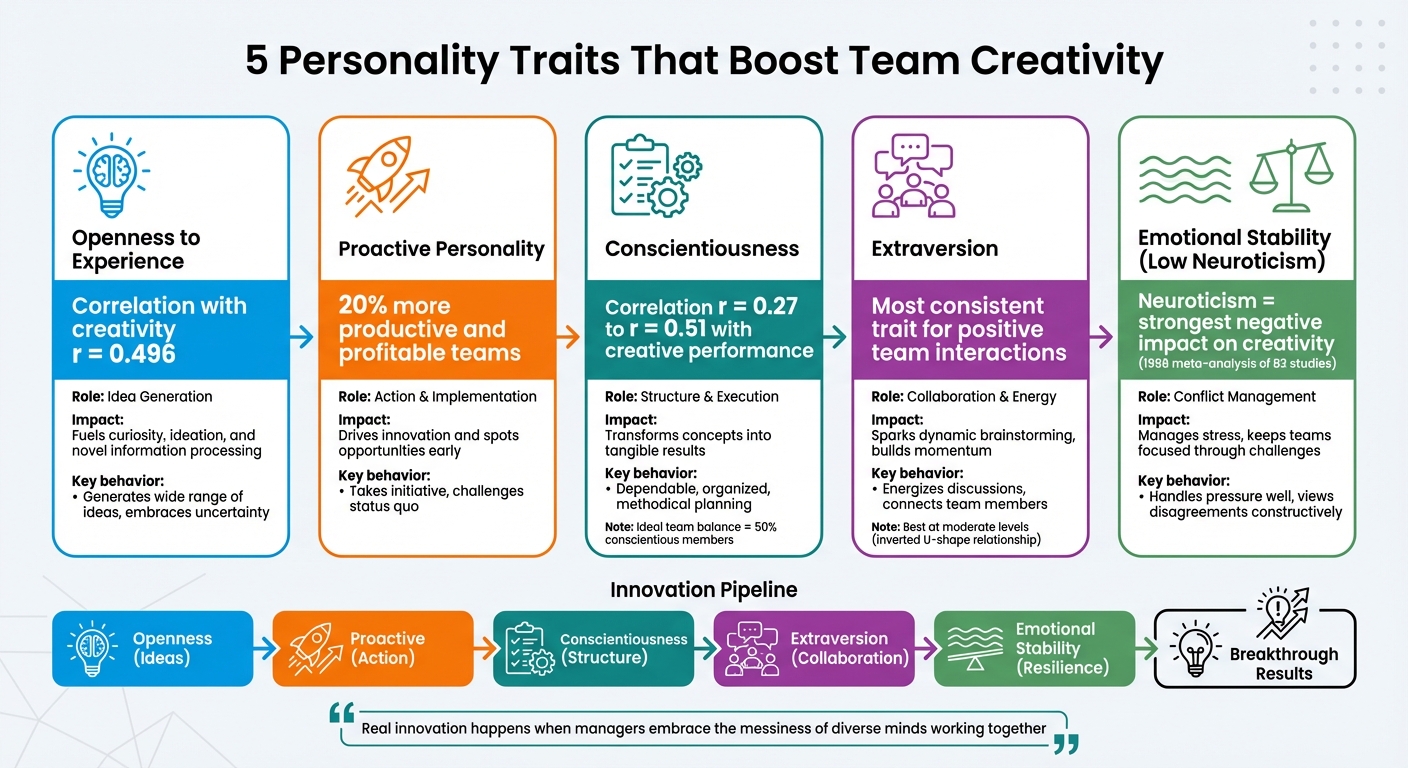
5 Personality Traits That Boost Team Creativity and Their Impact
1. Openness to Experience
Impact on Team Creativity
Openness is strongly linked to creativity, with studies showing a positive correlation (r = 0.496) [6]. This trait drives curiosity, a willingness to explore new ideas, and the ability to tackle challenges from fresh perspectives - all of which are critical for fostering innovative thinking within teams.
"Openness fuels curiosity, ideation, and efficient processing of novel information." - ScienceDirect [4]
People who score high in openness tend to generate a wider range of ideas, embrace uncertainty, and seek out new approaches. They often possess high creative self-efficacy, or confidence in their ability to produce creative results, which encourages them to push boundaries. A study involving 220 full-time employees identified openness as the key factor in generating novel ideas, though the success of implementing those ideas often depended on the surrounding work environment [4]. This blend of creativity and adaptability helps teams achieve innovative and well-rounded outcomes.
How Leaders Can Identify This Trait
Leaders can spot openness by observing team members who are imaginative, curious, and open to unconventional ideas. These individuals are comfortable navigating ambiguity and consistently explore new concepts. Employees who take initiative on innovative ideas, even without formal approval, often demonstrate a readiness to challenge norms.
To gain deeper insights into team dynamics, leaders might use tools like Personos (https://personos.ai), which provide data-driven personality assessments. These platforms can help identify traits like openness, enabling leaders to adopt strategies that encourage creativity. Once leaders recognize openness in their teams, they can focus on nurturing it effectively.
Practical Ways to Nurture This Trait in Teams
Generating ideas is just the first step. Research shows that perceptions of fairness - ensuring effort and performance are properly acknowledged - are crucial for motivating open individuals to act on their ideas [4]. Without fair recognition, even the most creative team members can lose their drive.
Pairing open-minded team members with colleagues who have a strong need for cognition (those who enjoy deep, effortful thinking) can help turn imaginative ideas into actionable solutions [4]. Leaders should foster an environment where unconventional suggestions are welcomed and protected during discussions. Actively encouraging "out-of-the-box" ideas can make team meetings more dynamic [4] [6]. Additionally, when innovative ideas arise outside formal channels, leaders should evaluate their potential carefully instead of defaulting to rigid policy enforcement [5]. This approach ensures that creativity thrives without stifling innovation.
2. Proactive Personality
Impact on Team Creativity
Proactive individuals are always on the lookout for ways to improve, making them key drivers of innovation [7]. Research highlights that proactive personality traits strongly predict innovative work behavior and overall creative potential [3]. Think of them as a team’s early warning system - they spot opportunities and potential issues well before anyone else does [7].
Their determined, "can-do" mindset, described by 5 Voices as one where "can't" simply isn’t an option, helps teams push through challenges [7]. The impact is measurable: teams with proactive leadership are 20% more productive and profitable than average teams. They also achieve 10% higher customer satisfaction ratings [9]. These traits often show up in actions, making it easier for leaders to identify proactive team members.
How Leaders Can Identify This Trait
To spot proactive individuals, pay attention to those who take initiative, challenge the status quo, and willingly take ownership of their tasks [10]. These team members act independently, often addressing opportunities or problems before anyone else notices. When hiring, look for candidates with a track record of stepping up and showing initiative - this is a reliable indicator of their proactive nature [10].
Practical Ways to Nurture This Trait in Teams
- Create an environment where it’s okay to fail, encouraging bold and unconventional ideas [11].
- Build psychological safety by listening actively and giving constructive feedback. Research shows that when leaders are strong listeners, 57% of employees prefer corrective feedback over simple praise. Teams with leaders in the top 10% for feedback see engagement levels in the 77th percentile, compared to just the 25th percentile for teams with leaders in the bottom 10% [11].
- Encourage autonomy and experimental thinking to help team members explore different perspectives [9][11].
- Set clear and ambitious goals that are achievable, ensuring everyone understands how their contributions align with the team's objectives [9].
3. Conscientiousness
Impact on Team Creativity
Conscientiousness is the glue that holds creative ideas together, transforming them from concepts into tangible outcomes. While traits like openness fuel brainstorming and innovation, conscientiousness ensures that ideas are executed with structure and persistence. A 2021 meta-analysis examining over 550,000 responses highlighted this connection, showing correlations between conscientiousness and creative performance ranging from r = 0.27 to r = 0.51 [6] [12] [13]. These individuals excel at dependability, organization, and methodical planning, making them essential for managing the critical middle stages of creative projects [6].
But there’s a downside. As researcher Ian MacRae explains:
"A team full of conscientious planners might sound ideal... but it can stifle creativity. When everyone on the team is focused on the long-term plan, immediate opportunities can be missed" [12].
The key? A balanced team. Ideally, about half of the group should consist of highly conscientious individuals, while the rest bring spontaneity and flexibility [12]. Recognizing and balancing these dynamics is crucial for maximizing team creativity.
How Leaders Can Identify This Trait
Spotting conscientious team members is all about looking for those who take ownership and consistently deliver on long-term goals. These individuals rarely miss deadlines, maintain detailed documentation, and thrive in structured environments. They’re the ones who follow through on commitments and excel in roles requiring precision and reliability [12].
For a more systematic approach, leaders can use tools like Personos (https://personos.ai). This AI-driven platform, built on the Five Factor Model, provides real-time insights into team members’ traits. By identifying those with high conscientiousness, leaders can better align their strengths with organizational needs.
Practical Ways to Nurture This Trait in Teams
Once conscientious individuals are identified, it’s important to position them in roles that match their strengths. Assign them to tasks requiring meticulous planning and execution, while pairing them with more spontaneous thinkers. MacRae’s research supports this approach:
"When the planners are in the operational roles, and the spontaneous thinkers are in the creative roles, things run more smoothly" [12].
This pairing ensures that the team benefits from both innovative ideas and the structured execution needed to bring those ideas to life. By finding this balance, leaders can create a dynamic environment where creativity thrives alongside dependability.
4. Extraversion
Impact on Team Creativity
Extraversion injects social energy and enthusiasm into a team, often serving as the driving force behind creative collaboration. Extraverts thrive in group settings, drawing energy from interaction and sparking dynamic brainstorming sessions. Studies highlight that extraversion is the most consistent personality trait linked to positive interpersonal interactions within teams [14].
That said, too much extraversion can overshadow quieter team members, making balance essential. The connection between extraversion and team creativity often resembles an inverted U-shape - moderate levels enhance creativity, while excessive extraversion can stifle it. As 5 Voices explains:
"The most charismatic can inspire everyone to follow their vision, but they can also become overbearing and unintentionally aggressive; often drowning out the quieter voices at the expense of relationships and great ideas." [7]
The ideal scenario blends the energy of extraverts with space for quieter contributions, ensuring a dynamic yet inclusive environment. This balance allows leaders to harness the strengths of extraverts without letting their enthusiasm overwhelm the group.
How Leaders Can Identify This Trait
Leaders can spot extraverts by observing their natural ability to energize team dynamics. These individuals often take the lead in conversations, eagerly volunteer for tasks, and bring energy to collaborative efforts. They may also organize social events, maintain extensive networks, and leave meetings visibly recharged. As G. Damon Wells notes:
"Extraverted leaders are energetic and charismatic, excelling in social interactions and team motivation." [8]
For a more precise understanding, tools like Personos can assess extraversion on an 80-point scale as part of the Five Factor Model. This helps leaders not only identify extraverts but also determine the degree of their extraversion - critical for maintaining the right balance and avoiding potential downsides.
Practical Ways to Nurture This Trait in Teams
To make the most of extraverts' strengths, assign them roles where their energy and enthusiasm can shine, such as idea generation or acting as connectors between team members. Structured formats like round-robin discussions or pre-meeting idea submissions can encourage active listening and ensure quieter voices are heard [2][14].
Extraverts are particularly effective in the early stages of innovation, where their risk-taking and divergent thinking can build momentum [15]. By teaching extraverts to balance their contributions with space for others, teams can tap into their infectious energy while also benefiting from the quieter insights that might otherwise go unnoticed.
5. Emotional Stability (Low Neuroticism)
Impact on Team Creativity
Teams with strong emotional stability are better equipped to handle the inevitable tensions that arise during creative collaboration. When individuals effectively manage stress and emotions, they’re more likely to view disagreements as part of the innovation process rather than as personal attacks. In fact, a 1998 meta-analysis of 83 studies highlighted that neuroticism had one of the strongest negative impacts on creative performance [1].
High levels of neuroticism can lead to anxiety and self-doubt, which often suppress fresh ideas. Researcher Shanza Liaqat explains:
"High levels of neuroticism may lead to anxiety or emotional instability, which could hinder creativity in some individuals" [6].
On the other hand, emotionally stable team members are more adept at navigating the temporary inefficiencies that can occur when diverse viewpoints clash. This resilience helps teams achieve more refined and innovative outcomes, offering leaders valuable insights into their group’s emotional adaptability.
How Leaders Can Identify This Trait
Leaders can spot emotional stability by observing how team members respond to high-pressure situations or uncertainty. Those with strong emotional stability are often dependable, meet deadlines with ease, and develop effective solutions to unexpected problems. On the flip side, signs such as a drop in engagement, overly subdued reactions, frequent miscommunications, or forced politeness that conceals disagreements may indicate struggles with the emotional demands of creative work.
Practical Ways to Nurture This Trait in Teams
Fostering emotional stability is key to unlocking a team’s creative potential. A good starting point is to normalize the challenges that come with creative projects. Leadership coach Bethany Peters suggests:
"reassure them that some conflict is a natural and necessary part of the creative process, not a problem to avoid" [2].
This perspective can help reduce the anxiety that often accompanies healthy debates. Leaders can also implement practical strategies, such as setting clear guidelines for constructive feedback and encouraging stress management practices to counteract self-doubt. Providing brainstorming materials in advance can ease pressure for team members who feel overwhelmed by generating ideas on the spot. When emotional friction arises, it’s important for leaders to approach the situation calmly, seeking to understand the root cause before making corrections. Additionally, tools like Personos, which use AI to analyze emotional patterns, can provide valuable insights that help leaders support their teams in maintaining emotional balance.
8 STUNNING Personality Traits of Creative People
How to Identify and Develop These Traits in Your Team
To refine your team’s potential, it’s important to first recognize and then nurture the traits that drive creativity and collaboration. Begin by observing behaviors closely. Some team members might frequently ask "what if" questions, sparking new ideas, while others excel at identifying flaws and potential risks. Pay attention during meetings - who quietly offers insightful contributions, who thrives under pressure, and who performs better with extra preparation? These subtle patterns often reveal personality differences that traditional assessments might miss. Tools based on frameworks like the Big Five personality model can also help by providing a shared language to discuss these traits. That said, it’s essential to guard against affinity bias - the tendency to favor like-minded individuals - which can lead to groupthink and stifle innovation. Leadership coach Bethany Peters emphasizes:
"Real innovation happens when managers embrace the messiness of diverse minds working together" [2].
By combining behavioral observations with formal tools, you can gain a well-rounded understanding of your team’s dynamics. Techniques like self-reports, 360-degree feedback, or AI-powered platforms provide deeper insights into diverse thinking styles. Platforms such as Personos take this further by offering real-time collaboration guidance and generating reports that map out how different personalities interact.
Once you’ve identified these patterns, aligning roles with individual strengths can unlock the team’s creative potential. For example:
- Those high in Openness ("Ideators") excel in brainstorming sessions.
- Team members with strong Conscientiousness ("Critics") are great at evaluating ideas.
- Proactive individuals ("Doers") thrive in execution and implementation.
Mapping out these strengths can also help identify gaps, like having plenty of idea generators but not enough finishers. Adjusting team processes - such as using brainwriting or round-robin formats during meetings - can ensure everyone’s voice is heard and no perspective is overlooked [2].
Development doesn’t stop at alignment. Investing in intentional development programs is key. Studies show that fostering Openness to Experience - the trait most strongly linked to creativity, with a standardized coefficient of 0.418 - can lead to meaningful improvements [3]. Recognizing and celebrating small wins, like a team member posing a tough question that shifts strategy or resolving a tricky communication issue, reinforces the behaviors that drive innovation. By prioritizing these efforts, you help build a team that’s not only collaborative but also ready to generate groundbreaking ideas.
Conclusion
Effective creative teams thrive by blending a variety of personality traits, each playing a unique role in driving innovation. Openness fuels the curiosity and "what if" thinking that sparks new ideas. Proactive individuals ensure those ideas don't just stay on paper - they push them into action. Conscientiousness adds the discipline and structure needed to see projects through to completion. Extraversion brings in social energy, connecting the team to new perspectives and fostering collaboration. And Emotional Stability ensures that inevitable conflicts are handled productively, keeping the team focused on solutions rather than setbacks [3][6].
Together, these traits create what can be seen as an "innovation pipeline", transforming raw creativity into impactful results [3]. This interplay of personalities doesn't just generate ideas - it builds the foundation for effective teamwork. Personality differences aren't just a bonus; they are essential for moving from brainstorming sessions to real-world breakthroughs.
For leaders, the challenge lies in choosing the right tools to assess and enhance these traits within their teams. Options like the Big Five offer scientifically grounded insights, while DISC provides practical frameworks for role alignment. Tools like Personos, which measure 30 personality traits on an 80-point scale, offer real-time guidance tailored to specific situations. These platforms can generate Dynamic Reports that help leaders understand how team members interact, identifying gaps - like having too many idea generators but not enough people to execute. By using such tools alongside targeted development programs, leaders can fine-tune their teams for success [2].
It's important to remember that personality traits aren't set in stone. With intentional development efforts, team members can become more open, emotionally resilient, and better equipped to leverage their strengths while stepping into new roles [16][17]. This ongoing alignment of diverse traits is what drives a team from simply brainstorming to achieving meaningful innovation. The most successful teams embrace the power of different minds working together in harmony.
FAQs
What’s the best mix of these traits on one team?
The best mix of personality traits for a creative team includes openness, curiosity, confidence, and a collaborative mindset. Openness sparks new ideas, curiosity pushes boundaries, confidence inspires sharing, and collaboration keeps the team working smoothly. When these traits come together with the right skills, teams can generate fresh ideas and work effectively, paving the way for creativity and success.
Can leaders develop these traits, or are they fixed?
Leaders can grow these traits through deliberate effort and regular practice. Qualities such as openness and creativity aren't set in stone - they can be cultivated and improved over time through self-reflection, learning, and applying these skills consistently within team environments.
How can I measure these traits without bias?
To assess personality traits fairly, it's important to use tools that are backed by science, such as the Big Five model. This model provides consistent insights into traits like openness and conscientiousness. Incorporating standardized techniques and leveraging AI-driven platforms like Personos can further enhance reliability. Additionally, gathering data from multiple sources - like self-assessments and peer reviews - helps minimize bias. By blending these methods with an understanding of cultural and situational influences, you can achieve more balanced and accurate evaluations, which are valuable for fostering teamwork and encouraging creativity.