How Personality Shapes Burnout Risk
Explains how Big Five traits (neuroticism, conscientiousness, extraversion) influence burnout risk and outlines tailored workplace strategies.
Rachel Johnson

How Personality Shapes Burnout Risk
Why do some people burn out while others thrive under the same conditions? The answer lies in personality. Research shows that personality traits like neuroticism, conscientiousness, and extraversion can influence burnout risk by 20–40%. For example:
- Neuroticism increases vulnerability due to emotional instability.
- Conscientiousness can protect against burnout but may backfire when paired with perfectionism.
- Extraversion often reduces risk through social support but can lead to isolation burnout in remote roles.
Understanding these traits allows organizations to move beyond generic solutions and implement tailored strategies and leverage AI for burnout prevention to help employees manage stress effectively. Tools like Personos use personality data to create personalized burnout prevention plans, offering actionable insights for just $9 per seat monthly. Burnout isn’t caused by personality, but personality shapes how it unfolds - and knowing this can help teams thrive.
Burnout as a Workplace Problem
What Burnout Is and Why It Matters
Burnout isn’t about personal shortcomings or being ill-suited for a job. The World Health Organization (WHO) defines it as an occupational phenomenon in the ICD-11, making it clear that burnout stems from workplace conditions, not individual failings [7].
Christina Maslach’s framework is widely used to understand burnout. Her model highlights three key dimensions:
- Emotional exhaustion: Feeling drained and depleted of energy.
- Depersonalization: Developing a cynical or detached attitude toward clients or colleagues.
- Reduced personal accomplishment: Losing the sense that your work has meaning or impact.
These effects are especially pronounced in helping professions. Research shows that teachers and professors make up 26% of burnout study subjects, while nurses account for another 22% [1]. Burnout doesn’t just harm individuals - it leads to higher turnover rates, more mistakes, and diminished care or support for those who rely on these professionals.
How Burnout Differs from Everyday Work Stress
Everyone experiences work stress from time to time, but burnout is a different beast entirely. Understanding this difference is crucial for addressing it effectively.
"Burnout does not mean being tired... Burnout is something else entirely; a fatigue you feel deep inside your bones, caused by nervous system overload over a period of months or even years." - Robert Croley [3]
Stress is typically short-lived and tied to specific challenges, like a tight deadline or a difficult project. It often improves with rest or resolution of the issue. Burnout, on the other hand, is chronic. It builds up over months or years and doesn’t go away easily, even after taking time off [2].
| Feature | Everyday Work Stress | Burnout |
|---|---|---|
| Duration | Temporary; linked to tasks | Chronic; persists over time |
| Emotional State | Alertness or pressure | Emotional exhaustion |
| Recovery | Achievable with rest | Requires focused intervention |
| Primary Impact | Physical fatigue | Emotional depletion and detachment |
| Work Performance | May dip temporarily | Long-term decline in effectiveness |
Organizational and Individual Factors That Drive Burnout
Burnout is shaped by a mix of workplace dynamics and personal traits. It doesn’t happen in a vacuum. The Job Demands-Resources (JD-R) model explains that burnout occurs when job demands - like excessive workloads, emotional strain, or interpersonal conflicts - consistently outweigh the resources available, such as autonomy, support, or fairness [7].
Organizational culture also plays a big role. Workplaces that prioritize productivity while neglecting employee well-being, fail to offer authentic leadership, or suffer from misaligned values are more likely to push employees toward burnout. On the flip side, fostering fairness, peer support, and genuine autonomy can help prevent it [7]. Organizations can also use AI-powered personality reports to build the empathy needed for a supportive culture.
Individual traits also influence how people experience workplace stress. Personality shapes how someone perceives and copes with challenges, meaning two people in the same job might react very differently to similar pressures. Recognizing both organizational and personal factors is key to designing effective, tailored strategies to address burnout.
The Personality Patterns that Can Lead to Burnout
How Personality Traits Affect Burnout Risk
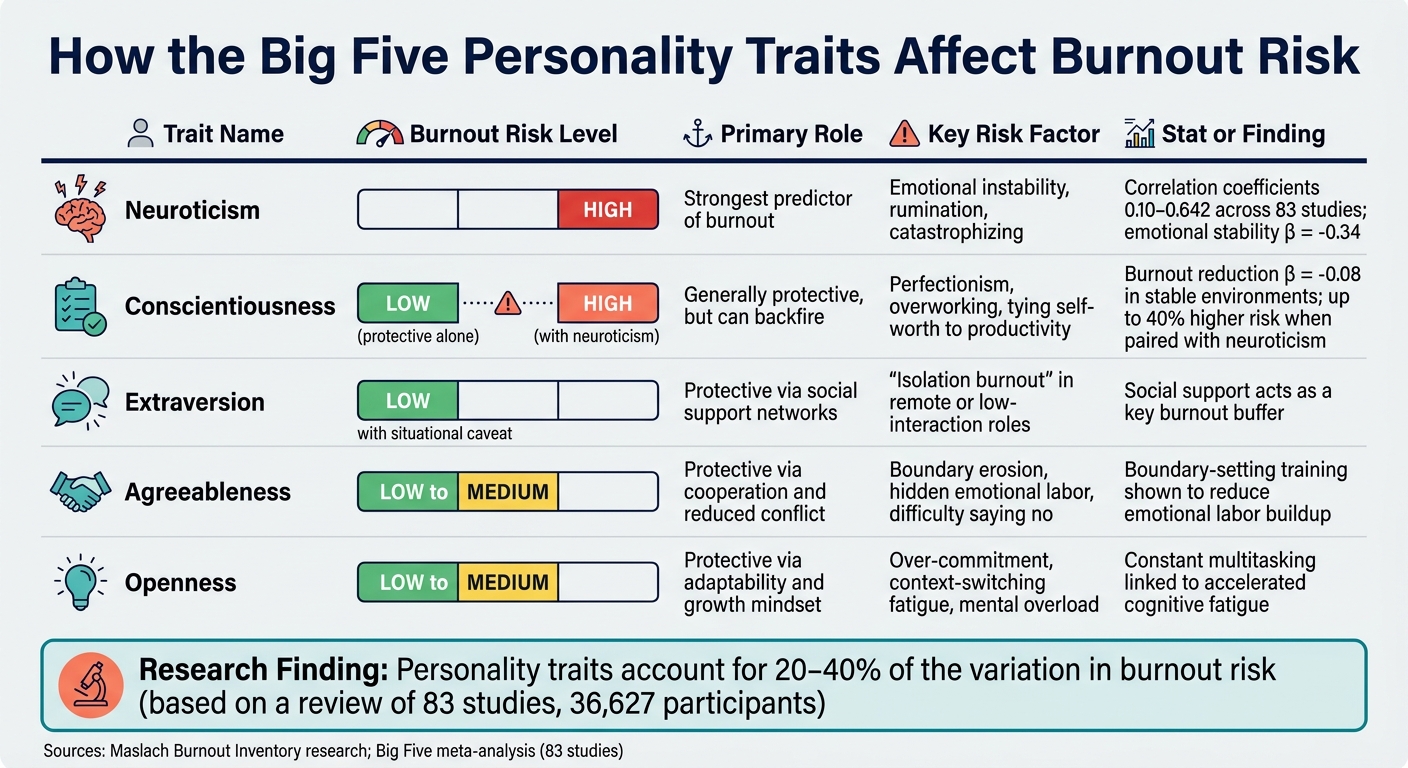
Big Five Personality Traits & Burnout Risk: What You Need to Know
Two individuals in identical roles, facing the same workload, can experience vastly different levels of stress. One key reason? Personality. Research shows that personality traits account for 20–40% of the variation in burnout risk [6]. The Big Five traits - Neuroticism, Conscientiousness, Extraversion, Agreeableness, and Openness - each play a unique role in shaping how susceptible someone might be to burnout. Let’s take a closer look at how these traits influence risk.
Neuroticism: The Strongest Predictor of Burnout
Among the Big Five, neuroticism stands out as the most consistent predictor of burnout. A review of 83 studies revealed a strong correlation between neuroticism and burnout, with coefficients ranging from 0.10 to 0.642 [1]. Individuals high in neuroticism - those prone to emotional instability and negative thinking - are particularly vulnerable.
People with high neuroticism often ruminate, catastrophize, and personalize stressors, which makes it harder for them to recover from stress.
"Some employees with high neuroticism may have a negative 'filter' in experiencing work stressors and can have increased levels of anxiety and emotional exhaustion." - Angelini [7]
Interestingly, emotional stability (the opposite of neuroticism) has a significant negative relationship with burnout (β = -0.34). This suggests that building emotional resilience can be a powerful way to lower burnout risk [7]. Without intervention, the tendencies linked to neuroticism can snowball, making targeted support essential.
Conscientiousness: Protective Trait or Hidden Risk?
Conscientiousness is generally seen as a shield against burnout. Conscientious individuals - who are organized and disciplined - tend to manage their workloads effectively. Longitudinal studies even show that higher conscientiousness is linked to a reduction in burnout over time (β = -0.08) [2]. In stable environments, this trait is undeniably beneficial.
However, in high-pressure situations, conscientiousness can backfire. Highly conscientious individuals may overwork themselves, take on extra responsibilities, and tie their self-worth to productivity.
"High Conscientiousness often shows up as overscheduling, perfectionism and an inability to stop once you've started. You feel responsible for doing things 'the right way,' so you pick up others' slack, stay late, and push through fatigue." - Robert Croley, Holistic Health Coach [3]
The highest burnout risk occurs when conscientiousness is paired with neuroticism. This combination - working relentlessly while doubting the quality of one’s work - can increase burnout risk by up to 40%, especially when perfectionist tendencies come into play [6]. Recognizing this interplay is key to creating effective interventions.
How Extraversion, Agreeableness, and Openness Factor In
The other three traits - Extraversion, Agreeableness, and Openness - influence burnout risk in more situational ways, often depending on specific workplace conditions.
| Trait | Primary Role | Key Risk |
|---|---|---|
| Extraversion | Protective via social support | "Isolation burnout" in remote or low-interaction roles |
| Agreeableness | Protective via cooperation | Boundary erosion and hidden emotional labor |
| Openness | Protective via adaptability | Context-switching fatigue from over-committing |
- Extraversion often lowers burnout risk by fostering strong social support networks and better coping strategies. However, for those lower in extraversion, especially in remote or isolated roles, the lack of meaningful interaction can lead to "isolation burnout."
- Agreeableness helps reduce workplace friction and fosters cooperation. Yet, highly agreeable individuals may struggle to set boundaries, taking on emotional labor to avoid disappointing others.
"For more Extraverted people, burnout often builds quietly when work or life become too isolated, such as long stretches of remote work." - Robert Croley, Holistic Health Coach [3]
- Openness encourages resilience by framing challenges as opportunities for growth. However, this curiosity can also lead to over-commitment and mental fatigue from constant context-switching [3].
Understanding how these traits influence burnout risk allows for more personalized and effective prevention strategies. Each trait highlights different vulnerabilities and strengths, offering a roadmap for tailored support.
Burnout Interventions Tailored to Personality
Understanding which personality traits increase burnout risk is only part of the solution. The other part? Knowing how to address it - and that depends on the individual.
Managing Workload and Boundaries by Personality Type
For highly conscientious individuals, the focus should be on separating their self-worth from their productivity. Setting a hard stop for the workday - and sticking to it - can help break the habit of overworking. Encouraging "good enough" standards instead of perfection isn’t about lowering expectations; it’s about showing how perfectionism can actually undermine their goals. Using metrics like documentation efficiency or collaboration quality can help shift their perspective.
"Personality does not cause burnout per se, but personality has a powerful effect on the presentation of burnout for you, and on what kind of recovery is the most effective." - Robert Croley, Holistic Health Coach [3]
For individuals prone to neuroticism, creating predictable workflows, setting clear expectations, and scheduling regular check-ins can make a big difference. Pair these with mindfulness exercises or grounding techniques to ease anxiety, rather than encouraging them to simply push through the stress [3].
These personalized adjustments create a foundation for broader team strategies that accommodate diverse personality needs.
Supporting Emotional Well-Being for At-Risk Staff
Team members high in agreeableness are often hesitant to ask for help. Assertiveness training can provide them with practical tools to set boundaries - like saying, "I can’t take that on right now" - without feeling guilty. Leaders can reinforce this by modeling boundary-setting themselves. As Brené Brown says, "Clear is kind." [9]
For staff shouldering heavy emotional demands (common among those high in agreeableness or neuroticism), reflective supervision is essential. This structured time allows them to process difficult emotions rather than letting those feelings build up. Combining reflective supervision with task rotation helps balance emotional labor across the team.
Team-Level Practices That Reflect Personality Differences
At the team level, the first step is awareness. Research from Bowling Green State University shows that teams often fall into four personality profiles: Resilient, Overcontroller, Undercontroller, and Reserved. Both Overcontrollers and Undercontrollers are more prone to burnout than Resilient types [8]. Mapping out these profiles can help leaders identify burnout risks early.
"Management of healthy, engaged workers may be aided by consideration of personality profiles." - Claire E. Smith, Department of Psychology, Bowling Green State University [8]
Small structural changes can make a big impact. Extraverted team members thrive on regular, real-time collaboration - not just asynchronous communication - to avoid feelings of isolation. Meanwhile, those high in openness benefit from having dedicated focus time and fewer overlapping projects, reducing the mental strain of constant multitasking. Research also highlights coworker support as a key factor in preventing burnout [2], making team norms around check-ins and shared workloads essential.
Leaders can also use tools like AI-powered platforms such as Personos to track personality profiles and implement tailored interventions. With these insights, leaders can fine-tune their strategies to better meet their team’s needs.
Using AI Tools to Address Burnout More Precisely
How AI Supports Personality-Based Burnout Prevention
AI-powered tools are now making it possible to apply personality-tailored burnout strategies with precision. These tools take the insights from frameworks like the Five Factor Model (FFM) and turn them into actionable recommendations.
For example, understanding traits like neuroticism and conscientiousness becomes far more impactful when used to guide specific actions. AI platforms can identify individuals with higher neuroticism who may benefit from early check-ins or flag those with both high conscientiousness and neuroticism who might be caught in a cycle of perfectionism. By analyzing facets such as Depression or Anxiety, AI enables early and targeted interventions, addressing burnout risks before they escalate [4].
A great example of this precision in action is Personos, a platform designed to transform personality insights into real-time burnout prevention strategies.
Personos: Built for Helping Professionals Under Pressure
Personos is tailored for professionals in high-stress roles like social work, coaching, and counseling - fields where burnout risks are high and mistakes can have serious consequences. Unlike generic wellness tools, Personos goes deeper by measuring 30 personality traits on an 80-point scale, offering a nuanced understanding of individual needs.
Here’s how Personos helps prevent burnout:
| Feature | Burnout Prevention |
|---|---|
| Conversational AI Chat | Uses personality data and situational context to provide tailored guidance, easing decision-making during stressful moments. |
| Dynamic Reports | Delivers updated insights for individuals and teams as circumstances change, avoiding the limitations of static assessments. |
| Prompts | Sends timely nudges, like boundary-setting reminders for those high in agreeableness, to encourage healthy habits. |
| ActionBoard | Translates insights into actionable steps, ensuring burnout prevention strategies are applied consistently. |
One standout feature is Transparent Reasoning, which explains the traits and logic behind AI recommendations. This empowers users to understand the reasoning rather than blindly follow suggestions. At just $9 per seat per month, Personos is an affordable option for nonprofits and smaller organizations that may not have the resources for larger wellness platforms.
With its dynamic and actionable approach, Personos stands out from traditional static tools.
How Personos Compares to Other Tools
Many personality-based platforms, like Crystal or Hogan Assessments, offer static reports that describe personality traits but lack adaptability. For example, Hogan Assessments is well-regarded for predicting leadership potential, but it’s primarily designed for hiring and executive development - not for managing burnout in frontline teams.
Personos, on the other hand, adapts to changing contexts. Its Dynamic Reports and conversational AI provide real-time, situation-specific guidance, making it especially effective for diverse teams. This adaptability is crucial for organizations aiming to address burnout proactively.
"When implementing organizational measures focusing on worker personality, those for preventing burnout are more effective compared with those promoting work engagement." - T. Fukuzaki & N. Iwata, PLOS One [2]
This underscores why tools like Personos, specifically designed for burnout prevention, offer a clear advantage over general productivity platforms. By focusing on burnout, Personos provides the kind of targeted support that can make a real difference.
Conclusion: Building Teams That Work With Personality, Not Against It
A comprehensive review of 83 studies involving 36,627 participants revealed a strong connection between personality traits and the risk of burnout [1]. Even when individuals hold the same roles, their susceptibility to burnout can differ significantly due to their inherent temperament.
"Personality traits create differential vulnerability that explains why some people sustain demanding work for decades while others burn out in comparable environments in months." – JobCannon [5]
Relying on a one-size-fits-all strategy to prevent burnout often fails to address individual needs. Tailored interventions, shaped by personality profiles, are far more effective. This concept ties back to the Job Demands-Resources model, where targeted support acts as a buffer, making prevention efforts more impactful compared to generic programs. These personalized strategies are increasingly supported by technology.
For most managers, tracking 30 personality facets across their teams and adapting strategies in real time is impractical. Tools like Personos simplify this process by transforming personality data into actionable, situation-specific guidance. At just $9 per seat per month, this level of precision becomes accessible to organizations of all sizes, including nonprofits and small businesses with limited resources.
The key takeaway? Burnout isn’t caused by personality, but personality shapes how burnout unfolds and what personality-based recovery support methods are effective [3]. Leaders who understand this can create environments that align with their team’s natural tendencies, fostering resilience and long-term well-being.
FAQs
Can personality tests really predict burnout risk?
Personality traits play a critical role in predicting burnout risk. Studies indicate that individuals with high neuroticism are more prone to burnout due to their heightened stress responses. On the other hand, traits like extraversion and emotional stability can serve as protective factors, helping individuals manage stress more effectively.
Tools such as Personos use the Five Factor Model to deliver personalized, real-time guidance. By analyzing personality traits, these tools can help professionals lower their burnout risk through customized interventions and better team communication strategies.
What if I’m both conscientious and neurotic?
Being both conscientious and neurotic can be a double-edged sword. While conscientiousness fuels ambition and high achievement, pairing it with neurotic tendencies often results in harsh perfectionism, overworking, and relentless self-criticism. This combination can quickly lead to burnout.
To counteract this, it's essential to set clear boundaries - like defining work end times or scheduling regular micro-breaks. Additionally, focus on personal values that go beyond just productivity. Tools such as Personos can provide personalized guidance based on your unique traits, helping you manage burnout and prioritize your well-being.
How can managers tailor burnout support without stereotyping people?
Managers can steer clear of stereotyping by focusing on individual personality profiles instead of assuming that employees in similar roles face the same challenges. Personality traits play a big role in determining how someone copes with stress. Tools like Personos, which use the Five-Factor Model, provide research-based insights. These insights help managers tailor their support, offering interventions that meet each employee's specific needs. This approach not only reduces burnout but also avoids the pitfalls of one-size-fits-all solutions.