Personality Retest Timing: Short vs. Long Intervals
Match retest timing to the decision: short gaps check short-term stability; long gaps track change—document intervals and test measurement invariance.
Rachel Johnson

Personality Retest Timing: Short vs. Long Intervals
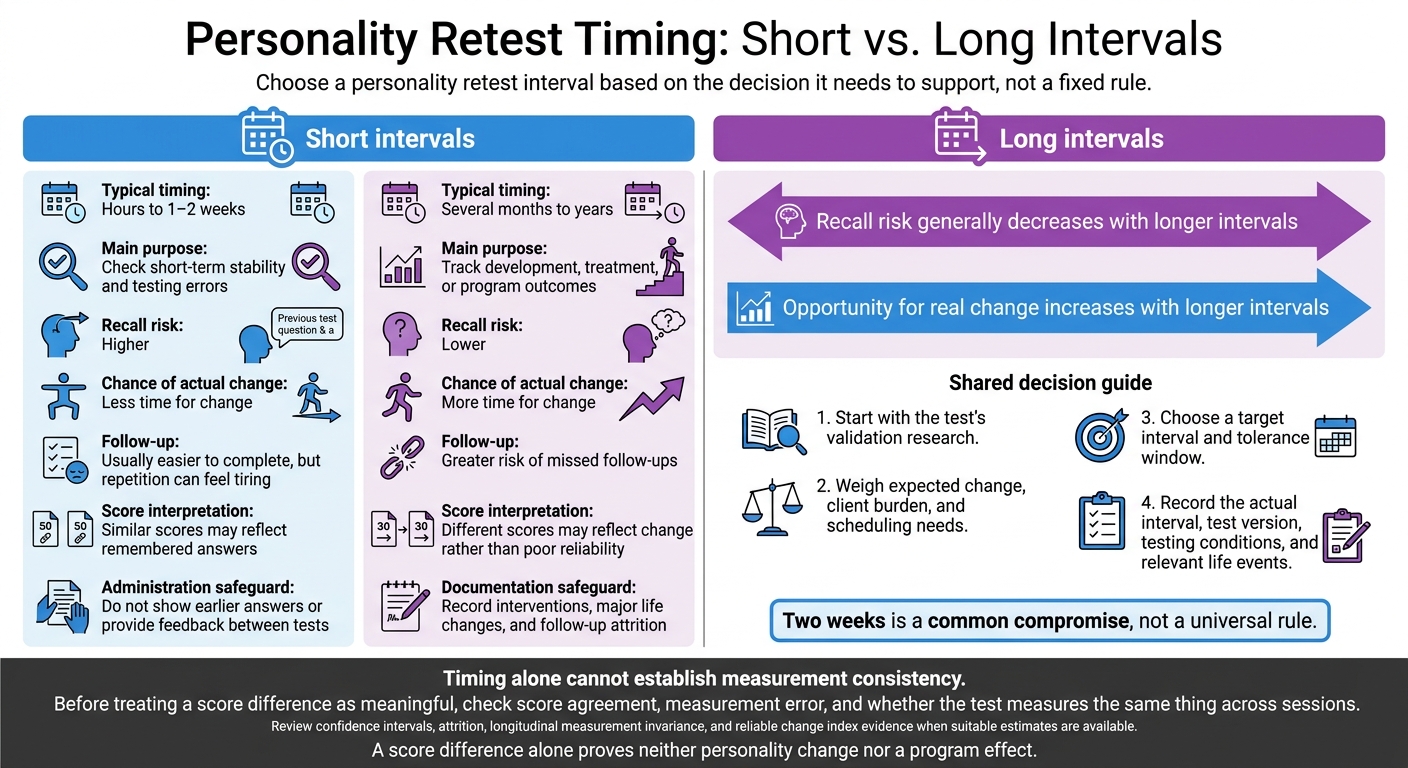
Choose a personality retest interval based on the decision it needs to support, not a fixed rule. Gaps of hours to 1–2 weeks can help assess short-term stability. Months to years allow more time to track change. Neither schedule, by itself, proves that scores are consistent.
Quick Comparison
| Criterion | Short intervals | Long intervals |
|---|---|---|
| Typical timing | Hours to 1–2 weeks | Several months to years |
| Main purpose | Check short-term stability and testing errors | Track development, treatment, or program outcomes |
| Recall risk | Higher | Lower |
| Chance of actual change | Less time for change | More time for change |
| Follow-up | Usually easier to complete, but repetition can feel tiring | Greater risk of missed follow-ups |
| Score interpretation | Similar scores may reflect remembered answers | Different scores may reflect change rather than poor reliability |
Two weeks is a common compromise, not a universal rule. Start with the test’s validation research, then account for expected change, client burden, and scheduling needs.
Record the actual interval, test version, testing conditions, and relevant life events. Before treating a score difference as meaningful, check score agreement, measurement error, and whether the test measures the same thing across sessions. Software can help preserve these records, such as AI tools for the Five Factor Model, but it cannot prove personality change or a program’s effect.
Personality Retest Timing: Short vs. Long Intervals
Reliability and Validity in Research: Test-Retest Reliability
Short vs. Long Retest Intervals
Interval length involves a trade-off: shorter gaps leave less time for real change but increase recall risk. Longer gaps reduce recall risk but allow more time for change. COSMIN recommends explaining the schedule based on expected change and recall risk.[7][9][11] This balance shapes how confidently you can interpret a score difference.
Use the comparison below to judge whether differences reflect memory, change, or both.
| Consideration | Short interval | Long interval |
|---|---|---|
| Recall risk | Higher, especially when the same items and response options appear again soon | Lower because participants are less likely to remember individual answers |
| Chance of real change | Limited; useful when stability is expected | Greater; scores may reflect development, intervention effects, life events, or changed circumstances |
| Score interpretation | Agreement can support short-term consistency, but familiarity or recall may inflate it | Lower agreement may reflect meaningful change rather than weak reliability |
| Analysis goals | Test-retest reliability, testing errors, and short-term stability | Longitudinal change, intervention follow-up, developmental trends, and program outcomes |
| Retention challenges | Usually easier to complete before contact is lost | Greater risk of failed follow-up contact, attrition, changed eligibility, and missing follow-up data |
Short Intervals: Less Time for Change, More Recall Risk
Intervals from hours to about 1–2 weeks work well when the measured trait should remain stable. Keep each administration independent: do not show earlier answers or provide feedback between tests.[8]
| Aspect | Practical implication |
|---|---|
| Uses | Test-retest checks, pilot testing, and detection of testing errors |
| Strengths | Leaves less time for genuine change; supports fast quality checks; reduces scheduling delays and participant loss |
| Recall and familiarity risks | Repeated items, response patterns, and feedback can inflate agreement |
| Client burden | Repetition may feel unnecessary or tiring, especially within days |
| Warning | High agreement may reflect recall, not validity |
Long Intervals: Less Recall, More Time for Change
Intervals of several months to years suit goals such as tracking personality development, evaluating an intervention or service program, and assessing follow-up outcomes. Lower agreement does not automatically mean poor reliability. The person, their circumstances, or both may have changed. Record interventions, major life changes, and follow-up attrition.[6][10][11]
| Aspect | Practical implication |
|---|---|
| Uses | Developmental tracking, program evaluation, intervention follow-up, and persistence of change |
| Strengths | Reduces direct recall and allows time for change |
| Risks | Attrition, failed follow-up contact, altered administration conditions, and missing data |
| Sources of score change | True development, treatment effects, major life events, temporary distress, measurement error, and changed interpretation of items |
Timing alone does not prove consistency.
Match the Interval to the Assessment Goal
Choose an interval that fits the construct and the decision you need to make. Start with the instrument’s validation evidence. Then weigh the construct’s expected rate of change, assessment length, participants’ age and circumstances, intervention exposure, and scheduling limits. Two weeks is a common compromise, not a universal rule.[5][7] Choose the shortest interval that still fits the construct and decision. This is particularly relevant when applying the Five Factor Model to dynamic environments like the workplace.
An intermediate interval may help when both immediate recall and genuine change are concerns. Use alternate forms only when the instrument’s evidence supports them, since switching forms adds another possible source of score differences. If the schedule shifts, record the actual interval.[7][11]
Why Timing Alone Cannot Prove Measurement Consistency
After choosing a retest interval, check whether the measure stayed comparable across waves. Elapsed time describes the schedule, not measurement consistency. Similar scores do not prove that the measure worked the same way each time. You need separate evidence about reliability, score agreement, measurement error, and longitudinal measurement invariance.[12][14]
Distinguish Reliability, Change, and Context
Test–retest reliability describes score consistency across administrations under defined conditions. Relative consistency means people stay in the same order; absolute agreement means their scores stay close. Internal consistency, measured by alpha or omega, describes how well items work together within one test. It does not establish stability across waves.
Interpret score differences in light of the interval, testing conditions, and recent life events. Distress, poor sleep, or conflict can shift scores without lasting change. Record relevant events rather than treating every difference as unreliability or every similarity as stability.
Check Measurement Invariance and Score Agreement
Before comparing scores across waves, test whether the measure behaved the same way each time. Longitudinal measurement invariance checks this at three levels: configural invariance tests for the same factor structure, metric invariance tests for comparable loadings, and scalar invariance tests for comparable intercepts or thresholds. Using identical instructions does not, by itself, establish invariance.[12][14][17]
Choose the analysis based on the decision you need to make. Correlations assess relative ordering. For absolute agreement, use an intraclass correlation coefficient (ICC) with the appropriate model. Also review mean change, confidence intervals, and measurement error. When suitable reliability and error estimates are available, a reliable change index (RCI) can flag change beyond random error. It cannot establish the cause or clinical meaning of that change.[13][15][16]
Check whether testing conditions were comparable and whether people who completed follow-up differed from those who dropped out. Complex invariance tests and ICC selection often call for a psychometrician’s help with interpreting retest results. Log the actual interval and testing conditions to support that work.
Plan and Document the Retest Schedule
Start with the decision the retest will support. Then choose a target interval and tolerance window that fit client availability and staff capacity. Document the schedule carefully: timing alone does not determine how to interpret results.[4][7] Once you set the interval, make the retest easy to complete and audit.
Postpone retesting during an acute crisis unless it affects immediate safety planning. Keep scheduling clear and convenient, since a confusing or difficult process can prevent follow-up.
Reduce Client Burden
Pair retesting with an existing appointment when possible. Explain its purpose, duration, data use, privacy limits, and any fees. Obtain informed consent, and confirm the client’s language, accessibility, technology, and testing-mode needs.[19][20]
Use alternate forms only when their comparability has been validated. Randomizing item order may reduce recall, but it does not prove that scores are equivalent.[18]
Log Actual Intervals and Assessment Conditions
Documentation connects the chosen interval to score interpretation. Use software that records planned and actual dates, start and completion times, time zones, wave IDs, elapsed intervals, and the rule used to calculate elapsed time. Record dates in US format:
Nov 17, 2026
Mark each completion as on time, late, or early. Record why the schedule changed rather than applying a generic follow-up label.
Preserve the instrument version, language, item set, scoring, testing mode, duration, interruptions, accommodations, assistance, and consent status. Link every score comparison to the exact instrument versions used.
Record only the context needed to interpret scores, with role-based access and suitable retention rules. Software helps only if it preserves the details needed to interpret each assessment wave.
Personos: Personality Profiles and Follow-Up
Personos can support follow-up if it records exact dates, times, time zones, wave IDs, elapsed intervals, version history, and item-set changes. Verify these capabilities before use.
Better engagement or completed goals do not prove personality change, reliability, or measurement invariance.
Conclusion: Choose Timing Based on Purpose and Evidence
Short and long intervals serve different purposes. Short gaps limit true change but increase recall risk and testing burden. Long gaps reduce recall but allow more true change and participant attrition.[4][21]
Choose the shortest interval that fits the construct and the decision. Explain your choice, and interpret results based on the actual interval and testing conditions.[9]
Timing alone cannot establish measurement consistency. Before calling a change meaningful or attributing it to a program, check measurement error, reliable change index evidence, confidence intervals, attrition, and longitudinal measurement invariance. A score difference alone proves neither personality change nor a program effect.[6][10][22]
FAQs
What if my test has no retest guidelines?
If your assessment doesn’t include clear retest guidelines, an evidence-based framework like the Five Factor Model (FFM) can help you plan your approach. But timing alone can’t establish measurement consistency.
Personos uses the FFM to measure 30 traits on an 80-point scale. This level of detail helps professionals track progress and work through complex interactions between people. It does not replace retest guidance for your original assessment.
How can I separate recall effects from real change?
Retest timing alone can’t establish measurement consistency [1]. Track specific growth goals and behavior changes over time to help separate actual progress from the effects of memory or familiarity with the assessment [1][3].
Tools like Personos’s ActionBoard can turn insights into goals you can track, helping you monitor progress alongside retest results [1][2].
Can I compare scores from late retests?
Yes, but use caution: timing alone can't establish measurement consistency. Longer gaps reduce recall bias, but they also leave room for personality to change. That makes it harder to tell actual growth from instability in the assessment tool.
Personos uses a scientifically validated Five Factor Model to measure 30 traits on an 80-point scale. Its ActionBoard also lets users track progress. Still, score differences alone can't tell you whether someone's personality changed or the assessment produced inconsistent results.