Personality Research on Team Fit and Context
How Big Five traits—especially conscientiousness and agreeableness—shape team fit, role alignment, and context-sensitive collaboration.
Nick Blasi

Personality Research on Team Fit and Context
Personality can help with team fit, but it should not drive hiring or role decisions on its own. If I boil the research down, the pattern is simple: conscientiousness and agreeableness show the steadiest links with team results, but the effects are small to moderate, and context changes a lot.
Here’s the short version:
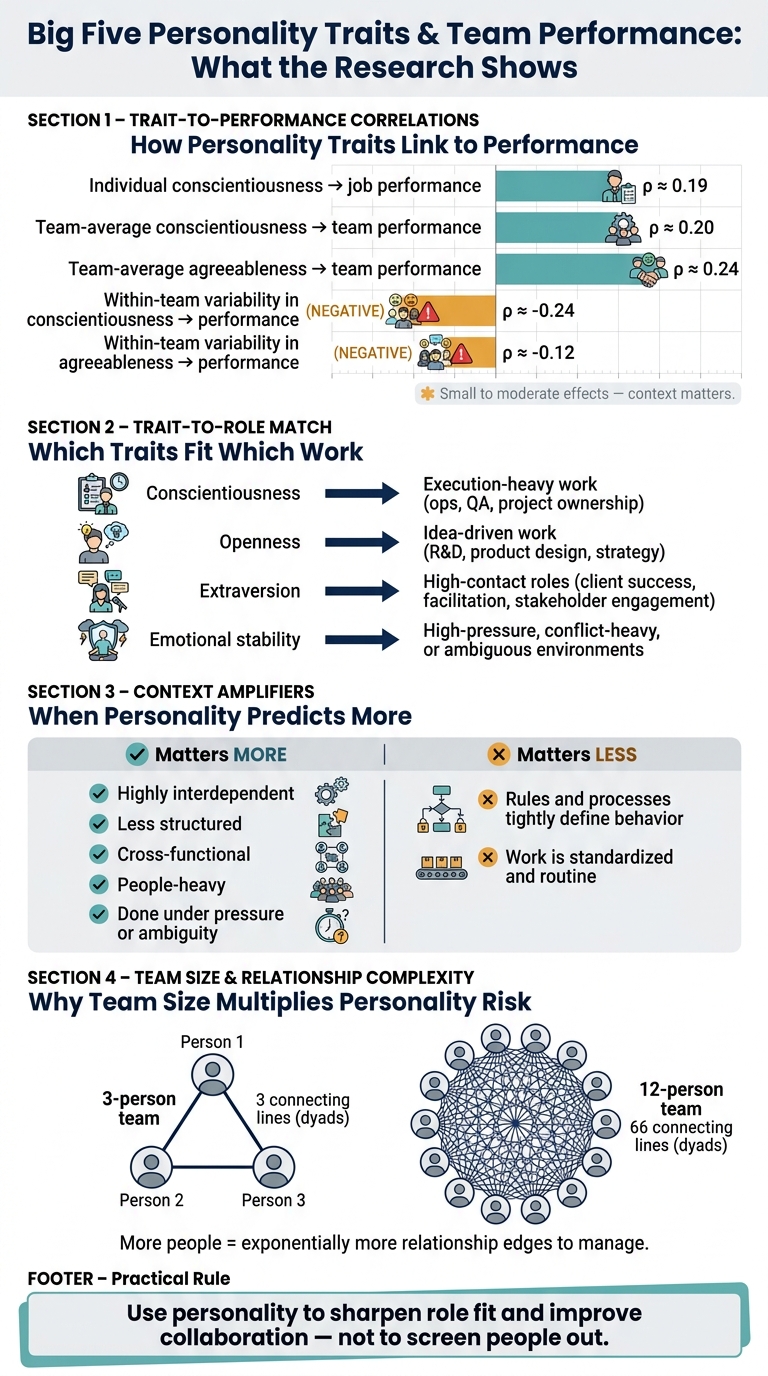
- Conscientiousness has the clearest link to performance, with overall job performance around ρ ≈ 0.19
- At the team level, average conscientiousness links with performance at ρ ≈ 0.20
- Average agreeableness links with team performance at ρ ≈ 0.24
- Big gaps inside a team can hurt results, especially for:
- conscientiousness: ρ ≈ -0.24
- agreeableness: ρ ≈ -0.12
- Personality tends to matter more for trust, communication, satisfaction, and conflict handling than for hard output alone
- Cognitive ability, skill, and experience still matter more for many task results
- Personality matters more when work is:
- highly interdependent
- less structured
- cross-functional
- people-heavy
- done under pressure or ambiguity
If I were applying this research, I’d keep it simple:
- Check skill first
- Match traits to role demands
- Look at the team average and the spread
- Adjust for context, not just the person
- Use assessment data as one input, not a pass/fail screen
A few role patterns show up often in the research:
- Conscientiousness tends to fit execution-heavy work
- Openness tends to fit idea-driven and learning-heavy work
- Extraversion tends to fit high-contact roles
- Emotional stability tends to matter more under strain, conflict, and uncertainty
There’s also a team design point that’s easy to miss: as teams get larger, the number of person-to-person links grows fast. A 3-person team has 3 dyads, while a 12-person team has 66. That means more room for friction, mixed standards, and missed handoffs.
| What to look at | What the research points to |
|---|---|
| Person to role fit | Match traits to thinking, people, and process demands |
| Person to team fit | Check average trait levels and how much members differ |
| Person to context fit | Weigh structure, pressure, interdependence, and norms |
| Best use of personality data | Role fit, coaching, team setup, and collaboration |
| Poor use of personality data | Screening people out without skill and context checks |
So my main takeaway is this: personality is most useful when I use it to improve role fit and day-to-day teamwork, not when I treat it like destiny.
Big Five Personality Traits & Team Performance: Key Research Stats
Personalities at Work • Dr. Brian Little • YOW! 2016
What Research Says About Big Five Traits and Team Outcomes
Building on the point that personality matters more for teamwork than for raw output, the pattern in the research is pretty clear. Some Big Five traits show up again and again in strong teams. Others depend more on the kind of work the team is doing. So it helps to drop the idea that any trait is always good or always bad.
Which Traits Show the Most Consistent Links to Team Effectiveness
Conscientiousness and agreeableness have the steadiest links to team performance. Higher team-average conscientiousness correlates with team performance at ρ ≈ 0.20, and agreeableness at ρ ≈ 0.24.[1][2][4]
That tracks with how teams work in practice. Conscientious teams tend to follow through. Agreeable teams are less likely to let conflict get personal. But there’s a catch: very high agreeableness can hold people back from speaking up, which can reduce dissent, challenge, and candor.
Extraversion helps more in fast, outward-facing work. Openness helps with learning and innovation. Emotional stability matters most when teams are under pressure, dealing with ambiguity, or working through conflict.
One key point stands out: these traits predict team process more reliably than bottom-line results like output or revenue.
Why Both Team Average and Differences Across Members Matter
At the team level, the mix of traits matters just as much as the traits themselves. Research looks at two things: the average trait score across the team and how much members differ from one another. For coaches and L&D leaders, that means the issue isn’t just who scores high. It’s also which roles need shared discipline and which ones benefit from more range across people. Organizations can now use AI to analyze personality to optimize these team dynamics.
Meta-analytic findings show that variability in conscientiousness within a team correlates with lower performance at ρ ≈ -0.24, and variability in agreeableness at ρ ≈ -0.12.[1][2][4] The team average sets the starting point. Variation shapes how hard day-to-day collaboration becomes.
In execution-heavy work, shared conscientiousness tends to matter most. In innovation work, a broader spread in openness can help idea generation, especially in structured brainstorming. And it doesn’t take much to throw a team off balance. Even one highly disagreeable member can disrupt cooperation across an otherwise agreeable team.[3]
Role Fit: Matching Personality, Capability, and Job Demands
Team fit isn't just about personality. First, a person has to clear the bar on skill and experience. After that, personality starts to matter because it shapes how the work gets done. Team averages tell you about the overall climate. Role fit tells you who should own which kind of work.
How Personality Supports Different Team Roles
Research keeps pointing to the same pattern: certain Big Five traits line up well with certain role types. Conscientiousness is the clearest marker for execution-heavy work like project ownership, operations, and quality assurance. People high in openness vs. other traits often do well in exploration-focused roles such as product design, R&D, and strategy, where reframing the problem matters more than sticking to a set process. Extraversion tends to help in client-facing or high-contact roles like client success, stakeholder engagement, and facilitation, where social energy and assertiveness are part of the job.
That said, more isn't always better. Trait effects can flatten out or even flip at the extremes. A trait that helps in one setting can turn into a problem if the role calls for candor, speed, or flexibility.
As AI transforms executive coaching, For coaches, it helps to map roles across three areas:
- Thinking demands
- People demands
- Process demands
Personality data gives you a clearer view of how someone is likely to move through each area, and where friction may show up before it turns into a bigger issue.
How Common Team Tools Compare for Role Alignment
The key question isn't which tool people already know. It's which one helps you make role decisions well enough to use in day-to-day work.
| Tool | Theoretical Basis | Empirical Support | Typical Use in Teams | Limitations for Role Fit |
|---|---|---|---|---|
| Big Five | Trait theory; five continuous dimensions | High - extensive validation and the strongest evidence for job and team performance | Role mapping, composition decisions, performance prediction | Requires careful interpretation; traits are continuous, not labels |
| Belbin | Observational team behavior; nine role types | Mixed - some convergent validity, but roles often overlap with Big Five traits | Intuitive role labeling and team discussions | Weaker psychometric rigor; limited precision for role-fit decisions |
| MBTI | Jungian type theory; 16 categorical types | Limited - concerns about reliability and predictive validity | Communication style workshops, self-awareness | Categorical typing oversimplifies personality |
| Personos | Five Factor Model; 30 traits on an 80-point scale | High - built on a scientifically validated trait model with context-aware guidance | Real-time role fit guidance, relationship dynamics, team composition, coaching support | Works best when current context and relationship details are included |
One problem with static tools is simple: they can get stale fast when job demands change. Personos brings in situational context, including project goals, relationship dynamics, and team norms, so the guidance stays tied to what's happening right now. That's most useful when the environment shifts and yesterday's read on a person no longer tells the whole story.
That's the main warning in any role-fit discussion: personality data is one input, not the full answer. Use it to sharpen role assignment decisions, not to replace judgment about the person, the team, and the work.
How Context Changes the Role of Personality in Teams
Role fit tells you who can do the work. Context tells you when that fit is likely to hold.
That matters because personality is context-dependent. A trait that helps in one setting can create tension in another. So before coaches and L&D leaders make too much of personality data, they need to step back and ask a simpler question: What does this team’s situation actually require?
Situational Strength, Task Interdependence, and Team Design
Situational strength is about how much a setting tells people how to behave. In tight settings, like compliance operations, call centers, and regulated manufacturing, rules and process shape behavior. In weaker settings, like innovation teams or roles built around complex problem-solving, personality tends to predict more.
That doesn’t mean personality stops mattering in tightly structured work. It still affects things like stress, motivation, and engagement. But its link to performance is smaller when the job leaves less room for personal style.
Task interdependence adds another layer. When people rely on each other to get the work done, personality-driven patterns around coordination, trust, and communication matter more. In teams with high interdependence, agreeableness, conscientiousness, emotional stability, and extraversion tend to carry more weight.
Here’s why:
- Agreeableness helps people handle conflict without turning every disagreement into a mess.
- Conscientiousness supports follow-through and dependable execution.
- Emotional stability helps people stay steady when pressure builds.
- Extraversion can support information sharing and team interaction.
Team size makes this even more important. A 3-person team has 3 dyads; a 12-person team has 66.[5] As teams get bigger, personality differences create more relationship edges to manage. In plain English, there are just more chances for friction, crossed wires, or drift. That’s why norms start to matter a lot more.
When Personality Diversity Helps and When It Creates Friction
Personality diversity isn’t automatically good or bad. It depends on the work.
In exploratory, non-routine work, differences in openness and social style often help idea generation and problem-solving. You want some variation there. Different angles can spark better thinking.
In routine, time-pressured, or highly standardized work, it’s a different story. Big gaps in conscientiousness and agreeableness can create friction around workload standards, pace, and cooperation. That risk climbs when the team needs consistency and fast handoffs. If one person is loose about details and another is strict about every step, the tension shows up fast.
| Work Context | Traits Likely to Help | Main Risk | Coaching or Design Support |
|---|---|---|---|
| Routine, standardized work | Conscientiousness, emotional stability | Rigidity, slower adaptation | Clear SOPs, tight role definitions |
| Unstructured exploratory work | Openness, varied perspectives | Too many ideas, no decision | Facilitation, decision deadlines |
| Highly interdependent teams | Agreeableness, conscientiousness, emotional stability, extraversion | Coordination drag, overdependence | Explicit coordination routines, role clarity |
| Cross-functional teams | Openness, working across functions | Silo conflict, communication gaps | Shared goals, integration roles |
| Weakly structured environments | Adaptability, initiative, self-management | Ambiguity overload | Light guardrails, frequent feedback |
The coaching rule is pretty simple: use personality as a stronger filter in weak, interdependent, and cross-functional work. Use it as a lighter filter in tightly standardized work.
Those context patterns set up the practical coaching moves that come next. They also point straight to the next step: role fit, collaboration, and team setup.
Practical Takeaways for Coaches and L&D Leaders
Using Research to Improve Role Fit, Collaboration, and Team Setup
Context shapes when personality matters most. The practical move is to start with the role itself: its structure, level of social contact, pressure, and coordination demands. Then use personality data to estimate how a person is likely to handle those conditions.
That said, trait data should sit next to skill evidence. Personality can't replace capability. It's one input, not the whole picture.
It also helps to treat trait scores as ranges, not fixed labels. A person isn't just "high" or "low" on a trait in some absolute sense. And because work shifts over time, fit should be checked again as the role changes.
At the team level, the same idea applies. You're not only thinking about where each person fits. You're also looking at the group's coordination norms. Big gaps in conscientiousness can hurt follow-through. Teams with very high agreeableness may sidestep the disagreement they actually need.
A few simple moves can help:
- Set shared standards for follow-through and accountability
- Create clear channels for disagreement so concerns don't stay buried
- Recheck those norms as the team changes
Where Dynamic Tools Like Personos Fit Into Practice
This is where dynamic tools can help. Personos adds context to static assessments. Built on the Five Factor Model, it offers conversational guidance, Dynamic Reports for people, pairs, and teams, Prompts between sessions, and an ActionBoard for tracking goals.
That makes it more useful than one-time reports when team needs shift.
Conclusion: What the Evidence Supports and What It Does Not
The evidence points to small but real links between personality traits and team outcomes, with conscientiousness standing out as the most reliable predictor. But those links do not justify using personality as a gatekeeping tool. And they do not replace capability assessment.
A better use is simple: use personality to sharpen role fit and improve collaboration, not to screen people out.
FAQs
How should teams use personality data without overusing it?
Teams should protect privacy and avoid sharing raw scores or diagnostic details. If managers or peers see deep data without the skill to read it well, they can make bad calls.
A better approach is to share high-level takeaways people can act on. For example, you might bring a more idea-driven team member into a brainstorming session instead of showing everyone that person's private assessment data.
Tools like Personos can help by keeping individual scores private and showing practical guidance tied to the situation at hand.
Which personality traits matter most for team fit?
No single trait decides team fit, but personality has a big effect on how people work together and how well leaders lead. Emotional intelligence matters a lot here, and it’s linked to a 58% increase in individual role performance.
Instead of putting people into fixed boxes, Personos uses the scientifically validated Five Factor Model to measure 30 traits and show how those traits interact within a team’s specific context.
When does personality matter more than work context?
Personality matters more than work context in high-stakes social moments like conflict, change, or performance pressure. That’s when personal traits tend to play a bigger role in how people take in information, react, and communicate.
In situations like these, personality-aware guidance matters because the “right” interaction isn’t just about the setting. It also depends on who you’re dealing with and how they’re likely to respond.