How Personality Profiles Guide Emotionally Agile Leaders
Five Factor profiles make emotional-agility advice personal—identify stress triggers, communication gaps, and which leadership skill to build first.
Rachel Johnson

How Personality Profiles Guide Emotionally Agile Leaders
Most leadership advice is too broad to fix repeat stress patterns. If I want better leadership under pressure, I need more than “stay calm” and “communicate well.” I need to know how I tend to react, where I get stuck, and which skill to work on first.
Here’s the core idea in plain English:
- Generic leadership advice gives me a basic starting point
- Five Factor personality data helps explain why I repeat the same patterns
- Stress, communication, and decisions do not look the same for every leader
- Personality is not destiny. It shows tendencies, not limits
- Research in the article notes that personality explains about 28% of leadership emergence and effectiveness
- The same article also points out links between stress and emotional agility, including r = -0.28 for team-oriented emotional agility and r = -0.24 for total emotional agility
If I put it simply, the article makes one main case: broad advice helps, but personality-based guidance is more precise. This precision allows for scaling personalized coaching across entire leadership teams.
The Four C's of Emotional Agility
Quick Comparison
| Area | Generic advice | Personality-based guidance |
|---|---|---|
| Stress | Tells me to stay calm and regulate emotions | Shows my likely trigger pattern and which response may fit me best |
| Communication | Pushes listening, empathy, and trust | Shows whether I talk too much, hold back, or avoid conflict |
| Decision-making | Tells me to handle uncertainty well | Shows my default bias under pressure, like rushing or overchecking |
| Coaching support | Same skill advice for most people | Focuses on the skill I may need first |
| Main risk | Too broad to change fixed habits | Can turn into labeling if used the wrong way |
What stood out to me is simple: emotionally agile leadership works better when the advice fits the person. That is the article’s full point, just in a shorter form.
1. Generic emotional-agility leadership advice
Most leadership training starts in the same spot: here’s what a good leader does, now go do it. That isn’t bad advice. It’s just generic.
Stress patterns
Generic guidance usually tells leaders to stay calm under pressure, practice mindfulness, and use cognitive reappraisal to avoid what researchers call "emotional flooding." [6] That makes sense on paper.
The problem is that stress doesn’t show up the same way for every leader, and it doesn’t respond to the same fix. In practice, perceived stress is significantly negatively associated with both Team-Oriented Emotional Agility (r = −0.28) and total Emotional Agility (r = −0.24). [7] Stress is real, but the way it hits, and what helps, can differ a lot from one person to the next.
Communication habits
Broad leadership frameworks often treat the leader as the team’s tone-setter. They lean on active listening, harmony, and trust-building. Fair enough. But many of these models also depend on all-hands meetings and group forums, which tend to favor more vocal, extroverted leaders.
That leaves out something important: trait patterns shape who speaks up, who listens, and who goes quiet under stress. One-size-fits-all communication advice can’t track those differences. As Dr. Joshua Read puts it:
"Most change communications are written for the mythical average employee: moderately open, moderately agreeable, moderately stressed. That person doesn't actually exist in your organization." [3]
That same mismatch helps explain why personality profiles do more than generic communication advice.
Decision style
Standard advice tells leaders to tolerate ambiguity, reframe problems, and make value-aligned decisions under uncertainty. That’s the logic behind cognitive flexibility, and it is useful.
But it can still miss where a leader begins. Under pressure, leaders often narrow their thinking. Some rush to cut uncertainty as fast as possible. Others lock onto details to regain a sense of control. [2][7] Five Factor data makes those pressure patterns easier to see and easier to use.
Support precision
This is where generic advice tends to fall apart most clearly. It often treats emotional intelligence like a universal skill set that everyone should build in the same way, at the same pace, in the same order.
That’s where coaching time gets wasted. Telling someone high in Agreeableness to “develop more empathy” doesn’t fix much. Pushing someone with high Neuroticism toward empathy before self-regulation is in place can backfire. [6] Five Factor data closes that gap by showing which skills a given leader needs first.
2. Personality-based guidance using Five Factor data
Five Factor data turns broad leadership advice into trait-specific guidance. It shows the stress pattern a leader is likely to fall into and which kind of help fits best. In plain English, it helps answer a practical question: what does this leader need right now?
Stress patterns
Five Factor data can make stress patterns easier to spot early. Leaders high in Neuroticism can go into emotional flooding, where the strength of the emotion gets in the way of self-awareness and regulation[6]. In that case, the first move is often physiological regulation, such as mindfulness, before coaching begins.
A leader high in Conscientiousness may swing toward perfectionism or pull back under pressure[9]. A high-Extraversion leader may do the opposite and push harder, taking over the room[9].
Those same trait patterns also shape how leaders talk, listen, and show disagreement.
Communication habits
Trait data can reveal specific failure modes that broad frameworks miss. High-Agreeableness leaders often hold back their own needs to avoid conflict. They can seem warm and collaborative while still hiding what they actually think[6].
High-Extraversion leaders can also take up too much space without meaning to, which can drown out quieter voices[10]. A simple fix is to use listening-first meetings and ask them to speak last[1].
Decision style
Five Factor profiles also help predict how leaders make decisions under uncertainty. High-Conscientiousness leaders are disciplined planners, but they may stay with a failing strategy for too long[5]. High-Openness leaders tend to move well in ambiguity, but they can lean toward novelty over execution[10].
When you know a leader's default pattern, coaching gets much more precise.
Support precision
This is where personality data shows its value most clearly. Instead of treating EQ like the same skill set for everyone, it helps leaders and coaches see which abilities come more easily and which ones need steady work. For high-Neuroticism leaders, that often means focusing on self-regulation before empathy training[6].
Platforms like Personos use this model with customized reports for individuals, relationships, and groups. That gives leaders a clearer view of how a profile plays out in context. The fit gets better, but the added detail can also make things more complex.
Pros and Cons of Broad Leadership Advice vs Personality-Based Support
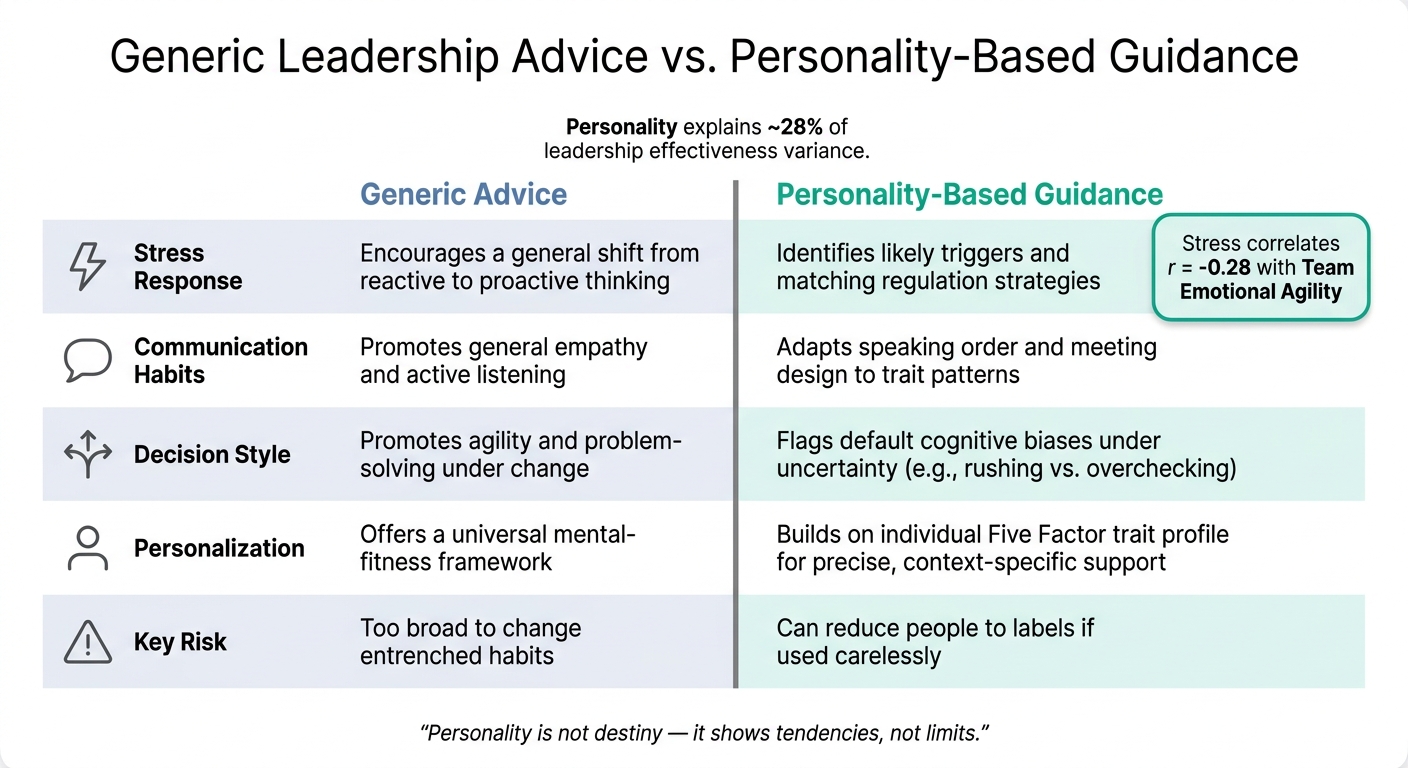
Generic Leadership Advice vs. Personality-Based Guidance: A Side-by-Side Breakdown
This difference shows up most clearly when leaders run into the same kind of pressure over and over.
Both approaches matter. They just do different jobs. Generic emotional-agility advice gives leaders a starting point. Personality-based guidance gets at something deeper: why one leader keeps falling into the same stress pattern.
That gap gets easier to see when pressure sticks around. Under sustained stress, leaders tend to lean too hard on their best traits. And when that happens, strengths can start working against them.
Trait-based guidance has a clear risk too. It can turn a profile into an identity. But a profile shows tendencies, not limits. Research from the past two decades shows that personality is not fixed. People often become more conscientious, emotionally stable, and agreeable as they step into new roles.[1] So the point isn't to box a leader in. It's to help them build a broader range.
Platforms like Personos put this model to work with customized reports for individuals, relationships, and groups.
Personality explains about 28% of the variance in leadership emergence and effectiveness [8], which helps explain why these two approaches play separate roles. Broad advice sets the baseline. Trait data adds precision. The table below shows where each one tends to work best.
| Generic Advice | Personality-Based Guidance | |
|---|---|---|
| Stress response | Encourages a general shift from reactive to proactive thinking | Identifies likely triggers and matching regulation strategies |
| Communication habits | Promotes general empathy and active listening | Adapts speaking order and meeting design to trait patterns |
| Decision style | Promotes agility and problem-solving under change | Flags default biases under uncertainty |
| Personalization | Offers a universal mental-fitness framework | Builds on an individual's actual trait profile for precise, context-specific support |
| Key risk | Can be too broad to change entrenched habits | Can reduce people to labels if used carelessly [4] |
Conclusion
The comparison leads to a plain takeaway: emotionally agile leadership tends to work better when the advice fits the person. Generic advice gives you a starting point, but it usually doesn't explain why the same leader falls into the same pattern again and again.
Five Factor data adds more precision without replacing judgment or the core ideas behind emotional intelligence. The right way to use these profiles is as a working lens, not a label. They should help you form hypotheses, not box people in.
"The Big Five is a lens, not a label. People are more complex than five dimensions, their trait expressions shift with context, and nobody should be reduced to their personality profile." - Dr. Joshua Read, Change Management Expert [3]
In day-to-day work, tools like Personos turn Five Factor profiles into situation-specific guidance for stress, communication, and decisions. The aim is better action, not a fixed identity. That is what personality-aware leadership makes possible: more precise action under pressure.
FAQs
How do I use a Five Factor profile without labeling people?
Treat personality as a spectrum, not a fixed label. A Five Factor profile points to patterns and tendencies, but it doesn’t box anyone in. People can and do adjust how they act depending on the situation.
Use the profile as a starting point for self-awareness and growth, not as a way to sort people into neat categories. Tools like Personos lean into that idea by giving situation-specific guidance on practical shifts, like how you communicate or make decisions.
Which leadership skill should I work on first based on my traits?
Start with self-awareness of your personality traits. The point isn’t to change who you are. It’s to understand your strongest tendencies, spot the areas where you may struggle, and learn how to work with both.
A Five Factor personality profile can show how you make decisions, how you react under stress, and how you tend to communicate. Tools like Personos can use that insight to give situation-specific guidance for delegation, feedback, and conflict.
Can personality-based coaching actually improve leadership under stress?
Yes. Personality-based coaching can help leaders perform better under stress because it builds emotional agility.
With Five Factor insights, leaders can spot patterns in the moment, like rushing decisions, over-explaining, or pulling back. That pause matters. It gives them a chance to step out of autopilot and choose a better response.
Tools like Personos make this easier by offering real-time, personality-aware guidance.