Personality Matching for Teams: 7 Use Cases
How personality data guides staff pairings to reduce friction and improve intake, crisis response, mentoring, supervision, and onboarding.
Rachel Johnson

Personality Matching for Teams: 7 Use Cases
Who you pair together can shape stress, trust, and service quality. In this article, I show how personality data can help with intake, crisis response, mentor matches, supervisor-staff pairings, cross-site projects, peer support, and onboarding.
Here’s the main idea in plain English: if you match people based on communication style, stress response, role fit, and client needs, you can lower team friction and make day-to-day work more steady. The article also points to a few numbers worth noting, like 97% of new hires who met with a buddy more than eight times in the first 90 days saying that support increased productivity, compared with 56% who met once.
If I had to boil the whole piece down, it would be this:
- Use personality data as one input, not the only input
- Match for role fit, trait balance, burnout risk, and client impact
- Use similar traits for smoother rapport and complementary traits for balance
- Focus first on pairings with the most day-to-day contact
- Protect privacy, get consent, and limit who can see what
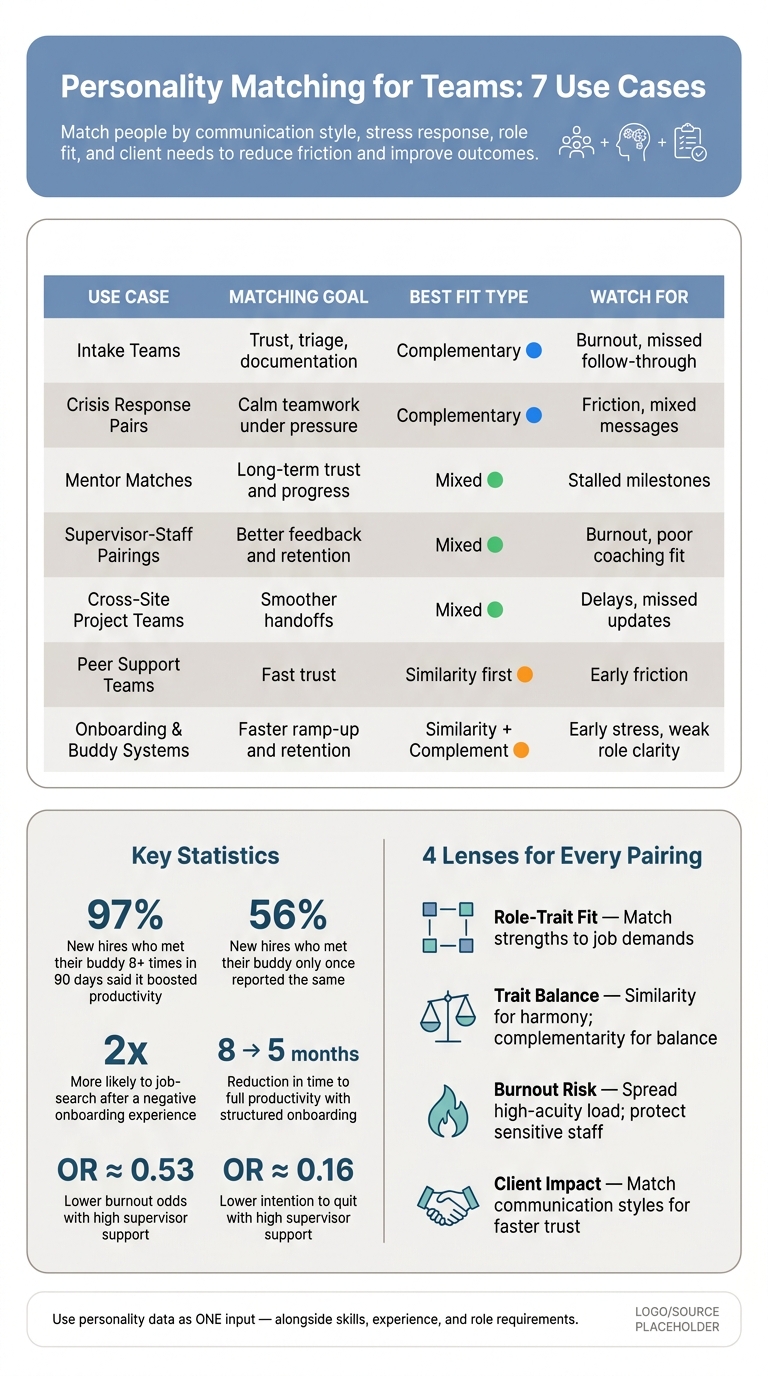
Personality-Informed Matching vs. First-Available Staffing: 7 Use Cases
Masterclass: Strategies for Handling Personality Differences at Work
Quick Comparison
| Use Case | Main Matching Goal | Best Fit Type | What to Watch |
|---|---|---|---|
| Intake teams | Trust, triage, documentation | Complementary | Burnout, missed follow-through |
| Crisis response pairs | Calm teamwork under pressure | Complementary | Friction, mixed messages |
| Mentor matches | Long-term trust and progress | Mixed | Stalled milestones |
| Supervisor-staff pairings | Better feedback and retention | Mixed | Burnout, poor coaching fit |
| Cross-site project teams | Smoother handoffs | Mixed | Delays, missed updates |
| Peer support teams | Fast trust | Similarity first | Early friction |
| Onboarding and buddy systems | Faster ramp-up and retention | Similarity + complement | Early stress, weak role clarity |
I read this article as a practical guide for team leaders in nonprofits, reentry programs, and social service settings who need a better way to decide who should work with whom.
What Team Leaders Should Look for in Personality Matching
Use these four lenses to judge every pairing below: role fit, trait balance, burnout risk, and client impact.
Role-Trait Fit
Every role in a helping organization asks for different things from a person. Role-trait fit means looking at whether someone's strengths, stress patterns, and motivations line up with what the job actually asks them to do, not just whether they have the credentials or happen to be available.
When you match people to work that fits their strengths and stress patterns, you improve consistency and job satisfaction.
Similar Traits vs. Complementary Traits
Use similarity when you want harmony and consistency. Use complementarity when you need balance and a different point of view.
Burnout and Turnover Risk
Poor-fit pairings create friction, and that friction can quietly push people toward burnout and turnover. Personality data helps teams spot those risks early, before turnover risk climbs.
Client Rapport, Safety, and Service Quality
Small differences in communication can speed up trust or slow it down. Match staff with clients whose communication style they can read fast, especially when safety and rapport matter most.
These four lenses tend to show up first in intake, where early fit shapes every next step.
1. Intake Teams
Intake sets the tone for the whole client journey. If the staff match is off, trust can slip, notes can get messy, and follow-through can fall apart.
That matters because intake staff deal with a lot at once. They handle walk-in triage, phone screenings, and eligibility checks. On top of that, they often meet people who are skeptical, overwhelmed, or in crisis. It’s a high-pressure part of the workflow, with tight documentation rules and little room for error. That’s why intake is one of the clearest places to use personality matching. Trust, triage, and paperwork all happen at the same time.
Role-Trait Fit for Daily Work
Intake work tends to fit people with high agreeableness, emotional stability, conscientiousness, and enough extraversion to guide interviews and set clear boundaries.
A 2023 systematic review found that personality traits play a meaningful role in why workers experience burnout differently under the same stressful work conditions. [2] So instead of handing intake work to whoever happens to be free, it makes more sense to match staff to functions that line up with how they work best. That can cut chronic role strain early.
Pairing Logic Inside the Team
Inside the team, complementary pairings work well.
One person can lead rapport-building and de-escalation. Another can focus on documentation and eligibility. Trauma assessments are often a better fit for staff with high stability and empathy. Documentation-heavy work tends to fit people who are detail-oriented and rule-conscious.
That same split matters even more in crisis response, where speed and safety both matter.
Burnout and Retention
Don’t stack the most volatile cases onto emotionally sensitive staff. Match assignments to stress tolerance, and spread workload in a way that lowers burnout and turnover.
Client Rapport and Early Outcomes
When intake staff are matched with clients whose communication style they can read fast, trust tends to build sooner. Disclosure can improve sooner too.
Staff with high interpersonal sensitivity and openness are often in a better position to work with clients who are reluctant or skeptical.
Track a few early signals:
- Completed intakes
- First-visit attendance
- Short client satisfaction surveys
2. Crisis Response Pairs
If intake shapes first trust, crisis pairs show whether that trust can hold when things get tense. When two responders show up together, their ability to stay in sync can shape de-escalation and client safety. In this kind of work, complementary traits matter more than sameness.
Stress Tolerance and Communication Fit
Not every strong responder works well with every partner. Pair people based on stress tolerance, communication style, and flexibility so they can move like one unit under pressure. The aim is simple: combine strengths that support fast, calm decisions and make role division clear when the pressure is on.
AI tools can flag likely friction points and prompt better communication in real time. Track friction points, prompt use, and pair effectiveness over time.
Burnout and Retention
Crisis work can wear people down, especially when one responder ends up carrying most of the emotional weight. Personality-aware pairing can help spread high-acuity assignments more evenly and cut the kind of friction that leads to burnout and turnover.
Client Safety and Outcomes
A better-matched pair communicates clearly, avoids mixed messages, and helps de-escalation go more smoothly.
The same matching logic also applies to mentor matches, where trust builds more slowly but still depends on fit.
3. Mentor Matches
Unlike crisis pairs, mentor matches need a fit that lasts for weeks, not just a few tense minutes. In reentry and nonprofit case management, the best pairings tend to happen when stress tolerance, communication style, goals, and incentives line up. When that fit is off, follow-through often slips, and the relationship can wear down both people.
Pairing Logic and Between-Session Progress
You can usually see a strong mentor match between sessions, not just during them. It shows up in follow-through, self-regulation, and day-to-day consistency. When the fit is there, the relationship helps someone keep moving between meetings instead of starting over each time.
Nick Blasi, co-founder and COO of Personos, described this dynamic after watching a social worker use personality-informed guidance to help a woman return to the community after incarceration:
"The difference was the daily momentum that she was able to maintain. It turned a complicated transition into something structured, supported, and most importantly, hopeful." - Nick Blasi, Co-Founder and COO, Personos [1]
With daily personality insights shaped around the client's stress patterns and communication style, the social worker helped the client reconnect with family, secure work, and find housing faster than typical program benchmarks. [1]
Burnout and Mentee Outcomes
Good matches also make mentor work easier to sustain. They cut some of the strain that comes from clashing communication styles and can help reduce overload. One simple way for managers to judge whether a pairing is working is to track time to milestone. If progress stalls, that can be a clear sign the match needs a reset.
That same pairing logic applies when supervisors are matched with staff.
4. Supervisor-Staff Pairings
Supervisor-staff fit shapes caseload management, feedback, and retention. A supervisor can change how a staff member handles hard client situations and whether they stay in the role over time. A poor match doesn't just slow someone down. It can push them toward burnout and turnover. So this isn't just a management preference. It's a retention tool.
Trait Fit for Role Demands
Not every supervisor style fits every staff member.
A new case manager may be high in empathy but weak on structure. In that case, they usually do better with a supervisor who is organized, patient, and nonjudgmental, not one who is disorganized or harsh with feedback. Traits like Conscientiousness for planning and follow-through, Agreeableness for supportive versus blunt feedback, and Emotional Stability for staying calm under pressure matter a lot here.
The research lines up with that. High supervisor support is linked to lower burnout (OR ≈ 0.53) and lower intention to quit (OR ≈ 0.16) among healthcare professionals. [3][4]
Pairing Logic That Reduces Friction
Some pairings work best because they balance a weak spot. If a staff member struggles with deadlines, it helps to pair them with a supervisor who is strong on structure and follow-up. Other pairings work better because the two people are similar in how they respond to stress. In trauma-heavy settings, for example, a supervisor high in empathy can model calm, steady support.
Studies show that supportive relationship communication and clear, work-focused communication from supervisors both predict lower burnout and lower turnover intention. Part of the reason is simple: they reduce perceived stress. [6]
Retention and Communication Quality
Supervisor burnout doesn't stay contained. It drains staff energy and dedication across the team.
A longitudinal study of community mental health providers found that supervisory support reduces turnover intention through lower emotional exhaustion, even when job satisfaction is not a major mediator. [5] When personality fit is strong, feedback tends to land better and conflict gets worked through faster.
You can see this in day-to-day coaching. Staff high in detail orientation and risk aversion usually do better with step-by-step guidance and clear rationales. Staff high in openness and autonomy often want the big picture first, then room to act. Get that match wrong, and small issues can snowball into fewer risks flagged early, weaker documentation, and uneven adherence to safety protocols.
These same fit principles extend to cross-site project teams, where coordination failures multiply fast.
5. Cross-Site Project Teams
When supervisor fit shapes one working relationship, cross-site projects put several relationships under pressure at the same time. The same matching logic still applies. It just matters more when work moves between locations and no single manager is there to smooth out every handoff.
In helping organizations, cross-site projects often fall apart at the handoff stage. That usually means shared casework, referrals, and program coordination, not the task itself. Personality matching can cut friction early, before it slows down the work everyone depends on.
Trait Fit for Role Demands
On cross-site teams, Conscientiousness and Openness matter more than usual.
Use Conscientiousness for follow-through and documentation. Use Openness when staff need to adjust to changing workflows. AI personality tools can flag likely friction points between sites and suggest stronger pairings. AI prompts can also help staff choose how to communicate, adapt, and follow through with each other.
In day-to-day work, the main payoff is simple: fewer communication gaps and faster coordination across sites.
Impact on Staff Stress and Collaboration Quality
Personality-informed matching can make cross-site coordination feel less draining because staff have a clearer sense of how their counterparts think and respond. That shared understanding tends to reduce missed signals and cut down on back-and-forth that goes nowhere.
Track results with measures like:
- handoff speed
- cross-site response time
- fewer missed updates
- fewer project delays
The same need for fit shows up in peer support, where trust and responsiveness matter just as much.
6. Peer Support Teams
Peer support works a lot like cross-site work. It depends on fit, trust, and steady follow-through. The difference is timing: peer support often runs on fast trust. People need to click early enough to help each other under pressure, not weeks later.
That’s why matching by communication style and stress response can cut early friction. Privacy-conscious tools built for helping organizations [1] can support those match decisions without sharing more personal detail than people need to see.
Trait Fit for Role Demands
Use Five-Factor Model profiles to match peer supporters based on stress response, motivation, and communication style. That matters because peer support is about reciprocity and day-to-day help. It is not the same as long-term guidance or top-down coaching.
That distinction is what sets peer matching apart from mentor work. In high-stakes settings like reentry programs, where consistent, structured support is a must, better pairings can make a measurable difference.
Impact on Staff Burnout and Retention
When peer support pairs are a poor match, friction goes up and morale drops. Small misunderstandings can pile up fast, especially when people are already stretched thin.
Personos turns those profiles into daily guidance for clearer peer-to-peer support and faster intervention when friction appears.
Effect on Peer Rapport and Outcomes
Intentional matching helps rapport form faster and stay steady under pressure. That gives coordinators a better shot at spotting friction early and resetting pairings before support breaks down.
The same matching logic also works for onboarding and buddy systems, where early trust can shape retention.
7. Onboarding Teams and Buddy Systems
Onboarding runs on the same fit logic as peer support, but the first 90 days are where role clarity and retention often swing one way or the other. Microsoft data makes one thing plain: repetition matters. 97% of new hires who met with their buddy more than eight times in the first 90 days said the buddy increased productivity, compared with 56% who met once [7]. That shifts buddy selection from a nice social gesture to a role-design choice.
Trait Fit for Role Demands
Start with emotional stability, conscientiousness, and agreeableness. For outreach-heavy roles like crisis services, housing case management, and domestic violence advocacy, add extraversion. For focused, steady work, lean more toward introversion.
A buddy with high emotional stability can model calm without brushing off stress. A buddy who is strong in conscientiousness can show how to handle documentation, compliance, and time management in day-to-day work. That kind of modeling matters because new hires usually learn the job from what they see, not just from what they’re told.
Pairing Logic: Similarity and Complementarity
The best onboarding matches usually blend similarity and complementarity. Match first on relational style so trust can form fast. Then add a complementary trait where the new hire needs support.
For example, a highly empathetic, conflict-averse outreach worker may do better with a buddy who shows strong boundary-setting and assertiveness. It’s a bit like learning from someone who speaks your language but also fills in your blind spots.
Impact on Stress, Burnout, and Retention
Personality-aware pairing can also help managers spot new hires who may face more burnout risk, such as people with very high empathy and lower emotional stability. In those cases, it helps to pair them with a buddy who can validate their feelings while also reinforcing healthy limits and self-care routines.
Personos can surface these risks in real time with prompts and relationship insights, which gives buddies a chance to respond before stress gets worse.
How AI-Powered Personality Tools Support These Use Cases
The next step is turning matching decisions into tools staff can use on the job. These use cases depend on fast, informed pairing decisions. AI-powered personality tools help by turning trait data into pairing and coaching guidance. That’s where these tools shift personality matching from theory into day-to-day work.
Group Reports for Team Balance
When leaders build intake teams or cross-site project groups, they often don’t have a clear view of how the team dynamic will play out. Group-level personality reports help map shared strengths and blind spots. They can show where a team may need more balance in communication, conflict, and follow-through.
Relationship Insights for Pairings
For one-to-one pairings like mentor-mentee, supervisor-staff, or crisis response pairs, relationship-level reports go past individual profiles. They show how two specific people are likely to communicate, where friction may show up first, and what each person needs from the other to build trust.
Prompts and Real-Time Guidance
Real-time prompts help keep personality insights active during high-stakes moments, such as crisis calls, difficult intakes, or first supervisory meetings.
Why Personos Fits Helping Settings
A platform built for helping settings can make these reports useful in the moment, not just something that sits on paper. Personos supports intake, crisis response, supervision, mentoring, and onboarding by delivering group balance, pair fit, and in-the-moment guidance grounded in the Five-Factor Model.
Its Dynamic Reports generate individual, pair, and group insights. Prompts and the ActionBoard help keep guidance and follow-through active. Its Transparent Reasoning feature shows which traits informed each recommendation, and its privacy model keeps individual scores protected by default, with organization-specific settings that let nonprofits tailor the platform to their programs and communities.
Comparison Tables
Use these tables when you have time to match for fit, not just fill a slot. They show where personality fit matters most, especially when leaders are weighing speed against better alignment.
Personality-Informed Matching vs. First-Available Staffing
First-available staffing is sometimes unavoidable, especially in crisis work where speed comes first. But if you have even a little lead time, pairing people with more care can change day-to-day results in a meaningful way.
| Factor | Personality-Informed Matching | First-Available Staffing |
|---|---|---|
| Staff Stress | Lower; less daily friction | Higher; adapting to mismatched styles adds recovery burden |
| Communication Quality | Clearer; pacing and directness line up better | More variable; mismatches require repeated clarification |
| Psychological Safety | More predictable; reactions are steadier | Variable; mismatches can leave staff feeling unheard |
| Time to Full Productivity | Faster ramp-up | Slower when staff must infer expectations mid-assignment |
| Client Outcomes | Stronger rapport; fewer escalations | More inconsistent; internal friction shows in client interactions |
The same pattern shows up in onboarding. Early fit can shape both retention and how fast a new hire reaches confidence.
Standard Onboarding vs. Personality-Aware Onboarding
Standard onboarding usually covers policies, systems, and compliance. Personality-aware onboarding goes a step further by adjusting coaching, feedback, and check-ins to fit the new hire.
That difference has a cost. Negative onboarding experiences can make new employees twice as likely to look for other jobs [9]. SHRM data also shows that structured onboarding cuts average time to full productivity from 8 months to 5 months [8].
| Factor | Standard Onboarding | Personality-Aware Onboarding |
|---|---|---|
| Staff Stress | Higher early stress; new hires infer unwritten norms | Lower; check-in frequency matches the person's preferences |
| Communication Quality | Generic; one-size feedback and instruction | Tailored; supervisors and buddies match the new hire's communication style |
| Psychological Safety | Variable; new hires may hesitate to flag concerns | Stronger; new hires feel seen and supported sooner |
| Time to Full Productivity | Slower ramp-up | Faster; personality-aware pacing reduces early mistakes |
| Client Outcomes | Inconsistent client interaction during longer adjustment | Faster client readiness; fewer service disruptions |
These tradeoffs only hold up if leaders are careful with consent, privacy, and manager access.
Implementation Considerations for U.S. Helping Organizations
Once leaders know where matching can help, the next step is putting it to work without creating ethical, legal, or workflow issues. The same four lenses still apply here: role fit, trait balance, burnout risk, and client impact. But now the focus shifts to keeping the process sound across consent, bias prevention, access control, and reporting. Those guardrails help personality matching stay useful without feeling invasive or arbitrary.
Consent and Privacy
Be clear with people from the start. Tell them what traits are being measured, why the data is collected, who can see it, and how long it will be kept.
For employees, participation should never be tied to hiring, promotion, or retaliation. For clients and program participants, consent language should be written at about an 8th- to 10th-grade reading level. It should also plainly state that saying no will not affect access to services.
If trait scores are stored with client records, apply HIPAA controls and BAAs with vendors. Default to private scores and role-based sharing.
Avoiding Labels and Stereotypes
Trait scores should not be used to deny roles, limit growth, or box people into narrow categories. Traits are better treated as tendencies, not fixed identities and not hard limits on what someone can do.
In practice, that means profiles should be only one input among several. Skills, licensure, experience, and stated preferences matter too. The profile should help guide pairing decisions, not define the person. Regular outcome reviews can also help spot patterns, especially if certain groups are being pushed away from leadership paths.
Manager Training and Data Access
Access should line up with decision-making power. A simple model looks like this:
- Individuals see their own profiles
- Supervisors see work-related insights
- HR sees de-identified trends
- Executives see only aggregate trends unless a documented need calls for individual access
Personality data should support conversations, not make assignments by itself. Managers also need training that uses scenarios from crisis response, mentoring, and supervision. That training should show how to use trait insights for intake, crisis response, mentoring, supervision, and onboarding without overstepping.
Role-based access controls, audit logs, and regular access reviews help make the policy more than words on paper. It also helps to build personality-informed steps into onboarding checklists, supervision templates, and case review meetings so the process fits everyday work.
Measures That Matter to Funders and Stakeholders
If you want to make the case for personality matching, track the outcomes funders already watch. Start with turnover, incidents, satisfaction, and waitlist data. Then add short survey items on supervisor fit and confidence in hard interactions.
The point is simple: show whether matching improves retention, service quality, and safety. Aggregate trends can do a lot of the heavy lifting here. Brief case vignettes can help too, especially when they show that better pairing reduced escalation or helped someone ramp up faster.
Conclusion
Across the seven use cases above, personality matching can improve stress management, trust, and care quality by lining people up with the way they work best.
Using the same four tests, role fit, trait balance, burnout risk, and client impact, the best matches tend to be the ones with day-to-day contact. Crisis pairs need communication styles and stress responses that work well together. Supervisors need feedback styles that click. Intake, mentoring, and onboarding all lean on fast trust.
Traits are tendencies, not identities. That matters. The point is to use personality data as one input among many, alongside skills, experience, and role requirements, so teams can make smarter calls about how people work together.
Personos turns those trait insights into day-to-day guidance for communication, crisis response, and team fit.
When teams use this well, personality-aware collaboration can extend staff capacity without lowering quality.
FAQs
How do you use personality data without overrelying on it?
Use personality data to guide human judgment, not to hand it over. The point is to support your decision-making, not replace it.
Platforms like Personos can help by showing the traits, situational details, and psychological principles behind each recommendation. That way, you can use AI suggestions as input for your own expertise, not as the final call.
Which team pairings should leaders prioritize first?
Start with the pairings that matter most, or where poor communication can drag work down. Supervisor-staff pairings should come first because clear feedback and aligned communication help people perform better and stay longer.
After that, turn to crisis response and intake teams, where communication style can matter even more when pressure is high. Tools like Personos can help leaders spot mismatches early and respond in a more tailored way than broad, one-style-fits-all management methods.
How can teams protect privacy and consent in personality matching?
Teams protect privacy and consent through clear communication, secure data handling, and plain permission rules. Personos puts a big focus on encrypted conversations that stay available only to the user, and individual scores aren't shared unless that person says yes.
Ethical use also means getting consent from everyone involved before generating reports, giving people a chance to review their own data, and treating AI insights as a tool for shared discussion, not as final judgment.