How Personality Insights Guide Empathy in Team Conflict
Personality insights should guide empathic, accountable conflict conversations—check stress, set clear actions, and protect consent.
Rachel Johnson

How Personality Insights Guide Empathy in Team Conflict
I use personality insights to ask better questions, not decide who’s at fault. In nonprofit and social service teams, I check workload, unclear roles, and stress first. Then I use the Five Factor Model to guide questions about communication needs, without treating traits as labels.
My approach is simple:
- Listen without excusing harm. I ask about needs, offer speaking or writing options, and keep expectations clear.
- Make agreements specific. I record who will do what, by when, and when we’ll check progress.
- Keep AI in a support role. I use Personos only with consent and privacy rules, to help prepare rather than judge people.
- Know when to stop mediation. I route safety, harassment, discrimination, or retaliation concerns through formal channels.
The goal? <u>Understanding with accountability</u>, measured by safer participation and completed commitments, not quick agreement.
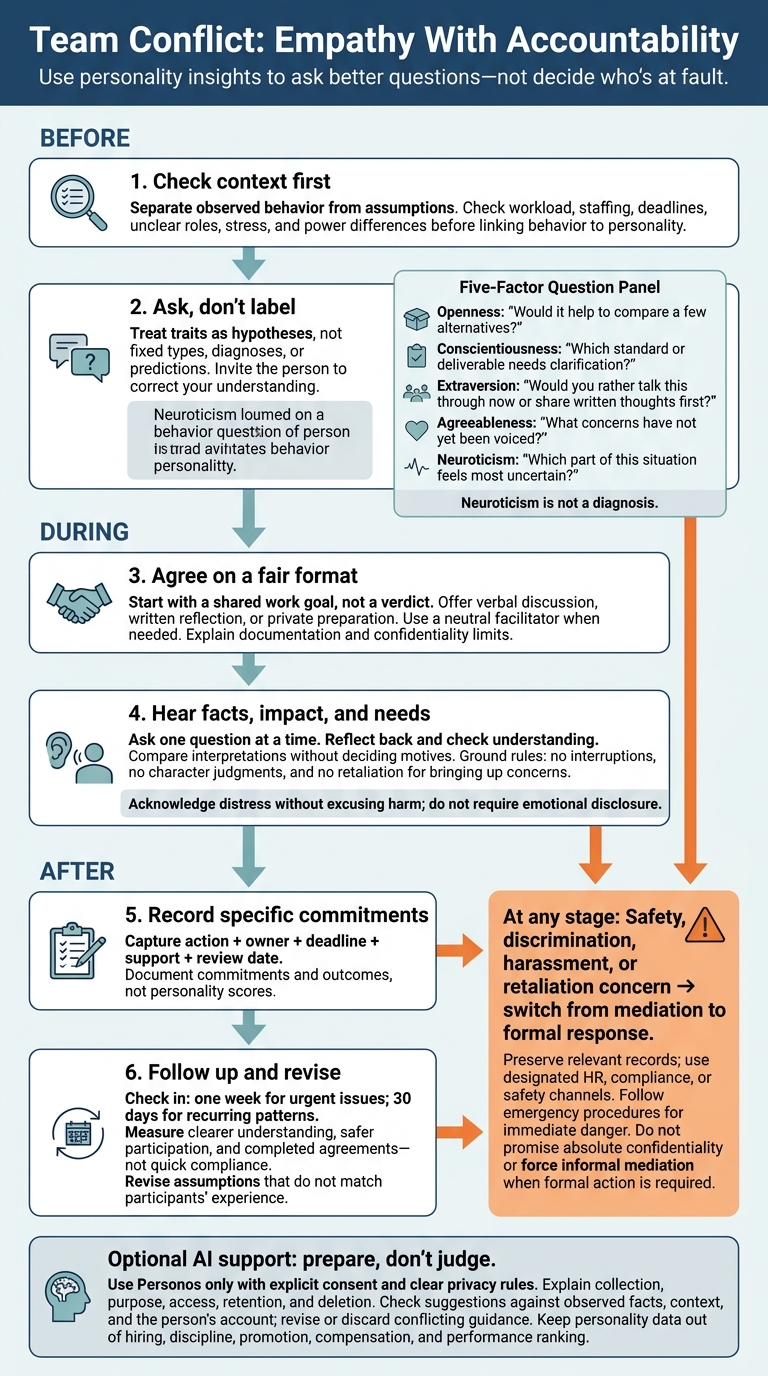
Team Conflict: Empathy With Accountability
Why Empathic Listening Is Essential for Workplace Conflict Resolution
Separate Personality Traits From Stress Responses
In team conflict, separate the person from the pressure they’re under.
Traits are stable tendencies along a continuum, not fixed types, diagnoses, or predictions. A stress response is temporary. An observation describes only what happened. Someone who usually welcomes debate may withdraw under pressure.[3][2] Use these patterns to ask better questions, not to label people.
Use the Five Factors to Guide Questions
Treat each trait below as a hypothesis to check with the person. This approach is central to how Personos works to support professional growth. Neuroticism describes a tendency toward stronger negative emotions; it is not a diagnosis.[1][4] Use each factor to guide how you ask questions, listen, and structure the discussion.
Factor Possible communication need Common misreads Useful question Openness May appreciate comparing alternatives. Reading preference for familiar methods as inflexibility. “Would it help to compare a few alternatives?” Conscientiousness May value clear standards. Mistaking requests for detail as control. “Which standard or deliverable needs clarification?” Extraversion May prefer verbal discussion or written reflection. Equating silence with disengagement. “Would you rather talk this through now or share written thoughts first?” Agreeableness May value respectful disagreement. Assuming agreement means genuine consent. “What concerns have not yet been voiced?” Neuroticism May benefit from predictability. Treating emotional reactions as weakness. “Which part of this situation feels most uncertain?”
Make assessments optional. Before asking for consent, explain their purpose, who can access the results, and how the results will be used. Even when scores are available, focus on direct questions, observed behavior, and the current situation. Invite the person to correct your understanding.[5]
Check Workload and Context Before Drawing Conclusions
One disagreement does not establish a trait. Before linking a reaction to personality, check what’s happening around the person. Is the behavior new, unusually intense, or limited to one setting?
Check caseload pressure, unclear authority, relationship history, unfair treatment, communication norms, and power differences. A supervisor’s presence or fear of consequences may make someone less willing to disagree.[2][4]
Replace labels with observations, then ask about barriers:
“You left the discussion before the decision was finalized.”
“What made it difficult to stay in the conversation?”
Do not infer trauma, diagnosis, or motive from one incident. Address the conditions the person names first. Agree on a practical adjustment, such as clearer decision authority or written input, and check whether participation improves.
Lead a Fair Conflict Conversation
After separating trait from stress, move from diagnosis to dialogue. Start with a shared work goal, not a verdict. Hear each person’s facts and the impact, clarify needs, compare interpretations, agree on actions, and set a follow-up date.
Use personality insights to solve team conflicts by shaping questions and format, not assigning blame. They can guide your choice of question, setting, and pace. They must not determine whose account to believe, who is at fault, or whether someone consents.[9] Participants can decline suggested options. Use personality context to ask better questions, not rush to judgment.
Ask About Perspectives, Needs, and Trust
Ask one question at a time about needs, expectations, and working conditions:
“What are you trying to protect or accomplish?”
“Which expectations are we interpreting differently?”
What would a fair fix look like?
“What would help rebuild trust?”
What impact is strongest right now?
Don’t require people to share their emotions. Practical effects and work needs are enough. Reflect back what you heard and check that you understood correctly. Acknowledge the impact without automatically accepting an explanation of someone’s motives.
Choose a Conversation Format Together
| Situation | Empathy goal | Question to offer | Next action |
|---|---|---|---|
| Escalation | Restore respectful exchange | “What would help us discuss this without interrupting or escalating?” | Use a facilitator, structured turns, and a pause with a return time. |
| Withdrawal | Support participation | “Would you prefer to share your perspective verbally, in writing, or in a private conversation first?” | Hold separate prep conversations or accept written input first. |
| High emotion | Allow recovery without disclosure | “Do you need a short break, a different setting, or another time to continue?” | Pause, set a return time, and document only the work decision. |
| Ambiguity | Clarify expectations | “Which instruction, deadline, or ownership point remains unclear?” | Review messages or workflow and record the agreed standard. |
| Repeated role conflict | Clarify responsibilities | “Where does the handoff break down, and who owns each step?” | Map responsibilities; set an escalation rule and review date. |
Whatever format you choose, keep the process structured, respectful, and documented.
Set Boundaries and Agree on Next Steps
Set clear ground rules: no interruptions, no character judgments, and no retaliation for bringing up concerns. Give each person uninterrupted speaking time. If a supervisor is involved, use a neutral facilitator or offer a reporting route outside the direct chain of command. Explain documentation and confidentiality limits before discussing sensitive details.
Hypothetical case-manager handoff dispute: A late handoff adds to workload concerns, while the sender experiences follow-up messages as accusatory. The shared goal is reliable client continuity without blame. Review workload and expectations, then agree on neutral follow-up messages. The sender completes the form by 3:00 p.m.; the receiver confirms receipt within 30 minutes. Record these commitments and review handoff completeness, acknowledgment times, and communication the following Friday.
If the conflict involves safety, discrimination, harassment, or retaliation, switch from mediation to formal response. Preserve relevant records and use the designated HR, compliance, or safety channel. Follow emergency procedures if there’s immediate danger. The EEOC recommends accessible complaint procedures, prompt impartial handling, multiple reporting options, and anti-retaliation protection.[6][7][8] Don’t promise absolute confidentiality or force informal mediation when formal reporting, investigation, accommodation, or safety action is required.
Use Personos to Prepare and Follow Through
Use Personos to help prepare questions, meeting formats, or follow-up language, not to replace the conversation. It’s an optional AI tool for communication planning, not diagnosis, supervision, or conflict adjudication. Its Five Factor Model base supports the framework, not claims about the product’s outcomes.[12][13]
Turn Personos Guidance Into Team Actions
In Personos Chat, enter observable behavior, context, and your goal to generate neutral questions and alternative interpretations. Use Dynamic Reports to plan agendas, pacing, and reflection time. Check these suggestions with participants rather than treating them as conclusions about anyone’s motives.[10]
Prompts can reinforce an agreed next step, while ActionBoard can track its owner, deadline, and review date.[11] Record commitments and follow-up outcomes, not personality scores. Transparent Reasoning explains why a suggestion was generated. It doesn’t prove the suggestion is right.
Use Personos to prepare better questions and policy to keep the process fair.
Protect Consent, Privacy, and Human Judgment
Use Personos only with explicit consent and a clear use policy. Before anyone participates, explain what you’ll collect, why you need it, who can access it, and how retention and deletion work. Limit sensitive information and check current contractual terms. Verify access, retention, deletion, and compliance rules before use. Vendor statements alone do not establish legal compliance.
Keep personality data out of hiring, discipline, promotion, compensation, and performance ranking. Check every AI suggestion against observed facts, workload, cultural context, power differences, and the person’s account. If the guidance conflicts with their account, pause and revise or discard it. Don’t treat disagreement as resistance. A profile should inform the conversation, not override the person.
Conclusion: Put Empathy Into Practice
Use Five Factor Model traits to guide questions, not label people. Check stress, workload, and context before treating behavior as a personality trait. AI-driven coaching tools can help you prepare, but they must not replace your judgment. Use this checklist before, during, and after conflict.
Before, During, and After: A Conflict Checklist
At every stage, check context, shape the conversation, and document the next step.
Before: Separate what you observed from what you assumed. Check workload, staffing, deadlines, role clarity, and power differences before linking conflict to personality. Confirm consent before using personality information.
During: Ask what each person needs to resolve the issue. Offer time for written reflection or a private follow-up, and invite disagreement. Acknowledge distress without excusing insults, intimidation, or missed commitments. Fair participation means people can challenge a manager, not just get equal speaking time. Aim for a fair conversation that leads to a workable agreement.
After: Record actions, who owns them, deadlines, and support. Schedule a check-in in one week for urgent issues or 30 days for recurring patterns. Ask whether people felt heard, could disagree safely, and saw progress. Revise assumptions that don't match their experience. Measure success by clearer understanding, safer participation, and completed agreements, not quick compliance.
FAQs
How can I distinguish personality patterns from ongoing stress?
Look at whether someone’s behavior reflects a steady trait or a response to pressure. The Five Factor Model’s 30 traits offer a stable personality baseline. Stress may show up as a shift from that baseline, such as empathy fatigue or trouble making decisions under pressure.
Personos provides personalized reports that help separate core traits from stress tied to a situation. These reports also offer strategies for managing work-related strain and keeping communication objective and mindful of personality differences.
What if teammates need conflicting communication styles?
Skip the one-size-fits-all approach. Adjust how you communicate to match how each teammate processes information. Personos can suggest specific language and ways to ease tension based on each person’s personality profile and the situation. Use those suggestions to shape your questions and feedback, not to label teammates or confuse stress responses with personality traits. The goal is to help people hear, process, and act on feedback.
How can I use personality insights without assessments?
Tools like Personos let you create private profiles from what you already know about someone. They don’t need to take an assessment. The platform uses your observations and an optional mini questionnaire to apply the Five Factor Model, producing a personality matrix and tailored guidance for communication and conflict.
Use these insights to shape your questions and how you communicate, not to label staff or mistake stress responses for personality traits.