How Personality Insights Build Trust Across Teams
Use personality insights to reduce conflict, improve communication, and boost trust across teams with dynamic reports, workshops, and AI coaching.
Nick Blasi

How Personality Insights Build Trust Across Teams
Trust is the backbone of any team, yet many workplaces struggle with it. Personality insights offer a practical way to improve team dynamics by helping individuals understand each other's communication styles, work preferences, and stress responses. This approach reduces misunderstandings, boosts collaboration, and creates a safer space for sharing ideas.
Key takeaways:
- Teams with high trust report 50% higher productivity and 76% more engagement.
- Personality frameworks like the Big Five or DISC help decode behaviors and reduce friction.
- AI tools like Personos provide actionable insights for real-time communication and task alignment.
- Companies using these methods have seen up to 50% fewer conflicts, 40% better communication, and significant reductions in turnover rates.
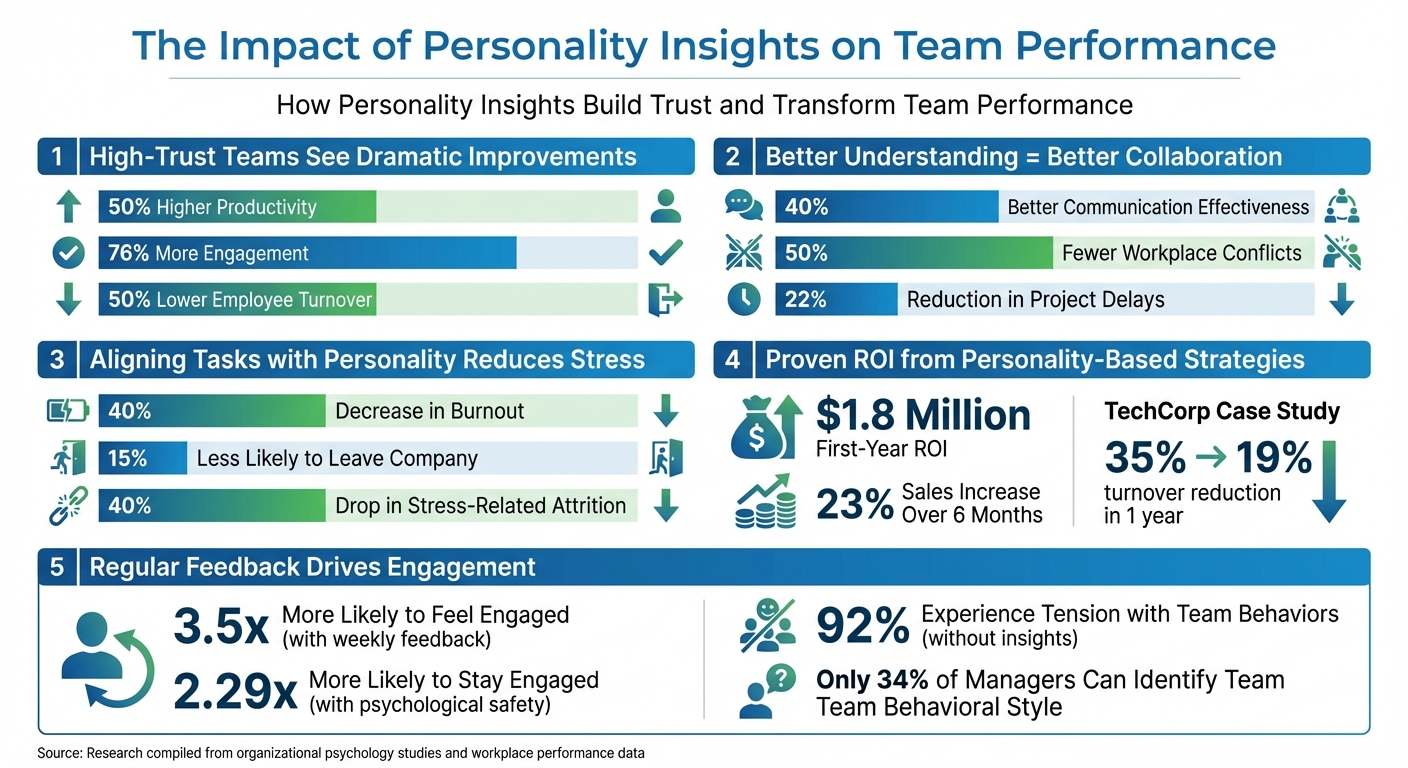
How Personality Insights Impact Team Performance: Key Statistics
Understanding Personality Dynamics to Build Empathy
How Personality Traits Affect Team Interaction
When a colleague seems withdrawn during meetings or another team member challenges every idea, it’s easy to misinterpret their actions as personal attacks. However, these behaviors often stem from personality traits, not ill intent. For example, a reserved colleague might be an introvert who processes information internally, while someone who frequently questions ideas may have a low agreeableness score - a trait linked to critical thinking and a focus on results.
Understanding these traits helps make sense of behavior. The Big Five personality framework - Openness, Conscientiousness, Extraversion, Agreeableness, and Neuroticism - is a useful tool for fostering empathy. Consider high conscientiousness: it drives attention to detail and follow-through but can also lead to perfectionism that delays progress. Knowing this, teams can support conscientious members by clearly defining what "done" means versus striving for "perfect", avoiding unnecessary delays [5].
"At the heart of trust is understanding. When team members have insight into each other's personalities, work styles, and motivations, it demystifies behaviors that might otherwise be confusing or misinterpreted." - TeamDynamics [1]
Stress can amplify personality traits in unexpected ways. A highly conscientious person might exhibit productive organization when calm, but under pressure, this same trait could morph into rigid perfectionism [5]. Recognizing these stress-induced shifts allows teams to set boundaries and align tasks with each member's natural tendencies [5]. By addressing these patterns, teams can build trust and improve collaboration.
These strategies pave the way for tools like dynamic reports, which offer actionable insights into team dynamics.
Using Dynamic Personality Reports
Dynamic personality reports take abstract personality traits and translate them into actionable advice. These tools go beyond merely describing traits - they show how individual personalities interact within specific team environments. For instance, Personos (https://personos.ai) creates customized reports that identify potential friction points and suggest ways to address them.
In October 2025, TechCorp, a mid-sized software company, faced a 35% annual turnover rate, costing the company $2.3 million. By incorporating Big Five personality assessments into their hiring and team-building processes, they reduced turnover to 19% within a year. This change also cut the time-to-productivity for new hires by 30% and delivered a first-year ROI of $1.8 million [6]. This example highlights how applying personality data strategically can lead to measurable improvements in team performance and stability.
Dynamic reports also provide teams with a shared language for discussing differences without making personal judgments [1][2]. Instead of labeling someone as "difficult to work with", a team might say, "Sarah’s direct communication style reflects low agreeableness, which helps us identify gaps in our planning." This approach reframes challenges as opportunities for curiosity, reducing workplace conflict by up to 50% when teams understand each other's stress responses [1].
Next, we’ll look at how self-awareness workshops can further align teams.
Building Self-Awareness and Team Awareness
Workshops to Build Empathy and Alignment
Workshops take personality data and turn it into actionable insights through hands-on learning. In these sessions, team members experience how different personality styles handle challenges, communicate, and solve problems under pressure. It’s a chance to see these dynamics in real-time [7].
The best workshops provide a shared framework for discussing behavioral differences without judgment [8][10]. For instance, the DISC model maps team members across four key dimensions: Dominance (focused on results), Influence (people-oriented), Steadiness (supportive), and Conscientiousness (detail-driven). This shared language helps teams replace vague criticisms with constructive observations. Instead of saying, "Mike is difficult", the team might frame it as, "Mike’s high D style values quick decisions, which can sometimes clash with our C-style members who prefer more data before moving forward."
"Through the DISC analysis, we ended the day with a better understanding of one another's qualities and how to best leverage our individual strengths for the benefit of our overall team performance." - Hermes, TeamBonding participant [7]
A great example comes from the Arizona Diamondbacks. By integrating personality assessments into their drafting process, they aligned roles more effectively, which significantly boosted team performance and contributed to their rapid success [9].
Activities like team mapping, style-specific brainstorming, and role-playing further enhance these workshops. They allow teams to identify gaps and practice adjusting their communication styles in real-time [10]. These exercises build a foundation for using analytical reports to fine-tune team dynamics even further.
Using Relationship and Group Analysis Reports
Workshops are just the beginning. Analytical reports take team insights to the next level by uncovering group dynamics and patterns that individual assessments might miss. Tools like Personos (https://personos.ai) create relationship and group analysis reports that highlight potential friction points while showcasing collective strengths. These insights give leaders a roadmap to address issues before they escalate.
The numbers speak volumes: 92% of individuals experience tension with at least one of their team’s core behaviors, yet only 34% of managers can accurately identify their team’s behavioral style [13]. This disconnect often leads to misalignment. By using group reports during focused discussions, leaders can tackle these tensions head-on. The trick is to concentrate on overall trends rather than individual scores, which helps maintain privacy and keeps the conversation constructive [13].
"When you shove conflict under the rug, you're also shoving opportunities under the rug." - Julie Straw, Vice President at Wiley [11]
Organizations that use psychometric profiling for team building have seen impressive results. For example, sales increased by 23% over six months, and stress-related attrition dropped by 40% when teams better understood their needs for autonomy versus structure [12]. However, these benefits only come when reports are treated as ongoing tools, not one-off exercises [11]. Reassessing profiles during major changes - like onboarding new hires, restructuring, or launching big projects - ensures the team’s dynamics stay aligned [12].
It’s also essential to combine these reports with real-world observations. Relying solely on data can lead to oversimplifications, like pigeonholing team members based on their profiles [12]. Managers should be trained to interpret these tools thoughtfully, using them to highlight that differences arise from natural behavioral tendencies - not personal conflicts or hidden agendas [11]. When done right, these reports become a powerful way to foster understanding and collaboration.
Using personality profiling @ work (Do they work? Insights Discovery)
Adapting Communication to Build Trust
Understanding personality dynamics is just the start - leaders need to adjust their communication styles to truly build trust. Trust grows when leaders tailor their interactions to align with each team member’s unique way of processing information and handling pressure. Research shows that teams applying personality insights see a 40% improvement in communication effectiveness, while employees in high-trust environments report being 76% more engaged and 50% more productive [1][2]. To make this happen, leaders must fine-tune their approach, ensuring every conversation resonates with the individual on the other side.
Using Communication Prompts for Better Interactions
In-the-moment guidance can make all the difference in communication. Tools like Personos (https://personos.ai) offer AI-powered prompts that help leaders adapt their tone and approach before key conversations. These prompts might suggest softening your tone or allowing extra reflection time, seamlessly weaving personality insights into everyday interactions [2].
One of the most effective uses of these prompts is during tense situations. For instance, instead of labeling a colleague as "difficult", a prompt might encourage you to ask, "What’s important to them right now?" This subtle shift in perspective can diffuse tension, reduce defensiveness, and create space for meaningful dialogue [2].
"When people truly get each other - how they communicate, make decisions, and handle pressure - conversations flow easier, feedback lands better, and trust takes root." - Training Magazine [2]
Equally important is establishing a shared language within the team. Whether your team uses DISC, the Big Five, or another framework, having everyone on the same page makes communication more productive. Instead of vague frustrations, team members can express specific observations, creating clarity and reducing misunderstandings [2][1]. Aligning tasks with individual strengths further strengthens this foundation of trust.
Assigning Tasks Based on Strengths
Delegating tasks based on personality insights is a game-changer for trust and performance. By pairing a detail-oriented individual with a big-picture thinker, for example, teams can tackle projects more effectively, addressing blind spots while maximizing strengths [1][14].
This strategy isn’t just about efficiency - it also reduces stress and burnout. When tasks align with someone’s natural working style, burnout decreases by 40%, and they’re 15% less likely to leave the company [1]. Imagine assigning a direct communicator to lead client negotiations, while a more diplomatic team member manages internal relationships. This kind of thoughtful task allocation ensures everyone is set up for success.
"One personality is not better than the other, but the team that leverages the most viewpoints in decision making has the competitive advantage to overcome natural blind spots." - Birkman [14]
The ripple effects of this approach are profound. High-trust organizations that align tasks with individual strengths see 50% lower employee turnover [1]. When people feel their contributions are recognized and valued, they’re more committed to the team’s success. That commitment shines through in every interaction, creating a workplace where trust and collaboration thrive.
sbb-itb-f8fc6bf
Creating Continuous Coaching and Feedback Loops
Building trust isn’t something that happens overnight or through a single workshop. It’s a process that requires consistent, meaningful support tailored to the evolving dynamics of a team. According to research, employees who receive meaningful feedback at least once a week are 3.5 times more likely to feel engaged [15]. The challenge? Implementing this kind of regular feedback without overwhelming leaders. The key lies in weaving personality insights into daily coaching moments and creating rhythms that feel natural - not forced. This is where technology can play a pivotal role.
Using Conversational AI for Coaching
Not long ago, personalized coaching for every team member seemed out of reach. But now, platforms like Personos (https://personos.ai) are changing the game. These AI-powered tools provide context-aware guidance to leaders exactly when they need it. For example, they might prompt you to adjust your tone before a difficult conversation or encourage you to interpret a colleague’s behavior as a reaction to stress, rather than labeling them as “difficult” [2].
The real strength of these tools lies in their seamless integration with systems teams already use, like Slack, Microsoft Teams, or email [15][2]. Picture this: before a performance review, conversational AI helps a manager tailor feedback to an employee’s personality profile, turning what could feel like generic criticism into a supportive and constructive conversation [1]. This approach transforms coaching into a continuous, everyday practice that builds trust over time, complementing earlier strategies for fostering team cohesion.
Establishing a Culture of Regular Feedback
While AI tools can help, building a culture where feedback flows regularly is just as important. Shifting from annual reviews to weekly or bi-weekly check-ins allows for quicker course corrections, and encouraging feedback in all directions - peer-to-peer, upward, and downward - creates psychological safety [15]. In high-performing teams, feedback isn’t limited to top-down evaluations; it’s a shared practice where team members feel safe discussing mistakes and taking risks [15][1].
"Employees, regardless of job level, rated regular weekly conversations the most desirable; it also correlated with the highest levels of engagement." - Steven G. Rogelberg, Professor and Researcher, HBR 2022 [15]
Using personality frameworks like DISC or the Enneagram can also make feedback more effective. These tools provide a shared language that shifts feedback from feeling like personal criticism to a collective growth opportunity. This approach reduces defensiveness and helps teams address the 92% of individuals who experience tension with at least one of their team’s core behaviors [2][1]. By anchoring feedback in personality insights and clear role expectations, leaders create an environment where continuous improvement feels supportive, not punitive [15].
Measuring and Improving Team Dynamics
Understanding personalities builds trust, while tracking metrics ensures progress is measurable. Studies show that using personality-driven data can lead to 40% better communication, 50% fewer workplace conflicts, and a 22% reduction in project delays [1].
The next step? Quantify team dynamics to drive meaningful improvements.
Tracking Progress Through Metrics
Start by establishing a baseline before introducing personality-based strategies. Tools like Personos can help by offering task tracking and group analysis features that measure team health through specific indicators. For example, assess how many team members’ natural styles align with key team behaviors. This alignment metric can be a useful way to monitor whether interventions are easing team friction.
Metrics tied to trust and collaboration are especially insightful. Communication effectiveness scores measure how clearly teams interact, while psychological safety tracking evaluates whether team members feel comfortable taking risks or speaking up. Research shows that teams with high psychological safety are 2.29 times more likely to stay engaged in their work [4]. Other valuable metrics include conflict resolution speed and employee turnover rates - teams with strong trust see 50% lower turnover [1]. By connecting these personality-based insights to traditional KPIs like engagement and productivity, you can get a more complete picture of team performance.
Refining Insights for Long-Term Results
Once you’ve tracked measurable progress, focus on fine-tuning strategies to maintain trust. Personality insights aren’t static; as teams evolve, it’s important to recalibrate regularly and integrate these insights into daily workflows. Organizations that revisit psychometric assessments report a 30% boost in team performance and collaboration [4].
Use personality data to tweak communication styles during meetings, delegate tasks based on individual strengths, and tailor recognition to match personal preferences. For instance, some team members might appreciate public acknowledgment, while others prefer a private “thank you.” Aligning rewards with personality types helps maintain engagement over time [14]. By refining your approach based on real data, you can turn personality insights into a lasting trust-building system.
Conclusion
Building trust within teams isn’t a matter of luck or simply maintaining surface-level harmony. It’s about recognizing the personality dynamics that influence how people communicate, work together, and handle pressure. When leaders tap into these personality insights thoughtfully, they create spaces where team members feel comfortable taking risks, sharing ideas, and being themselves. This strategy forms the backbone of the approach discussed earlier.
The numbers speak volumes: companies with high levels of trust see 50% higher productivity, 76% greater engagement, and 40% less burnout. Additionally, leveraging personality insights leads to 40% better communication and 50% fewer conflicts [1]. These improvements ripple across the organization, boosting retention, sparking innovation, and strengthening overall performance.
"Trust is the bedrock of any successful team. When you're on a team founded on trust, you're much more likely to share ideas, take risks and support your team members." – Jennifer Lucas, Analyst, The Omnia Group [3]
But trust-building isn’t just about occasional workshops. It requires ongoing, integrated efforts. Tools like Personos make this shift possible by embedding personality insights into everyday workflows. Through features like real-time communication tips, dynamic reports, and AI-driven coaching, these tools transform trust-building from a one-time event into a daily practice. This kind of consistent, "just-in-time" approach helps teams develop trust as a habit, ensuring long-term success and stronger team dynamics.
FAQs
How can understanding personality insights help teams build trust and communicate better?
Understanding personality insights can transform how team members communicate and collaborate. These insights reveal each person's preferred communication style, decision-making approach, and emotional triggers. By translating abstract personality traits into practical, actionable data, teams can adapt their interactions to ensure everyone feels acknowledged and valued. For instance, if a colleague thrives on written updates rather than impromptu meetings, aligning with that preference can prevent miscommunication and build trust.
AI-powered tools like Personos take this a step further by analyzing communication patterns and offering real-time suggestions. Whether it’s tweaking your phrasing or identifying the best way to collaborate with a specific individual, these tools help smooth interactions and foster a sense of psychological safety. The result? Teams that communicate more effectively, experience fewer conflicts, and build deeper connections. This supportive dynamic lays the groundwork for trust that lasts.
What are dynamic personality reports, and how do they improve team collaboration?
Dynamic personality reports are AI-driven profiles designed to evolve in real-time, reflecting changes in each team member’s traits, communication habits, and work preferences. Unlike traditional assessments that remain static, these reports continuously analyze data such as interaction patterns and task behaviors. The result? Up-to-date insights into how individuals collaborate and perform.
Here’s how these reports can benefit teams:
- Stronger collaboration and trust: By outlining how each person prefers to give and receive feedback, these reports help teams fine-tune their communication styles. This reduces misunderstandings and builds better connections.
- Smarter role alignment: Leaders can pinpoint emerging strengths or challenges, ensuring tasks are assigned to the right people. This boosts efficiency and reduces unnecessary friction.
- Early conflict resolution: Real-time alerts highlight potential issues before they grow, giving teams the chance to address concerns early and maintain a supportive, productive environment.
By leveraging these insights, teams can enhance trust, streamline communication, and work more effectively together, ultimately driving better results.
How can leaders use personality insights to assign tasks and boost team productivity?
Leaders can tap into personality insights to align tasks with their team members' strengths, creating a more productive and engaged workforce. By understanding traits such as conscientiousness, extraversion, or analytical thinking, they can assign roles that naturally suit each person's abilities. For instance, detail-oriented individuals are well-suited for deadline-focused tasks, while extroverts often shine in client-facing roles or team leadership.
With tools like AI-powered personality assessments, leaders can keep a pulse on team dynamics and adapt assignments as projects progress. This not only boosts efficiency but also builds trust by demonstrating that each team member's unique skills are recognized and appreciated. A straightforward approach - evaluating personality traits, matching tasks accordingly, and revisiting workloads regularly - can turn these insights into a game-changer for team performance.