Personality Fit and Leadership Outcomes: What Studies Show
Matching leader and team personalities boosts performance, cuts burnout, and raises job satisfaction.
Rachel Johnson

Personality Fit and Leadership Outcomes: What Studies Show
Choosing leaders based on personality fit can significantly improve team performance and satisfaction. Research reveals that personality traits influence 28% of leadership success, yet many companies promote extroverted, highly visible individuals over those who are genuinely effective.
Key findings:
- Conscientiousness and Emotional Stability are critical for long-term leadership success.
- Personality compatibility between leaders and teams reduces burnout (r = -0.505) and increases satisfaction (r = 0.548).
- Shared values and traits matter more than surface-level similarities like age or gender.
Effective leadership isn't about charisma - it's about aligning leaders with team needs. Tools like personality assessments can help organizations identify better leaders and build stronger teams. The challenge lies in focusing on deeper connections rather than appearances.
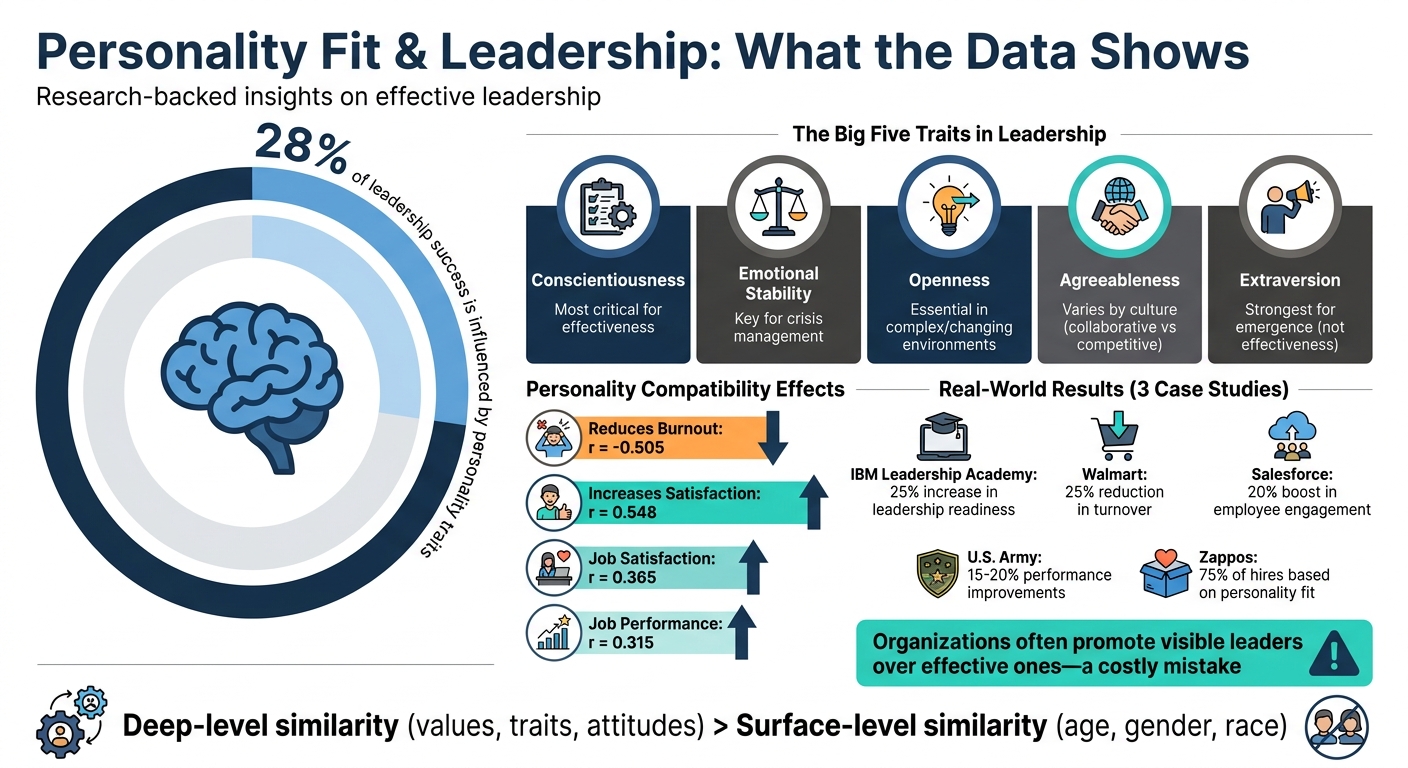
Leadership Personality Traits Impact: Key Statistics and Research Findings
How Personality Traits Affect Leadership: Research Findings
The Big Five Personality Traits in Leadership
The Big Five personality traits - Extraversion, Conscientiousness, Openness, Agreeableness, and Emotional Stability (low Neuroticism) - offer a well-established way to understand leadership. Each trait influences leadership differently, and their importance can shift depending on the workplace environment.
Conscientiousness is a standout trait when it comes to leadership effectiveness. Conscientious leaders are dependable, meet deadlines, and keep their teams organized. These behaviors build trust and create a sense of reliability within the team. On the other hand, leaders lacking this trait may struggle with organization and fail to meet commitments, which can disrupt team dynamics [1].
Emotional Stability (or low levels of Neuroticism) is consistently tied to leadership success. Leaders who stay calm under pressure, make clear decisions during crises, and prevent anxiety from spreading within their teams are especially valuable in high-stress situations [1].
Openness is particularly important in environments that are complex or constantly changing. Leaders who are open to new ideas and adaptable to disruption thrive in industries that are growing or evolving rapidly [1].
Agreeableness can have varying effects based on the organizational culture. In collaborative environments, high agreeableness helps leaders build consensus and foster teamwork. However, in competitive settings, lower agreeableness may be beneficial, as leaders might need to enforce stricter standards [1].
While these traits provide a foundation for effective leadership behaviors, their influence on becoming a leader can differ from their role in ensuring long-term success.
Leadership Emergence vs. Leadership Effectiveness
The traits that help someone rise to a leadership position aren’t always the same as those that ensure they excel once they’re there. This phenomenon, known as "visibility bias", occurs when organizations prioritize individuals who "look" like leaders over those who actually lead effectively [1].
Extraversion is the strongest predictor of leadership emergence. Extroverted individuals often project confidence and gain attention, making them more likely to be seen as leaders. While extroverts can energize teams that need direction, research suggests that in self-motivated teams, introverted leaders often perform better by actively listening and amplifying team contributions [1].
"Organizations systematically promote people who look like leaders - confident, vocal, socially dominant - over people who lead effectively but quietly. This is a costly organizational mistake that personality science helps diagnose." - JobCannon [1]
This distinction highlights a recurring issue: organizations often confuse social dominance with genuine leadership ability. A review of 22 studies published between 2019 and 2024 revealed that while all Big Five traits relate to leadership, Neuroticism consistently correlates negatively with leadership outcomes [3]. Meanwhile, traits like Conscientiousness and Emotional Stability, though less outwardly noticeable, remain strong indicators of long-term leadership success.
Personality Compatibility in Leader-Follower Relationships
Why Leader-Follower Personality Fit Matters
When leaders and team members share deeper similarities - like values, personality traits, and attitudes - it creates stronger and more effective relationships compared to similarities based on surface-level traits such as age, gender, or race.
The similarity-attraction theory sheds light on this. It suggests that when people share psychological traits, it builds trust and strengthens connections by validating each other's worldviews. This shared understanding fosters consistency and attraction, leading to better collaboration. As noted in Current Psychology:
"Agreement from others serves to affirm our perspectives, reinforcing internal consistency and generating positive emotional responses that promote interpersonal attraction." - Current Psychology [2]
Research confirms that deep-level alignment between leaders and followers enhances relationship quality and reduces emotional exhaustion. On the other hand, surface-level similarities - like matching based on demographics - don’t significantly impact job satisfaction, performance, or relationship dynamics [2].
There are two types of personality fit to consider:
- Supplementary fit: When leaders and team members share similar traits, it often leads to higher job satisfaction and stronger relationships.
- Complementary fit: This occurs when a leader’s strengths balance a team’s weaknesses. For example, an introverted leader guiding an extroverted, proactive team can sometimes achieve better results than a leader with a similar personality.
This distinction highlights how personality alignment can shape workplace dynamics. The next section explores how these relationships influence team performance.
How Personality Fit Affects Team Performance
The impact of personality compatibility goes beyond relationships - it directly affects team performance. Studies reveal that deep-level similarity correlates moderately with both job satisfaction (r = .365) and job performance (r = .315) [2]. While these numbers might seem modest, they reflect meaningful improvements in how teams operate daily.
Context plays a huge role in determining the effectiveness of personality fit. For example:
- Proactive teams: In self-directed teams where members take initiative, introverted leaders often excel. They amplify the team’s contributions by listening and supporting rather than dominating discussions [1].
- Passive teams: Extroverted leaders thrive in teams that need motivation and clear direction, as their energy and visibility drive engagement [1].
Organizations should focus on psychological compatibility rather than surface-level traits. Tools based on the Five Factor Model - measuring traits like Extraversion, Conscientiousness, and Openness - offer detailed insights into personality dynamics. Platforms like Personos go a step further, providing reports on how individual personalities interact. These tools help identify potential challenges and offer strategies to improve communication and collaboration.
When personality fit is less than ideal, leaders must actively create psychological safety and foster emotional connection. Without this effort, differences can lead to bias and harm team morale. Personality-aware communication becomes crucial here - leaders need to understand not just their team members' traits but also how these traits interact with their own.
Ultimately, personality compatibility plays a key role in boosting leadership effectiveness and team success.
Applying Personality Data to Leadership and Teams
Using Personality Assessments for Leadership Development
Personality data gives organizations a way to identify and nurture effective leaders. Yet, many companies still tend to promote individuals who seem like leaders - those who are confident, outspoken, or socially dominant - over those who lead effectively but in quieter ways [1].
IBM's Leadership Academy leveraged the MBTI to create training programs tailored to specific personality types, resulting in a 25% increase in leadership readiness [4]. For example, strategic leaders (NTJ types) worked on improving emotional awareness, while operational leaders (STJ types) focused on becoming more adaptable [1].
Walmart used psychometric assessments during hiring, which reduced turnover by 25% [4]. Similarly, Salesforce developed the "Salesforce 5", a personality inventory to pinpoint traits that align with successful leadership. This initiative boosted employee engagement scores by 20% by better matching leadership styles to organizational needs [4].
Turning assessment results into actionable steps is key. Leaders with low Neuroticism (or high Emotional Stability) tend to perform well under pressure, maintaining calm during crises [1]. Those with high Openness excel in uncertain or evolving situations, while leaders high in Conscientiousness thrive in structured, goal-oriented environments [1].
These insights don’t just apply to leaders - they can also enhance team dynamics and performance.
Building Better Teams with Personality Insights
Teams benefit significantly when personality dynamics are understood and managed effectively. Without this understanding, personality differences can lead to conflicts that hurt productivity and drive up turnover [5]. However, teams that apply personality assessments strategically can see productivity gains of up to 25% [4].
The U.S. Army demonstrated this by aligning recruits with roles that matched their psychometric profiles, leading to 15–20% performance improvements in operational tasks [4]. Zappos takes a similar approach, using personality assessments to prioritize adaptability and emotional intelligence during hiring. This focus on compatibility results in 75% of new hires being chosen based on alignment with company values [4].
Tools like Personos push this concept further by offering Dynamic Reports that examine how specific personality profiles interact. Based on the Five Factor Model, which evaluates 30 traits on an 80-point scale, these reports pinpoint potential friction points and suggest ways to improve communication. Unlike static assessments that simply categorize individuals, Personos provides relationship-specific insights, helping teams appreciate diverse working styles without oversimplifying personalities.
The goal isn’t to create uniformity but to harness complementary strengths. For instance, dominant personalities might need guidance to ensure quieter team members feel encouraged to share their ideas [5]. Recognizing and valuing individual traits is the first step toward avoiding conflicts that could derail collaboration [5]. When team members understand each other's tendencies, what might have been a source of tension can turn into an opportunity for synergy, allowing diverse skills to drive stronger outcomes.
Unlocking Personalities: Understanding the Big Five Model
Conclusion
Personality traits explain about 28% of the differences in leadership outcomes [1]. Still, many organizations prioritize flashy, visible leadership over truly effective leadership. This often results in missed opportunities to nurture quieter, highly capable leaders, which can negatively impact team morale.
To address this, start by differentiating between leadership emergence and leadership effectiveness when making promotion decisions. Extroverted leaders might rise quickly, but traits like Conscientiousness and Emotional Stability are critical for long-term success [1][6]. Next, align leadership styles with team needs - introverted leaders often thrive with proactive, self-directed teams, while extroverts tend to shine with more passive groups [1]. Finally, incorporate personality assessments throughout the HR process. Using these tools for team-building, resolving team conflicts, and leadership training ensures a better match between personalities and roles [6].
Platforms like Personos help implement these ideas by going beyond static personality profiles. Their Dynamic Reports focus on how specific traits interact in real-world relationships, identifying potential friction points and offering tailored communication strategies. With conversational AI, leaders can get real-time, context-specific advice, helping them adapt their natural tendencies to fit their teams’ needs - addressing many of the challenges discussed earlier.
The goal is to leverage complementary strengths by understanding how traits interact. Using personality data to refine promotion pipelines, customize leadership development, and create psychologically safe team environments can unlock performance improvements that generic approaches simply can’t achieve.
So, the question remains: Will your organization embrace these insights to cultivate better leaders and stronger teams, or continue promoting only the loudest voices?
FAQs
Which personality traits best predict long-term leadership success?
Leadership success often connects to five key personality traits: extraversion, openness, conscientiousness, agreeableness, and neuroticism. Each plays a unique role in shaping leadership styles and effectiveness.
- Extraversion and openness tend to align closely with transformational leadership. Leaders with these traits often inspire and motivate teams, driving creativity and innovation.
- On the other hand, conscientiousness and neuroticism are frequently tied to more autocratic leadership styles, which emphasize control and structure.
Understanding how these traits influence leadership can provide valuable insights into team dynamics and help refine approaches to managing and inspiring others.
How can I tell leadership potential from leadership performance?
Leadership potential refers to a person’s ability to develop into leadership roles, often tied to qualities like motivation, personality, and the ability to adjust to new challenges. On the other hand, leadership performance focuses on how well someone is currently performing, measured by their results and proven skills. By using personality assessments, such as those provided by tools like Personos, alongside performance data, organizations can better identify individuals excelling today and those with the traits needed to grow into leadership roles in the future.
How can teams use personality tests without bias?
Teams can use personality tests as a way to better understand individual traits, but they should never rely on them to define or label people. These tests work best when combined with other factors, such as skills, experience, and how someone fits within the team dynamic. To get the most out of these tools, it’s important to use scientifically validated assessments and keep the results in context. This approach minimizes the risk of stereotyping.
Platforms like Personos offer real-time insights based on personality data. When applied carefully, these insights can help create a more balanced workplace, reduce burnout, and improve teamwork. The key is to use these tools as part of a bigger picture, not as standalone solutions.