Personality Feedback Systems: Best Practices for Practitioners
Practitioner guide to using validated personality models for tailored feedback, ethical privacy safeguards, and measurable outcomes.
Rachel Johnson

Personality Feedback Systems: Best Practices for Practitioners
Personality feedback systems are tools that tailor guidance based on individual traits, making feedback more precise and effective. Unlike traditional feedback approaches, these systems use scientifically validated models like the Five Factor Model (FFM) to provide detailed insights into how people process feedback, build trust, and manage stress. This article outlines how practitioners can use these systems to improve communication, enhance outcomes, and reduce burnout.
Key Takeaways:
- What they are: Tools like Personos use FFM to offer actionable, personalized feedback instead of broad personality labels.
- Why they matter: Research shows personalized feedback improves motivation and reduces miscommunication.
- How to use them: Start by defining clear goals, choosing validated tools, and establishing ethical and privacy safeguards.
- Best practices: Match feedback to personality traits, use structured processes, and track outcomes to ensure progress.
By integrating platforms like Personos into your workflow, you can streamline feedback delivery, ensure ethical data use, and achieve measurable results. Whether you're a coach, manager, or therapist, these systems can help you provide tailored, effective feedback that aligns with individual needs.
Using personality insights to strengthen coaching and team performance
How to Prepare for a Personality Feedback System
Jumping into a feedback system without proper planning can lead to wasted effort and confusion. A well-thought-out approach ensures the system genuinely improves client outcomes and simplifies your workflow, rather than adding unnecessary complexity.
Define Your Goals and Use Cases
Start by clearly identifying the specific problems you want to address. Avoid vague objectives like "improve communication" that lack measurable outcomes. Instead, tie your goals to concrete workplace challenges.
Think about key scenarios where the system will be applied, such as managing crises, building trust with hesitant clients, handling tough supervisory conversations, or improving team dynamics. Once you've identified these, define 3–5 measurable metrics to track progress. For instance, you could measure trust ratings by session milestones, program completion rates, or staff burnout levels over a set period (e.g., 6–12 months) [6][7].
When your goals are clearly outlined, you can focus on finding tools that align with these specific needs.
Choose Validated Tools and Models
Opt for tools that are backed by solid scientific research. The Five Factor Model (FFM) is widely regarded as the standard for personality assessments due to its continuous-scale approach and extensive validation across different groups [5][6]. When evaluating platforms, prioritize those with published psychometrics, population-specific validation, and actionable insights that guide behavior rather than just describing traits.
For example, Personos is a platform built on the FFM. It combines personality assessments with real-time data like case notes, client history, and presenting issues to offer situation-specific advice instead of static reports. This practical integration makes it stand out from tools that stop at personality scoring.
"With Personos, I no longer feel the burden of solving my client's problems. Instead, I walk beside them as they discover their own solutions." - Steve Huff, PhD, 30-year social work veteran [4]
Once you've selected a scientifically sound tool, it's crucial to address ethical considerations and privacy safeguards.
Ethics, Privacy, and Bias Mitigation
Ethical planning is non-negotiable. The guiding principle is simple: personality insights should empower individuals, not limit or monitor them. Decisions about services should never rely solely on AI outputs or personality scores.
To ensure ethical use, establish clear policies before implementing the system. Define how the data will be used, inform clients transparently, and provide them with ways to question or correct their profiles. In settings where participation is mandatory, emphasize that personality assessments are meant to support - not enforce - compliance.
On the privacy front, U.S. organizations handling health-related data must comply with HIPAA and relevant state laws. Look for platforms with robust privacy features, such as data masking, which replaces personal identifiers with placeholders before processing. Additionally, ensure the platform has a strict non-training policy, meaning client data is not used to train the AI model [2][4]. For instance, Personos adopts a privacy-first design by default, using revolving placeholders to prevent the AI from directly accessing identifiable information [2]. This kind of safeguard is essential, so don't hesitate to ask vendors about their privacy practices.
How to Design and Deliver Personality-Aware Feedback
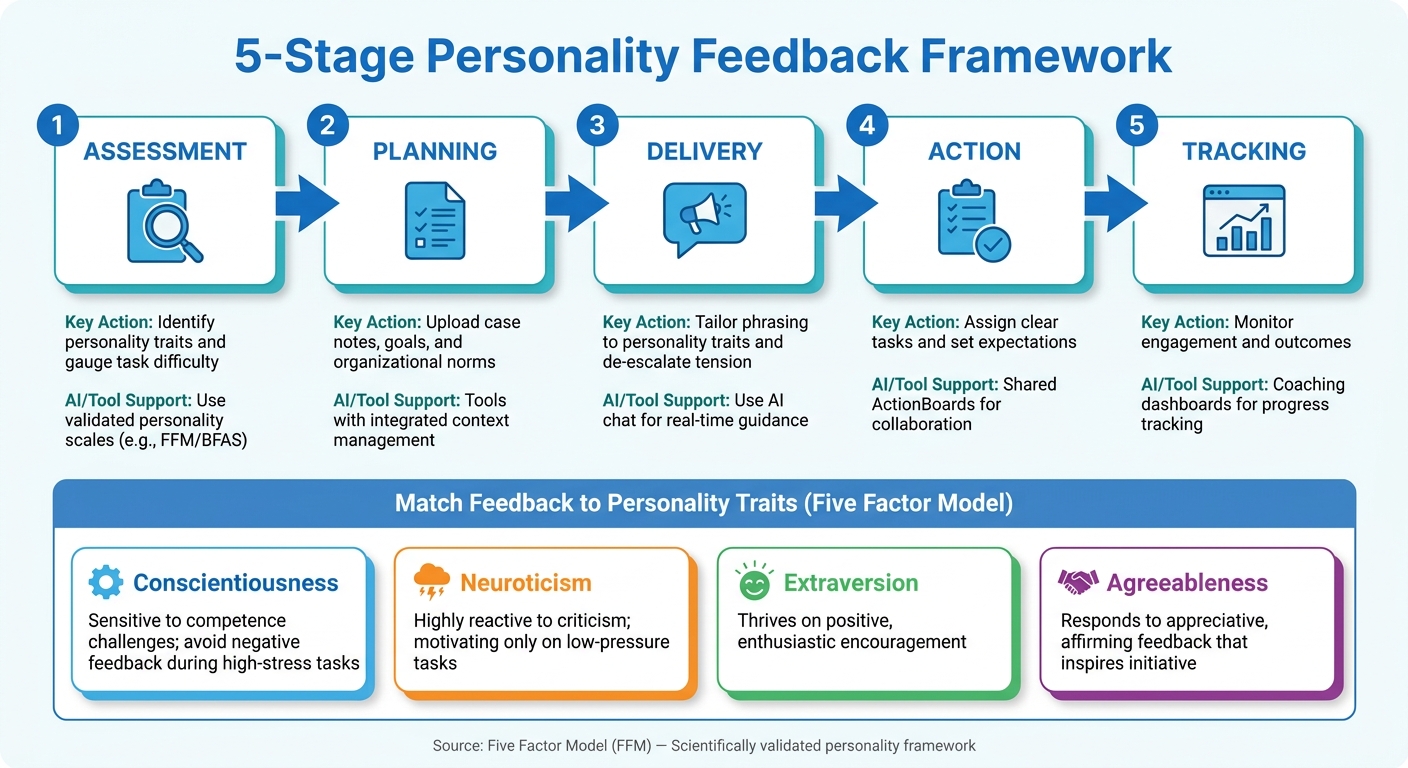
5-Stage Personality Feedback Framework for Practitioners
Match Feedback to Personality Traits
Once you have your ethical framework and tools in place, the next step is tailoring feedback to fit the individual. Research shows that a one-size-fits-all approach rarely works. The Five Factor Model offers a clear way to understand how people process and respond to feedback. Here are some key patterns to consider:
- Conscientiousness: These individuals are highly sensitive to anything that might challenge their sense of competence. While negative feedback can push them to improve on simpler tasks, it can backfire if they're already tackling something difficult or stressful, leading to heightened tension [3].
- Neuroticism: People with high neuroticism are very reactive to criticism. Like conscientious individuals, they may find constructive criticism motivating for low-pressure tasks but feel deeply discouraged when facing criticism during challenging situations [3].
- Extraversion: Extraverts thrive on positive, enthusiastic feedback. They tend to perform better when they feel encouraged and supported [3].
- Agreeableness: Those with a strong sense of prosocial concern respond well to feedback that is appreciative and affirming. This kind of feedback often inspires them to take initiative [3].
"Conscientious and Neurotic individuals together appear particularly sensitive to task difficulty, becoming significantly more motivated by negative feedback on playful tasks and demotivated by negative feedback on frustrating tasks." - Swift V, Peterson JB [3]
Tools like Personos can help practitioners apply these insights. By analyzing personality traits, these tools suggest specific language and phrasing to ensure feedback reduces tension rather than escalating it [8].
Once you understand personality-specific tendencies, the next challenge is turning these insights into a reliable feedback process.
Build a Repeatable Feedback Process
Consistency is key when delivering feedback. A structured approach ensures your feedback is grounded in data and avoids becoming inconsistent or overly reactive. Following a repeatable process also makes it easier to measure the impact of your feedback over time.
Here’s a five-stage framework for delivering feedback, along with examples of how AI tools can assist at each step:
| Feedback Stage | Key Action | AI/Tool Support |
|---|---|---|
| Assessment | Identify personality traits and gauge task difficulty | Use validated personality scales (e.g., FFM/BFAS) |
| Planning | Upload case notes, goals, and organizational norms | Tools with integrated context management |
| Delivery | Tailor phrasing to personality traits and de-escalate tension | Use AI chat for real-time guidance |
| Action | Assign clear tasks and set expectations | Shared ActionBoards for collaboration |
| Tracking | Monitor engagement and outcomes | Coaching dashboards for progress tracking |
Platforms like Personos allow you to incorporate all relevant context - like client history, goals, and organizational values - into the feedback process. This ensures that any AI-generated guidance is specific to the situation rather than relying on generic templates. Additionally, tools that include features for practitioner well-being (like burnout checks) can help sustain long-term effectiveness [1].
A structured process also makes it easier to select the right communication channels and tone for each individual.
Choose the Right Channels and Tone
The way feedback is delivered can be just as important as the feedback itself. For example, someone with high neuroticism might shut down if they receive blunt, written criticism via email. However, the same message delivered in a supportive, face-to-face conversation with thoughtful phrasing could have a completely different impact.
Here’s a quick guide to matching feedback channels with personality types:
- Real-time AI chat tools: Ideal for high-stakes or crisis situations where immediate de-escalation is needed.
- Structured coaching reports: Work well for conscientious individuals who prefer detailed and organized information.
- Shared ActionBoards: Keep agreeable clients engaged by offering transparency and clear progress tracking.
- Comprehensive relationship reports: Appeal to open, intellectually curious individuals by explaining the reasoning behind feedback.
"Language that lands for each personality so tense moments turn into progress." - Personos [8]
Personos can generate prompts tailored to both the practitioner's goals and the client's personality profile. This removes the uncertainty around tone and phrasing, making feedback delivery more precise and effective. Importantly, the platform ensures that sensitive information, like individual personality scores, remains private. This helps maintain a psychologically safe environment for everyone involved [2].
Using AI Tools to Scale Personality Feedback Systems
Key Features to Look for in AI Personality Tools
A great AI personality tool goes beyond just producing a static report - it provides real-time insights without complicating your workflow. One critical aspect to prioritize is whether the tool is grounded in a scientifically validated framework. Tools based on such models offer more precise insights compared to systems that simply group individuals into broad categories. Traditional platforms often display raw scores, which can raise privacy concerns, especially in sensitive environments.
Take Personos, for example. It prioritizes privacy by default, masking raw personality scores and focusing on high-level, actionable insights. This makes it particularly effective when working with vulnerable populations. On top of that, its Dynamic Reports adapt to changing contexts, offering insights at individual, relationship, and group levels. The tool is priced at $9 per seat per month for nonprofits and smaller organizations, making it accessible even for those with tighter budgets.
Here’s a quick breakdown of what to look for in an AI personality tool:
| Feature | Why It Matters |
|---|---|
| Validated scientific model (e.g., FFM) | Ensures insights are grounded in research, not guesswork |
| Real-time AI guidance | Provides support during live interactions, not just post-session |
| Updating, context-sensitive reports | Keeps recommendations relevant as situations evolve |
| Privacy-first design (score masking) | Protects client confidentiality and psychological safety |
| Progress tracking (ActionBoard) | Links feedback to measurable, actionable goals |
These features not only improve the quality of feedback but also make it easier to implement at scale in fast-paced environments.
Integrating AI Feedback Tools with Your Existing Workflow
To make the most of an AI personality tool, it should fit seamlessly into your current workflow rather than replacing it. The best platforms, like Personos, allow you to integrate case notes, client goals, and intervention strategies directly into the system. This ensures that every suggestion aligns with your specific needs. Since Personos is available as a Progressive Web App (PWA), you can access it on mobile devices whether you’re in the field or between meetings. It also syncs with tools like Slack and Microsoft Teams, keeping personality insights at your fingertips during day-to-day operations.
"I went in thinking I didn't have bandwidth for another tool. What I didn't expect was that it would make me so much more effective that I actually ended up with more bandwidth." - Robert Fields, Community Outreach Coordinator
To ease the transition, start small. For instance, try using the AI chat feature during a challenging client interaction. Once you’re comfortable, you can expand to using full reports and shared ActionBoards for broader applications.
After integration, the next step is to ensure that progress is tracked effectively.
Track Progress and Measure Outcomes
Once the tool is integrated, tracking outcomes becomes essential to ensure feedback translates into meaningful change. With Personos, you can turn any recommendation into a trackable action with a single click. Both practitioners and clients can monitor task progress, fostering shared accountability and keeping momentum alive. For organizations needing to showcase results to funders or stakeholders, this ability to document progress is a game-changer.
"We reduced team turnover by 45% in six months. Personos helped us understand why certain team dynamics weren't working and gave managers the exact words to fix it." - Sarah Mitchell, MBA, VP of Operations
Outcome tracking also allows you to refine your approach over time, helping you identify what works best and build a practice that’s continually improving based on evidence.
Conclusion: Best Practices for Personality Feedback Systems
Key Takeaways
For personality feedback systems to work effectively, certain core elements are essential. Start with the Five Factor Model, a scientifically validated framework that provides accurate personality insights. Combine this with well-defined objectives - whether it's for de-escalation, coaching, or improving team communication. Ensure your intake process includes clear consent language and a built-in bias check to maintain ethical standards.
How you deliver the feedback is just as critical as the data itself. Tailor your tone, pacing, and communication channels to align with each client's personality. For instance, someone with high neuroticism might benefit from a calm, private one-on-one discussion rather than a group setting where scores are shared openly. Using a consistent feedback script across your team ensures uniform quality and reliability. Finally, track metrics like attendance rates, goal achievement, and critical incidents to monitor progress and refine your approach.
These principles provide a solid foundation for actionable improvements.
Next Steps for Practitioners
To put these ideas into practice, start small. During the first 30 days, focus on a single use case - such as intake for high-risk clients, managing conflict within teams, or early-stage coaching sessions. Identify two or three outcomes you'd like to improve. Draft a consent script that ensures clients can access services without feeling pressured, and pilot a validated personality tool. This method aligns with ethical and data-driven practices while keeping the process manageable.
Consider tools like Personos, which is priced at $9 per seat per month for nonprofits and smaller organizations. Features like Dynamic Reports, ActionBoard, and conversational AI chat integrate seamlessly into existing workflows - an important factor when resources are already stretched thin. Between days 31 and 90, run a pilot with 25–50 clients or one team. Gather feedback from practitioners to evaluate usability and use these insights to fine-tune your system before scaling further.
The ultimate objective is to create a consistent, evidence-based feedback process that enhances client understanding, supports practitioners, and meets the expectations of all stakeholders involved.
FAQs
Does my whole team need to take a personality test?
Whether your team should take a personality test really depends on what you're trying to achieve. Tools like Personos can evaluate team dynamics by observing interactions, meaning not everyone has to complete a formal test. However, if you're looking for detailed individual profiles or specific interventions, quick assessments like the Five Factor Model can be a great option. With Personos, you get science-based insights that are efficient and non-intrusive, making it easier to understand how your team works together.
How do I use personality insights without stereotyping people?
To steer clear of stereotyping, think of personality insights as adaptable tools rather than rigid definitions. Personality traits aren't set in stone - they exist along a spectrum and are influenced by context and life experiences. AI tools like Personos help by offering detailed, real-time insights based on behavioral data instead of relying on static self-reports. It's important to keep profiles updated regularly to capture changes over time. Prioritize personalized guidance to ensure communication is respectful, precise, and aligned with each person's specific traits and circumstances.
What should I ask vendors about HIPAA and AI data use?
When evaluating vendors, it's crucial to ask the right questions to ensure they align with HIPAA standards and safeguard sensitive information. Start by confirming whether they have a Business Associate Agreement (BAA) in place. This agreement is essential for outlining their responsibilities in handling protected health information (PHI).
Next, inquire about their approach to data retention and deletion. Understanding how long they keep your data and the methods they use to securely delete it is key to maintaining compliance and mitigating risks.
Ask whether your data is processed domestically in the U.S. or internationally. Data processed outside the U.S. may be subject to different regulations, which could impact its security and compliance.
Finally, clarify if AI models are trained or used with your data. This ensures transparency about how your information is utilized and whether it could potentially be exposed.
By addressing these points, you can better assess whether a vendor's practices meet the required standards for protecting sensitive data.