Personality Dynamics vs. Cultural Norms in Emotional Responses
How Big Five traits shape internal emotions while cultural display rules shape expression; guidance for culturally aware practice.
Rachel Johnson

Personality Dynamics vs. Cultural Norms in Emotional Responses
When someone stays calm under pressure, is it their personality or their environment shaping that response? This article explores how personality traits, like neuroticism or agreeableness, influence internal emotional experiences, while societal norms dictate how emotions are outwardly expressed. For professionals working with diverse populations, understanding this balance is critical to avoiding miscommunication.
Key takeaways:
- Personality traits (Big Five): Traits like neuroticism affect emotional reactivity, while agreeableness promotes empathy and cooperation.
- Cultural norms: Social "display rules" guide when and how emotions are expressed, often varying between individualistic (self-expression) and collectivistic (group harmony) societies.
- Overlap and conflict: Personality and societal expectations can align (e.g., agreeableness in collaborative settings) or clash (e.g., extraversion in restraint-valuing environments).
- Practical tools: Platforms like Personos use personality data to guide emotional regulation strategies, helping professionals tailor their approach to clients' unique traits and values.
Understanding these dynamics requires moving beyond stereotypes and focusing on individual orientations, making emotional responses easier to interpret and address in professional settings.
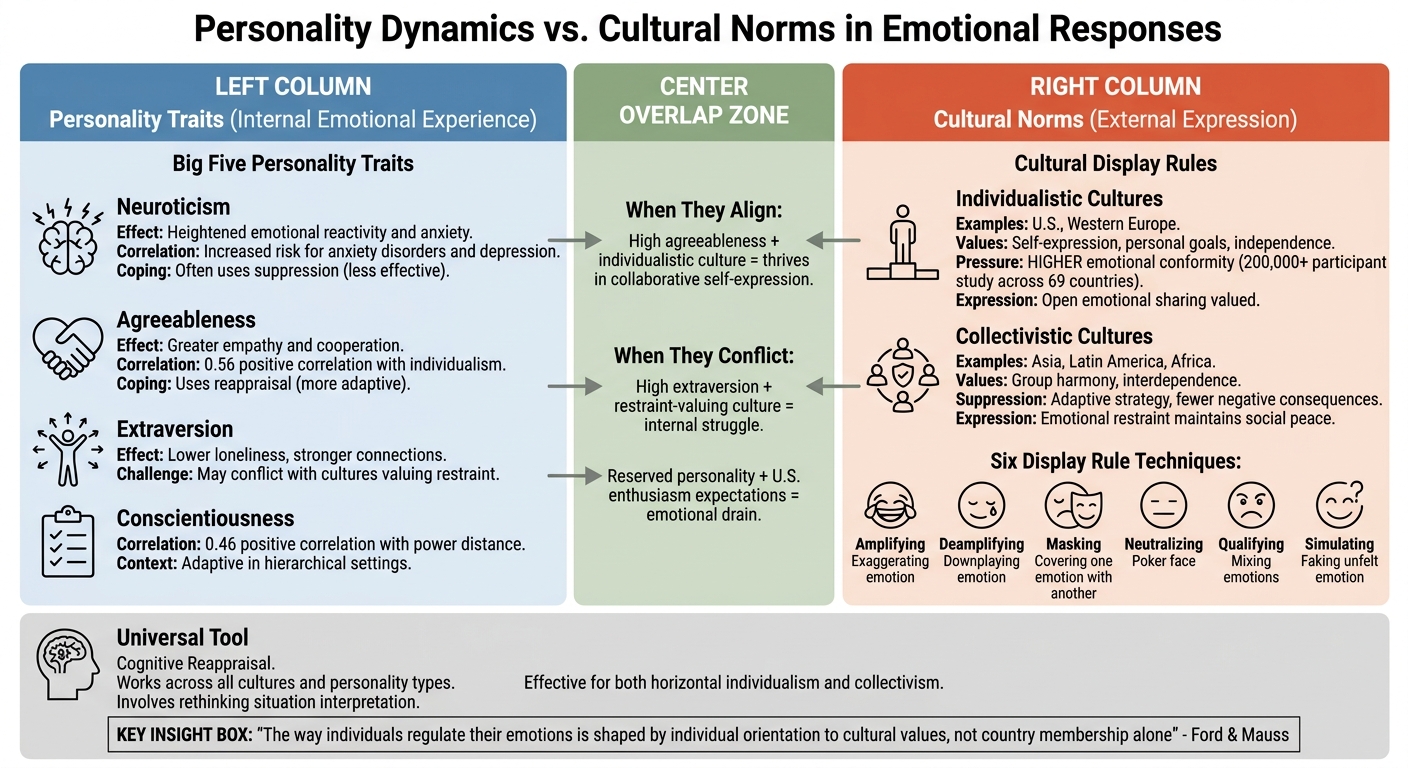
How Personality Traits and Cultural Norms Shape Emotional Responses
Cultural Values: Is it cultural or is it personal?
How Personality Traits Shape Emotional Responses
While cultural norms influence how emotions are outwardly displayed, personality traits play a key role in shaping our internal emotional experiences. The Five Factor Model - comprising Neuroticism, Conscientiousness, Openness, Agreeableness, and Extraversion - provides a well-researched framework for understanding these differences [3]. This model helps us explore how specific traits, like neuroticism and agreeableness, influence the way individuals regulate and express emotions.
Key Personality Traits That Affect Emotional Expression
Neuroticism stands out as a strong predictor of emotional distress. Those with high levels of neuroticism often experience heightened emotional reactivity and anxiety. As David Susman, PhD, a licensed clinical psychologist, notes:
"High levels of neuroticism are associated with an increased risk for anxiety disorders, depression, and overall psychological distress" [9].
These individuals frequently perceive situations as more threatening than they are, often relying on less effective coping strategies like emotional suppression instead of reappraisal - reevaluating a situation to alter its emotional impact [7].
On the other hand, Agreeableness fosters positive emotional interactions. People with high agreeableness show greater empathy and cooperation, which supports prosocial behaviors that enhance emotional well-being and reduce stress in relationships [6]. They are also more likely to use adaptive strategies like reappraisal rather than suppression [7]. Similarly, Extraversion plays a significant role in emotional health. A study by Buecker et al. found that individuals high in extraversion and agreeableness reported lower levels of loneliness, highlighting how these traits help build stronger emotional connections and support systems [8]. Together, these insights provide valuable tools for understanding how personality traits shape emotional experiences.
Personality Measurement Tools
To apply these insights effectively, reliable personality assessment tools are crucial. One such tool is the NEO Personality Inventory, which evaluates the Big Five traits and offers a deeper understanding of how these traits influence emotional responses and regulation strategies [1]. However, many traditional assessments focus solely on measurement without offering actionable advice for practitioners.
This is where Personos (https://personos.ai) steps in. Built on the Five Factor Model, this platform measures 30 personality traits on an 80-point scale and integrates conversational AI to provide real-time, personalized guidance. For example, Personos can recommend cognitive-behavioral techniques like reappraisal for clients with high neuroticism or suggest strategies for leveraging empathy in highly agreeable individuals. At $9 per seat per month, the Personos Pro plan includes Dynamic Reports that generate tailored insights, allowing practitioners to create customized emotional regulation strategies based on individual personality profiles. This combination of measurement and actionable guidance bridges the gap between assessment and practical application.
How Cultural Norms Influence Emotional Communication
Personality shapes how we feel internally, but cultural norms play a big role in determining how and when we express those emotions. These norms act like unwritten rules, guiding our behavior in social situations. For professionals working with diverse populations, understanding these patterns is essential. What might seem like emotional dysfunction in one culture could actually be an adaptive behavior in another.
Take the difference between individualistic and collectivistic cultures, for example. In individualistic cultures - like those in the United States and much of Western Europe - personal goals, independence, and self-expression are top priorities. Openly sharing emotions is often seen as a sign of being genuine. In contrast, collectivistic cultures - found in many parts of Asia, Latin America, and Africa - value group harmony and interdependence. In these societies, holding back emotions isn’t necessarily a problem; it’s often a strategy to keep social peace and avoid conflict [1]. Developing emotional intelligence solutions can help navigate these cultural differences in the workplace.
Interestingly, a massive study involving over 200,000 participants from 69 countries found that individualistic societies enforce stricter norms around emotional expression than collectivistic ones [5]. In places like the U.S., there’s significant pressure to experience emotions in "culturally appropriate" ways. For Americans, this often translates to a subtle but powerful form of social conformity that can impact life satisfaction.
Display Rules and Emotional Scripts Across Cultures
From a young age, we learn cultural "display rules" - social codes that dictate when and how to show emotions. David Matsumoto, a psychology professor, describes them as:
"cultural norms learned early in life that govern the regulation of expressive behaviors depending on social contexts" [10].
These rules are applied through six techniques:
- Amplifying: Exaggerating an emotion, like showing intense sadness at a funeral.
- Deamplifying: Downplaying emotions, such as hiding sadness at a wedding.
- Masking: Covering one emotion by showing another.
- Neutralizing: Keeping a neutral face, like a "poker face."
- Qualifying: Mixing emotions, like smiling while feeling sad.
- Simulating: Displaying an emotion you don’t actually feel [10].
A well-known study highlights these rules in practice. When watching stressful films alone, American and Japanese participants showed similar expressions of disgust and fear. But when an observer was present, Japanese participants masked their negative feelings with smiles [10]. This reflects cultural competence - Japanese participants were following their culture’s rules to prioritize group comfort over personal expression.
It’s not just about individualism versus collectivism. The vertical and horizontal dimensions of culture add another layer of complexity. Vertical cultures emphasize hierarchy and status, while horizontal ones focus on equality. A study involving 5,900 college students across seven countries found that these orientations are better predictors of emotional regulation than national labels [1]. For instance, someone from a collectivistic country who values equality may regulate emotions differently than someone from the same country who prioritizes hierarchy [1].
Working with Clients from Different Cultures
Understanding these cultural rules can greatly improve interactions with clients from diverse backgrounds. Emotional suppression, for instance, carries different meanings depending on the culture. As highlighted in Current Psychology:
"Suppression is in line with collectivist values of interdependence and maintaining social harmony, making it unsurprising that there are fewer negative consequences associated with suppression in collectivist contexts" [1].
For clients from collectivistic cultures, suppressing emotions might signal social competence rather than emotional distress.
It’s also important to avoid making assumptions based solely on someone’s country of origin or ethnicity. Instead, consider their personal orientation toward cultural values. For example, a Chinese American raised in San Francisco might lean toward individualistic values, while a third-generation Japanese American might still practice collectivistic emotional regulation. Personal beliefs and values often matter more than cultural stereotypes.
When working with clients, ask whether emotional suppression is helping them navigate social relationships or creating challenges. This insight will help you decide whether to frame suppression as a cultural strength or an area for growth. One universal tool that works across cultures is cognitive reappraisal, which involves rethinking how to view a situation. This technique has been shown to support mental health in diverse populations [1].
When Personality and Culture Overlap or Conflict
Previously, we looked at how personality traits and cultural norms shape emotional expression. Now, let’s dive into how these two forces can align or clash, influencing emotional responses in complex ways.
Examples of Alignment and Conflict
Sometimes, personality traits and cultural expectations are in sync. For instance, individuals with high agreeableness - traits like warmth and cooperation - thrive in individualistic cultures that encourage both self-expression and collaboration. Research even shows a positive correlation (0.56) between agreeableness and individualism[11]. On the flip side, conflict arises when personality traits and cultural norms clash. Imagine someone with high extraversion living in a culture that values calmness and restraint. This person might struggle to balance their natural tendency for lively self-expression with societal expectations for composure[1].
Interestingly, individualistic cultures often place more pressure on emotional conformity than collectivistic ones. A study of over 200,000 participants across 69 countries found:
"In countries higher in individualism, emotional experiences of individuals were more homogenous and more concordant with the emotions of others in their culture" [5].
In the U.S., for example, there’s strong internal pressure to not only act appropriately but also to feel the "right" emotions. For someone who is naturally reserved, working in an American environment that prizes enthusiasm and excitement can feel draining. Research links deviations from these emotional norms to lower life satisfaction in individualistic settings[5].
These dynamics highlight the need for tailored approaches when addressing personality and culture in practice.
How Practitioners Can Balance Both Influences
To navigate the interplay of personality and culture effectively, practitioners should avoid relying on broad cultural stereotypes. Instead, they need to assess each client’s individual cultural orientation. As one study points out:
"The way individuals regulate their emotions is not shaped by the membership of a particular cultural group or country, but instead the individual's orientation to particular cultural values" [1].
For example, a third-generation Chinese American might prioritize individualistic values, while a white American raised in a close-knit religious community might lean toward collectivistic principles. These nuances are crucial to understanding emotional regulation.
When emotional suppression is observed, practitioners should consider its purpose. In hierarchical settings with high power distance, suppression may serve as an adaptive strategy rather than a sign of psychological distress. Research shows a positive correlation (0.46) between conscientiousness and power distance[11], suggesting that structured environments naturally influence personality expression.
Tools like Personos can help practitioners bridge the gap between personality and cultural context. Using the Five Factor Model, Personos evaluates 30 personality traits on an 80-point scale and generates personalized reports with relationship-specific insights. This approach moves beyond generic cultural assumptions, providing deeper, more individualized guidance.
Context is everything. A client’s quietness might reflect disengagement - or it could align with the calm ideal valued in interdependent cultures. Similarly, emotional expressiveness might be authentic or the result of societal pressure to display enthusiasm. These are the kinds of questions that truly matter.
One universal tool for practitioners is cognitive reappraisal - rethinking how to interpret a situation. Research shows that both horizontal individualism and horizontal collectivism are linked to higher use of reappraisal[1]. This makes it a valuable strategy for clients across different cultural orientations and personality types.
Applying These Concepts in Professional Practice
Using Personality Data to Improve Communication
Personality data transforms abstract traits into actionable strategies, helping professionals tailor their communication for better outcomes. For example, Personos uses the Five Factor Model to measure 30 personality traits on an 80-point scale. It generates Dynamic Reports that highlight how two individuals interact, pinpoint potential friction points, and suggest effective communication approaches. The platform's AI chat feature leverages detailed personality profiles and case notes to provide real-time advice for crisis intervention and trust-building.
Other tools, like Mark Murphy's Communication Style Assessment and the Founder Institute's Entrepreneur DNA Assessment, offer valuable insights as well. However, Personos stands out by offering transparent reasoning for its recommendations. It explains which personality traits were analyzed and the psychological principles behind each suggestion. With its ActionBoard, users can turn insights into specific, trackable tasks, ensuring that personality data leads to measurable behavioral changes - something especially important when demonstrating results to funders and stakeholders.
When combined with cultural insights, personality metrics become even more powerful. This pairing allows practitioners to design communication frameworks that are both precise and empathetic, enhancing their overall effectiveness.
Building Cultural Awareness into Your Practice
Cultural awareness goes beyond generalizations, focusing instead on each individual’s unique cultural orientation. Tools like the 32-item Vertical and Horizontal Individualism and Collectivism Scale can help practitioners better understand cultural values[1]. By integrating this cultural perspective with personality data, professionals can create a more comprehensive and nuanced approach.
Dr. Meagan Pollock highlights the importance of this practice:
"Adapting your communication style isn't about changing who you are - it's about ensuring your message is heard, understood, and acted upon"[4].
This involves decoding social cues to decide when to use formal or informal language, or whether to provide direct or indirect feedback. For example, in high-context cultures like Japan or China, non-verbal cues and implied meanings carry significant weight. In contrast, low-context cultures such as the U.S. or Germany rely heavily on explicit verbal communication[4].
Another key consideration is "ideal affect" - the emotional states people strive for - which varies across cultures. North Americans often favor high-energy positive states like excitement, while East Asians tend to value low-energy positive states like calmness and peace[2]. Misinterpreting these preferences can lead to communication breakdowns. For instance, a calm demeanor might be seen as disengagement in one culture but as a sign of contentment in another. One study found that 95% of U.S. participants associated a smile with happiness, compared to only 69% of participants from Sumatra[2].
Practitioners should also address the mental effort involved in code-switching, where individuals adjust their language or tone to align with dominant cultural norms. Dr. Pollock explains:
"Code-switching is not just about adapting; it's about navigating the complexities of identity in different spaces. True inclusivity allows us to bring our authentic selves without the need for constant shifts"[4].
Conclusion
Emotional responses are shaped by a mix of personality traits and cultural influences. A study involving 200,000 participants found that emotional experiences tend to be more consistent in individualist cultures compared to collectivist ones[5]. This highlights the importance of moving beyond broad country-level generalizations or standalone personality assessments. Instead, professionals need tools that evaluate both personality and cultural orientation on an individual basis.
As Ford & Mauss point out:
"The way individuals regulate their emotions is not shaped by the membership of a particular cultural group or country, but instead the individual's orientation to particular cultural values"[1].
Tools like Personos are leading the way by combining insights from 30 personality traits with cultural orientation measures. They provide real-time, actionable guidance while explaining the psychological principles behind each recommendation, helping professionals make informed decisions.
To better navigate emotional complexities, start by evaluating individual orientations rather than relying on cultural stereotypes. Use strategies like cognitive reappraisal, which works well across cultures, and understand that emotional suppression can sometimes promote social harmony rather than signal dysfunction[1]. When faced with unexpected emotional reactions, consider whether they stem from personality, cultural values, or a blend of both.
Professionals who embrace this dual framework excel in diverse settings. They recognize that a client’s calm demeanor might reflect their cultural ideal affect rather than indifference, or that emotional suppression could be a way to maintain group harmony instead of avoiding emotions. By using the right tools and cultivating awareness, you can confidently navigate these dynamics and foster meaningful change in every interaction.
FAQs
How can I tell if someone’s calmness is personality or culture?
Calmness can arise from either personality traits or external cultural influences, and the key to understanding its origin lies in observing its consistency. If someone remains calm across a variety of situations, it’s likely tied to a personality trait such as emotional stability. On the other hand, if their calmness fluctuates depending on the social environment or cultural expectations, this suggests external influences are shaping their behavior.
Professionals can use tools like Personos to dive deeper into these dynamics. By blending insights into personality with the context of specific situations, these tools provide a more nuanced understanding of where calmness originates.
When is emotional suppression healthy vs. a red flag?
In some East Asian societies, holding back emotions is seen as a way to maintain social harmony. This approach can even contribute to a sense of well-being because it aligns with cultural values that emphasize restraint. On the other hand, in places like the United States, where openly expressing emotions is often encouraged, suppressing feelings can have the opposite effect. It might lead to challenges like lower well-being or even depression. The impact of emotional suppression really depends on whether it matches the cultural norms and supports a person’s mental health.
How can personality data improve cross-cultural communication?
Personality data plays a crucial role in improving communication across different cultures by highlighting how individual emotional responses are shaped by cultural norms. For example, in individualist cultures, there’s often a stronger focus on openly expressing emotions compared to collectivist cultures, where emotional restraint might be more common. Tools like Personos, which are based on well-researched personality models, offer customized insights that take into account both cultural and personal traits. These tools help professionals minimize misunderstandings, build trust, and adapt their communication style to meet both cultural and individual expectations, leading to more compassionate and effective interactions.