Personality Dynamics in Conversation Breakdowns
How personality differences cause miscommunication and how AI tools help professionals adapt communication in real time.
Christian Thomas

Personality Dynamics in Conversation Breakdowns
- Personality Traits Shape Communication: Traits like Extraversion, Openness, and Agreeableness influence how people interact, listen, and respond.
- Mismatch Risks: Differences in traits (e.g., high Extraversion vs. low Extraversion) can lead to reduced alignment in conversations, increasing misunderstandings.
- High-Stakes Impact: Poor communication can have serious outcomes, from eroding trust to critical failures in caregiving or crisis intervention.
- AI Solutions: Tools like Personos use personality models to help professionals adjust their communication in real time, improving outcomes in sensitive scenarios.
Quick Takeaway:
Understanding personality dynamics is key to preventing communication breakdowns. With AI tools offering tailored insights, professionals can navigate complex interactions more effectively.
Avoid Interpersonal Communication Breakdowns
The Science Behind Personality and Communication
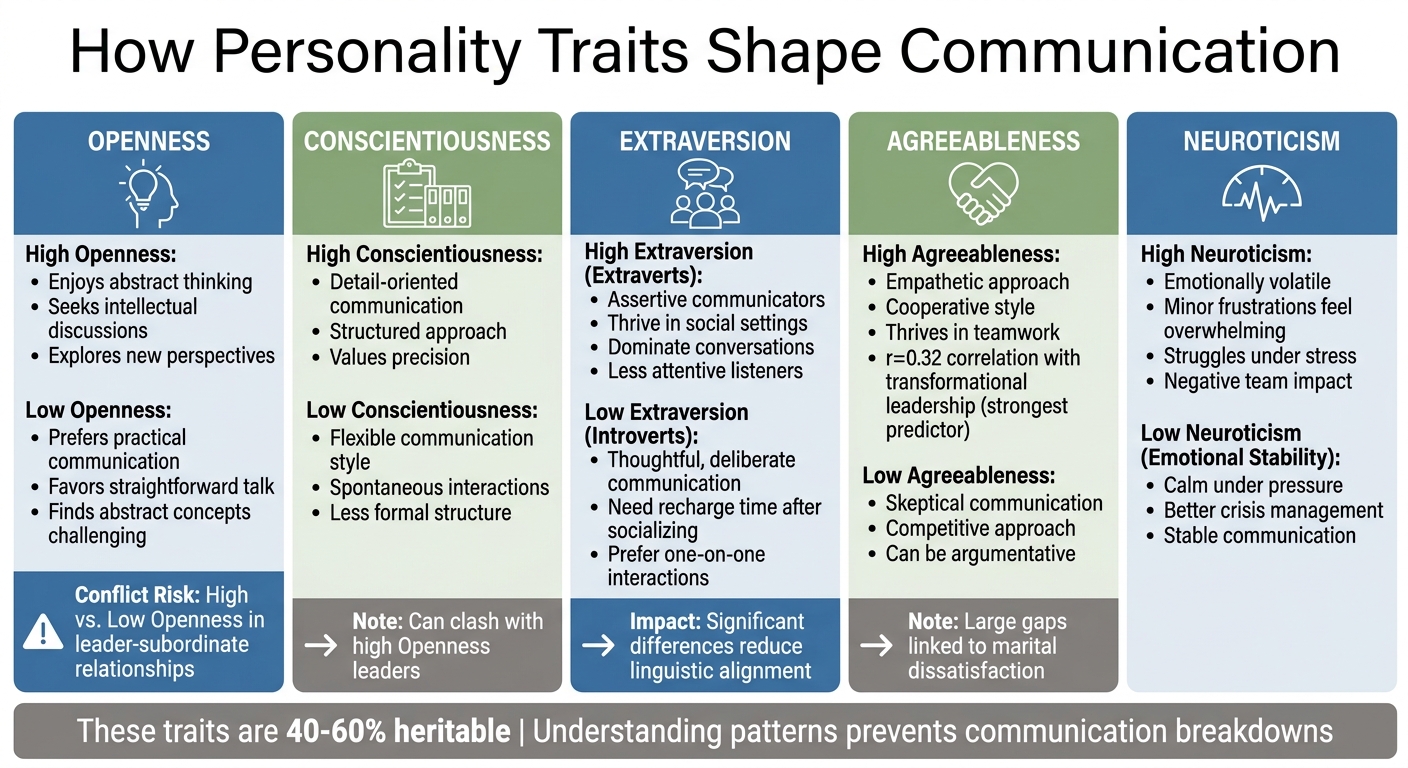
Big Five Personality Traits and Communication Styles
How Personality Traits Affect Communication Styles
The Five Factor Model, often called the Big Five, offers a framework to understand how personality traits influence communication. It focuses on five key traits: Openness, Conscientiousness, Extraversion, Agreeableness, and Neuroticism. Each of these traits shapes communication in unique ways.
For instance, individuals high in Openness tend to enjoy abstract thinking and intellectual discussions. They seek out new perspectives and prefer conversations that explore ideas. On the other hand, those with lower levels of Openness favor practical, straightforward communication and may find abstract concepts challenging [3]. Conflicts can arise when personality traits differ significantly - like a leader high in Openness working with a highly Conscientious subordinate [6].
Extraversion often creates a noticeable communication divide. Extraverts are assertive and thrive in social settings, often dominating conversations. However, they can be perceived as less attentive listeners. In contrast, introverts prefer thoughtful, deliberate communication and need time to recharge after engaging socially [3].
Agreeableness influences how people approach social interactions. Those high in Agreeableness are empathetic, cooperative, and thrive in teamwork settings. In contrast, individuals low in this trait may be more skeptical, competitive, and even argumentative [3]. Interestingly, Agreeableness has been identified as the strongest predictor of transformational leadership skills, with a correlation of r=0.32 [4].
Neuroticism, or emotional stability, affects how people handle stress in conversations. High Neuroticism is linked to emotional volatility, where even minor frustrations can feel overwhelming [4]. Those with lower Neuroticism remain calm under pressure, making them better suited for managing communication during crises.
"A mercurial leader with vacillating emotions can negatively impact a team's performance. If you're high in openness be careful in how you communicate with those with greater conscientiousness."
These personality traits are not solely shaped by environment - research indicates they are 40% to 60% heritable [3][5]. Recognizing these patterns is key to avoiding communication breakdowns and fostering better interactions.
Personality Combinations That Lead to Breakdowns
While not all personality pairings create tension, certain combinations are more likely to lead to communication issues. For example, significant differences in Extraversion can result in reduced linguistic alignment during conversations [1]. Similarly, large gaps in Openness between partners have been linked to marital dissatisfaction [3]. Poor emotional management skills, or the inability to regulate responses to situations, also predict conversational breakdowns, particularly in task-oriented discussions [5].
Another factor to consider is neutral perceptual sensitivity (NPS) - a person's ability to pick up on subtle linguistic cues. When someone has low NPS, they may miss unspoken intentions or goals, causing irrelevant responses and stalled conversations [5]. Understanding these dynamics can help improve communication, especially in AI systems designed to bridge gaps.
In human-machine interactions, personality mismatches can have tangible effects. Studies show that when a chatbot's personality doesn't align with the user's - particularly regarding Extraversion - user satisfaction, trust, and perceived appropriateness of responses drop significantly [5]. This has important implications for AI tools used in critical areas like crisis intervention or customer support.
Personos applies the Five Factor Model to provide real-time insights, allowing professionals to adjust their communication strategies dynamically. These insights pave the way for AI solutions that adapt to personality dynamics, improving interactions across various contexts.
AI Solutions for Personality-Aware Communication
How AI Analyzes Personality and Adjusts Communication
AI systems are revolutionizing how communication adapts to personality by blending psychological models with real-time data. Tools like Crystal rely on the DISC model (Driver, Influencer, Steadiness, Conscientiousness) to classify traits, while advanced systems use 8-dimension models that include factors such as Decency, Engagement, and Serviceability [7][8].
These systems analyze personality through various methods. Some platforms use direct questionnaires, while others - like Crystal - can predict personality traits from a LinkedIn profile without requiring user input [7]. The most advanced AI integrates personality insights directly into its processing, ensuring every response is tailored to the user’s tone, structure, and emotional needs [8].
AI’s ability to adjust dynamically is a game-changer. Research from early 2026 highlights that users prefer AI with flexible personas - for example, a "Balanced Engaging Guide" for informational tasks or a "High-Functioning Supportive Partner" for emotional support. Some systems even allow users to tweak these personas through adjustable settings [8].
Real-time coaching features further enhance communication. Tools like Crystal and MindReader.ai offer live suggestions, such as "avoid surprises" for Steadiness personalities or "lead with data" for Analysts [7][9]. Tony Tong from MindReader.ai emphasizes this approach, stating, "The secret to truly engaging conversations actually lies in tailoring our approach to the receiver" [9].
Building on these advancements, Personos takes a focused approach to assist professionals in high-stakes scenarios.
Personos: Built for Personality-Based Communication
Personos is designed specifically for helping professionals, addressing the unique challenges of high-pressure human interactions. Using established personality frameworks like the Five Factor Model, which scores 30 facets on an 80-point scale, it delivers highly detailed personality insights [10].
The platform’s core feature is a conversational AI chat that combines personality profiles and situational context. For instance, if a social worker describes a crisis involving a resistant client, the system analyzes the practitioner’s personality, the client’s traits, their relationship history, and the current situation to offer tailored advice [10]. Users can also import profiles on the fly by typing "@" followed by a name, ensuring recommendations are rooted in real-world dynamics [10].
Dynamic Reports provide multi-layered insights, including self-awareness, relationship friction points, and group dynamics. Unlike static assessments, these reports evolve with the situation and offer role-specific details, such as trauma responses or resource readiness for social workers [10].
To turn insights into action, the ActionBoard offers a Kanban-style task management tool. Users can convert chat messages, report sections, or prompts into actionable tasks with a single click. This feature is particularly useful for integrating recommendations into daily workflows [10].
Personos Prompts deliver concise, actionable reminders on a customizable schedule. For professionals juggling heavy caseloads, these prompts reinforce specific communication strategies during challenging interactions, keeping personality-based insights accessible even in busy moments [10].
What sets Personos apart is its commitment to scientific transparency. Every recommendation includes a clear explanation of the personality traits, context, and psychological principles involved. As Personos explains, "By surfacing how the system arrived at the answer... if you choose to take action you can do so with confidence" [10]. This openness helps professionals build expertise and trust the system’s guidance.
How Personos Compares to Other AI Communication Tools
While many AI tools focus on dynamic adaptation, Personos stands out for its specialization in high-stakes professional interactions. Tools like Crystal and MindReader.ai excel in business and sales contexts, but Personos is tailored for helping professionals. Its unique memory architecture tracks individual, relationship, and group dynamics, enabling it to align personal goals, relationship boundaries, and team norms seamlessly over time [10]. This is especially useful for social workers managing complex cases that balance immediate crises with long-term goals and organizational constraints.
Research shows that personality-based communication is most effective when applied consistently rather than in isolated messages. A 2026 study involving 90 participants found that those exposed to a higher proportion of personality-informed messages rated them as more appropriate and experienced less negative emotion [11]. Personos leverages this insight by delivering consistent, personality-aligned Prompts to build meaningful communication patterns over time.
Personos also fosters trust through specialized "Coaching" relationship types. These allow practitioners to upload custom context, like case notes and goals, and track client progress using collaborative ActionBoards [10].
For professionals dealing with high caseloads and emotional strain, Personos offers more than just convenience - it’s an essential tool. At $9 per seat per month, it transforms detailed personality insights into actionable strategies, helping practitioners extend their impact while maintaining confidence through transparent and tailored guidance.
How Helping Professionals Use Personality-Aware AI
Building Trust with Resistant Clients
Working with resistant clients can be tough, especially when personality traits influence their reactions. For instance, a client with high Neuroticism might withdraw out of fear of being judged, while someone low in Agreeableness might see advice as controlling. These dynamics can derail progress if not addressed effectively.
Personos steps in by analyzing both the professional's and the client's personality profiles, identifying potential friction points before they escalate. Its conversational AI provides real-time suggestions for tone, pacing, and approach, tailored to the client's personality. This helps professionals adapt on the fly. For Carla Mendoza, LCSW, an addiction recovery counselor, this feature has been a game-changer:
"In recovery, timing is everything. Personos helps me anticipate when a client is on the edge of shutting down and adjust my approach so we stay connected. Such timely support is vital" [12].
The platform also uses predictive behavioral analysis to flag early signs of disengagement. This is especially crucial for professionals working with clients who are at risk of relapse or dropping out [12].
Managing Crisis Situations and De-escalating Conflict
Once trust is built, managing crises effectively requires recognizing and responding to emotional shifts as they happen. Personos excels here, detecting emotions in real time and guiding practitioners to adjust their responses immediately [13]. This is particularly valuable in fields like domestic violence advocacy, where maintaining empathy while setting boundaries is critical to avoiding burnout.
Lisa Chen, MSW, a domestic violence advocate, shared her experience:
"When you work with survivors, you're constantly balancing empathy with boundaries. Personos has helped me protect my own well-being while staying fully present for the people I serve" [12].
The platform provides specific de-escalation strategies tailored to individual personalities, offering phrases and approaches to use when tensions rise [12][13]. Beyond handling immediate crises, Personos includes tools like crisis simulations and decision-making support to help professionals practice ethical responses under pressure [13]. Post-crisis, the AI analyzes events and suggests ways to improve future responses, creating a feedback loop that boosts confidence and skills over time [13].
Improving Team Communication and Collaboration
These personality-focused strategies aren't limited to individual interactions - they also enhance teamwork. Personality differences often lead to workplace conflict [12], and many organizations struggle to address these issues effectively. Personos helps managers understand team dynamics, offering tailored conflict-resolution language for each team member.
Sarah Mitchell, MBA, VP of Operations, highlighted the impact on her organization:
"We reduced team turnover by 45% in six months. Personos helped us understand why certain team dynamics weren't working and gave managers the exact words to fix it" [12].
The platform's Dynamic Reports for groups identify strengths, blind spots, and potential conflict areas, allowing teams to address issues before they escalate. For nonprofit teams juggling heavy workloads and tight resources, this means less burnout and smoother collaboration. Personos even offers tools like grant writing assistance to support these organizations [12]. Additionally, its Transparent Reasoning feature explains the rationale behind its suggestions, helping professionals develop their emotional intelligence rather than relying solely on the AI [12].
Conclusion: From Conflict to Collaboration
Key Takeaways for Professionals
Recognizing personality differences can turn potential communication failures into opportunities for growth. Research highlights how specific personality combinations influence collaboration. For instance, a study led by Harang Ju from Johns Hopkins Carey Business School and Sinan Aral from MIT Sloan School of Management in October 2024 involved 1,258 participants creating 7,266 display ads. The findings? Neurotic humans paired with neurotic AI achieved notably higher click-through rates during a field experiment on the X platform, which reached 5 million impressions. On the other hand, extraverted humans working with conscientious AI produced the least effective ads [14].
The takeaway: aligning personalities boosts performance. Tools like Personos leverage psychological insights to deliver measurable results, turning awareness into actionable strategies. This is crucial because past studies have shown that mismatched traits often lead to communication breakdowns [1].
For professionals managing heavy workloads, personality-aware AI can be a game-changer. By offering real-time, tailored guidance based on both the professional's and client's personality traits, it eases cognitive strain, reduces burnout, and enhances outcomes.
These findings pave the way for even more adaptable personality-aware AI systems in the future.
What's Next for Personality-Aware AI
The next evolution of personality-aware AI is moving toward flexibility. A 2026 study with 60 participants demonstrated that AI with adjustable personalities across three task contexts - informational, emotional, and appraisal - was perceived as more trustworthy and relatable [2]. As Shakyani Jayasiriwardene and her team put it:
"Our findings highlight the importance of designing conversational agents that adapt alongside their users, advancing more responsive and human-centred AI" [2].
Imagine AI that evolves with your needs. Instead of static personalities, future tools will adapt their approach depending on whether you require data-driven insights, emotional support, or constructive feedback. Tools like Personos are already paving the way for this shift, enabling context-sensitive interactions that adjust in real time. Professionals will gain the ability to fine-tune AI personality traits on the fly, fostering what researchers call "co-evolution" - AI that grows alongside its user to maintain relevance and build long-term rapport [2].
This transformation - from viewing AI as just a tool to treating it as a collaborative partner - has the potential to reshape how we navigate complex interpersonal dynamics. By engineering AI traits for better collaboration, every challenge becomes an opportunity to strengthen connections and achieve deeper understanding [14].
FAQs
Which Big Five traits most often trigger misunderstandings?
Extraversion and agreeableness are two traits from the Big Five personality model that often play a role in misunderstandings. Variations in these traits can influence how conversations progress, the topics people prefer to discuss, and even the way they align their language with others. These differences can make miscommunication more likely. Recognizing how these traits impact interactions can lead to smoother communication and fewer breakdowns.
How can I spot a personality mismatch mid-conversation?
Recognizing a personality mismatch often involves noticing changes in someone's behavior or communication style. For example, an outgoing person might suddenly become quiet, or someone typically easygoing might start acting combative. Nonverbal signals, like shifts in tone, body language, or even how smoothly someone speaks, can also hint at a disconnect.
Tools like Personos can be incredibly helpful in these situations. By analyzing personality profiles in real time, they provide actionable insights - suggesting adjustments in tone, pacing, or content. This can make conversations flow more smoothly and help bridge any gaps in understanding or connection.
How does Personos personalize guidance in real time?
Personos provides real-time, customized guidance by analyzing individual personality traits using the Big Five model. It offers specific insights and actionable suggestions tailored to the situation, making it easier for professionals to improve communication and handle complex interactions with confidence.