Personality-Driven Leadership vs. One-Size-Fits-All
Compare personality-driven and one-size-fits-all leadership: benefits, risks, real examples, and AI tools for personalized team management.
Christian Thomas

Personality-Driven Leadership vs. One-Size-Fits-All
Which leadership style works better? Personality-driven leadership tailors communication, motivation, and feedback to individual team members, while one-size-fits-all leadership applies the same approach to everyone. Research shows that understanding personality traits can improve team performance, job satisfaction, and retention. Meanwhile, rigid, uniform methods often fail to meet the needs of diverse teams.
Key Takeaways:
- Personality-Driven Leadership: Focuses on individual traits using tools like the Big Five personality model. It’s flexible and effective for diverse, knowledge-based teams.
- One-Size-Fits-All Leadership: Sticks to a single approach, which can work in repetitive tasks but often leads to disengagement and burnout in modern workplaces.
- AI Tools: Platforms like Personos help leaders apply personality-driven strategies with real-time insights and tailored guidance.
Quick Comparison:
| Feature | Personality-Driven Leadership | One-Size-Fits-All Leadership |
|---|---|---|
| Approach | Tailored to individual traits | Uniform for all |
| Best For | Diverse teams, creative projects | Repetitive tasks, crisis management |
| Engagement | Builds trust and motivation | Achieves compliance but limits morale |
| Development | Encourages independent thinking | Restricts growth and decision-making |
| Challenges | Requires time and emotional insight | Risks burnout and disengagement |
Conclusion: Personality-driven leadership aligns better with modern team dynamics, while one-size-fits-all leadership struggles in today’s workplaces. Tools like Personos can help leaders make the shift.
Becoming the Ultimate Leader: Aligning Personality Traits with Leadership Traits - Dr. Jim Collins
The Core Principles of Personality-Driven Leadership
Personality-driven leadership is all about recognizing that no two people are the same. Applying a one-size-fits-all approach to managing a team often leads to inconsistent results. Instead, this style of leadership focuses on understanding individual temperaments to customize communication, motivation, and feedback.
"Effective managers of all eras have realized they need to find out what motivates each individual team member and speak to them in their own language." - Lindsey Pollak, Multigenerational Workplace Expert [1]
Using Personality Assessments to Guide Leadership
Tools like the Five Factor Model offer a structured way to go beyond surface-level observations and truly understand team dynamics. Other frameworks, such as the Guardian/Driver/Pioneer/Integrator model, help leaders identify cognitive diversity and pinpoint where their teams might be lacking balance. For instance, in 2015, Alison Beard, Marriott's Chief Talent Officer, used this approach to add a "Pioneer" to a team that was heavily weighted with "Guardians" and "Drivers." The result? A more balanced team that combined precision with creativity [5].
What makes personality-driven leadership stand out is its emphasis on leadership agility - the ability to recognize when your default leadership style doesn’t fit the situation and adjust accordingly. This approach moves away from rigid methods and instead encourages leaders to adapt based on individual needs and specific contexts. As IMD explains: "The key is not finding the 'perfect' leadership style, but rather understanding your natural tendencies, recognizing their strengths and limitations, and developing the skills to adapt when circumstances require a different approach." [6]
By fostering a deeper understanding of individual differences, leaders can respond dynamically in real time - especially during high-pressure moments with their teams.
Real-Time Guidance for Leaders
Understanding personality is only part of the equation. The real challenge lies in applying that knowledge in real-world scenarios. Personality assessments can guide leaders in how they deliver feedback, resolve conflict and strengthen teams, or re-engage team members who seem disengaged. This is where AI tools like Personos come into play, offering practical, real-time support.
Personos, built on the Five Factor Model, provides leaders with actionable advice tailored to individual personality profiles. For example, a leader dealing with a team member who shuts down during feedback can describe the situation and receive specific, personalized recommendations. Its Dynamic Reports deliver insights into individuals, relationships, and team dynamics, helping leaders make more informed decisions. Meanwhile, the Prompts feature offers quick, actionable tips at regular intervals, ensuring personality insights remain top of mind between formal check-ins. Unlike static assessments, these features integrate personality-driven strategies into daily team management, making them a practical tool for improving team performance.
Where One-Size-Fits-All Leadership Falls Short
Unlike the personality-driven leadership styles discussed earlier, a one-size-fits-all approach applies a single method to everyone, regardless of individual differences. This approach often leads to serious issues within teams.
"When it comes to leadership styles, one size fits none." [1]
Ignoring Individual Differences
Teams are made up of individuals, each with their own strengths, communication preferences, and motivations. A uniform leadership style overlooks these differences entirely. For instance, some team members are natural innovators who excel when given creative freedom, while others thrive in structured environments with clear guidelines. Treating everyone the same way prevents both groups from reaching their full potential.
This mismatch doesn't just impact productivity - it affects morale, too. Employees who feel like just another "replaceable cog" rather than a valued part of the team often become disengaged. Research highlights a growing departure from uniform leadership models, reflecting this dissatisfaction [3].
"A one-size-fits-all approach doesn't work any better in leadership than it does with serving coffee to a Starbucks generation." - Kristin Baird, CEO, Baird Group [7]
The problem becomes even more pronounced in larger teams. As organizations adopt flatter hierarchies, some managers are tasked with overseeing up to 40 direct reports. In such scenarios, applying a single leadership style across the board becomes not just ineffective but practically impossible [3].
This lack of adaptability not only hampers individual performance but also contributes to higher stress levels across the board.
The Burnout Factor
Rigid leadership styles can lead to burnout for both employees and managers. When leaders rely on a single directive approach, they often find themselves shouldering unnecessary workloads - repeating instructions, resolving conflicts that could have been avoided by solving team conflicts with personality insights, and stifling the development of their team’s skills.
Yale Professor Victor Vroom shared a personal anecdote to illustrate this. His son Derek had sailed 4,000 miles on their family boat but couldn’t dock it, adjust the sails, or navigate independently. Why? Vroom’s autocratic leadership style had left no room for Derek to develop these skills. Reflecting on this, Vroom admitted:
"A consequence of my autocratic approach on the boat was that he had no practice with anything other than taking orders." [3]
This same dynamic often plays out in workplaces. When leaders fail to adapt to the unique needs of their teams, employees remain dependent on constant direction, and managers become overwhelmed with responsibilities. The result? A cycle of stress and stagnation that benefits no one. Uniform leadership doesn’t just limit growth - it concentrates all the pressure on the leader, making it unsustainable in the long run.
Personality-Driven vs. One-Size-Fits-All Leadership: A Direct Comparison
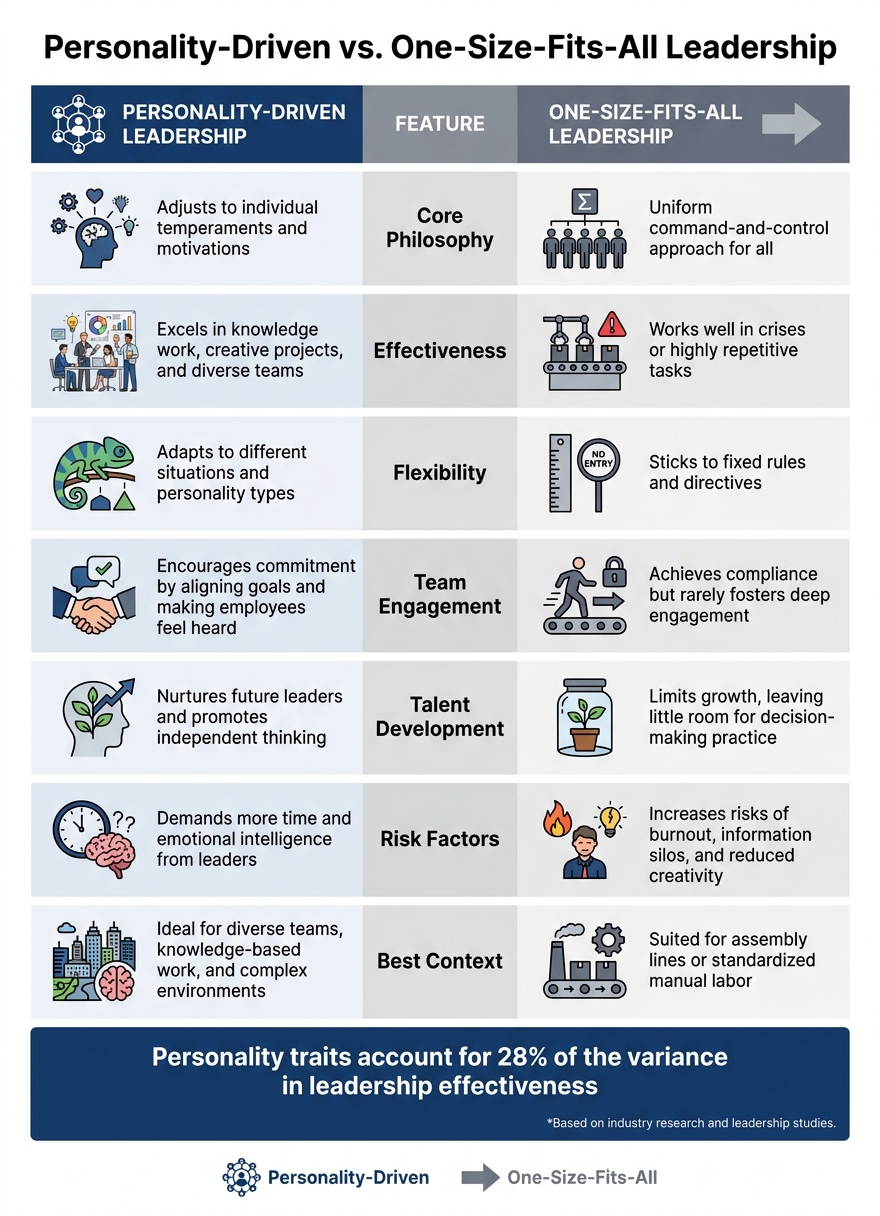
Personality-Driven vs. One-Size-Fits-All Leadership: Key Differences
The last section highlighted how rigid leadership can hinder individual growth and lead to burnout. But what happens when we put personality-driven and one-size-fits-all leadership approaches head-to-head? Their impact on team performance, development, and overall organizational health becomes clear.
Research involving 200,000 managers worldwide points to a significant shift in leadership styles since 1972, moving toward more inclusive and participative methods [3]. This shift reflects the growing diversity of workplaces and the increasing reliance on knowledge-driven environments. These changes make the limitations of a uniform leadership style even more evident. Comparing these approaches shows how tailored leadership better matches the demands of today’s teams.
Take Emily Reynolds, CEO of R Public Relations, as an example. She moved away from a one-size-fits-all model and embraced leadership tailored to six distinct workplace personality types. The result? A more stable company and improved team performance [4].
Comparison Table: Personality-Driven vs. One-Size-Fits-All Leadership
Here’s a side-by-side look at how these leadership styles stack up:
| Feature | Personality-Driven Leadership | One-Size-Fits-All Leadership |
|---|---|---|
| Core Philosophy | Adjusts to individual temperaments and motivations | Uniform "command and control" approach for all |
| Effectiveness | Excels in knowledge work, creative projects, and diverse teams | Works well in crises or highly repetitive tasks |
| Flexibility | Adapts to different situations and personality types | Sticks to fixed rules and directives |
| Team Engagement | Encourages commitment by aligning goals and making employees feel heard | Achieves compliance but rarely fosters deep engagement |
| Talent Development | Nurtures future leaders and promotes independent thinking | Limits growth, leaving little room for decision-making practice |
| Risk Factors | Demands more time and emotional intelligence from leaders | Increases risks of burnout, information silos, and reduced creativity |
| Best Context | Ideal for diverse teams, knowledge-based work, and complex environments | Suited for assembly lines or standardized manual labor |
While neither approach is inherently wrong, one-size-fits-all leadership often struggles to meet the needs of modern teams. Considering that personality traits account for 28% of the variance in leadership effectiveness [2], ignoring individual differences doesn’t just fall short - it can actively hinder success. Organizations can overcome these hurdles by scaling personalized coaching with AI to better support diverse leadership needs.
How AI Platforms Support Personality-Driven Leadership
For leaders to turn personality insights into actionable strategies, they need tools that seamlessly integrate this data into their day-to-day decisions. AI platforms step in to bridge the gap, enabling leaders to adapt their approach in real time and move beyond one-size-fits-all leadership styles.
Custom Reports and Team Insights
Personos offers Dynamic Reports across three levels - personal, relationship, and group - to provide a clear picture of team dynamics as they evolve. Here's how these reports work:
- Personal Reports: Help leaders understand their own behavior under various conditions, like how they manage stress or deliver feedback.
- Relationship Reports: Highlight communication strategies and potential friction points between two individuals, such as a manager and a team member.
- Group Reports: Uncover collective strengths and potential blind spots at the team level.
These reports aren’t static. They update automatically when team structures or goals change, ensuring that the insights remain relevant. Personos bases its analysis on the Five Factor Model, a scientifically backed framework that evaluates 30 personality traits on an 80-point scale. This level of detail provides more precise and actionable guidance than traditional personality categories.
But Personos doesn’t stop at reporting. It translates these insights into practical tools leaders can use immediately.
Real-Time Nudges and Practical Support
One of the biggest hurdles in personality-driven leadership is scaling insights across an organization. Personos addresses this challenge with configurable prompts and conversational AI tools. These tools deliver tailored guidance - whether daily, weekly, or monthly - based on specific personality profiles and the context provided by the leader. For example, a manager can describe a situation and receive immediate advice on how to approach it effectively.
At just $9 per seat per month, Personos makes this kind of tailored leadership support accessible to everyone, not just top executives.
"AI-powered tools can easily be scaled across an organization, making it feasible to assess and develop a large number of leaders simultaneously." - Soren Kaplan [8]
This scalability is a game-changer, especially compared to traditional executive coaching, which can be both expensive and difficult to implement on a large scale.
Privacy and Ethical Use of Personality Data
As these tools become integral to leadership, ethical considerations around personality data are crucial. One of the biggest concerns with workplace assessments is the risk of labeling individuals - reducing them to a single "type" and making decisions based on that label. Personos tackles this issue with a privacy-first design:
- Individual personality scores are never shared without explicit consent.
- Assessment results remain private by default.
This approach fosters psychological safety, encouraging open and honest communication. In addition, every AI-generated recommendation comes with a clear explanation of the traits and psychological principles involved. This transparency ensures leaders understand the reasoning behind suggestions, empowering them to make informed decisions instead of blindly following an algorithm.
Case Studies: Leadership Approaches in Practice
Results from Personality-Driven Leadership
Examples from the business world show how leadership styles can shape team performance and outcomes.
From 2015 to 2017, Alison Beard, who was then the Chief Talent Officer at Marriott, applied a personality framework to reorganize her learning and development team. She observed that her creative development groups were largely composed of "Guardian" and "Driver" personalities - individuals who excel at details and execution but often lack a creative spark. To address this, she brought in a "Pioneer" to lead the creative team and assigned "Guardians" and "Integrators" to roles requiring precision and collaboration. This thoughtful restructuring helped the team achieve its strategic goals over two years, demonstrating how personality-based team design can deliver results [5].
"As a Pioneer and Driver, I need those types [Guardians and Integrators] around me personally, too." - Alison Beard, Executive Editor, Harvard Business Review [5]
Another example comes from Microsoft under Satya Nadella’s leadership. When Nadella became CEO in 2014, he shifted away from the competitive, rigid leadership culture of his predecessor, which had fostered silos and internal rivalries. By embracing an empathetic and "learn-it-all" mindset, Nadella transformed Microsoft’s culture. This shift not only revitalized the organization but also tripled its market capitalization, providing a powerful case for leadership that adapts to personalities and fosters collaboration [9].
Problems Caused by Uniform Leadership
While personality-driven leadership has shown clear benefits, sticking to uniform leadership practices often leads to challenges. Research highlights a persistent issue called "visibility bias", where organizations tend to promote individuals who appear charismatic or dominant, rather than those who are effective leaders. This bias can prevent organizations from recognizing and rewarding quieter, yet highly capable, leaders [2].
"Organizations systematically promote people who look like leaders - confident, vocal, socially dominant - over people who lead effectively but quietly. This is a costly organizational mistake that personality science helps diagnose." - JobCannon [2]
Howard Schultz’s tenure at Starbucks offers a cautionary tale of the pitfalls of a one-size-fits-all leadership approach. During a period of rapid expansion, the company’s share price dropped by 42%, and employees became disengaged. Schultz responded by temporarily closing thousands of stores in 2008 to retrain baristas, signaling a need to reconnect with Starbucks' core values. The recovery required Schultz to shift from a growth-focused mindset to one centered on empathy and coaching, helping to restore both quality and morale [9].
These examples highlight how rigid leadership models can limit success, while approaches tailored to individual and team dynamics can unlock greater potential. Tools like Personos are designed to help leaders address these challenges by using personality insights to identify and resolve misalignments before they escalate.
Conclusion: Picking the Right Leadership Approach
Key Takeaways
Research shows that a one-size-fits-all leadership style falls short. Personality differences account for about 28% of the variance in leadership effectiveness [2], which is a significant factor. Overlooking these differences doesn’t just limit a team’s potential - it can lead to unnecessary conflicts, disengagement, and even burnout.
The best leaders don’t stick rigidly to a single approach. Instead, they adapt. As one leadership researcher explains:
"The most effective leaders use multiple styles flexibly, switching between them as situations require." - JobCannon [2]
This ability to adapt - knowing when to guide, when to step back, when to offer detailed instructions, and when to give autonomy - is what elevates leaders from good to exceptional.
Next Steps for Leaders
Armed with these insights, leaders can take practical steps to create meaningful change. Start by having regular discussions with team members about their communication preferences, feedback needs, and motivation. These conversations show respect and build trust. From there, tools like Personos can help leaders take a more personalized approach.
Personos leverages the Five Factor Model, a validated framework that measures 30 personality traits on an 80-point scale. Its features - like Dynamic Reports, AI-powered chat, and quick Prompts - provide leaders with tailored guidance to adapt their style for each individual. At just $9 per seat per month, it’s an accessible solution for managing diverse teams or navigating complex dynamics.
Transitioning from a uniform approach to one that taps into individual strengths takes time, but it starts with a single choice: to embrace the diversity within your team instead of working against it. The tools and research are ready to support that journey.
FAQs
When does one-size-fits-all leadership actually work?
One-size-fits-all leadership can be effective in specific scenarios. For example, during emergencies or crises, when quick, decisive action is essential, this approach ensures clarity and swift execution. It also works well in environments that rely on routine or strict regulations, where compliance and predictability are key priorities.
However, in workplaces that are more dynamic or diverse, a more flexible leadership style often yields better results. By tailoring leadership to individual personalities and specific situations - using tools like Personos to guide this process - organizations can foster stronger engagement and achieve sustained success.
How can I personalize my leadership without labeling people?
Great leadership starts with understanding the unique strengths, behaviors, and communication styles of each team member - without boxing anyone into fixed labels. By focusing on individual traits and preferences, leaders can build stronger, more personal connections.
Tools like AI-driven platforms make this easier by offering real-time insights into personality and behavior. These tools help leaders adjust their approach on the fly, ensuring their interactions feel genuine and relevant. When leaders take the time to adapt, they foster trust and boost engagement across the team.
What sets effective leaders apart is their ability to respect the unique circumstances and needs of each person. Instead of relying on stereotypes, they provide tailored feedback and support that truly resonates. This personalized approach not only motivates team members but also strengthens collaboration, creating meaningful, label-free relationships within the workplace.
What’s the quickest way to use personality insights day to day?
The quickest way to incorporate personality insights into your daily routine is by using tools that offer real-time, tailored guidance based on individual traits. For example, platforms like Personos use the Five Factor Model to deliver actionable tips, dynamic reports, and customized recommendations. This allows professionals to adjust their communication and behavior on the spot, enhancing results while minimizing burnout - all in a way that fits the specific context of each situation.