Top Studies on Personality Diversity in Team Work
Research shows teams perform best when agreeableness and conscientiousness are high and gaps are managed with clear roles and structure.
Nick Blasi

Top Studies on Personality Diversity in Team Work
Personality differences can help a team, but only in the right kind of work and with clear structure. I see the strongest pattern in the research here: teams often do better when average Agreeableness and Conscientiousness are high, but performance tends to drop when teammates are far apart on those same traits.
Here’s the short version:
- Higher team averages in Agreeableness and Conscientiousness are linked with better performance
- Larger gaps in those traits are linked with more friction and lower performance
- Differences in Extraversion can help with speaking and idea-sharing tasks
- Differences in Emotional Stability can make stress-heavy work harder
- For supervisors, the main levers are role fit, clear rules, and tighter coordination
A few numbers stand out. In one meta-analysis of 527 teams, higher average Agreeableness was linked to better team performance (ρ = 0.24), and higher average Conscientiousness showed a similar pattern (ρ = 0.20). But diversity in Conscientiousness was linked to lower performance (ρ = -0.24), and diversity in Agreeableness also moved downward (ρ = -0.12).
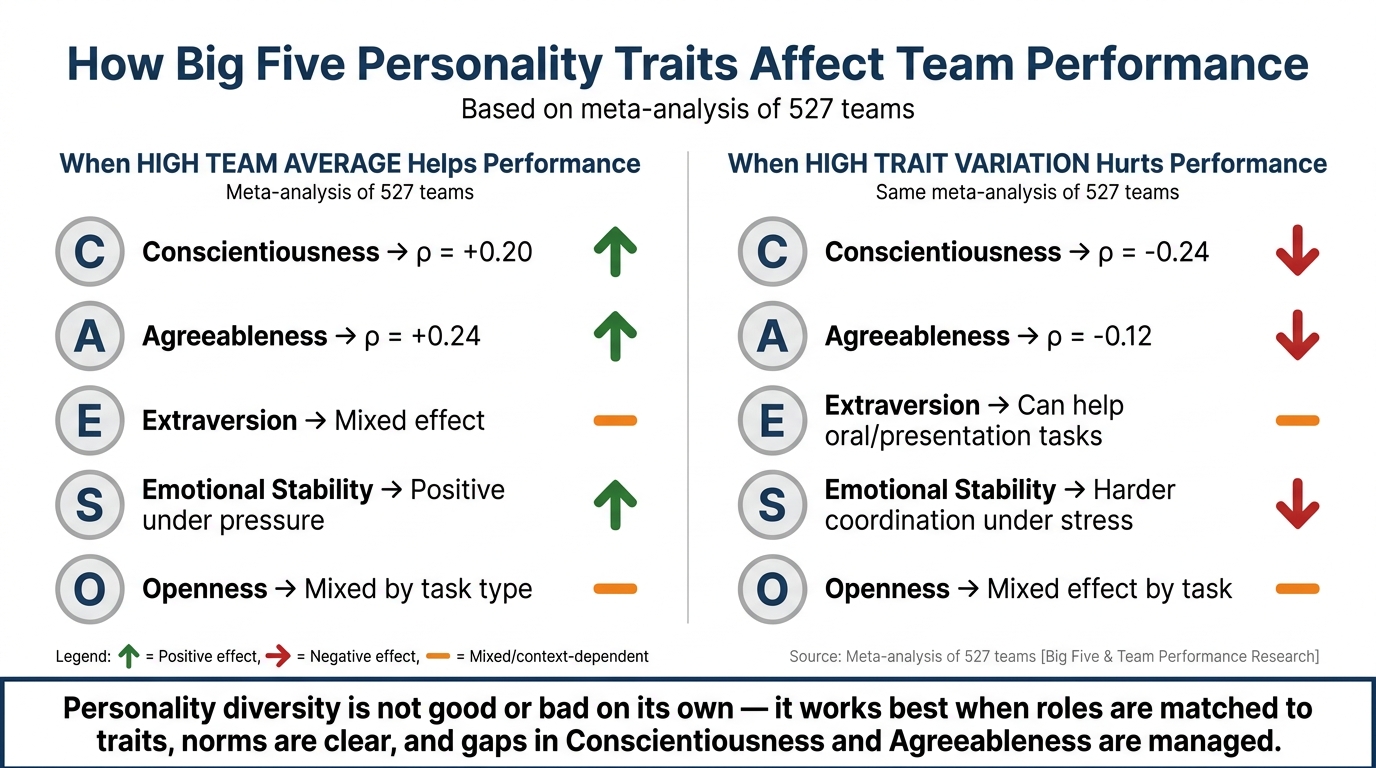
Big Five Personality Traits & Team Performance: Average vs. Diversity Effects
How Does Diversity Affect Teamwork
Quick Comparison
| Trait | When higher team average helps | When high variation hurts | What I’d watch for |
|---|---|---|---|
| Conscientiousness | Better follow-through and reliability | Lower performance, missed handoffs | Uneven workload, patchy documentation |
| Agreeableness | Smoother cooperation | More friction and tension | Conflict over tone, support, and standards |
| Extraversion | Mixed effect | Can help some speaking tasks | Who dominates discussion vs. who holds back |
| Emotional Stability | Better under pressure | Harder coordination in stress | Coverage gaps, slower recovery after hard cases |
| Openness | More options and broader thinking | Mixed effect by task | Better for planning and new-program work than routine delivery |
So if you want the plain answer, here it is: personality diversity is not good or bad on its own. It works best when you match people to the job, set clear norms, and keep gaps in follow-through and cooperation from dragging the team down.
Key studies on personality diversity and team performance
What meta-analyses say about Big Five traits and team performance
Large-scale studies point to a clear pattern: teams tend to do better when members, on average, score higher on certain traits. But big differences between teammates on those same traits can drag performance down.
One meta-analysis of 527 teams found that higher average levels of Agreeableness (ρ = 0.24) and Conscientiousness (ρ = 0.20) were linked to better team performance [1]. At the same time, when team members varied a lot on those traits, the pattern reversed. Diversity in Conscientiousness was tied to lower team performance (ρ = -0.24), and diversity in Agreeableness moved in the same direction (ρ = -0.12) [1].
In case-management teams, this often looks less abstract than it sounds. It can mean missed handoffs, patchy follow-through, and more day-to-day friction.
| Trait | High Average Effect | High Diversity Effect |
|---|---|---|
| Conscientiousness | Positive (ρ = 0.20) [1] | Negative (ρ = -0.24) [1] |
| Agreeableness | Positive (ρ = 0.24) [1] | Negative (ρ = -0.12) [1] |
Those patterns do not play out the same way in every setting. The effect shifts with the work itself, especially when a team needs originality, close coordination, or steady service delivery.
How personality diversity affects creativity and innovation
Personality diversity can be a help or a headache, depending on the task.
Research shows that differences in personality and cognitive style tend to pay off more when work is complex or calls for creative problem-solving [6]. In a study of 59 teams, higher variability in extraversion was linked to higher oral presentation scores. But higher variability in agreeableness and neuroticism was linked to lower scores [3].
For helping teams, that tension matters. A mix of styles can sharpen program design and improve problem-solving. On the flip side, that same mix can make routine coordination harder if the team does not have clear structure.
That’s why it helps to look at the evidence trait by trait, instead of treating “personality diversity” as one single thing.
Deep-level diversity versus surface-level diversity
A 2024 meta-analysis of 615 reports found only a tiny average link between team diversity and performance, accounting for less than 1% of outcome variance [6]. That pushes back on the idea that building teams around visible demographic diversity alone will reliably improve results.
What seems to matter more is deep-level diversity: differences in personality, values, and attitudes [6]. You can’t spot those at a glance, but they shape how people communicate, deal with conflict, and share information.
For supervisors in nonprofit and helping organizations, this is a practical distinction. Demographic representation and personality fit are not the same issue. If you want a clearer picture of how a team is likely to work together, it helps to know how members differ on traits like Conscientiousness and Agreeableness, not just how the team looks on paper.
The next question is which traits lead to the biggest gains, and which ones tend to spark the most friction.
What the evidence says about specific traits
Building on the last section, the strongest effects show up trait by trait. And they don’t all work the same way. The same personality mix that helps one kind of task can get in the way of another.
How openness and extraversion differences affect idea quality
Openness shapes how broadly a team searches for ideas. Staff with high openness often look at a broad set of possible solutions, while staff with low openness tend to work within narrower, more defined paths [2]. That can matter a lot when a team needs to generate options instead of settling on the first workable answer.
Extraversion is one area where differences across team members can help in certain situations. Higher variation in extraversion was linked to better presentation quality [3]. In plain terms, some people may drive the room, while others keep the message grounded. That mix can work well when the task is not just having ideas, but also communicating them clearly.
Openness and extraversion tend to help more with idea generation. Agreeableness and conscientiousness are the traits where friction shows up most often.
How agreeableness and conscientiousness gaps create friction
These gaps often surface in pretty concrete ways: missed deadlines, uneven follow-through, and conflict over what “good enough” looks like. A team with one highly conscientious staff member and another who misses deadlines can run into documentation problems and uneven caseload distribution. And if one member is underperforming, that person can hold back the whole group [4].
For supervisors, the takeaway is simple: pay attention to the floor, not just the average, when assigning high-stakes casework or coordinating across program teams.
How emotional stability shapes team resilience under stress
Emotional stability tends to matter most when pressure is high. Large gaps in this trait weaken communication and make it harder for teams to recover after setbacks [2][3]. In crisis intervention teams or programs carrying heavy caseloads, that can show up as coverage gaps, inconsistent client interactions, and trouble regrouping after difficult cases.
That gives supervisors something concrete to act on. Peer support and staffing plans matter a lot during high-demand periods. These patterns point to clear staffing and supervision choices. Those differences translate directly into how supervisors assign work and manage pressure.
How supervisors and program staff can apply these findings
The research points to complementarity and balance, not personality sameness. A few focused changes in how you assign roles, run meetings, and set expectations can help personality differences support the team instead of tripping it up.
Build teams around complementary strengths, not personality sameness
Because conscientiousness and agreeableness are the traits most linked to performance, staffing should balance those functions. Use personality data to cover the work, not to make people the same. The goal is complementary coverage, not matching personalities.
Try to cover four core functions: idea generation, follow-through, relationship management, and steadiness under pressure.
| Work function | Common nonprofit roles | Likely strengths | Supervision needs |
|---|---|---|---|
| Idea generation (high openness) | Program design, outreach innovation, pilot projects | New ideas, flexibility, problem reframing | Clear goals, deadlines, milestone check-ins |
| Follow-through (high conscientiousness) | Case coordination, documentation, compliance, operations | Reliability, organization, follow-through | Help with prioritizing, permission to stop at "good enough" |
| Relationship management (high agreeableness) | Client-facing support, mediation, partnership work | Rapport, cooperation, conflict resolution | Coaching on boundaries and speaking up |
| Steadiness under pressure (emotionally stable) | Crisis response, high-stress caseloads, supervision | Calm under pressure, resilience | Make sure they can see risk early and know escalation rules |
Even traits that usually help can cause problems when they go too far. A 2019 study found that extremes in extraversion, agreeableness, and conscientiousness reduced teamwork contributions [5]. So the better move is to match traits to roles, not turn them into fixed identity labels.
Once roles are balanced, structure is what keeps those differences from turning into friction.
Use structure to prevent conflict and uneven workload
Personality differences tend to become a problem when teams don't have enough structure. If there's no clear case owner, no shared documentation rule, and no clear norm for disagreement, the most conscientious person often ends up doing extra work.
Teams do better when minimum standards, ownership, and turn-taking are spelled out.
Simple systems can fix a lot of this fast. Name one case owner for every client file. Set shared documentation rules so detail-oriented staff aren't the only ones keeping records. Use structured case conferences for hard situations, with a facilitator and a time limit. And make disagreement procedural: ask for evidence before an idea is rejected, and rotate who plays devil's advocate.
| Unmanaged personality diversity | Managed personality diversity |
|---|---|
| Uneven workload and hidden "default workers" | Clear case ownership and handoffs |
| Duplicate or missing documentation | Shared documentation rules |
| Conflict becomes personal | Conflict stays focused on the task |
| Strong personalities dominate meetings | Structured agendas and turn-taking |
| Good traits pushed too far | Traits matched to the right roles |
Where Big Five-based tools fit, including Personos
For teams that want a practical way to use these findings, tools like Personos can help turn trait data into day-to-day guidance. Unlike instruments such as the NEO-PI-R, which are used mainly for research, Personos is built for helping professionals. It generates individual, relationship, and group-level reports, so supervisors can see not just who a person is, but where friction between specific people is most likely to show up.
Personos turns Five Factor Model data into individual, relationship, and group guidance, along with trackable next steps through its ActionBoard.
Conclusion: What the research means for teamwork in practice
Personality diversity helps teams only when it’s managed on purpose. In nonprofit and helping settings, the work is often messy and uncertain. When differences go unmanaged, they tend to create friction instead of better results. That puts the real pressure on role design and supervision.
The biggest performance risks come from gaps in agreeableness and conscientiousness. Meta-analyses show that large gaps in those traits hurt team performance, which means supervisors should pay attention to minimum levels, not just team averages [1].
That shifts the focus a bit. The issue is not only who’s on the team. It’s also where the floor sits on the traits that matter most. For supervisors, an average score doesn’t tell the whole story. One person with a low score in conscientiousness or agreeableness can slow the group down, so it makes sense to screen for minimum levels in those traits, not just strong averages [4][7].
The practical way forward is pretty clear: role clarity and structured collaboration. Tools can help support that kind of setup. Personos can turn Five Factor Model data into group, relationship, and next-step guidance that helps teams work better together.
FAQs
How much personality diversity is too much?
There’s no one-size-fits-all threshold here. The effect depends on the task and the trait in play.
Research suggests that high variability in traits like agreeableness and conscientiousness can hurt team performance, especially in conjunctive tasks, where success depends on the weakest member. That kind of gap can drag the whole group down.
Personos helps teams work through these differences with tailored guidance based on the Five Factor Model.
Which team roles benefit most from specific traits?
It depends on the task and the context. Research shows that traits like extraversion, agreeableness, and conscientiousness often have an optimal range. In plain English, more isn't always better.
For teams dealing with high uncertainty, a higher average level of agreeableness can help. On the other hand, work that involves oral presentations may do better with some variation in extraversion. Personos helps teams use these insights in real time.
Should managers screen for minimum trait levels?
Yes. Research suggests that minimum trait levels can predict team effectiveness about as well as average scores.
This matters most for conjunctive tasks, where a team’s output is limited by its weakest member. In plain English, the whole group can only move as fast as the slowest link in the chain. In those cases, screening for a baseline level of key traits can help. Tools like Personos can support this with customized team-composition insights.