Personality Data in Talent Development
How AI personality data improves hiring, leadership development, and team dynamics—comparing real-time, validated, and predictive assessment tools.
Rachel Johnson

Personality Data in Talent Development
AI is transforming how organizations approach talent development. By analyzing behavioral patterns, language, and digital footprints, AI tools provide instant insights into personality traits, improving hiring, leadership development, and team dynamics. Key platforms like Personos, Hogan Assessments, and AssessFirst each offer unique strengths:
- Personos: Delivers real-time personality insights and tailored coaching for managers.
- Hogan Assessments: Focuses on leadership evaluation with scientifically validated personality data.
- AssessFirst: Predicts performance, engagement, and retention, reducing recruitment errors by 78%.
Each tool aligns with specific organizational needs - whether for immediate feedback, leadership tracking, or predictive hiring. AI-driven personality data helps organizations address challenges earlier, enhancing workplace outcomes.
1. Personos
Real-Time Insights
Personos uses AI to deliver real-time personality evaluations, powered by a deep neural network that predicts personality correlations much faster than traditional methods [3]. Instead of waiting months for data collection and expert analysis, Personos automates these predictions instantly. This means talent developers can validate scales and test psychological hypotheses without relying on time-consuming surveys [3].
The platform also includes a conversational AI chat that combines detailed personality profiles with contextual insights. Managers can ask specific questions about team dynamics and conflict resolution or individual motivations and receive tailored responses that reflect the personalities involved. These quick, automated insights make it easier to evaluate performance in a dynamic and adaptive way.
Customization and Contextual Intelligence
One standout feature of Personos is its ability to create benchmarks tailored to a company’s unique needs [4]. For instance, "high extroversion" might mean one thing for a group of entrepreneurs and something entirely different for accountants [4]. The platform assesses natural behavior through video, audio, and speech transcripts from real interactions, offering a more genuine understanding of personality than traditional surveys can provide. With continuously updated Dynamic Reports, Personos delivers personalized insights for individuals, teams, and relationships. This customization helps organizations refine their assessments and develop actionable strategies for talent growth.
Practical Applications for Talent Development
Personos is especially useful for leadership development, offering training and mentorship plans based on traits like emotional intelligence and flexibility [1]. For succession planning, the platform evaluates how individuals perform across various social scenarios, helping organizations make informed promotion decisions [4]. Its ActionBoard feature turns these insights into actionable goals, giving managers a way to track progress and show measurable outcomes to stakeholders.
2. Hogan Assessments
Predictive Accuracy
Hogan Assessments stands out with its extensive database of over 14 million assessments conducted across 190 countries and in 50 languages [5]. This global reach, combined with its proven track record, makes it a trusted tool for organizations, including 75% of the Fortune 500. The platform delivers a 36% improvement in selection accuracy, doubling the likelihood of identifying candidates who excel in their roles [5]. For leadership development, the predictive power is even more striking - candidates identified through Hogan are four times more likely to exhibit strong leadership qualities [5].
What sets Hogan apart is its focus on assessing core personality traits rather than surface-level impressions. As Jackie Sahm, Vice President of Integrated Solutions at Hogan, explains:
"Personality assessment reduces bias in leader identification because it measures the underlying tendencies that drive effective leadership, not just superficial impressions" [6].
This approach tackles a common issue: relying on charisma or "executive presence" during interviews often fails to reveal whether a candidate can build trust within a team or create a psychologically safe environment [6]. By prioritizing these deeper insights, Hogan provides a foundation for customized leadership development strategies.
Practical Applications for Talent Development
Hogan's methodology centers on four key leadership pillars: Integrity, Judgment, Competence, and Vision [7]. The assessments are particularly effective at identifying problematic interpersonal tendencies - issues that contribute to nearly 66% of leadership failures, often stemming from an inability to build and sustain cohesive teams [7]. Trustworthiness, a critical leadership trait, is highlighted by 81% of employees as the defining quality of their best bosses, while 50% label their worst bosses as deceitful [7].
The impact of Hogan's assessments varies by industry but consistently delivers measurable results:
- Healthcare: Organizations see a 27% improvement in selection accuracy, with employees being 13 times more likely to remain in their roles [5].
- Retail: Annual store sales grow by 49%, with employees three times more likely to be top performers [5].
- Finance: Companies report six times stronger overall performance and a 50% reduction in annual loss rates [5].
- Transportation: Absenteeism drops by 77%, and accidents decrease by 31% [5].
Allison Howell, CEO of Hogan Assessments, emphasizes the versatility of their approach:
"We can use personality data to support and navigate all these transformations." [6]
3. AssessFirst
Predictive Accuracy
AssessFirst takes a modern approach to talent development by focusing on AI-driven performance forecasting. Instead of relying on traditional resumes, it evaluates candidates using behavioral cues. The platform integrates three core assessments: SWIPE (personality), DRIVE (motivation), and BRAIN (cognitive ability). Together, these tools predict factors like performance, engagement, and retention before hiring or promotion decisions are made [9]. The results? A 78% reduction in recruitment errors, a 50% drop in first-year turnover, a 40% boost in team performance, a 45% cut in recruitment time, and triple the diversity among candidates [8][9]. By focusing on potential rather than credentials, the platform’s AI engine identifies role-specific performance drivers that resumes often miss [8][9].
Customization and Contextual Intelligence
AssessFirst doesn’t stop at prediction - it adapts its insights to fit each organization’s unique needs. With over 2,500 ready-to-use predictive models and the ability to create custom ones, it provides tailored solutions for specific challenges [10][11]. The platform also evaluates how well candidates align with team dynamics and leadership styles, reducing potential friction in the workplace [9]. For example, BNP Paribas developed 22 predictive models in just two weeks. Vicky Docker, their Head of Talent, highlighted the shift in approach:
"We used to promote who stood out. Now we promote who's built to grow - with confidence." [10]
This shift led to a 34% improvement in internal promotion success, a 40% reduction in top performer attrition, and a 48-point jump in employee Net Promoter Score (eNPS) [10]. Additionally, AssessFirst integrates with over 35 HR tools like Workday, Greenhouse, and SmartRecruiters, ensuring that its insights are accessible throughout an employee’s journey [9].
Practical Applications for Talent Development
Beyond hiring, AssessFirst provides actionable strategies for employee growth. Its four core modules give a well-rounded view of potential:
- SWIPE: Highlights collaboration styles and ideal work environments.
- DRIVE: Identifies what energizes employees and what might lead to burnout.
- BRAIN: Assesses learning agility and how quickly someone adapts.
- VOICE: Uses AI to evaluate technical and language skills.
These tools help organizations identify future leaders early and create personalized coaching plans. On average, recruiters save 80 days per year using the platform's automated insights [8]. Employees matched through this system are also 2.5 times more engaged, showcasing the platform’s impact on workplace satisfaction and productivity [9].
How Talent Leaders Are Using AI
This shift highlights AI’s role in personality-driven growth, moving beyond traditional assessments to provide real-time, actionable insights for leadership and team development.
Pros and Cons
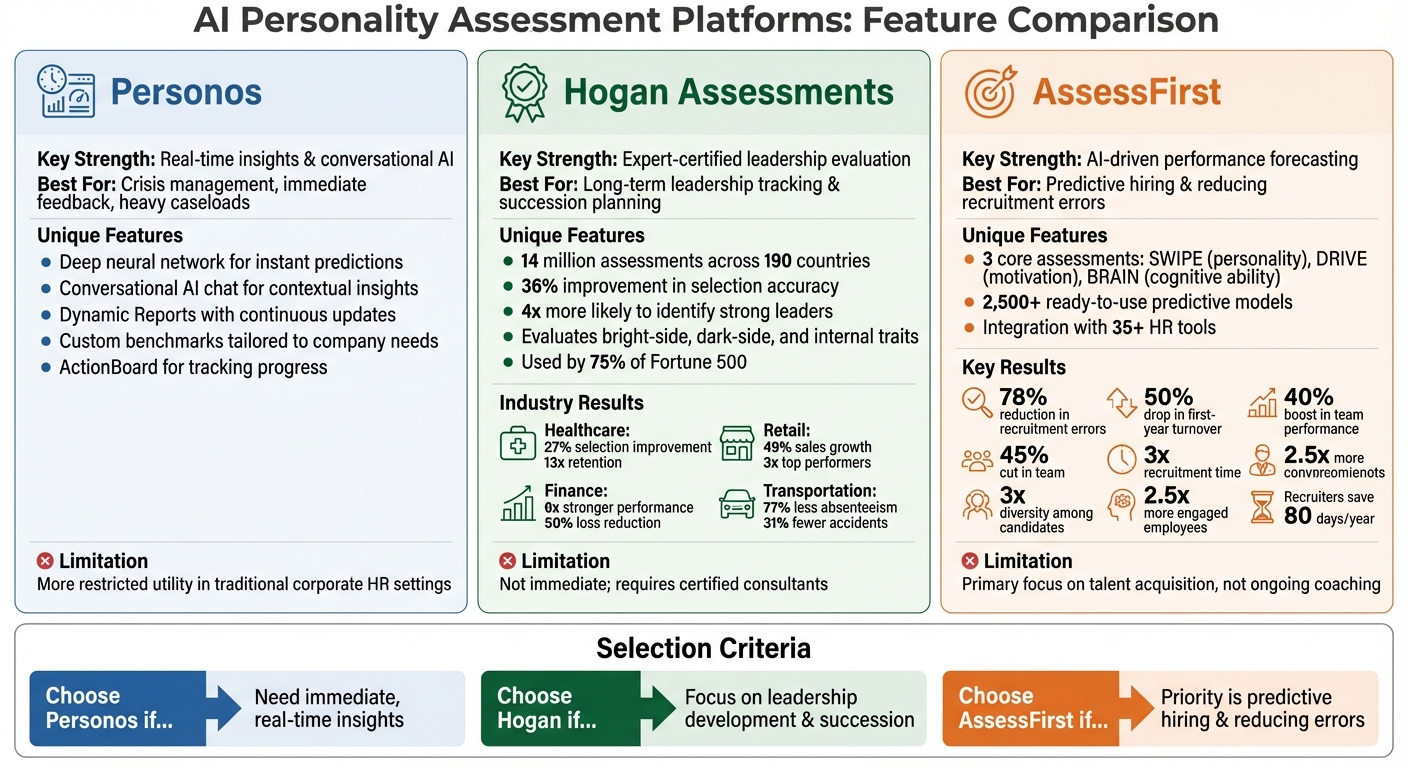
Comparison of Top 3 AI Personality Assessment Platforms for Talent Development
Understanding the strengths and limitations of each platform sheds light on their roles in AI-driven talent development. Each tool stands out for specific features, depending on whether the focus is on immediate insights, expert analysis, or predictive accuracy.
Personos offers real-time, actionable insights with its advanced AI model. Its standout features include conversational guidance and comprehensive personality profiles, making it particularly helpful in crisis management or when handling heavy caseloads. However, its utility may be more restricted in traditional corporate HR settings, where broader applications might be needed.
Hogan Assessments provides in-depth evaluations of bright-side, dark-side, and internal traits, supported by expert-certified analysis [12]. While it delivers highly detailed insights, the process is not immediate and relies on certified consultants to maximize its effectiveness. This makes it better suited for long-term leadership tracking rather than quick, on-the-spot decision-making.
AssessFirst focuses on predicting performance, engagement, and retention, helping reduce recruitment errors and improve team dynamics. Its strengths lie in using data to enhance hiring decisions, but its primary function is talent acquisition, not ongoing coaching or development.
As AI continues to reshape talent management, choosing between instant feedback, expert-driven insights, or predictive analytics becomes critical for aligning with organizational goals. The rise of "human skills" like leadership and adaptability is more important than ever, especially as job postings in HR mentioning AI grew by 419% between December 2022 and December 2024 [13]. This rapid shift highlights the importance of selecting tools that match an organization’s strategic priorities in an evolving workplace.
Conclusion
AI-powered personality data tackles a major flaw in traditional talent development: the lag in management's response to workplace challenges. Typically, organizations only notice issues after visible signs appear - like an employee quitting, a project delay, or team conflicts. By then, the root problem has often been brewing for weeks or months [14]. AI-driven behavioral intelligence, however, identifies hidden risks such as disengagement, team friction, or psychological safety concerns much earlier than conventional performance metrics [14]. For instance, in early 2026, an engineering team using Catch Up AI experienced this firsthand. The platform pinpointed a communication issue causing inconsistent sprint deliveries - something that had gone unresolved for over six months - in just one week. With AI-guided one-on-one interventions, the team stabilized its delivery within a single sprint cycle [14].
Selecting the right platform depends heavily on your organization's specific needs. Personos is ideal for providing real-time coaching in high-pressure environments, such as managing heavy caseloads or crises. Hogan Assessments specializes in leadership evaluation and succession planning, leveraging scientifically validated personality data to measure traits like humility, collaboration, and judgment. AssessFirst, on the other hand, focuses on predictive hiring, helping organizations reduce recruitment errors by forecasting performance, engagement, and retention. These distinctions highlight the importance of matching the platform to your unique challenges.
When choosing an AI-powered personality platform, prioritize those based on interview data rather than demographic profiles. Platforms using interview-based models achieve an impressive 85% accuracy in predicting real-life behaviors, with an 80% correlation to validated tests [2]. As Joon Sung Park of Stanford University explains:
"The beauty of having interview data is that it includes people's idiosyncrasies and therefore the language models don't resort to making race-based generalizations as often" [2].
Additionally, ensure that the platform offers robust data ownership features, audit logs for tracking agent activity, and options for employees to withdraw consent and delete their data.
Transitioning from reactive management to proactive leadership requires tools that provide early warning signs rather than lagging indicators. AI platforms go beyond static dashboards by analyzing both technical and behavioral signals in real time, delivering actionable insights and nudges that prompt immediate managerial responses [14]. Leveraging these insights can help organizations move from merely addressing problems to actively preventing them, fostering a culture of forward-thinking leadership.
FAQs
How is AI personality data different from performance reviews?
AI personality data offers a dynamic way to understand traits, behaviors, and interpersonal interactions in real time. In contrast, performance reviews look backward, relying on periodic assessments and fixed metrics to evaluate past performance. Tools like Personos take a different approach, using scientifically backed models to deliver ongoing, personalized insights. Unlike traditional reviews, which can sometimes be biased and overly retrospective, this method emphasizes continuous improvement. The result? Better communication, stronger trust, and more effective talent development - moving beyond static performance measurements.
How do I choose the right personality platform for my org?
To choose the best personality platform, consider how effectively it supports your goals for talent development and managing interpersonal dynamics. Focus on factors like its scientific basis, ability to be tailored to your needs, ease of integration with existing systems, and how well it handles complex human interactions.
Personos stands out with its foundation in the Five Factor Model and AI-powered insights. It provides real-time guidance, practical suggestions, and adaptive reports, making it a strong choice for minimizing burnout and enhancing performance in roles that demand deep understanding of human behavior.
How can we use personality data without hurting privacy or trust?
To handle personality data responsibly, it's crucial to be upfront about how the data is gathered, used, and stored. Always get clear and informed consent from individuals. Protecting this sensitive information should involve strong measures like encryption, strict access controls, and anonymization. Platforms such as Personos adhere to these practices, blending ethical data management with scientifically backed methods. Collect only what’s necessary and ensure compliance with privacy laws like GDPR or CCPA to build trust and avoid potential misuse.