5 personality cues that shape conflict response
Read behavior in the moment—five cues (threat, trust, directness, intensity, control) guide better conflict responses.
Rachel Johnson

5 personality cues that shape conflict response
Most conflict turns on 5 cues: threat response, trust pace, directness, emotional intensity, and need for control. If I spot the cue in front of me, I can pick a better next move instead of pushing facts too soon or reading the whole person from one moment.
Here’s the short version:
- Threat response: when stress takes over, I slow the moment down first
- Trust pace: some people need more time and proof before they open up
- Directness: some people say the issue out loud, others circle it
- Emotional intensity: big feelings need less pressure and fewer questions
- Need for control: structure and clear choices can calm uncertainty
The main idea is simple: I read behavior, not identity. A short answer, silence, tears, blunt words, or repeated questions are not fixed traits. They are clues about what the person may need right now.
A lot of conflict advice misses this. In one survey, 85% of employees said they deal with conflict at work, and 29% said they handle it almost all the time. That helps explain why small shifts in tone, pacing, and choice can change how a talk goes.
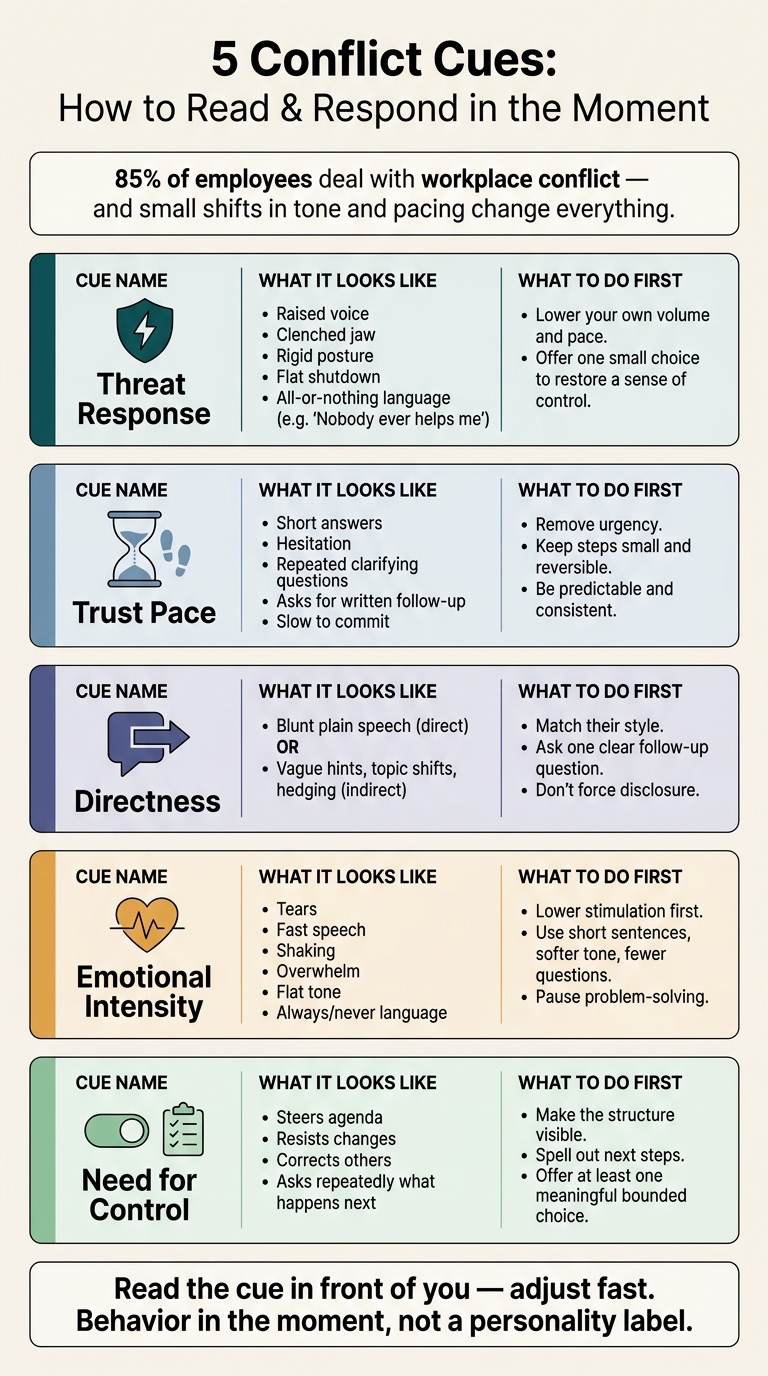
5 Conflict Cues: How to Read & Respond in the Moment
Asked and Answered: Navigating High Conflict Personalities with Practical Strategies
Quick comparison
| Cue | What I notice first | What I do first |
|---|---|---|
| Threat response | louder voice, shut down, rigid body, all-or-nothing talk | lower my voice, slow my pace, offer one small choice |
| Trust pace | short answers, delay, careful questions, asks for follow-up | reduce pressure, keep steps small, be predictable |
| Directness | blunt words or vague hints | match the style and ask one clear follow-up |
| Emotional intensity | tears, fast speech, shaking, overwhelm, flat tone | lower stimulation, use short sentences, pause problem-solving |
| Need for control | pushes agenda, resists changes, wants step-by-step detail | make the process clear and give bounded choices |
Bottom line: the cue tells me how to respond in the moment. The goal is not to type people. The goal is to steady the talk, keep respect in place, and make the next step easier.
How to Read Conflict Cues Without Overlabeling People
Conflict cues are visible behaviors, not diagnoses. If someone's voice turns sharp or their answers get short, that tells you what may be going on right now in this conversation. That's what makes the cue useful. It's a snapshot, not a full portrait.
Conflict carries emotion. So a person's behavior often shows stress in the moment, not fixed character.
Watch behavior in the moment, not personality labels
In a disagreement, stay with what you can see and hear. Is the person's speech getting faster, or suddenly flat? Are their shoulders tense? Do they keep asking the same question, or keep pulling the talk away from one topic?
Those cues matter. Agitation can show up as rapid speech, rigid posture, and defensive language. That tells you much more than any personality label ever will.
A better read is this: you may be seeing control behavior tied to fear or uncertainty. Use that cue to shape your next move, not to explain the whole person.
Treat cues as testable reads
A cue should help you choose what to do next. It shouldn't end your thinking. A simple inner script can help: "I might be seeing X, so I'll try Y and watch what happens."
If a client's breathing is fast and their answers are clipped, slow your own pace. Lower your voice. Offer a short validating statement. Then watch the response. Did the tension ease? Did cooperation improve? If tension jumps, change your read.
That approach helps keep threat response, trust pace, directness, emotional intensity, and need for control from turning into stereotypes.
Adjust for role and setting
The same cue can mean very different things depending on who's in the room. A client's repeated interruptions may come from years of feeling ignored by systems that were supposed to help. A coworker's interruptions might point to disagreement about process. A supervisor's silence after feedback could mean careful thinking, or discomfort with the topic.
De-escalation should fit the relationship, setting, and immediate safety risk. With clients, that often means giving them the floor on purpose and slowing the pace. With peers, it may look like shared boundary-setting. With supervisors, it may mean asking an open question, "What's on your mind as you hear this?", instead of rushing to fill the silence.
With that lens, the first cue to watch is threat response.
1. Threat Response
Threat response is probably the clearest case for why cues matter more than labels. When a person shifts from frustrated to threatened, it usually happens fast, and you can often see it right away. Look for a clenched jaw, tight fists, a sudden jump in volume, or a stiff posture. Sometimes it goes the other way and the person becomes flat, quiet, and hard to read. They might scan the room, repeat the same accusation, or get stuck on one detail and refuse to move past it. All-or-nothing language is another common sign. "You're just like everyone else" or "Nobody ever helps me" often means threat has taken over the conversation. At that point, the job changes. You're not trying to solve things yet. You're trying to help the moment settle.
When threat spikes, reasoning drops. Your first move is to reduce threat, not solve the problem. Step back a little. Keep your hands visible and relaxed. Slow your speech. Bring your volume below theirs. Then offer one simple choice: "Would you rather stay here or step outside for a minute?" That small choice gives the person some control, and that control often helps them settle.
Once the nervous system calms down, meaning-making can start again. Then you can shift from calming to rapport. Name the self-protection inside the reaction: "You've had people promise help and then disappear - no wonder this felt like another betrayal." After that, invite one concrete next step: "What would help this feel safer next time?"
The most common mistake is jumping straight to facts, policy, or fixes while the person is still flooded. In that state, even a well-meant answer can land like one more attack. Personos can flag threat sensitivity early, so practitioners know when to slow down before problem-solving.
2. Trust Pace
When the issue is caution, not threat, trust pace is the next thing to read. People don't open up on the same timeline, and you can usually see that fast during conflict.
Someone with a slow trust pace might go quiet, keep answers short, repeat a clarifying question, ask for a written follow-up, or hesitate to commit in the moment. That can look like resistance. Most of the time, it's caution.
The clearest sign is cautious engagement. They stay in the conversation, but they wait for consistency before they relax. That difference matters. If someone is asking questions and checking details, they're still taking part. They're just doing it carefully.
Your main de-escalation move is to lower the pressure, slow the pace, and stay predictable. You might say: "You do not need to decide this right now. Here is what I can do today, and I will follow up tomorrow at 2:00 p.m." That takes away urgency and shows predictability. For a person who needs to see reliability before trust forms, predictability often does more than warmth by itself.
Build trust through consistency. Keep small promises. Remember details. Follow through on timing, process, and resources. With a slow-trust person, trust builds through repeated evidence, not one reassuring talk.
The most common mistake is pushing for closeness too early. Saying "you can trust me" before your actions show it, asking personal questions too soon, or reading silence as defiance usually backfires.
They don't calm things down. They increase defensiveness instead.
Personos can help practitioners spot a slow trust pace early and pick a staged response. If the person stays engaged but gets more blunt or more guarded, directness is the next cue to check.
3. Directness
When caution isn't the main issue, look at how the person communicates. Some people say the problem plainly. Others hint at it, soften it, or drift to another topic.
Pay attention to hesitation, vague wording, or a sudden shift in subject. With direct communicators, the words usually are the message. With indirect communicators, the signal often sits in the pauses, the hedging, or the topic change. Once you spot the style, match your reply to it. Then pause and ask one clarifying question.
With a direct person, use clear, short, non-defensive language. Skip the long explanation, because it can sound evasive. For example: "You're right that the timeline changed. Here's what I can do next." With an indirect person, don't jump in with "What's your real issue?" Try: "What part of this feels off to you?" That wording makes space for honesty without pushing too hard.
After the moment settles, consistency starts to matter. Direct people tend to trust specificity and follow-through. Indirect people tend to speak more openly when disagreement feels safe. Offering clear options like "Would you prefer to talk now, by email, or after you've had more time?" gives them room to choose without cornering them.
- Direct: be clear, not vague.
- Indirect: lower pressure and don't force disclosure.
Match the style, not your urge to smooth it over.
4. Emotional Intensity
Emotional intensity is one of those signals that can catch you off guard. You might notice a raised voice, fast speech, tears, shaking, or a level of overwhelm that pushes the facts into the background. When that happens, stop debating the details and lower the pressure instead. Intensity changes both the pace and the message, so your response needs to slow the conversation before it can do any good.
As Laura Noelle Henderson notes, conflict is emotionally activated.
High intensity is not the same as aggression. A client who tears up after hard news and a coworker who talks over others in a tense meeting are both showing intensity. Neither one is automatically being aggressive.
Lower stimulation first. Solve second. Slow your own speech. Speak more softly. Use shorter sentences. Ask fewer questions. If the conversation is too heated to stay useful, suggest a short break:
"I want to understand, and I can see this feels big. Let's slow down and take this one piece at a time."
Once things settle, move from calming the moment to rebuilding connection. Use accurate acknowledgment. Name what you see without judging it.
"You seem really overwhelmed,"
"I can tell this hit a nerve"
That often lowers defensiveness more than a long explanation ever could. With clients, put safety and stabilization first. With peers, pair acknowledgment with a firmer boundary and a faster return to the task at hand. Name the feeling, lower the pressure, then offer one choice:
"Take a minute, or keep going and pause later?"
That helps the person keep their dignity and gives them some control.
The mistake people make most often is reaching for logic too early. A correction or policy defense, when someone is still activated, usually lands as dismissive instead of helpful. A better move is this:
"I can tell this is really upsetting; let's slow it down so I can respond well."
Your first job is regulation and connection. Persuasion comes later.
When intensity shows up along with repeated pushing or resistance to limits, the next cue is need for control.
5. Need for Control
In conflict, control often shows up as a push for predictability. You can usually spot it pretty fast: setting the agenda, correcting people mid-sentence, pushing back on plan changes, and asking over and over what happens next. When you see that pattern, answer the need for structure, not the demand itself.
Treat it as a signal of uncertainty, not a fixed personality label. In many cases, this comes from anxiety about not knowing what's around the corner, not just a desire to dominate.
Because uncertainty is driving the reaction, the fastest way to calm things down is to make the structure visible. Give two clear options. Spell out the next steps. Show where their input matters. An unclear process often escalates tension more than the disagreement itself, so clearing that up fast can lower the pressure.
Once the immediate pressure eases, bring the person into the process so they stay engaged. Set shared decision checkpoints so nothing lands like a surprise. Name their strength out loud: "You're thoughtful about process, and that helps here." The point is to protect their sense of autonomy without giving up structure. Tools like Personos can help practitioners go deeper by mapping traits like Orderliness, Assertiveness, and Anxiety, making it easier to tell the difference between a simple preference for planning and high control sensitivity, so you know whether to offer more structure, more decision authority, or more frequent check-ins.
The mistake people make most often is reading this need for control as defiance and turning the moment into a power contest. Do not turn it into a power contest. Instead, acknowledge the need for influence, offer bounded choices, and hold non-negotiables calmly.
Quick-Scan Table: Cue, De-Escalation Move, and Rapport Move
Use this table as a quick field guide before or after hard conversations. The five cue sections cover what to watch for, similar to reading personality types in meetings. This table focuses on what to do in the moment and what to keep doing later.
Read each row as your best read for now, not a fixed label. A person's background, trauma history, and role can all shape how these cues appear.
| Cue | What It Looks Like | De-Escalation Move (Right Now) | Rapport Move (Over Time) |
|---|---|---|---|
| Threat Response | Defensive, louder, closed off, or withdrawn | Lower your own volume and pace first. Validate safety and reduce judgment. Offer a small choice to give some agency back. | Build a track record of non-punitive responses. Involve them in coming up with solutions so safety and shared control become normal. |
| Trust Pace | Slow to open up, hesitant to accept help, or quick to agree but later withdraws | Match their speed. Don't push for big decisions. Keep early steps small and reversible. | Show reliability through small promises you keep. Explain your reasoning in plain terms. |
| Directness | Blunt and plain-spoken, or hints at problems rather than naming them | With direct communicators, name the conflict plainly and invite candid input. With indirect ones, ask for a brief rating so it's easier to answer honestly. | Match their preferred style over time. With less direct people, make it clear that disagreement is okay and use structured ways to invite feedback. |
| Emotional Intensity | Big reactions, voice and expression shift quickly, always/never language, or flat tone that minimizes distress | Regulate your own tone first, then reflect the emotion without amplifying it. Shift from problem-solving to containment until they are calm enough to think clearly. | Co-create early warning signals they can use when they're nearing overload, and check in on feelings, not just tasks. |
| Need for Control | Steers the agenda, struggles with plan changes, asks for step-by-step detail, or corrects others mid-sentence | Make the structure visible right away. Spell out what's in their hands, what's in yours, and what you'll decide together. Offer at least one meaningful choice about sequence or focus. | Design the process together ahead of time. Honor their expertise and autonomy, and give advance notice before major changes. |
For helping professionals with high caseloads, Personos can turn these cues into real-time guidance.
Conclusion
These cues work best as a quick read, not a fixed label. What moves conflict forward is reading the cue in front of you and adjusting fast. Threat response, trust pace, directness, emotional intensity, and need for control can help you respond without boxing people in. Keep your tone steady, and you protect the relationship and sustain emotional resilience long enough for collaboration to follow. That keeps the conversation flexible instead of reactive.
The point is not perfect typing. The point is faster, steadier adjustment, behavior in the moment, not personality insights.
For practitioners who need support in the moment, Personos can help with real-time guidance for the conversation in front of you.
FAQs
How do I tell a cue from a personality trait?
Personality traits are stable patterns, like the Big Five, that shape how people usually think, choose, and interact. Cues are the in-the-moment, observable signs of those traits during communication.
You spot cues by paying attention to behavior such as word choice, tone, speech patterns, and body language. Traits are the underlying baseline. Cues are how those traits show up from moment to moment.
What if someone shows more than one cue at once?
That’s common. People often show more than one personality cue at the same time, so conflict can feel more layered, not inconsistent.
Personos helps by looking at how those cues work together in the specific situation. Then it gives tailored guidance for the main tension points instead of generic advice.
Which cue should I respond to first in a heated conflict?
Start with self-regulation. Pause, breathe, and give yourself a moment to process what you’re feeling so you don’t react on impulse.
Once you’re calm, lean on empathy and social awareness to spot the other person’s deeper concern, not just the thing that set them off on the surface. Personos can help here by giving real-time, personality-aware guidance, so you can shape your response and lower the tension.