Personality-Based Messaging: What Works in Care
Fit messages to how people handle stress: small tone, pace, and choice shifts cut mistrust, missed follow‑up, shutdown, pushback, and confusion.
Rachel Johnson

Personality-Based Messaging: What Works in Care
Most care communication problems are not about effort. They are about fit. When I match the message to how a person handles stress, trust, choice, and detail, I can cut down on five common problems: mistrust, missed follow-up, shutdown, pushback, and confusion.
Here’s the core idea in plain terms: I do not need a new script for every client. I need small message shifts. That can mean using one next step instead of four, asking permission before giving advice, slowing the pace in tense moments, or stating who I am and why I’m reaching out. Even small wording changes can affect whether someone replies, shows up, or follows through.
A quick breakdown:
- Mistrust: lead with identity, purpose, and plain context
- Missed follow-up: give one action, one deadline, and one contact
- Shutdown: lower pressure, use fewer words, and pause more
- Pushback: offer choices instead of orders
- Confusion: use short sentences, plain language, and a simple step order
The article also makes one point clear: personality is only one input. I still need to factor in trauma history, stress level, past system harm, and the person’s background and day-to-day situation. The goal is not to label people. The goal is to make care messages easier to receive and easier to act on.
A simple stat worth noting: the article points to five repeat breakdowns that show up across outreach, follow-up, case planning, and crisis check-ins. That gives teams a short list they can spot fast and use in daily work.
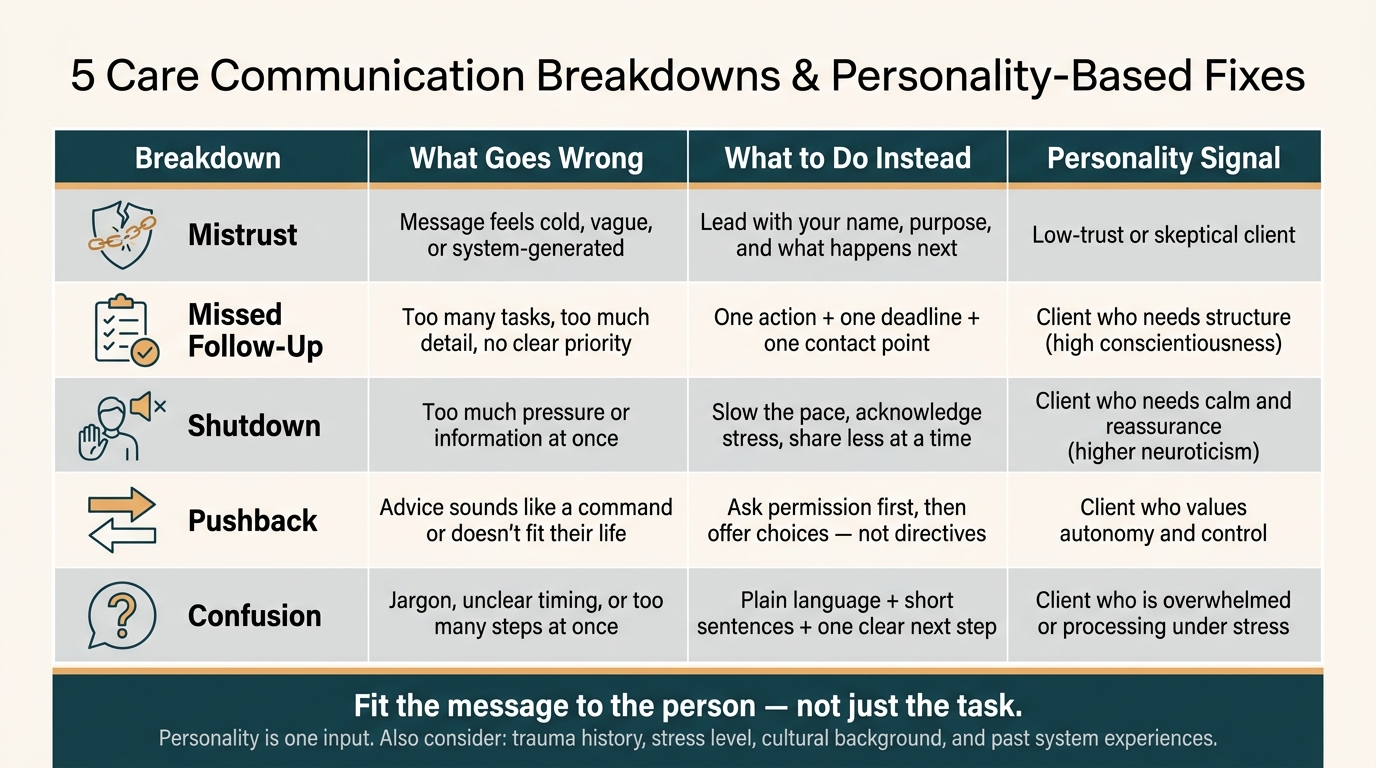
5 Care Communication Breakdowns & Personality-Based Fixes
How to Communicate with Different Personality Types
Quick comparison
| Breakdown | What often goes wrong | What I should do instead |
|---|---|---|
| Mistrust | Message feels cold or system-made | Say who I am, why I’m reaching out, and what happens next |
| Missed follow-up | Too many tasks or too much detail | Give one clear next step and one due date |
| Shutdown | Too much pressure at once | Slow down and keep the message short |
| Pushback | Advice sounds controlling | Ask permission and give options |
| Confusion | Jargon or messy instructions | Use plain language and a simple order |
If I remember just one thing from this piece, it’s this: <u>fit the message to the person, not just the task.</u>
5 Communication Breakdowns That Personality-Aware Messaging Can Prevent
A lot of communication problems in care settings come down to one thing: the message doesn't match the person's current state. Maybe trust is low. Maybe stress is high. Maybe they need more context before they can act. When that mismatch happens, even a well-meant message can miss the mark.
Mistrust in Outreach
When someone has been let down by institutions before, a generic appointment reminder, intake call, or benefits outreach usually won't land well. If the message feels cold, vague, or automatic, it can sound like one more system-generated note instead of a person trying to help.
Trust can drop fast when communication feels like a system failure or a broken promise. Rebuild it with context, transparency, and accountability. [2]
Missed Follow-Up After a Clear Plan
A case plan, referral, or next-step text may seem clear during a session and still fall apart afterward. That usually happens when the next step gets buried under too much detail.
Follow-up tends to work better when it keeps things simple:
- One clear action
- One deadline
- One contact point
That gives the person a direct path instead of a wall of information.
Shutdown During High-Stress Conversations
Some people shut down during a hard check-in, crisis call, or service planning conversation when too much information comes at once or the emotional pressure gets too high. In those moments, pace matters.
Slow things down. Acknowledge the stress. Share less at one time. The point is to make the conversation easier to stay in, not harder.
Pushback When Advice Feels Controlling
Pushback often shows up when a treatment suggestion, referral, or compliance request doesn't connect to the person's day-to-day situation. It can also happen when the message sounds like an instruction instead of a conversation.
People are more likely to engage when they understand why the recommendation matters and when they have room to choose how to respond.
Personalization can also go wrong if it leans on old details. When a message uses information that no longer fits, it can feel off and spark resistance [1].
Confusion About Instructions and Next Steps
Confusion usually starts with jargon, fuzzy timing, or too many steps piled together. That can happen with forms, eligibility steps, or appointment logistics.
Plain language helps. So does a clear sequence. If people can see exactly what to do next, they're far more likely to follow through.
These breakdowns show where tone, detail, and pacing need to shift.
How to Match Messages to Personality Without Stereotyping
These breakdowns point to one simple rule: match the message to the person’s usual style and their stress level right now.
Personality-based messaging means using what you know about a client to make a message more likely to land. The Big Five offers a research-based starting point, alongside clinical judgment, culture, trauma history, and current stressors. In outreach, follow-up, case planning, and crisis check-ins, that mix can shape whether a message gets ignored, pushed back on, or acted on.
Using the Big Five to Adjust Tone, Detail, and Pacing
Several Big Five traits can hint at different communication needs. Someone higher in conscientiousness often does better with structure: clear steps, firm deadlines, and a set order. Someone higher in neuroticism may need calm, nonjudgmental language and more reassurance before they can take in the next step. People higher in extraversion often respond better to warmer, more relational outreach that feels like a conversation, not a form letter.
That said, a client’s personality profile is just one input, not the whole story. Trauma history, cultural background, current stress level, and past experiences with systems all affect how a message lands on a given day.
Message Approaches for Each Breakdown
In outreach, follow-up, and hard conversations, a few simple message moves can help.
Use the breakdown itself to pick the message move:
| Breakdown | Likely Communication Need | Messaging Approach |
|---|---|---|
| Mistrust in outreach | Client who is skeptical or low-trust | Lead with identity, purpose, and transparency. |
| Missed follow-up | Client who needs structure | Send one action, one deadline, one contact. |
| Shutdown during hard conversations | Client who needs calm and reassurance | Acknowledge stress, then slow the pace. |
| Pushback on advice | Client who values control over decisions | Use choice-based language, not commands. |
| Confusion about next steps | Client who is overwhelmed | Use plain language, short sentences, and a brief check for understanding. |
Good personalization shifts as the person’s situation changes. It should not rely on a fixed label.
What to Avoid in High-Stress Care Conversations
Avoid overexplaining, sounding scripted, using commands, and leaning on jargon. In high-stress care conversations, plain and direct works better than polished and formal.
One safeguard matters here: flag any detail that could damage trust if it gets reused later.
The examples next show what these adjustments look like in real care messages.
Message Examples for Common Care Situations
The examples below turn the earlier tone, pacing, and choice-based rules into actual care messages. These made-up examples show how the same goal can sound different depending on a person's stress response. They are not copy-and-paste templates.
Sample Appointment Reminder for a Skeptical Client
This example deals with mistrust during outreach. The client is slow to trust and quick to notice anything that feels pushy or vague.
Ineffective:
"Reminder: You have an appointment at 2:30 PM on 7/14/26 at the agency. Missing this appointment could affect your services."
There's no clear identity, no context, and the last line can sound like a threat. For a low-trust client, that alone can lead to disengagement.
Here is a version that lowers suspicion and leaves control with the client.
Better (text message):
"Hi [Name], this is [Worker First Name] from [Program Name]. We talked last week about options to help with your rent. You're scheduled for a check-in on Tuesday, July 14, 2026 at 2:30 PM at our office on 3rd Street. The goal is to review what support you qualify for and decide next steps.
Reply 1 to keep this time, 2 to reschedule, or 3 to stop. You're in control of what happens next - I'm here to support whatever you decide."
This version speaks to the trust barrier head-on.
Sample Follow-Up Text for a Client Who Gets Overwhelmed
This example deals with missed follow-up after a clear plan. The client gets overloaded when too many tasks land at once.
Ineffective:
"Hi, just a reminder that we need your pay stub, ID copy, lease agreement, and completed intake form before your next appointment. Let me know if you have questions!"
That's four tasks, no clear priority, and no sign that the worker understands how much the client may already be carrying.
Here is a version that cuts down overload and makes the next step easy.
Better (text message):
"Hi [Name], it's [Worker First Name] from [Program]. I want to keep this simple.
One next step: Take a photo of your pay stub and text it back to me. When: Anytime before Friday, July 17, 2026 at 5:00 PM.
If that's too much, reply HELP and we'll find another way."
That makes the message easier to act on for someone who feels overloaded.
Sample Case Plan Conversation with an Autonomy-Protective Client
This example deals with pushback when advice feels controlling. The client resists being told what to do.
The shift here is simple: ask permission first, then offer choices. A spoken script might sound like this:
"You've been clear that you don't want people telling you how to live your life, and I respect that. You also said keeping your housing and having CPS out of your life is a top priority.
Would it be okay if I share a few options that other parents have tried in similar situations, and you can decide what, if anything, fits for you?
One option is we set up a weekly 20-minute check-in call to problem-solve school or appointment issues. Another option is I help you connect with a parent advocate who's been through the system and can be on your side in meetings. A third option is we keep the plan as is for now, and we just review the current plan to see if there's one small change that would make it feel more doable.
Which, if any, of these sounds like something you'd be willing to try in the next month?"
This reflects motivational interviewing: affirm the goal, ask permission, offer choices, then let the client decide.
Tools and Workflows That Make Personality-Based Messaging Work at Scale
Where Generic Assessments and General AI Fall Short
At scale, the hard part is using personality insight the same way across a full caseload. Then comes the next problem: turning that insight into something staff can use in day-to-day outreach.
Most teams start with generic assessments or broad AI tools. MBTI and DISC can help with self-awareness, but they sort people into types. They do not tell you how to word a message, and they often miss client context and shifts in stress.
General-purpose AI tools give teams more flexibility, but in care settings, that flexibility can come with risk. As OpenAI has noted:
"The previous saved memories experience often became stale and relied on users to manually manage updates. Memories could also contradict one another... which made personalization less accurate." [1]
If memory is stale or conflicting, the message can feel off. And when a message feels off, trust can slip. It can also miss a change in the client's situation.
So here's the gap: generic assessments are static, general AI can vary too much, and care-focused platforms bring together context, clear reasoning, and workflow support.
How Personos Supports Real-Time Care Communication
Personos is built for helping professionals: social workers, case managers, coaches, counselors, and nonprofit staff. It uses the Five Factor Model, which matters because people don't fit neatly into fixed types. And the kind of guidance a worker needs after a client's housing falls through is not the same as what they needed during intake.
The platform helps most when a worker is trying to respond to mistrust, overload, shutdown, pushback, or confusion. Its conversational AI chat uses a client's full personality profile along with case context, so a follow-up question after a client goes silent can reflect that person's stress response instead of sounding like a stock script.
Dynamic Reports point out friction in a given practitioner-client pairing and suggest ways to communicate more effectively. Prompts give short, usable nudges between sessions, which helps workers stay personality-aware even when their caseload is heavy.
Each recommendation also shows the reasoning behind it. That matters. Staff can pause, review the logic, and use their own judgment before sending anything.
The point isn't the tool for its own sake. The point is whether it helps workers send the right message fast.
A Simple Workflow for Frontline Teams
Personality-based messaging works best when teams use it as a repeatable process. The goal is not more analysis. It's better outreach with less friction.
- Name the breakdown. Before writing any outreach, identify the communication pattern at risk: mistrust, overload, shutdown, pushback, or confusion. That choice shapes the rest of the message.
- Note the personality and stress factors. Write down how this client tends to respond under pressure.
- Choose a message style. Match the tone, length, and set of choices to the breakdown you're dealing with.
- Send a short, tailored outreach. Keep it brief. Use the client's name, say who you are, and make the next step easy to spot. If you use an AI tool, review the reasoning behind any suggested tone before you hit send.
- Document what worked. Note the message style, the client's response, and what you'd change next time. Over time, this gives the team a usable communication record for future outreach.
Conclusion: What Works in Care
Communication in care tends to fall apart when a message doesn't line up with how someone handles stress. That's why small shifts in tone, detail, and pacing can make such a big difference.
You can see the same pattern across outreach, follow-up, and case planning: fit the message to the person. The five breakdowns in this guide point back to that same idea: mistrust, missed follow-up, shutdown, pushback, and confusion. Those problems ease when the message matches how a person responds to stress, makes decisions, and protects their sense of control. In many cases, the issue isn't the goal of the message. It's the fit. And fit is something staff can adjust.
Big Five-based messaging gives frontline staff a concrete way to do that. Not by labeling clients or reworking every interaction, but through small, deliberate choices. A shorter text instead of a detailed letter. A choice instead of a directive. A slower pace instead of a packed agenda. Those shifts can make outreach easier to take in and easier to act on.
At every level, the practical move stays the same: name the breakdown, adjust the message to the person, and build personality-aware communication into routine workflow.
Personality insight strengthens trauma-informed, culturally responsive care. It doesn't replace it. When the message fits the person, care gets through.
FAQs
How do I tell which breakdown is happening?
Pay close attention to behavioral cues like tone, response time, and word choice. These signals often tell you what’s going on before the client says it out loud. For example, impatience may show up as interruptions or incomplete sentences, while shutdown can appear in small shifts in engagement.
Personos adds another layer by reading these real-time signals alongside a client’s personality profile. It points to the likely psychological reason behind the breakdown and suggests how to adjust your approach right then and there.
How can I personalize messages without stereotyping clients?
Focus on the person, not the label. Skip broad demographic assumptions and use data that reflects how people actually act, like behavioral signals and communication preferences, to shape your message.
It also helps to treat AI-generated insights as hypotheses, not facts. Check them against what you see and hear directly. That way, you can adjust your tone and structure to fit real needs, and keep the conversation collaborative instead of prescriptive.
When should personality-based messaging not be the main focus?
Assessment tools shouldn't be the main focus when people treat them like fixed snapshots instead of living, ongoing guides. A one-size-fits-all assessment that ignores context, local norms, or changes in someone's situation often leads to generic advice that doesn't help much.
Things can also go off track when practitioners depend too heavily on self-reported data, which may be biased. If the input doesn't match what people actually do, the messaging can miss the mark. In those cases, static assessments can get in the way of lasting change.