5 Steps for Personality-Based Leader Coaching
Use personality data to shape leadership behavior: focused intake, trait review, 2–3 SMART goals, weekly habits, and monthly reviews.
Nick Blasi

5 Steps for Personality-Based Leader Coaching
Personality scores do not change leadership on their own. What works is a simple 5-step process: ask focused intake questions, review trait patterns, set 2 to 3 clear goals, build short weekly habits, and check progress every month.
If I had to sum up the article in one line, it would be this: use personality data to shape behavior in day-to-day leadership moments. That matters even more in nonprofits, where leaders deal with staff strain, board pressure, donor talks, and fast-changing problems. One research point in the article stands out: studies covering nearly 20,000 workers found links between personality traits and job demands. But those links only matter when you connect them to the leader’s actual job.
Here’s the full process at a glance:
- Step 1: Intake
- Ask about role demands, stress points, communication style, feedback preferences, and work habits.
- Step 2: Trait review
- Look at Big Five-style traits and connect them to day-to-day leadership behavior.
- Step 3: Goal setting
- Turn trait patterns into 2 to 3 SMART goals with clear measures.
- Step 4: Weekly practice
- Tie each goal to a small habit that fits into existing meetings or routines.
- Step 5: Monthly review
- Check behavior change, stress response, and team response, then update the plan if needed.
A few points matter most:
- Trait data is a starting point, not a label
- Weekly practice beats long theory sessions
- Small, measurable actions are easier to keep up
- Monthly review keeps coaching tied to current pressures
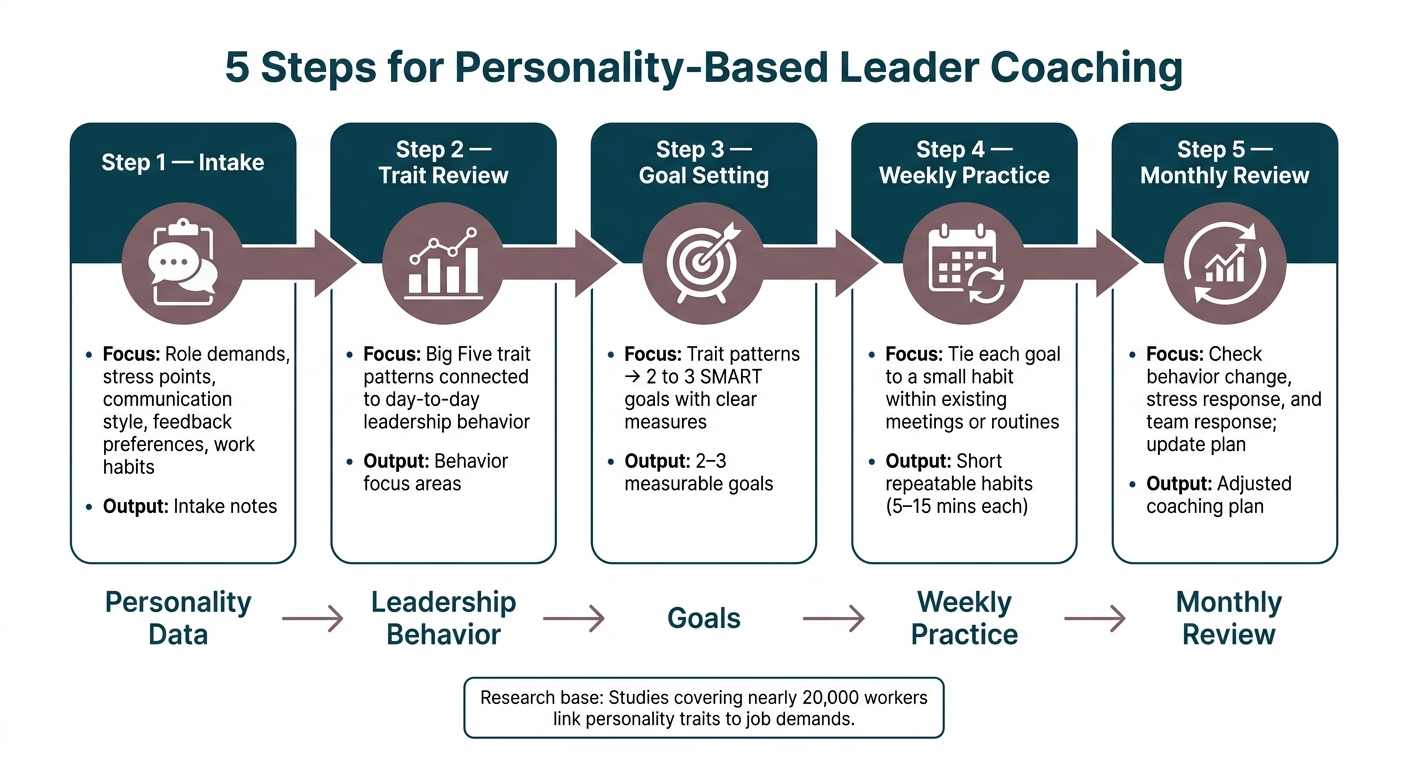
5-Step Personality-Based Leader Coaching Process
Adaptive Coaching: Using Personality Type to Flex Your Coaching Style
Quick Comparison
| Step | Main Focus | Output |
|---|---|---|
| 1 | Role, pressure, work style | Intake notes |
| 2 | Trait patterns in context | Behavior focus areas |
| 3 | Goal setting | 2 to 3 measurable goals |
| 4 | Weekly action | Short repeatable habits |
| 5 | Review and update | Adjusted coaching plan |
In short, the article lays out a clear coaching flow: personality-driven growth → leadership behavior → goals → weekly practice → monthly review.
Step 1: Start with intake questions tied to role, stress, and work style
A good intake is not a checklist. It’s a focused conversation that gives you just enough context to make the personality results useful. These details show where personality patterns are most likely to matter in Step 2.
Ask about role demands and leadership pressure points
Start with the work itself. Ask about team size, program types, and where the leader feels the most strain in a nonprofit setting. Ask:
- "Where do you feel stretched most often - staff burnout, difficult board conversations, or workload bottlenecks?"
- "Can you identify situations where emotions shaped your decisions under pressure?"
- "What are your current and upcoming challenges?"
Pay attention to pressure points that come up more than once. If someone keeps mentioning conflict, burnout, or board strain, that usually points to where coaching should focus. Treat those recurring themes as coaching signals, not background noise.
Capture communication, feedback, and learning preferences
Once you understand the role demands, shift to how the leader works day to day. This is where you connect their traits to the coaching plan. A few short-answer prompts can tell you a lot:
| Preference Area | Sample Intake Question |
|---|---|
| Communication | "Where do you feel most effective - in large groups, board meetings, or one-on-one conversations?" |
| Feedback | "Do you prefer immediate verbal feedback or written summaries to process later?" |
| Decision-Making | "How do you balance assertiveness and relationships?" |
| Stress Response | "How do you typically respond to pressure or unexpected changes?" |
| Learning | "How do you handle unfamiliar challenges or tools?" |
Once you have these preferences on record, the trait review can stay grounded in how the leader works under pressure. Also note any existing assessment data, so Step 2 can move straight to trait patterns. Use these notes to spot which traits deserve the closest look in Step 2.
Step 2: Review personality traits and connect them to leadership behavior
Use the intake notes from Step 1 to figure out which traits matter most for this role. Then turn those scores into day-to-day leadership behavior, not personality jargon.
Map trait patterns to common nonprofit leadership situations
Think of Big Five scores as a range, not a fixed box. In a nonprofit leadership role, each trait tends to show up like this:
| Trait | Where It Helps | Where It Creates Friction |
|---|---|---|
| Openness | Adapting to new tools | Moving too fast on untested ideas |
| Conscientiousness | Deadlines and grant work | Getting stuck in details and losing sight of strategy |
| Extraversion | Donor outreach and staff energy | Talking over others or acting too fast |
| Agreeableness | Trust-building and mediation | Avoiding hard feedback |
| Emotional Stability | Calm under pressure | More stress reactivity under strain |
Start with the traits linked to the leader’s most common pressure points. Leave the rest alone for now.
Choose tools that give trait-level coaching context, not just static labels
Static reports make the coach do the extra work. They show the score, but they don’t always show what to do with it.
Contextual tools help bridge that gap. They connect personality data to the leader’s role, current pressure points, and the moments that come up every week.
Personos combines personality profiles, intake context, and situation-specific guidance, so coaches spend less time interpreting scores and more time working on behavior change.
Pick the tool that turns trait data into a short list of behavior changes, not a longer report. That makes it simpler to choose 2 to 3 coaching goals in Step 3.
Step 3: Turn trait insights into 2 to 3 coaching goals with clear measures
Use the trait patterns from Step 2 to choose 2 to 3 concrete coaching goals. That keeps the work focused and easier to stick with, even during busy weeks.
Link strengths and friction points to specific outcomes
Start with a simple lens: choose 1 to 2 traits to build on and 1 trait that tends to cause problems under pressure. In many cases, that friction point is just a strength pushed a bit too far. High conscientiousness can drift into perfectionism. High agreeableness can make tough feedback feel awkward, often leading to avoided conflict.
Then connect those traits to outcomes the leader needs most, such as productivity, engagement, collaboration, delegation, boundaries, or faster decisions.
Write goals in a simple SMART format
“Be a better communicator” sounds nice, but it doesn’t tell anyone what to do next. A SMART goal does: "Give one constructive piece of feedback in each weekly 1-on-1 for 6 weeks." That’s specific, measurable, and realistic.
| Trait Pattern | Friction Point | SMART Goal Example |
|---|---|---|
| High Agreeableness | Avoids hard feedback | Deliver one constructive observation in every weekly 1-on-1 for 6 weeks |
| High Conscientiousness | Perfectionism stalls execution | Define "good enough" in writing before starting each major project deliverable |
| Low Extraversion | Seems unapproachable | Schedule two 15-minute "office hours" blocks per week for informal staff drop-ins |
| High Openness | Ideas outrun follow-through | Limit new initiative brainstorming to the first 15 minutes of staff meetings only |
Track progress with simple measures, not just good intentions. Look at things like meeting follow-through, project completion rates, staff feedback, or output metrics.
These goals should connect straight into the weekly routines in Step 4.
For leaders who tend to nod along with everything in the room, make space for pushback before you lock the goals in. If they can’t point to even one thing they disagree with, the plan may be too polished to be honest. A simple action tracker helps too. It keeps each goal easy to review between sessions.
Keep each goal small enough to practice every week.
Step 4: Build short practice routines that fit nonprofit schedules
Turn each Step 3 goal into a weekly practice that can happen between meetings. That matters in nonprofit work, where long training blocks are hard to pull off. In many cases, short coaching moments that happen every week work better than a long session that drains the calendar.
The key is simple: connect one behavior to something that already happens each week.
Match each goal to one small weekly behavior
Tie the practice to the trait pattern behind the goal. Then link it to a recurring meeting, deadline, or check-in. That way, the routine has a natural place on the calendar instead of becoming "one more thing."
Here’s what that can look like by trait:
| Trait Profile | Calendar Trigger | Micro-Practice (5–15 mins) |
|---|---|---|
| Low Conscientiousness | End of workday | 10-minute planning routine for tomorrow's priorities |
| High Agreeableness | Before a difficult conversation | 5-minute prep to balance empathy with direct feedback |
| Low Emotional Stability | After a high-pressure meeting | Reflection exercise to identify stress patterns and reframe |
| Low Extraversion | Before a large team meeting | 5-minute role-play to practice specific communication points and build visibility |
| High Openness | Strategy or planning session | 10-minute brainstorm to explore one unconventional approach in a low-risk setting |
Use digital prompts and action tracking to cut follow-up burden
The biggest gap usually shows up in the week between sessions. Without a prompt, even leaders with good intentions can slide back into old habits. A generic reminder often gets ignored. A personality-aware prompt tied to a real meeting or feedback moment is much more likely to stick.
Personos pairs trait-specific Prompts with ActionBoard tracking, so coaches can keep follow-up light.
Use the same trigger, behavior, and measure so Step 5 can review progress fast.
Step 5: Review progress monthly and adjust the plan as conditions change
Review the plan every month against the goals and weekly routines already in place. Use the goals from Step 3 and the weekly routines from Step 4 as the baseline for that check-in.
Check behavior change, stress response, and team response
Look at three things: what changed, what flared up under stress, and what shifted for the team. Did the leader stick with their weekly routines? Are there signs of burnout or emotional reactivity when pressure hits? Has team communication gotten better?
A few simple questions can tell you a lot:
- "How did you respond to recent pressure?"
- "Where did your trait patterns help you - and where did they get in the way?"
- "What feedback approach worked best with your team?"
These questions tie straight back to the trait patterns found in Steps 1 and 2. That matters because the answers show whether coaching is changing day-to-day behavior, not just helping someone name what they already know.
Nonprofit conditions can shift fast. Staffing losses, funding cuts, or program crises can make last month’s goals feel out of date almost overnight. If behavior is not changing, revise the goals. Personos ActionBoard can track progress and update action items between sessions.
Conclusion: Keep the plan simple, trait-informed, and easy to repeat
A monthly review helps keep the plan lined up with changing conditions. Keep it simple: trait-informed, measurable, and easy to repeat.
FAQs
How do I choose which traits to coach first?
Start with the leader’s values and goals. Then look at personality results through that lens: what helps those goals, and what gets in the way.
Focus first on the traits that have the biggest effect on performance and energy, especially where the leader feels energized or drained. That keeps coaching centered on growth, not just problem-solving.
Personos can help by turning trait data into customized, actionable development goals.
What if a leader resists personality-based coaching?
Frame personality insights as neutral tendencies, not labels or judgments. The point isn’t to put someone in a box. It’s to help them see how they tend to operate under pressure, in meetings, during conflict, or when making decisions.
Coaching also shouldn’t push people toward some made-up “ideal” leadership style. That usually backfires. A better approach is to understand how they naturally work, then help them build stronger partnerships, communicate more clearly, and spot the blind spots that can trip them up.
Just as important, personality should be used as a tool for growth, not an excuse for behavior. Saying “that’s just how I am” shuts the door. Using insight to adjust how you lead, listen, and respond opens it.
If it helps to make this more concrete, Personos can connect those insights to specific people situations with data-backed guidance. That might mean showing how someone tends to handle feedback, where collaboration can break down, or what kind of support helps them manage tension on a day-to-day basis.
How can I measure coaching progress without adding extra work?
Focus on one specific behavior you can actually see over the next 90 days, not a vague goal. Then define success in plain, concrete terms.
For example, don’t aim to “be a better leader.” Aim to give clear weekly feedback to each direct report or start every team meeting with priorities and next steps. That gives you something you can spot, track, and talk about.
Keep tracking light. Use a simple progress tracker or set up check-ins on a schedule that fits the leader’s personality. Platforms like Personos can also help with ActionBoard goal tracking and small nudges between sessions.