Guide to Personality-Based Compatibility at Work
How personality assessments and AI tools improve team fit, communication, and performance while reducing turnover.
Christian Thomas

Guide to Personality-Based Compatibility at Work
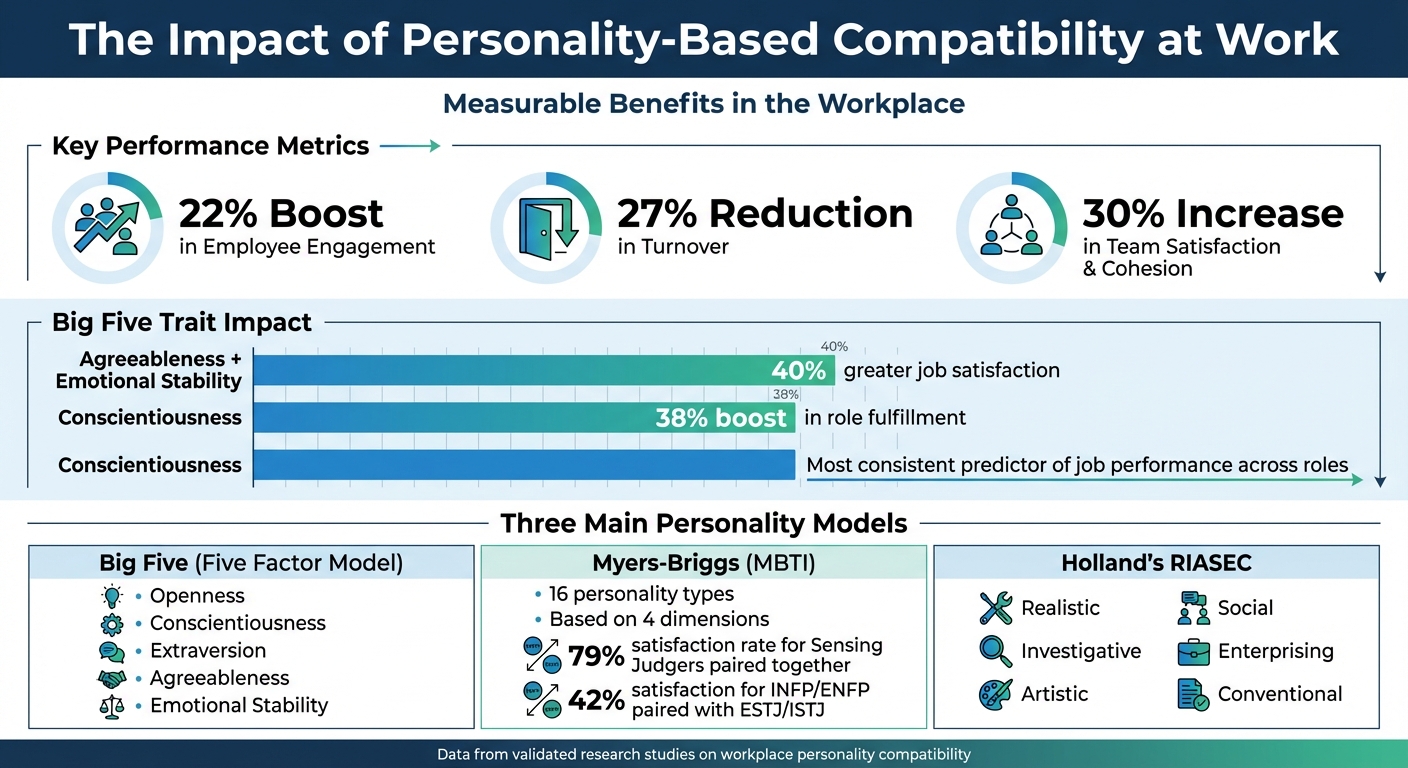
Personality-based compatibility helps align individual traits and work styles to improve team performance and workplace harmony. Companies using personality assessments report measurable improvements, including:
- 22% boost in employee engagement
- 27% reduction in turnover
- 30% better team satisfaction and cohesion
The most effective personality models include:
- Big Five (Five Factor Model): Focuses on Openness, Conscientiousness, Extraversion, Agreeableness, and Emotional Stability.
- Myers-Briggs (MBTI): Categorizes into 16 personality types based on preferences like Thinking/Feeling or Judging/Perceiving.
- Holland's RIASEC Types: Matches people to roles based on six vocational categories like Realistic or Enterprising.
Using these tools, you can:
- Build balanced teams by pairing complementary traits.
- Assign roles that match natural strengths.
- Improve communication by tailoring leadership styles. This includes learning how to read personality types in meetings to ensure every voice is heard.
Modern tools like Personos take this further with AI-powered insights, offering real-time guidance for team dynamics and decision-making. For $9/month per user, Personos provides actionable strategies while ensuring data privacy.
Understanding personality compatibility can lead to better communication, reduced conflict, and stronger team performance.
Personality-Based Compatibility Impact on Workplace Performance Statistics
How Personality Types Affect Teamwork And Collaboration w/ Leanne Wyvill
Personality Models for Measuring Compatibility
When it comes to assessing workplace compatibility, three major frameworks stand out: the Five Factor Model (Big Five), Holland's RIASEC Types, and the Myers-Briggs Type Indicator (MBTI). Each offers unique insights into team dynamics, communication, and role alignment, making them valuable tools for building effective teams. Let’s dive into what sets these models apart.
Five Factor Model (Big Five)
The Big Five focuses on five core traits: Openness to Experience, Conscientiousness, Extraversion, Agreeableness, and Neuroticism (or Emotional Stability). These traits help predict how individuals approach tasks, interact with others, and manage conflicts. Among these, Conscientiousness stands out as the most consistent predictor of job performance across different roles, while Agreeableness promotes smoother team interactions by easing conflict resolution. On the flip side, Neuroticism can lead to defensive behaviors during disputes [3][4].
The impact of these traits is striking. Teams with high levels of Agreeableness and Emotional Stability report up to 40% greater job satisfaction, while Conscientiousness boosts role fulfillment by 38% [3][4]. For example, highly conscientious individuals tend to tackle problems systematically, while agreeable team members focus on maintaining harmony and empathy.
"Personality compatibility is real, measurable, and backed by decades of scientific research." – Plexality Research Team [4]
Organizations can use this data to create balanced teams. For instance, if a group excels in Agreeableness but lacks Conscientiousness, adding a conscientious team member can enhance reliability and structure [3]. Research also shows that as people age, they naturally become more agreeable, conscientious, and emotionally stable, which can improve long-term compatibility in professional settings [4]. These insights can guide strategies for conflict resolution and team optimization.
Holland's RIASEC Types
Holland's RIASEC framework categorizes people into six vocational types: Realistic (hands-on, technical), Investigative (analytical, research-focused), Artistic (creative, expressive), Social (helping, teaching), Enterprising (leadership, persuasion), and Conventional (organized, detail-oriented) [5][6]. This model emphasizes the importance of aligning individuals’ interests with their work environment.
Interestingly, RIASEC and the Big Five often complement one another. For example, Enterprising types align with Extraversion, and Artistic types correlate with Openness. However, the Realistic category doesn’t strongly overlap with any Big Five traits, highlighting its unique focus on vocational preferences [5].
"The overall conclusion from the study is that although FFM personality traits and RIASEC types are related, they are not merely substitutes for each other." – Murray R. Barrick, Professor, University of Iowa [5]
In practice, RIASEC helps align people with roles they’ll enjoy, such as placing "Social" types in client-facing positions. Meanwhile, the Big Five provides insight into team dynamics, ensuring traits like Conscientiousness and Agreeableness are well-balanced [3][4]. By combining these models, organizations can address both role fit in teams and interpersonal fit ("How will they work with others?") [3].
Myers-Briggs Type Indicator (MBTI)
The MBTI categorizes individuals into 16 personality types based on four key dimensions: Extraversion vs. Introversion, Sensing vs. Intuition, Thinking vs. Feeling, and Judging vs. Perceiving [7]. While its scientific validity is debated, MBTI remains popular for understanding communication styles and work preferences [8][4].
Studies show that certain pairings lead to higher satisfaction. For example, Sensing Judgers (ESTJ, ESFJ, ISTJ, ISFJ) report a 79% satisfaction rate when paired with similar types. In contrast, Intuitive, Feeling, Perceiving types (INFP, ENFP) often experience lower satisfaction - around 42% - when paired with Sensing, Thinking, Judging types (ESTJ, ISTJ) [7]. The Sensing/Intuition dimension is particularly crucial, as shared preferences here can make communication feel more natural [7].
"When couples make an effort to understand and appreciate their differences, they can turn what might be a problem or source of conflict into an asset for their partnership." – Truity [7]
MBTI can be a valuable tool for self-reflection and team building. While similar types may communicate more easily, diverse teams often benefit from a mix of perspectives. Success ultimately depends on fostering trust, respect, and effective communication - factors that transcend personality types [7].
How to Apply Personality Compatibility at Work
Measuring Individual, Peer, and Team Compatibility
Understanding compatibility in the workplace involves looking at three levels: self-awareness, peer interactions, and team dynamics. By combining validated personality assessments with observations of communication and decision-making styles, you can gain valuable insights into how people work together.
It starts with self-awareness. Employees can use tools like the Five Factor Model to uncover their personality traits, motivations, and work preferences. This step is crucial since about one-third of workplace stress comes from interpersonal relationships [14]. Knowing how others perceive your traits allows for adjustments that strengthen relationships.
Next, focus on peer compatibility. Differences in communication and decision-making styles can heavily influence workplace dynamics. For instance, some people prefer concrete facts and data (a Sensing approach), while others lean toward exploring abstract possibilities (an Intuitive approach) [11]. Regional trends can also play a role - data from the 16Personalities database shows that Thinking-Judging types are more common in Singapore compared to global averages [11]. Asking simple questions like, "Do you prefer Slack or email?" or "When do you feel most productive for brainstorming?" can reveal work style preferences [10].
On a team level, compatibility scoring helps identify areas of synergy and potential conflict. Holland's RIASEC framework is a helpful tool here. For example, Social types tend to collaborate well with Artistic and Enterprising personalities, while Realistic types often work best with Investigative or Conventional colleagues [9]. These insights are the foundation for intentional team-building efforts.
Team Building Strategies Based on Personality
Once you understand compatibility, you can create well-rounded, high-performing teams by strategically pairing individuals with complementary strengths. For instance, teaming up an analytical introvert with an outgoing mentor-type extrovert ensures that great ideas are not only developed but also effectively communicated [14].
Assigning tasks based on personality strengths also boosts productivity. Detail-oriented work suits those with Investigative traits, while deadline-driven projects are better suited for achievement-focused individuals, like ESTJ/ENTJ types often referred to as "Knights" [9]. A 2023 study in Malaysia even found that image-based communication appeals across personality types, suggesting that visual dashboards or short video clips might be more effective than dense text documents [11].
Research involving 100,000 corporate leaders revealed that trust within a team plays a massive role. A skilled leader without team trust sees their collaboration effectiveness plummet - from the 79th percentile to just the 10th [13].
Feedback is another area where personality-based strategies shine. Some employees may shut down if feedback feels overly critical, while others thrive on role-specific, constructive input [13][14]. For example, when a high-urgency Type A works with a relaxed Type B, setting boundaries with a simple, "I’d love to help, but I need 10 minutes to finish this first", can prevent misunderstandings [12]. Similarly, Thinking-Judging types respond well to concise summaries and measurable outcomes, like "This will cut processing time by 22%" [11].
"The most effective salespeople don't just sell a product; they sell understanding. They adapt their style to make the buying process feel natural and intuitive for the client."
– Tony Tong, Founder, Mindreader [11]
Even the physical workplace can benefit from personality insights. Open, collaborative spaces often suit Artistic and Enterprising types, while Realistic and Investigative personalities may prefer quiet, private areas for focused tasks [9].
These strategies, combined with modern tools, make it easier to create teams that work well together.
Using AI-Powered Tools Like Personos
AI tools take personality compatibility to the next level by offering real-time, adaptive solutions for team dynamics. Platforms like Personos turn personality insights into actionable guidance, providing continuous support as workplace relationships evolve [15]. Unlike traditional assessments, which offer static reports, AI-powered tools deliver dynamic coaching tailored to specific situations.
Personos uses the scientifically validated Five Factor Model to measure 30 personality traits on an 80-point scale. This approach captures millions of unique personality combinations, avoiding the limitations of rigid personality categories [18]. The platform's conversational AI integrates these profiles with contextual data, offering personalized advice for challenges like navigating tough conversations, preparing for high-stakes meetings, or resolving conflicts.
For instance, before a one-on-one meeting, you can request a "personality brief" on the other person to fine-tune your tone and agenda [15]. The platform can even rewrite emails or presentations to align with the recipient's preferred communication style - whether they prefer direct messaging (for "Driver" types) or data-rich content (for "Analyst" personalities) [15].
AI tools also calculate "fit scores" by analyzing individual traits, team dynamics, company culture, and job roles [16][17]. In one case, a Fortune 500 company saw $1.68 million in production yield improvements and cut their hiring process by 47 days using these tools [16]. Additionally, AI tools can help prevent up to 76% of workplace conflicts by identifying potential friction points early on [18].
"Crystal gives AI tools deep personality context so every interaction adapts to how you think, work, and communicate."
– Crystal [15]
Personos further integrates into daily workflows with features like Dynamic Reports, Prompts, and an ActionBoard for tracking progress. Its privacy-first design ensures that personality data remains confidential unless shared explicitly, reducing the risk of labeling or stereotyping.
For professionals such as social workers, coaches, or counselors, Personos offers a practical solution to enhance communication and reduce burnout. At just $9 per seat per month, it provides an affordable way to improve workplace interactions and outcomes through personality-aware strategies.
Comparing Personality Compatibility Tools
Personos vs. Traditional Assessment Tools
When it comes to selecting personality compatibility tools for the workplace, two main options exist: traditional self-report assessments and modern AI-powered platforms. Traditional tools, such as the MBTI and MMPI-2, rely on straightforward yes/no or scale-based questions. While these tools are easy to implement and don't require advanced technology, they have their limitations. For example, the MMPI-2 is respected for its validity and even includes measures to detect overly positive self-reports, but these tools still provide a static snapshot of personality and may be influenced by bias. In hiring scenarios, respondents might adjust their answers to appear more favorable, which reduces the reliability of results [22][19].
Modern AI tools like Personos, on the other hand, take a much different approach. Instead of relying solely on self-reports, they analyze real workplace behavior through interactions captured in text, video, and audio. For instance, in December 2024, Athena, a company with 2,500 employees, used AI-driven personality assessments to analyze meeting recordings. This allowed them to deduce Big Five personality profiles, predict employee turnover, and identify ideal matches for specific roles [22].
One of the standout benefits of AI tools is their ability to provide real-time, actionable insights. While traditional tools are static and primarily descriptive, platforms like Personos go further by offering guidance tailored to specific workplace scenarios. For example, they can suggest how to approach a difficult conversation or adapt a presentation to suit a team's communication style. Research shows that correlations between AI-predicted traits and self-reported personalities range from 0.42 to 0.48, which suggests these tools work best as a complement to traditional methods rather than a complete replacement [20].
| Tool | Key Features | Strengths | Limitations |
|---|---|---|---|
| Personos | AI chat guidance, Dynamic Reports, ActionBoard, 30 traits on an 80-point scale | Real-time insights, workplace-specific guidance, adaptive support | Requires subscription ($9/month) and sufficient data for optimal accuracy |
| MBTI | 16 personality types, static assessments | Well-known, easy to use, no need for advanced tech | Static results, prone to "faking", lacks workplace-specific recommendations |
| 16Personalities | Free online test, MBTI-inspired | Free, user-friendly interface | No real-time feedback, lacks depth, and produces static, generalized results |
"AI-based personality assessments remove the need for self-reporting and close-ended questionnaires, as algorithms can analyse video, audio, speech transcripts of free-flowing interactions and social media information."
– Eliot Gattegno and Nadav Klein, INSEAD Knowledge [22]
This shift from static to dynamic tools reflects the growing need for more personalized, context-aware solutions in professional environments. However, organizations must approach AI-driven tools thoughtfully. Customizing data to fit specific industries or roles is essential - for example, extroversion may mean different things for entrepreneurs versus accountants. Additionally, maintaining human oversight is critical. AI insights should support decision-making, not replace it, to avoid bias and preserve empathy [21].
It's worth noting that only 20% of research papers on AI-based personality prediction separate training, validation, and testing phases correctly. This highlights the importance of using platforms grounded in validated frameworks like the Five Factor Model [20].
For professionals like social workers, coaches, and counselors, Personos offers a balanced solution. At $9 per user per month, it combines the scientific foundation of traditional assessments with the flexibility and real-time support needed in today's workplaces. Its privacy-first approach ensures sensitive personality data remains secure, avoiding the risk of labeling that often comes with traditional methods.
Conclusion: Using Personality Insights to Improve Workplace Relationships
Key Takeaways
Understanding personality compatibility is a game-changer for workplace performance. Traits like conscientiousness, openness, and emotional stability significantly influence how people interact at work. When these dynamics are understood and applied, organizations can experience real benefits - like a 22% jump in employee engagement, up to a 30% drop in turnover, and a 30% rise in productivity[1].
The move from traditional assessments to AI-powered tools, such as Personos, represents a major leap forward. Unlike older methods that provide a one-time snapshot, platforms like Personos offer real-time, adaptive insights tailored to specific situations. For just $9 per user per month, Personos uses the Five Factor Model - a proven framework - to deliver tools like conversational AI chat, Dynamic Reports, and an ActionBoard. These features are invaluable for professionals like social workers, coaches, and team leaders who deal with complex human interactions every day.
It’s important to treat personality assessments as conversation starters, not rigid labels[2]. Assign people to roles that align with their strengths, adjust leadership styles to suit diverse personalities, and create workspaces that cater to different preferences. These practices lead to better communication, faster problem-solving in meetings, and stronger team cohesion, highlighting the value of integrating personality insights into workplace strategies.
Next Steps
To take action, begin by evaluating your team’s dynamics using a reliable tool based on the Five Factor Model. This framework has consistently shown its ability to predict job performance across various industries[23]. For professionals handling complex challenges, Personos offers real-time guidance and a privacy-focused design, steering clear of the labeling pitfalls associated with traditional assessments.
Incorporate personality insights into your hiring process to ensure new team members align with both the role and your workplace culture. Use real-time tools to keep team dynamics balanced as roles and relationships evolve. Encourage open discussions where team members can share their assessment results, fostering understanding and reducing potential conflicts[2]. Regularly revisit and reassess team interactions to ensure they remain in sync with personality-based insights. Since personality is one of the most reliable predictors of job performance[23], treating these insights as actionable data can completely reshape how your team works together, communicates, and achieves success.
FAQs
Which personality model is best for my team?
The Big Five Personality Traits model is a well-known framework for understanding team dynamics and individual compatibility in professional settings. It evaluates five key traits: openness, conscientiousness, extraversion, agreeableness, and neuroticism, giving a detailed picture of personal and interpersonal behaviors.
Tools like Personos leverage this research-backed model to deliver real-time, customized insights. These insights help teams work together more effectively, minimize conflicts, and boost overall performance. With its strong scientific foundation and practical benefits, this model has become a go-to resource for many organizations.
How can I use personality data without stereotyping people?
To steer clear of stereotyping, prioritize understanding people as individuals rather than lumping them into generalized categories. Personality data can be a helpful resource when used to provide tailored insights that suit specific situations. It's also important to appreciate a variety of communication styles and actively challenge unconscious biases by questioning your own assumptions. Think of personality data as a means to better comprehend and support each person in their unique context - rather than using it to create rigid labels or make assumptions about their behavior or potential.
How can I measure if compatibility work is improving results?
To gauge progress, keep an eye on changes in team performance, how well members collaborate, and the quality of individual interactions over time. Regular assessments or feedback sessions can help you evaluate these areas effectively. Platforms like Personos, which are designed to be personality-aware, provide tailored insights and tracking tools to monitor shifts in team dynamics and engagement. Pay attention to key areas like performance metrics, team cohesion, and individual contributions to confirm that your compatibility strategies are making a real impact.