Personality Assessment Across Languages: Guide
Use validated translations, pilot new versions, get plain-language consent, and require human review for cross-language personality scores.
Nick Blasi

Personality Assessment Across Languages: Guide
If a personality test is not shown to work the same way in each language, I should not use the scores to compare people across language groups.
That is the core point. In care and social service work, I can use translated assessments more safely when I:
- use a validated language version first
- avoid making my own live translations during intake
- test any new translation with real users before rollout
- treat scores as supporting input, not the final call
- get plain-language consent
- require human review for triage, eligibility, referrals, and other high-stakes decisions
A small wording shift can change what an item means. And when that happens, the score may reflect language differences, not trait differences. Research on cross-language testing often looks at whether scores are comparable across groups. If that step is missing, the safer move is simple: read results within the same language version only.
Quick comparison
| Issue | Safer approach | Risk if skipped |
|---|---|---|
| Translation choice | Use a validated version | Scores may not match the original meaning |
| New translation | Use forward translation, back translation, and review by bilingual staff | Meaning drift |
| Pre-launch testing | Pilot with target users | Confusing items and weak data |
| Score comparison | Compare only where cross-language evidence exists | False group differences |
| Intake | Record preferred language, literacy, and interpreter needs | Wrong version used |
| Consent | Explain what results can and cannot be used for | Misuse of scores |
| Final decision | Staff review every high-stakes case | Overreliance on test or AI output |
In other words: translation is not just a language task. It is a score-use and decision-use task too.
Bias in Standardized Testing: A Professional Explanation
How To Choose and Translate a Personality Measure
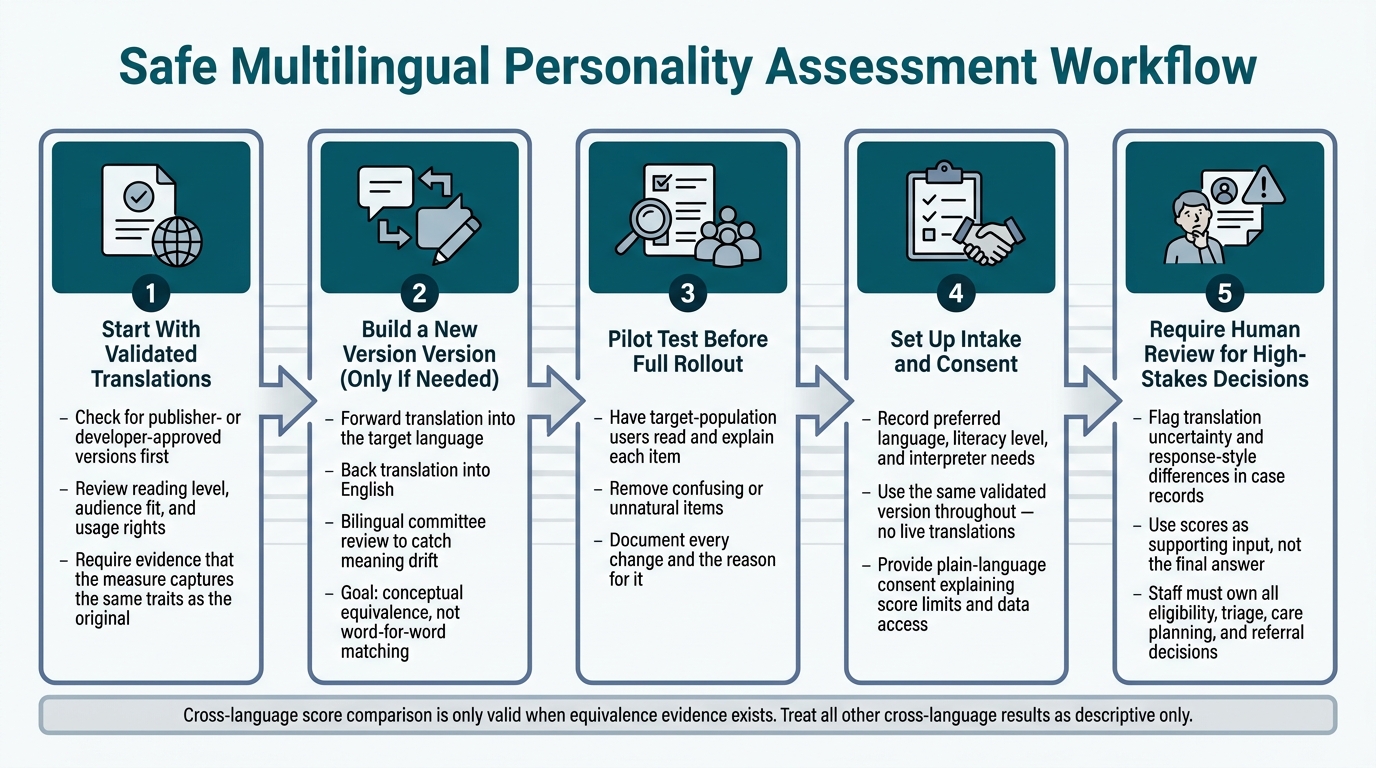
Multilingual Personality Assessment: Safe Use Workflow
Translated scores can change meaning. So start with the version that has the strongest evidence.
Use a validated translation in the language your clients speak. Build a new version only if no validated option is available.
Start With Validated Translations Before Building a New Version
Before you translate anything on your own, check for a publisher- or developer-approved version first. Also review the reading level, fit for the audience, and usage rights before you put it into practice.
A translated measure should include evidence that it still measures the same traits as the original. If that evidence isn't there, don't use that version to make decisions.
Use Forward Translation, Back Translation, and Committee Review
If no suitable validated version exists, use a structured process:
- Forward translation into the target language
- Back translation into English
- Review by a bilingual committee to catch meaning drift
The goal is conceptual equivalence, not word-for-word matching. That's a big deal. A phrase can look fine on paper and still land in a different way once a real person reads it.
This comes up a lot with social nuance or wording tied to a specific way of speaking. In those cases, committee review helps spot problems before clients ever see the measure.
Pilot Test With Real Users Before Full Rollout
Even a careful translation needs testing before full rollout. Have a small group from the target population read the items, explain what they think each one means, and point out wording that feels unclear or unnatural.
Then run a pilot. Remove items that confuse respondents or don't work in your setting. Document every change and why you made it. Keep a short record of translation choices so later score review stays defensible.
Those notes also make score review and comparison much easier later on.
How To Use Scores Safely Across Languages
Once you have a translation, the next step is simple to ask and hard to answer: can you compare scores across languages at all?
When Scores Can Be Compared Across Language Groups and When They Cannot
Only compare scores across language groups when the translated version has evidence showing it works in much the same way across those languages. If that evidence is missing, a score gap may point to translation problems or shifts in meaning, not actual personality differences.
For most nonprofit teams, the safer move is to use scores within the same language version and avoid using them to rank people, filter cases, or make direct cross-group comparisons. A translated score can still help with case discussion. It just shouldn't drive automatic comparisons across languages.
Without that evidence, treat the score as a discussion aid, not a final answer.
Common Bias Problems in Multilingual Assessment
Even a solid translation can change meaning through idioms, tone, and response style. On top of that, response styles differ across groups. One group may seem more extreme, while another may seem more restrained, even when their trait levels are close.
If your goal is to understand stress patterns, motivations, and communication style, bring in more than the score:
- situational details
- past notes
- relevant organizational context
That extra context matters. Raw scores should be used as input, not as the decision. They can mislead when language norms differ.
That's why intake and review workflows need to carry the final interpretation.
Comparing Assessment Options for Nonprofit Teams
Fixed score reports can help when your team needs documented baselines. They're less useful when the real need is advice on how to respond in a specific relationship or care setting.
Use language-validated assessments when you need cross-language score comparison. Use context-aware tools when you need practical guidance for communication and care.
How To Build Intake, Consent, and Review Workflows
Multilingual assessment only works if intake, consent, and review all follow the same translation rules. In plain terms, the same rules you use to translate items and compare scores also need to show up in intake forms and case notes.
Add Language Screening and Version Selection at Intake
Start at intake by asking which language the person uses in daily life. Record their preferred language, literacy level, and any interpreter needs right away. Then document the exact validated version and administration mode used.
Stick with the same validated version you selected earlier. Do not make up translations during administration. The moment you do that, you've created a new version that has not been validated. If a version is not comparable, flag it in the case record so staff don't treat it like an equivalent option.
Once the version is set, move to plain-language consent.
Use Plain-Language Consent That Explains Limits on Score Use
Clients need clear consent before they answer. Consent forms should use plain language, be available in the client's preferred language where possible, and explain:
- what the assessment measures
- how long it takes
- how results support care planning or communication
- who can see the results
- when scores can and cannot guide decisions
Results can support care decisions, but they do not determine eligibility on their own. Access to assessment data should be limited to staff who need it for that case.
Even when consent is in place, high-stakes decisions still need staff review.
Require Human Review Before High-Stakes Decisions
Consent does not replace judgment. It sets the rules for how judgment should be used. Personality scores and AI outputs can support decisions, but staff make them.
Document review triggers for eligibility, care planning, triage, and any other high-stakes decisions touched by language, translation, or context. Translation uncertainty and response-style differences are the exact reason a person must make the final call. Tools like Personos should stay assistive. A human must own the final call.
Conclusion: A Working Standard for Multilingual Personality Assessment
Multilingual personality assessment is a matter of documentation, consent, and judgment, not just translation. That distinction matters most when teams need to read scores across languages.
When score comparability has not been established, treat cross-language results as descriptive only. They can help guide service decisions, but they should not be used to deny someone access to services. Tools that let staff add case context can help keep that standard in place. Personos, for example, lets staff add case context directly to a client's profile so AI guidance stays tied to the client's actual case context. [1]
Use translated scores only when their limits are documented, consent is clear, and a human reviews any high-stakes decision.
FAQs
How do I know a translated test is validated?
A translated test is validated when it keeps the same meaning, not just the same words. In plain English, it should measure the same underlying traits in a steady way across different cultures and settings.
Look for assessments adapted with recognized best practices and standards from groups like AERA, APA, and the ITC. If this fits your workflow, Personos is built on the widely validated Five Factor Model and puts a clear focus on transparent, human-in-the-loop validation.
What if no validated version exists in my client’s language?
If no validated version exists in your client’s language, don’t just translate the assessment. A direct translation usually misses the mark. The measure needs to be adjusted so the meaning and the way it works stay consistent across different settings and groups.
In that case, Personos can be a helpful option. It’s based on the scientifically validated Five Factor Model and can give context-specific guidance across languages. Use those insights as a starting point, then test them against what you see in practice and what you learn through open conversation.
When is human review required?
Human review is required whenever personality insights are used. That’s what keeps the process ethical, responsible, and accurate.
Think of AI output as a starting point, not the final call. It can point you in a direction, but it shouldn’t decide things on its own.
The better approach is simple:
- Cross-check AI output with direct observation
- Talk openly with the person involved
- Run regular human-led audits across diverse demographic groups to spot and reduce bias
That mix matters. AI can help surface patterns, but people still need to sanity-check the result and make sure it lines up with what’s actually happening.