Personality Alignment in Multicultural Workplaces: Case Studies
Focus on individual personality traits to improve communication, reduce conflict, and boost performance in global teams.
Rachel Johnson

Personality Alignment in Multicultural Workplaces: Case Studies
Personality alignment focuses on understanding individual traits - like introversion, conflict management, and openness - over generalizing by nationality. This approach helps teams collaborate better, especially in global and diverse workplaces. Companies like Deloitte and Unilever have improved team productivity and profits by leveraging personality-focused strategies. Tools like the Five Factor Model and AI platforms such as Personos provide actionable insights to improve communication and reduce conflicts.
Key insights from the article:
- 89% of white-collar workers participate in global virtual teams.
- Diverse executive teams are 33% more likely to outperform competitors in profitability.
- Personality-based strategies led to a 60% revenue increase for Unilever in emerging markets.
- AI tools like Personos offer real-time, tailored guidance using personality data.
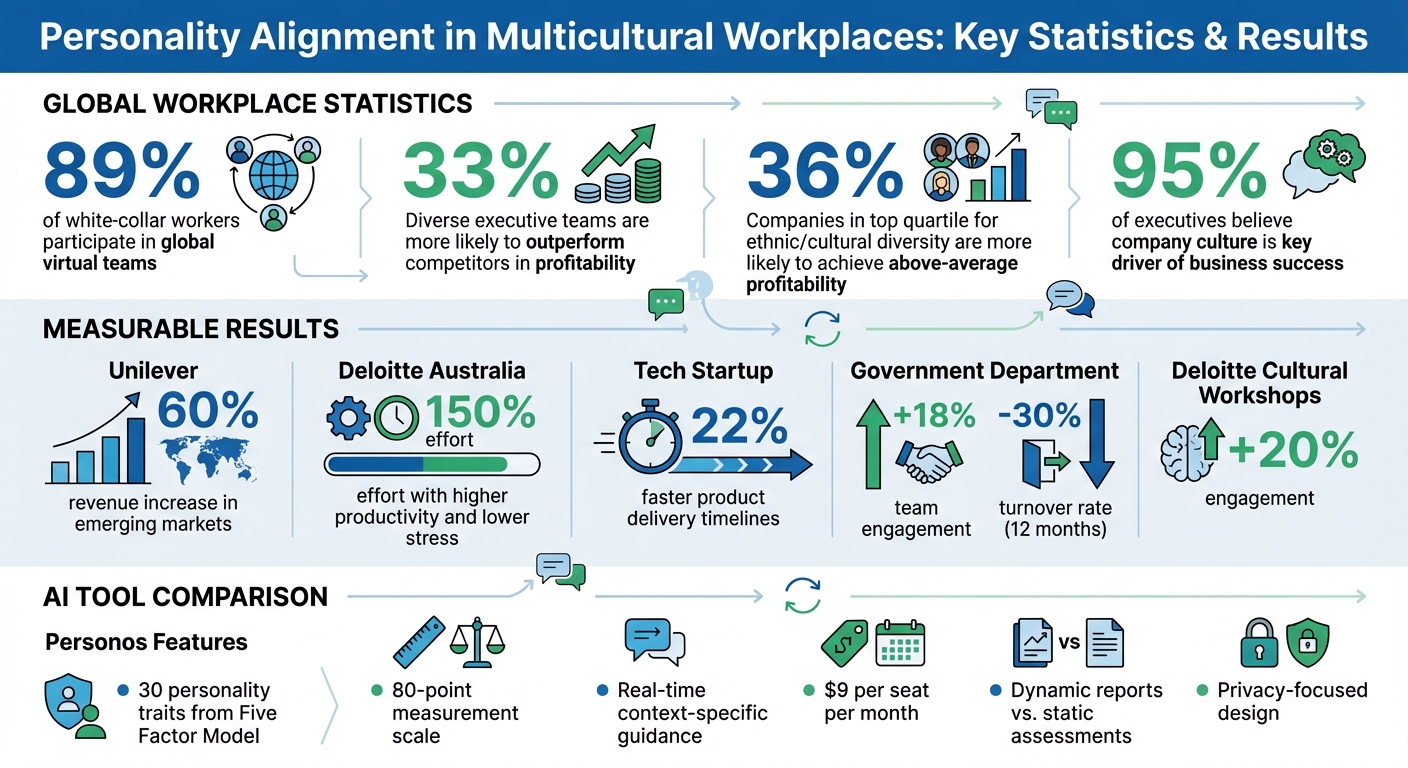
Personality Alignment Impact: Key Statistics and Performance Metrics Across Industries
4 Communication Traps of Multicultural Teams
Case Studies from Different Industries
These case studies illustrate how aligning personality traits can lead to measurable improvements across various fields, including technology, consulting, software development, and nonprofit organizations. Each example highlights the challenges and opportunities of working within multicultural teams.
Case Study 1: Tech Startup Enhances Remote Team Communication
Tech startups often face hurdles when managing remote, multicultural teams. Adapting communication styles to accommodate diverse cultural norms is essential for building trust and reducing friction [2]. By implementing personality alignment strategies, teams can tailor their feedback and interaction styles to suit different audiences, creating a smoother workflow [5].
The results speak for themselves. 95% of executives believe company culture is a key driver of business success [3], and research on 200 startups reveals that companies with strong culture alignment are less likely to fail [4]. For remote teams, personality science helps avoid information silos and ensures that off-site employees feel connected to the broader team culture [3] [5]. By prioritizing traits beyond technical skills, these strategies foster a natural synergy among team members [2].
This approach mirrors the success seen in organizations like Deloitte Australia, which has effectively leveraged personality differences to enhance team dynamics.
Case Study 2: Deloitte Australia Tackles Personality Differences
At Deloitte Australia, a 360-degree interview approach was used to differentiate between behaviors influenced by culture and those driven by personality [1]. The findings were transformative. The client noted that the team delivered 150% effort, with higher productivity and lower stress levels compared to other teams [1].
"How one behaves (what they say, how they act) at work is more linked to their level of introversion vs. extroversion and how they handle conflict" [1].
Despite linguistic diversity - team members spoke four different first languages - this variety became an asset. It encouraged clearer communication and shifted meeting dynamics from assertive styles to active listening and valuing diverse input [1].
Case Study 3: Resolving Cross-Cultural Conflicts in Software Teams
Multicultural software teams often encounter conflicts during decision-making. Personality-driven strategies help individuals navigate these challenges while avoiding hasty decisions [5]. Aligning employees' personalities with the organizational culture has been shown to reduce turnover and save resources [2]. However, one-third of employees report that efforts to improve company culture often fall short [3]. Success in this area requires open communication, where personality assessment results are shared with team members to support their growth and encourage mutual understanding [2].
This method has proven effective outside the tech industry as well, particularly in nonprofit organizations.
Case Study 4: Nonprofit Strengthens Team Cohesion
Thrive, a nonprofit organization, uses personality tools to help its staff manage significant challenges [5]. By adopting the Five-Factor Model, the organization provides tailored communication guidance based on each individual's style and behavior [5]. Staff access online dashboards to receive actionable advice on adapting their communication and feedback methods, fostering trust and reducing misunderstandings [5].
In this case, Personos technology played a pivotal role. The platform offers real-time communication prompts that enhance team cohesion. Steve Huff, PhD, Founder of Thrive, shared:
"Personos isn't just technology, it's a teaching partner. A constant criticism of AI is that it makes us dumber. To the contrary, Personos helps make our members smarter about how they communicate, how to mitigate challenges, and the opportunities available to them for more successful outcomes" [5].
Christian Thomas, CEO and Co-Founder of Personos, added:
"AI has made us more efficient in how we work and communicate, but not smarter about how we connect with people" [5].
This approach makes psychological insights, once reserved for AI-driven executive coaching due to cost, accessible to all team members. The focus shifts from improving efficiency to building empathy and fostering meaningful connections within teams [5].
How AI Tools Support Personality Alignment
Scaling personality alignment requires tools that provide real-time insights, and case studies show how effective this approach can be. Traditional personality assessments tend to deliver static reports that quickly lose relevance and fail to address specific scenarios. AI-powered platforms step in to fill this gap, combining personality psychology and AI coaching with situational intelligence. By offering timely psychological insights, these tools, like Personos, are changing how teams work together.
Personos Features for Multicultural Teams
Personos uses 30 personality traits from the Five Factor Model, measured on an 80-point scale, to deliver AI-driven, context-specific guidance. This is especially useful for multicultural teams. In complex cross-cultural situations, users can describe the scenario in plain language and receive advice tailored to their personality, the other person's traits, and the cultural nuances involved.
Static assessments typically categorize individuals, but Dynamic Reports from Personos go further by providing actionable advice. For instance, instead of just noting that a colleague prefers direct communication, the platform explains how to adapt an indirect communication style to collaborate effectively under tight deadlines.
Privacy remains a top priority. Personality scores are kept private unless explicitly shared, ensuring that the tool doesn't become a means of labeling or judging team members. Instead, users receive individualized guidance to adjust their behavior without revealing their full profile. The Transparent Reasoning feature adds another layer by showing how personality traits and psychological principles shape the recommendations. This helps users build their understanding over time, rather than just following AI-generated advice without context.
These features highlight how Personos can significantly improve collaboration in diverse teams, aligning with real-world examples of personality alignment’s benefits.
Personos Compared to Other Personality Tools
Personos stands out by focusing on real-time, context-aware guidance. Most personality tools fall into two categories: general assessment tools that offer static reports or enterprise systems aimed at hiring and talent management. Personos takes a different route, emphasizing practical, everyday application over one-time analysis. Tools like Myers-Briggs or DiSC assessments classify people into types but rarely provide actionable insights for specific workplace interactions. Meanwhile, enterprise platforms often prioritize organizational goals, such as identifying top performers, rather than helping individuals improve their interactions.
The standout feature is contextual intelligence. While other tools might indicate that a colleague scores high on conscientiousness, Personos explains how that trait interacts with your personality in the context of your current project, cultural dynamics, and shared history. The platform’s conversational AI chat delivers guidance that considers multiple factors at once - something traditional tools or generic advice can’t achieve. For example, in a nonprofit organization managing a multicultural team with heavy workloads, Personos provides immediate, expert-level support for tricky interactions without requiring external consultants or supervisors.
At just $9 per seat per month, Personos makes advanced personality insights accessible to organizations that previously couldn’t afford executive coaching or extensive training programs. The ActionBoard turns these insights into actionable tasks, ensuring that personality awareness translates into measurable behavior changes. This blend of affordability, real-time insights, and privacy-focused design makes Personos an effective choice for multicultural workplaces aiming to enhance collaboration without adding complexity or compromising individual autonomy.
Key Lessons and Results
Personality-Aware Communication Practices That Work
Studies reveal that focusing on individual personality traits, rather than nationality, leads to better adaptation and trust within teams [1]. Successful strategies included weekly "sync and reflect" meetings, cross-cultural coaching, and setting clear communication norms [6]. For example, a tech startup that implemented these practices - along with rotating meeting times to fit global time zones - achieved a 22% improvement in product delivery speed [6]. Similarly, a government department used third-party mediation and restorative conversations to address conflicts, resulting in an 18% increase in engagement and a 30% drop in turnover within a year [6].
Cultural diversity encouraged teams to adapt and grow. Deloitte, for instance, emphasized linguistic clarity and tailored communication styles, which helped team members become more self-aware [1]. These reflective practices cultivated psychological safety, allowing personality traits to shape team dynamics more than nationality ever could.
By adopting these approaches, teams not only improved their internal dynamics but also achieved measurable performance improvements.
Performance Metrics Across Industries
The impact of aligning communication with individual personalities is clear in these performance metrics. By focusing on personality alignment, organizations have seen gains in engagement, retention, and efficiency across various industries.
| Organization | Metric | Improvement |
|---|---|---|
| Tech Startup (US, Europe, Asia offices) | Product Delivery Timelines | 22% faster [6] |
| Government Department | Team Engagement | +18% [6] |
| Government Department | Turnover Rate | -30% (over 12 months) [6] |
| Deloitte (Cultural Workshops) | Engagement | +20% [7] |
Additionally, broader research indicates that companies ranking in the top quartile for ethnic and cultural diversity on executive teams are 36% more likely to achieve above-average profitability [6]. Diverse teams, when managed effectively, outperformed their peers by 33% in profitability measures [7]. However, these results depended heavily on implementing personality-aware communication practices. The combination of understanding individual traits, setting shared norms, and fostering reflective spaces turned cultural diversity into a competitive strength rather than a source of friction.
Conclusion: Building Better Multicultural Teams
The case studies make one thing clear: aligning personalities can transform diverse cultural traits into a powerful advantage. By focusing less on nationality and more on individual behaviors - like communication styles, feedback preferences, and conflict resolution approaches - teams can foster genuine collaboration. The benefits? Faster project completion, lower turnover rates, and higher profitability for culturally diverse leadership teams.
But success doesn’t happen by accident. It takes intentional steps like cross-cultural coaching, establishing shared communication norms, and holding regular check-ins to address personality differences before they turn into larger issues. These strategies reinforce earlier findings about the importance of personality-focused communication in diverse teams.
Advanced AI tools also help bring these strategies to life. For example, Personos leverages the Five Factor Model, incorporating 30 personality traits to offer real-time, tailored guidance. It provides dynamic reports on communication strategies based on team members’ personalities, tracks collaboration goals through its ActionBoard, and delivers timely reminders to keep personality awareness front and center, even between meetings.
For organizations managing multicultural teams - whether nonprofits coordinating across regions, project managers leading global teams, or coaches working with diverse clients - understanding personality alignment is key. It transforms cultural differences into opportunities for innovation rather than challenges. By adapting to individual traits, teams can not only resolve team conflicts but also build trust, expand their influence, and achieve lasting, measurable results [1].
FAQs
How do you tell personality differences from cultural ones at work?
Personality differences highlight stable traits unique to an individual, such as openness or extraversion. On the other hand, cultural differences focus on shared norms, values, and communication styles within a specific group. These cultural contexts can influence how someone's personality is expressed or interpreted by others, making it essential to consider both aspects when understanding behavior.
Platforms like Personos, which specialize in personality psychology, provide tools to help professionals navigate these distinctions. This is especially useful in multicultural workplaces, where understanding these nuances can lead to better collaboration and more accurate interpretations of individual behaviors.
What’s the simplest way to start personality alignment in a global team?
To better understand personality traits and communication styles, using validated assessment tools is a great starting point. Some platforms even provide real-time insights tailored to individual personalities, helping team members adjust their interactions for smoother collaboration. Case studies highlight how technology can bridge working style differences and cultural nuances, making it easier to align personalities - particularly in diverse, multicultural teams.
How can AI tools like Personos help without exposing private personality data?
AI tools, such as Personos, prioritize privacy through measures like user data ownership, information separation, and robust security protocols (including SOC2, HIPAA, and GDPR compliance). These precautions allow professionals to leverage AI-powered insights for collaboration and client communication while maintaining strict confidentiality. Additionally, responsible platforms reduce risks by avoiding sensitive data storage and recommending against sharing private information directly within chat systems.