How Personality Alignment Improves Team Leadership
Assess and align team personalities to improve communication, reduce conflict, and boost productivity with practical steps and AI-backed tools.
Rachel Johnson

How Personality Alignment Improves Team Leadership
Personality alignment is about understanding how individual traits interact within a team to improve performance, communication, and conflict resolution. By recognizing and leveraging personality dynamics, leaders can:
- Enhance collaboration by tailoring communication to team members' styles.
- Reduce conflicts by anticipating friction points and creating psychological safety.
- Boost productivity by assigning tasks that match individual strengths.
For example, teams that align personalities report a 20% improvement in collaboration and a 15% reduction in project timelines. Tools like the Five-Factor Model or platforms like Personos provide actionable insights into team dynamics, helping leaders make informed decisions about roles and communication strategies.
Benefits of Personality Alignment for Teams and Leaders
Better Communication and Collaboration
When team members understand each other's personalities, they can tailor their communication styles to align with their colleagues' preferences and behaviors. This makes interactions smoother and more efficient [3]. For example, research shows that teams with higher levels of Agreeableness have a 0.24 correlation with improved performance, while those with elevated Conscientiousness correlate at 0.20 with better outcomes [4].
Using frameworks like the Five-Factor Model helps build empathy and ensures roles are distributed effectively. For instance, introducing a creative "Pioneer" personality to a team dominated by meticulous "Guardians" can strike a balance between innovation and execution [1]. Companies that prioritize understanding team dynamics report a 30% boost in team performance [7]. This kind of alignment also lays the groundwork for better conflict resolution.
Stronger Conflict Resolution
When leaders understand personality dynamics, they can anticipate and manage conflicts more effectively. Teams with high Agreeableness are naturally better at handling interpersonal challenges and fostering social coordination. Meanwhile, those with high Emotional Stability are better equipped to navigate stress without succumbing to anxiety or frustration. Data backs this up: a leader's Five-Factor Model traits show a correlation of Multiple R = .39 with leadership effectiveness and .53 with leader emergence [2].
Creating an environment of psychological safety - where team members feel comfortable voicing differing opinions - can turn conflicts into opportunities for growth. As Soren Kaplan Ph.D. explains:
Conflict in teams is inevitable, but how it's handled can either foster growth or cause disruptions [5].
Interestingly, teams with high variability in Conscientiousness show a -0.24 correlation with performance, while variability in Agreeableness correlates at -0.12 [4]. These figures highlight how aligning personalities within a team can significantly improve productivity and engagement.
Higher Productivity and Engagement
When individual strengths are matched to specific tasks, teams become more effective. Analytical thinkers thrive in data-driven roles, while empathetic communicators excel in client-facing positions. Teams that use personality assessments report a 20% improvement in collaboration and a 15% reduction in project timelines [6][7]. Additionally, effective communication alone can increase productivity by as much as 25% [7].
Aligning work assignments with natural tendencies also helps prevent burnout by distributing tasks more equitably and respecting individual limits [7]. Leaders who adapt their management style to suit their team's personalities - whether by offering detailed guidance to more structured individuals or presenting big-picture visions to ambitious team members - boost both performance and job satisfaction [8]. As Xobin puts it:
Hiring for skills is important, but aligning values and motivations is the real game-changer [6].
What It Means to Lead in Alignment
How to Align Personalities for Better Team Leadership
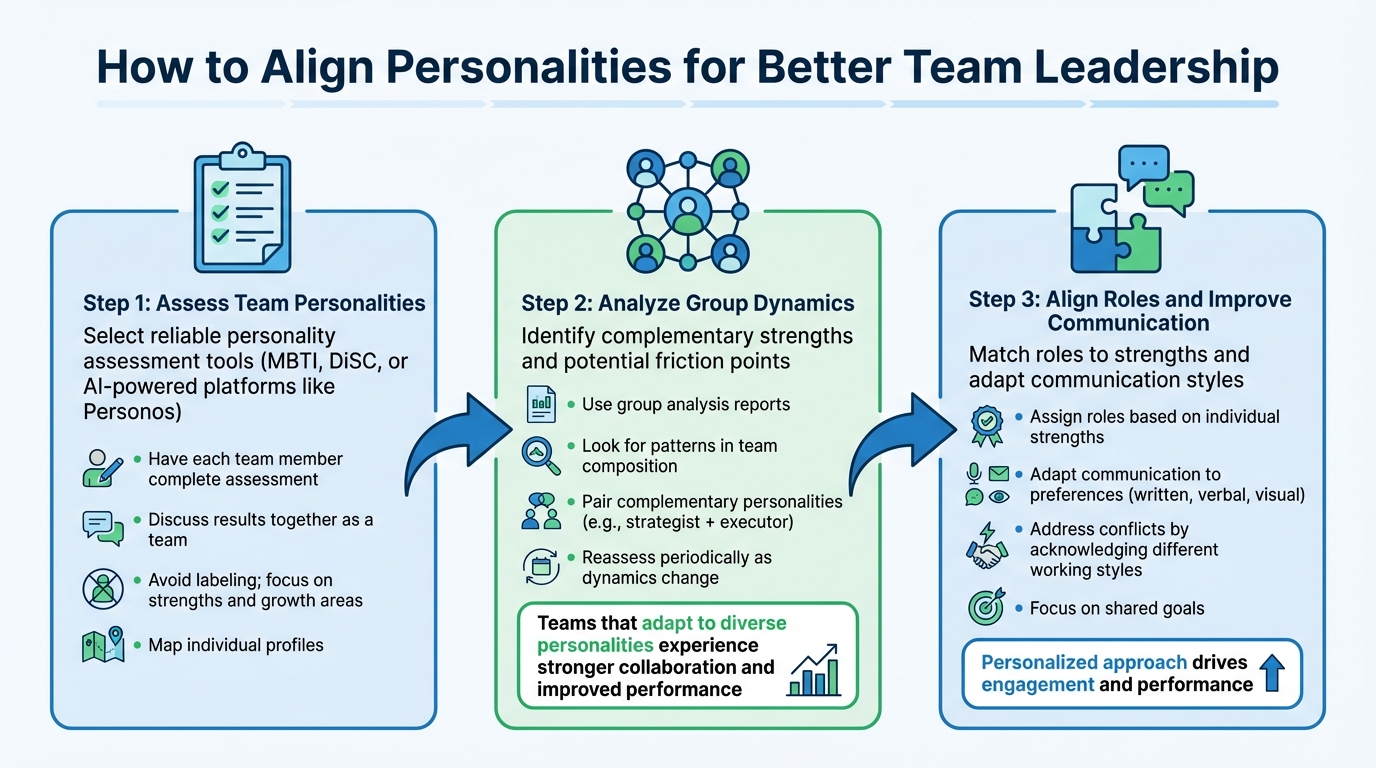
3-Step Process for Aligning Team Personalities to Improve Leadership
Step 1: Assess Team Personalities
Start by selecting a reliable personality assessment tool that aligns with your team’s and organization’s goals. Popular options include frameworks like MBTI, DiSC, or even AI-powered tools like Personos, which provide detailed reports on communication styles, problem-solving approaches, and work environment preferences [9]. Have each team member complete the assessment, then take time to discuss the results together.
It’s important to avoid labeling employees based on these assessments. Instead, use the insights to highlight individual strengths and identify areas for growth. For example, an introverted team member might excel at independent research but could also benefit from opportunities to present findings and enhance their communication skills.
Once you’ve mapped individual profiles, shift your focus to understanding how these traits interact within the group.
Step 2: Analyze Group Dynamics
Dive deeper into how individual personality traits influence team dynamics. Use group analysis reports to identify complementary strengths and potential areas of friction. According to research published in the Journal of Business Research, teams that adapt to diverse personalities tend to experience stronger collaboration, mutual respect, and improved performance [10].
Look for patterns in your team’s composition. For instance, if you have more visionary thinkers than detail-oriented planners, the team might struggle to execute ideas effectively. On the flip side, a group dominated by meticulous planners might find it challenging to innovate. Pairing complementary personalities - such as a big-picture strategist with someone skilled at execution - can help balance decision-making and implementation [9][10]. Keep in mind that team dynamics aren’t static, so reassess periodically to accommodate changes in personalities and team needs.
Once you understand these dynamics, you can start aligning roles and improving communication to make the most of your team’s strengths.
Step 3: Align Roles and Improve Communication
Assign roles that match each team member’s strengths. For example, someone with a sharp eye for detail might thrive in quality control or project management, while a creative thinker could excel in product development or customer experience roles.
Adapt your communication style to suit individual preferences. Some team members may work best with detailed written instructions, while others might prefer quick verbal updates or visual aids. When solving team conflicts, address them by acknowledging differing working styles and redirecting focus to shared goals [10]. This personalized approach not only improves communication but also ensures that every team member feels valued and understood - key factors that drive engagement and performance.
sbb-itb-f8fc6bf
Using Personality Insights to Solve Common Leadership Problems
Fixing Miscommunication and Misaligned Expectations
Miscommunication often stems from differing communication styles. Tools like the MBTI or EQi can provide a shared framework to help teams navigate these differences objectively [11]. For instance, understanding whether someone prefers detailed analysis or big-picture thinking allows team members to adjust their communication approaches accordingly [12].
"Most conflicts arise from miscommunications and misperceptions. With clearer and more effective communication, many conflicts can be diminished." - Jeremy Pollack, Ph.D., Founder, Peaceful Leaders Academy [12]
One effective method is creating "work-with-me" guides - personalized cheat sheets where individuals outline their communication preferences, feedback styles, and personality insights. Mandy Gilbert, Founder and CEO of Creative Niche, highlights their value:
"The simple beauty of this strategy is that it eliminates the guesswork of communication, and social interactions" [11].
By clarifying these preferences upfront, teams can avoid unnecessary misunderstandings and foster smoother interactions. These guides act as a proactive measure, making conflict less likely to arise in the first place.
Resolving Team Conflicts
Understanding personality traits can significantly reduce the time leaders spend resolving conflicts. Structured one-on-one meetings, guided by open-ended questions, help uncover what motivates or concerns team members [13]. Sharing these questions in advance encourages candid discussions without putting anyone on the spot.
To further ease tensions, shift the focus from individual competition to team-based rewards that promote collaboration [11]. Tracey Adams, Ph.D., Founder of ThriveOn Seminars, underscores the importance of embracing conflict:
"Managers have to be comfortable with conflict and know it's for the better of the organization" [13].
Instead of trying to change someone’s personality, leaders can assign tasks that align with individual strengths. For example, a direct communicator could handle challenging conversations, leveraging their natural abilities [11].
Building Long-Term Team Growth
For lasting team development, leaders must identify "derailers" - strengths that can backfire when overused. For example, excessive confidence might lead to dismissing alternate perspectives [14]. Scott Bryant, Ph.D., Consulting Manager at DDI, explains:
"The goal is for leaders to understand their wiring as a starting point for growth, not an excuse for why they 'can't' do something" [14].
By analyzing aggregated personality data, leaders can pinpoint team strengths and potential friction areas [14]. This holistic perspective supports succession planning, ensuring future leaders are adaptable and prepared for greater responsibilities [14]. Establishing a culture of psychological safety - where continuous feedback is the norm - helps resolve tensions early, preventing escalation [15].
In environments that prioritize collaboration, traits like Extraversion and Agreeableness become even more critical for effective leadership due to the heightened need for social coordination [2]. These insights strengthen leadership strategies, paving the way for long-term team success.
How Personos Supports Personality Alignment in Leadership
Personos helps leaders turn personality insights into meaningful team improvements. By leveraging AI-powered personality reports, Personos (https://personos.ai) provides actionable insights tailored for individuals, relationships, and groups. These reports go beyond identifying personality traits - they reveal how those traits interact within daily team dynamics. With its conversational AI interface, Personos offers real-time advice customized to the team’s current situation, assisting with conversations, task delegation, and overall team interaction. This data-driven approach sets the stage for better communication and proactive conflict management.
Communication and Conflict Resolution Tools
Personos doesn’t stop at providing insights - it equips leaders with tools to address challenges before they escalate. The platform includes proactive prompts that notify leaders about potential friction points stemming from personality differences. These timely alerts allow leaders to step in early and prevent misunderstandings. On top of that, Personos delivers personalized strategies for handling tough conversations, tailored to each team member’s unique personality profile.
Task Tracking and Progress Monitoring
With built-in task tracking, Personos enables leaders to measure how personality alignment efforts impact team performance over time. Instead of relying on gut feelings, leaders can monitor specific metrics to see tangible results. The platform ensures privacy, with all interactions accessible only to the user. And at just $9 per seat per month for Personos Pro, implementing a full-scale personality alignment strategy is both effective and budget-friendly.
Conclusion
Personality alignment offers a practical, data-backed approach to improving leadership effectiveness and boosting team performance. Studies reveal that a leader's personality traits can significantly predict both their emergence as a leader (Multiple R = 0.53) and their overall effectiveness (Multiple R = 0.39) [2].
Ronald E. Riggio, a Professor of Leadership and Organizational Psychology, puts it well:
Personality isn't destiny. Being aware of one's personality and developing skills to leverage it to your advantage is key [16].
This perspective encourages leaders to take a closer look at individual personalities, assess group dynamics, and make thoughtful decisions about assigning roles, communicating effectively, and managing conflicts.
The benefits of this approach are tangible. Organizations that incorporate top personality tests report a 6% boost in employee performance, a 12% drop in turnover, and teams that are 25% more effective at achieving their goals [17].
Platforms like Personos make implementing these strategies straightforward and cost-effective. For just $9 per seat each month, leaders gain access to AI-powered insights, tailored communication suggestions, and tools to track progress over time. By turning personality psychology into actionable strategies, Personos helps leaders improve daily interactions and foster long-term team success. With personality alignment, leaders don't just resolve conflicts - they create resilient, high-performing teams.
FAQs
How does aligning team members’ personalities help reduce conflicts?
Aligning team members' personalities can make a huge difference in how smoothly a team operates. When people understand each other’s ways of thinking, communicating, and reacting, it cuts down on confusion and helps avoid unnecessary conflicts. By recognizing everyone’s natural preferences and work styles, leaders can assign tasks and pair team members in ways that play to their strengths while steering clear of potential clashes.
AI-powered tools can take this a step further by spotting early signs of tension within the team. These tools can even suggest ways to communicate more effectively, helping to address issues before they snowball into bigger problems. This kind of proactive approach doesn’t just prevent friction - it also encourages better collaboration and builds stronger relationships within the team. When roles and team structures align with individual personalities, interactions become more predictable, workplace disputes drop, and productivity gets a solid boost.
What are the best tools for understanding team personalities?
To get a clearer picture of team dynamics, leaders often turn to personality assessments like the Myers-Briggs Type Indicator (MBTI), the Big Five (Five-Factor Model), the Enneagram, DISC, and the VIA Strengths Survey. These tools break down complex personality traits into practical insights, making it easier for teams to communicate and work together effectively.
For those seeking a more tech-driven approach, Personos steps in with an AI-powered solution. This platform analyzes personality signals from everyday interactions, offering dynamic personality reports, real-time communication tips, and practical insights to address conflicts and align work styles. By combining traditional frameworks like the Big Five and MBTI with advanced AI analytics, Personos provides leaders with modern tools to refine team collaboration and boost overall performance.
How does aligning team members' personalities enhance productivity?
Aligning team members' personalities can significantly boost productivity by enhancing communication, minimizing conflicts, and building a stronger sense of teamwork. When individual traits align with their roles and fit well within the team culture, collaboration becomes smoother, and overall performance improves. Teams that achieve this alignment often face fewer coordination challenges and enjoy higher levels of motivation, leading to better results and reduced employee turnover.
Creating this alignment fosters an atmosphere where information flows effortlessly, psychological safety is nurtured, and creativity can flourish. Tools like Personos enable leaders to assess personality traits, fine-tune team dynamics, and address potential mismatches before they escalate. With these insights, teams can reallocate roles, balance workloads effectively, and maintain the momentum needed for long-term success.