Perceived Social Support and Personality Change
Perceived social support often fluctuates with personality traits, but links are associative—not proof that support causes trait change.
Rachel Johnson

Perceived Social Support and Personality Change
Perceived social support and personality change are linked, but studies do not show that support causes traits to change. Support and personality should be tracked separately, rather than treating a higher support score as proof of personality change.
Perceived support means believing help is available, not simply having more contacts. In one study of 3,914 older adults across six annual assessments, support and traits often shifted together, but there was little evidence that either predicted later changes in the other.
The takeaway: address support needs without promising personality change. Findings vary by age, life stage, and study design. Validated measures, the client’s own account, and careful follow-up can guide care. AI tools may help organize that work, but require consent, privacy checks, and professional oversight.
What Longitudinal Studies Find
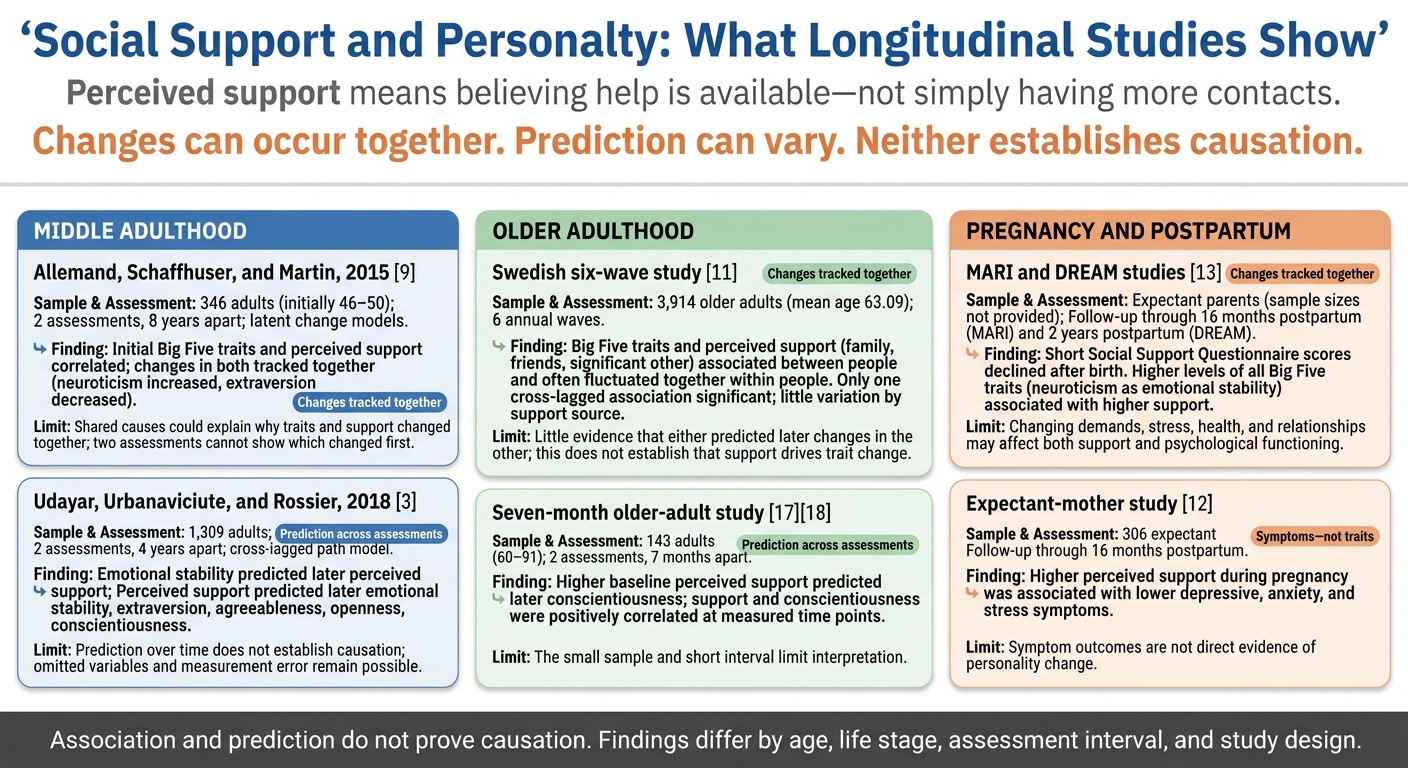
Social Support and Personality: What Longitudinal Studies Show
The studies show two patterns: changes that occur together over time and two-way prediction across assessment waves.
Middle Adulthood: Shared Change and Two-Way Prediction
ILSE found that adults whose personality traits changed also tended to report changes in support. But with only two assessments, the study cannot show which changed first.[9]
A cross-lagged study found two-way links over time: emotional stability predicted later perceived support, and perceived support predicted later emotional stability, extraversion, agreeableness, openness, and conscientiousness.[3] Prediction over time does not establish causation.
| Citation | Sample, life stage, and design | Principal finding | Causal limitation |
|---|---|---|---|
| Allemand, Schaffhuser, and Martin, 2015 [9] | 346 adults, initially ages 46–50; two assessments eight years apart; latent change models | Initial Big Five traits and perceived support levels were correlated, and changes in both tracked together. On average, neuroticism increased and extraversion decreased. | Shared causes could explain why traits and support changed together. |
| Udayar, Urbanaviciute, and Rossier, 2018 [3] | 1,309 adults in middle adulthood; two assessments four years apart; cross-lagged path model | Emotional stability predicted later perceived support; support predicted later levels of all five traits. | Omitted variables and measurement error remain possible. |
| Swedish six-wave study [10] | 3,914 older adults; mean age 63.09; six annual waves | Big Five traits and perceived support from family, friends, and a significant other were associated between people and often fluctuated together within people. Only one cross-lagged association was statistically significant; findings varied little by support source. | Limited evidence about direction does not establish that support drives trait change. |
| Seven-month older-adult study [13][14] | 143 adults ages 60–91; two assessments seven months apart | Higher baseline perceived support predicted later conscientiousness; support and conscientiousness were positively correlated at the measured time points. | The small sample and short interval limit interpretation. |
| MARI and DREAM studies [12] | Expectant parents followed through 16 months postpartum in MARI and two years postpartum in DREAM | Short Social Support Questionnaire scores declined after birth. Higher levels of all Big Five traits, with neuroticism scored as emotional stability, were associated with higher support. | Changing demands, stress, health, and relationships may affect both support and psychological functioning. |
| Expectant-mother study [11] | 306 expectant mothers followed through 16 months postpartum | Higher perceived support during pregnancy was associated with lower depressive, anxiety, and stress symptoms. | Symptom outcomes are not direct evidence of personality change. |
Older Adulthood: Shared Change and Mixed Predictions
Later-life findings are mixed. The six-wave study found that support and traits often moved together within people, but offered little evidence that one predicted the other over time. The shorter, seven-month study found that higher baseline support predicted later conscientiousness.[10][13][14]
Pregnancy and After Childbirth: Support and Trait Change
Life transitions make changes in support and personality especially hard to separate. In pregnancy and postpartum samples, perceived support declined after birth. Higher extraversion, emotional stability, agreeableness, conscientiousness, and openness were linked to higher support.[12]
For practitioners, these findings support asking about changing support needs using AI-powered coaching tools rather than assuming every parent or client population follows the same path.
How to Interpret the Findings
Consider Two-Way Influence and Shared Causes
These findings show associations, not causes. Support may increase safety and engagement, while personality may shape relationships and how people perceive support. Health, trauma, poverty, housing instability, caregiving, mood, and response styles can affect both.
These possibilities may explain why perceived support and personality move together over time, but they are not established mechanisms. Measurement error and selective attrition can also distort the association.[17]
Match Claims to Study Design
Study design determines what researchers can and cannot claim. The studies above use different designs to examine timing, stability, and change. None, on its own, shows that support causes trait change.
Two-wave studies provide limited evidence about timing, direction, or lasting change.[19] Standard cross-lagged models can blur stable differences between people and changes within a person.[16][18]
Random-intercept cross-lagged models separate stable between-person differences from within-person change. They usually require at least three waves and still rely on assumptions about timing, measurement, and confounding.[15] Latent change models estimate change and whether changes track together, but they do not establish causation.
Check Measures, Replication, and Fit
When applying findings in practice, check whether the sample matches your population and whether the measure assesses perceived support. Review support sources, assessment intervals, effect sizes, confidence intervals, and replication. Look for reliable measures that mean the same thing across waves, along with evidence about attrition bias.[17]
For clients facing trauma, illness, or unstable housing, ask whether the study represented those circumstances. Do not treat crisis-related withdrawal or guardedness as evidence of lasting personality change.
Use Findings Without Labeling Clients
The studies show association, not causation, so use support scores to guide care without labeling clients. Perceived support provides context. It is not a diagnosis, a fixed identity, or a prediction of trait change. A low score may reflect isolation, stigma, transportation barriers, discrimination, caregiving demands, or crisis. Ask what support the client wants and which relationships feel safe.
Measure Support, Behavior, and Traits Separately
Track four areas separately: perceived support, relevant trait measures, observed behavior and outcomes, and the client’s goals and narrative. The 12-item MSPSS measures perceived support from family, friends, and a significant other. It does not measure personality.[23]
Agree on a review interval, such as every four to eight weeks when appropriate. Record assessment dates, missing responses, and relevant life events. Ask whether the results match the client’s experience.
In case notes and reports, distinguish what was done from what changed. Neither completed referrals nor higher support scores prove personality change.
Use Personos for Communication and Follow-Up
For teams that need a structured follow-up workflow, Personos can help organize communication and follow-up through profiles, dynamic reports, prompts, and action tracking to enhance counselor awareness of client personality dynamics.[1] Treat these features as workflow aids, not diagnoses, evidence of trait change, or replacements for repeated validated assessment. Check suggestions against the client’s preferences and current needs.
Before use, get informed consent and complete a privacy and security review. Explain what information is collected, who can access it, how it is stored and retained, whether third parties are involved, and how clients can decline or withdraw consent.[22][24]
Review AI outputs for bias and unsupported inferences, and keep decisions under professional oversight. AI guidance must not replace clinical judgment, mandated reporting, or crisis protocols.[20][21]
Conclusion: Association Does Not Prove Causation
Across studies, the pattern is association, not proof of causation.[25][4][7] Perceived support is linked to personality change, but the direction of that link and its cause remain uncertain.[26]
In practice, strengthen perceived support without promising changes in personality traits. Track support and trait outcomes separately, and describe associations precisely. Address clients’ support needs without assuming their personalities will change.
FAQs
Why might I feel unsupported despite having close relationships?
Feeling unsupported in close relationships can come down to misunderstandings in communication. Personality traits influence how you express yourself and read other people’s social cues [1][2]. The support you receive may also miss the mark if it doesn’t fit your personal history or respect your boundaries [3][4].
Tools like Personos use the Five Factor Model to provide personality-informed guidance on these patterns, helping you find more effective ways to give and receive support [5][6][7][8].
How can I distinguish stress reactions from personality changes?
Use the scientifically validated Five Factor Model (FFM) to track personality traits over time instead of relying on personality types. When behavior shifts, look at whether the change reflects a short-term stress response or a lasting change in traits.
Personos offers personality-aware insights and real-time guidance tailored to the context, helping practitioners distinguish stable patterns from reactions to a specific situation.
How can I tell whether support is helping me?
Look for concrete changes in how you handle challenges, such as clearer communication, better conflict de-escalation, or more resilience in specific situations. These changes don't necessarily mean your personality traits have changed [1][2][3][4].
Personos helps professionals track progress with AI-powered reports and insights into how people respond to change and support. These reports can help assess whether interventions align with intended growth or relationship stability, but they don't prove causation [1][5][6].