Why 'People Skills' Are the New Competitive Advantage - and How to Build Them
With AI automating routine tasks, empathy, active listening, and adaptability are now essential skills — learn how to develop and measure them.
Rachel Johnson

Why 'People Skills' Are the New Competitive Advantage - and How to Build Them
Machines handle tasks. People connect. As AI takes over repetitive work like data sorting and content drafting, what sets professionals apart today is their ability to connect with others. Skills like empathy, active listening, and flexibility are now more critical than ever, especially in roles that deal directly with people, such as healthcare, counseling, and social work. These "people skills" not only improve workplace relationships but also drive better outcomes for clients and teams.
Key takeaways:
- AI can't replace human connection: By 2030, two-thirds of jobs will rely heavily on interpersonal abilities.
- Soft skills matter more than hard skills: Employers increasingly seek traits like critical thinking and emotional intelligence.
- Tools like Personos help develop these skills: For $9/month, it offers tailored personality insights, real-time guidance, and progress tracking.
In a world where automation handles the routine, your ability to connect, listen, and adapt is what gives you an edge. Ready to stand out? Start by sharpening your people skills.
Do These 7 Habits Everyday to Improve Your Interpersonal Skills This Year!
Core People Skills for Helping Professionals
In a world where AI takes care of routine tasks, the ability to connect with others on a human level becomes your edge. For helping professionals, three key interpersonal skills stand out: empathy, active listening, and flexibility. Research highlights that interpersonal skills are twice as critical to job performance as general cognitive ability [3]. These skills not only enhance client relationships but also amplify your overall effectiveness in the workplace.
Empathy: Understanding Others' Perspectives
Empathy is about recognizing and validating someone else's emotions without passing judgment. When a client is in distress, being attuned to their emotional state and seeing things from their perspective can defuse tension and build the trust needed for meaningful intervention. The World Health Organization even lists empathy as one of the "foundational helping skills" essential in psychosocial care roles [5]. It's not about agreeing with every viewpoint - it’s about understanding where someone is coming from. Paired with empathy, active listening strengthens connections by ensuring clients feel heard and understood.
Active Listening: Building Trust Through Attention
Did you know that only about 10% of people demonstrate effective listening skills [6]? Active listening isn’t just hearing words; it’s giving your full attention to the speaker, using supportive gestures like eye contact and nodding, and then paraphrasing to confirm you’ve understood. This approach reduces misunderstandings and reassures clients, especially when they’re feeling vulnerable. As productivity coach Donna McGeorge wisely says:
"Listen with an intention to have your mind changed" [7].
When you genuinely listen, even challenging moments can transform into opportunities for deeper connection. But these skills work best when paired with the ability to adapt to constantly changing circumstances.
Flexibility: Managing Dynamic Situations
In helping professions, unpredictability is part of the job. A client might cancel last minute, a crisis could arise, or new information could shift your plans entirely. Flexibility - the ability to stay composed and adapt during sudden changes - helps you navigate these challenges smoothly [4]. This means keeping an open mind, preparing backup plans, and focusing on what’s within your control. In high-pressure roles, adaptability not only supports your clients but also protects your own mental well-being, allowing you to continue delivering effective care. This adaptability is a core component of AI-driven behavioral insights for leaders looking to optimize team performance.
Building People Skills with AI Tools Like Personos
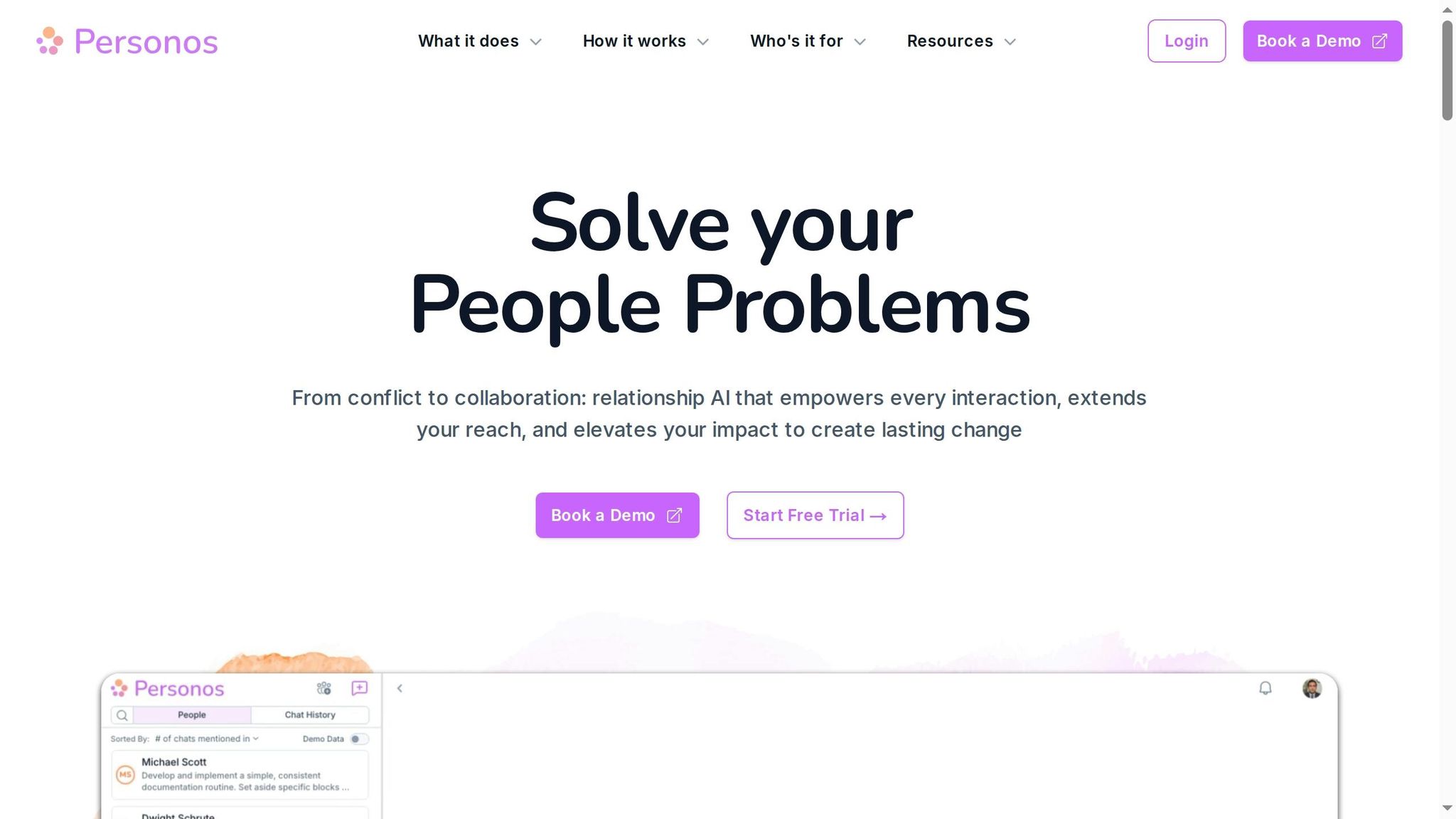
Improving people skills doesn’t have to rely solely on experience or trial and error anymore. With AI-driven platforms like Personos, you can fast-track your development by analyzing 30 personality traits on an 80-point scale. What sets Personos apart is its use of the Five Factor Model (FFM), which uncovers unique behavioral patterns and communication blind spots that simpler, category-based tools often overlook [8]. This data-driven approach delivers highly specific insights, making it easier to tailor your interactions with team members and clients.
Using AI for Personality Insights
Personality differences are one of the most common sources of workplace conflict [9]. Imagine working with a client who seems disengaged or a colleague who processes information in a completely different way - understanding their personality can change everything. Carla Mendoza, an addiction recovery counselor, highlights how Personos helps her:
"In recovery, timing is everything. Personos helps me anticipate when a client is on the edge of shutting down and adjust my approach so we stay connected." [9]
Personos offers tools like "Specialized Chats" and "Relationship Reports", which analyze the dynamics between two personalities. These features provide guidance on maintaining empathy while respecting professional boundaries, especially in sensitive situations. For instance, by typing "@" followed by a name in Personos Chat, you can instantly pull up personality profiles and receive tailored advice for that specific interaction. This level of contextual intelligence ensures that recommendations are not only relevant but also actionable, helping you navigate real-world challenges with confidence.
Personos Features: Practical Tools for Skill Development
Personos doesn’t stop at offering insights - it equips you with tools to act on them. The platform’s "Prompts" feature delivers actionable suggestions on a customizable schedule, helping you make steady progress. If a suggestion resonates, you can instantly turn it into a task on the ActionBoard, a Kanban-style system that tracks your behavioral improvements.
David Kim, an executive leadership coach, shared his experience:
"I've coached C-suite executives for 15 years, and Personos changed my practice overnight. It surfaces blind spots I would have taken months to uncover." [9]
Another standout feature is "Transparent Reasoning", which explains the personality traits and psychological principles behind each piece of advice. This not only helps you take action but also builds your understanding over time. For professionals managing heavy workloads, these tools can be game-changing. One organization even reduced team turnover by 45% in just six months by using Personos to address team dynamics [9].
At $9 per month per user, with a 7-day free trial [9], Personos makes advanced personality insights accessible, whether you’re an individual practitioner or part of a larger organization.
Personos vs. Competitors: Why It Stands Out
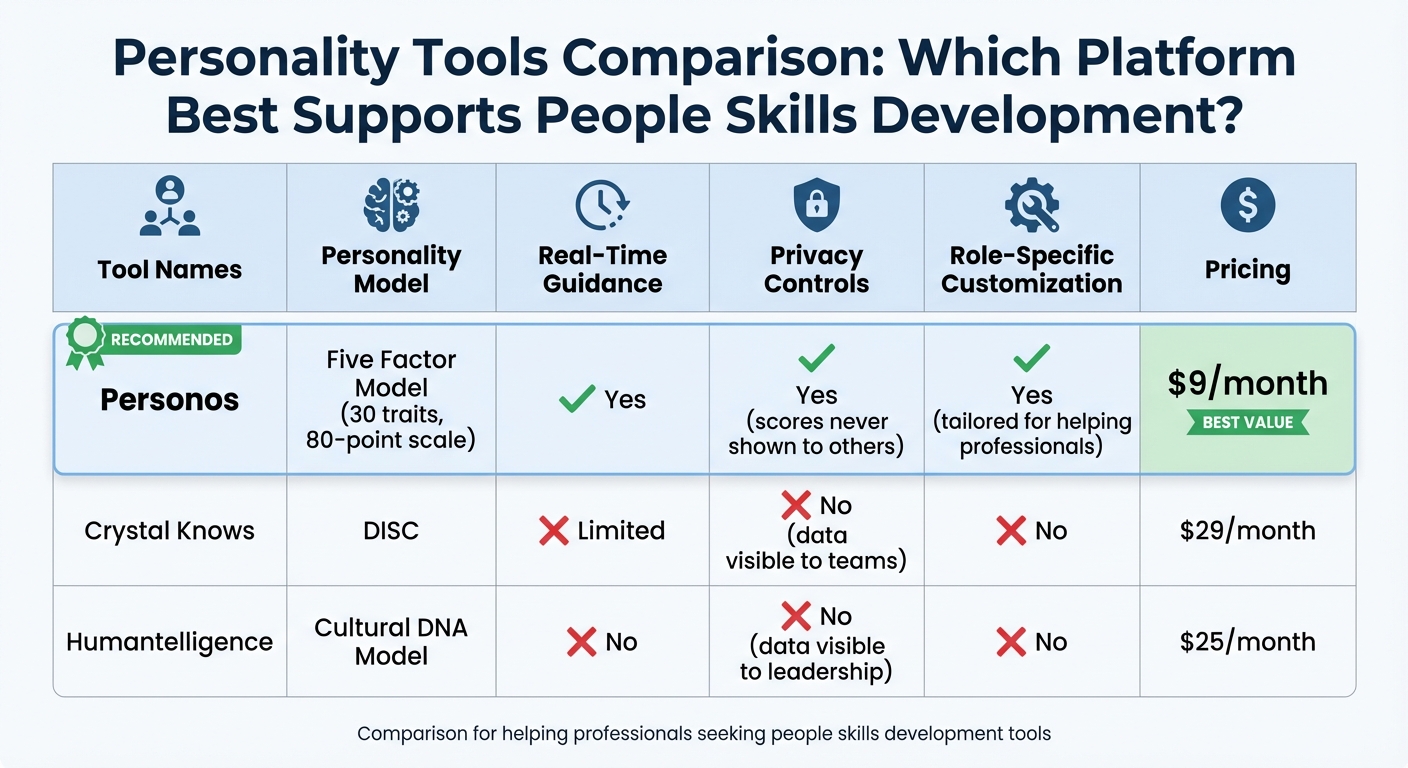
Personos vs Crystal Knows vs Humantelligence Feature Comparison
Personos brings a fresh approach to personality tools, offering features that outshine its competitors when it comes to building people skills.
Feature Comparison Table
Choosing the right tool for personality insights can make all the difference. Here’s how Personos stacks up against other platforms:
| Tool | Personality Model | Real-Time Guidance | Privacy Controls | Role-Specific Customization | Pricing |
|---|---|---|---|---|---|
| Personos | Five Factor Model (30 traits, 80-point scale) | Yes | Yes (scores never shown to others) | Yes (tailored for helping professionals) | $9/month |
| Crystal Knows | DISC | Limited | No (data visible to teams) | No | $29/month |
| Humantelligence | Cultural DNA Model | No | No (data visible to leadership) | No | $25/month |
This comparison highlights Personos’s competitive pricing and its focus on customization, particularly for helping professionals.
Personos' Advantages for Helping Professionals
Privacy is a game-changer with Personos. Unlike Crystal Knows and Humantelligence, which allow personality scores to be visible to managers or teammates, Personos ensures that your data stays private. Scores are never shared, reducing the risk of bias or labeling in professional environments [8]. This makes it an ideal tool for protecting the integrity of client relationships and workplace dynamics and meetings.
Another standout feature is Personos’s transparent reasoning. Instead of offering generic advice, the platform explains the personality traits and psychological principles behind its recommendations [10]. This empowers professionals to deepen their understanding over time, rather than relying on a system that keeps its logic hidden.
For those in fields like social work, counseling, or coaching, Personos provides tools tailored to their needs. Features like uploading client notes, tracking progress on shared ActionBoards, and generating detailed reports address the specific challenges of trauma-informed care and recovery support [10]. By contrast, competitors like Crystal Knows and Humantelligence are primarily focused on sales and corporate team dynamics.
At just $9/month with a 7-day free trial [9], Personos delivers exceptional value. Its use of the Five Factor Model, which assesses 30 traits on an 80-point scale [8], ensures a level of precision that category-based tools like DISC simply can’t achieve. For helping professionals, this means no two profiles are treated the same, offering insights that are as nuanced as the individuals they serve.
Tracking Progress and Measuring Impact
Building strong people skills isn’t something you achieve overnight - it’s a continuous process. To see meaningful results, professionals need to actively track their growth and assess how it influences their work. Without clear markers, it’s easy to slip into old habits or miss chances to improve. Let’s dive into how Personos supports this ongoing journey.
Using Personos ActionBoard to Track Growth
Personos’ ActionBoard tackles what they call the "Insight-Action Gap" - the disconnect between gaining insights and actually applying them. Instead of letting new ideas fade away, you can turn them into actionable tasks with just one click. The Kanban-style board provides a visual way to track progress, taking goals from start to finish. For example, if your objective is to "improve active listening", but it feels too broad, the "Discuss in Chat" feature can help you break it into manageable, actionable steps.
This tool isn’t just for individuals - coaches and supervisors can also assign tasks, provide feedback, and monitor outcomes directly through the ActionBoard. This makes it especially useful in fields like social work or counseling, where tracking progress is often critical for case management and funding reports. It’s a practical way to ensure that insights are not only understood but also acted upon effectively.
Measuring Client and Team Outcomes
Strong interpersonal skills lead to measurable improvements. According to research by Goleman, people skills are twice as important as general cognitive ability when it comes to job performance [3]. Even in technical fields like engineering or software development, better collaboration has been linked to higher performance levels [3].
The key to tracking these skills is to focus on specific, observable actions. Instead of vague metrics like "good communication", measure behaviors such as summarizing a client’s concerns before offering solutions or asking thoughtful clarifying questions. Personos takes this a step further by integrating personality data and the Five Factor Model to monitor 30 traits on an 80-point scale. This ensures that development goals are tailored to your unique profile [8]. As you rate the advice you receive and provide feedback, the system fine-tunes its recommendations, making them increasingly personalized [8].
The impact of these improvements is tangible. For helping professionals, it might mean resolving cases faster, boosting client satisfaction, or reducing escalations. For teams, benefits can include fewer conflicts, quicker project completion, and lower turnover rates. By aligning your skill-building efforts with the metrics that matter most for your role, you can clearly document the journey from initial insights to real-world outcomes. These measurable results underscore the importance of consistently tracking your progress.
Conclusion: The Path to Better People Skills
As AI takes over routine tasks, what sets top professionals apart is their ability to connect meaningfully, navigate emotions, and build trust. In fact, 92% of companies now state that human skills are just as important, if not more, than technical expertise [2]. By 2030, two-thirds of all jobs will heavily depend on interpersonal abilities, with these roles growing 2.5 times faster than others [2].
The good news? These skills can be developed through consistent practice and the right tools. The key lies in moving beyond one-time training sessions to integrating skill-building into your daily work [2]. It's not about checking a box - it’s about weaving these habits into your workflow for lasting growth [11].
As industry experts Alexis Krivkovich and Anu Madgavkar from McKinsey & Company put it:
"AI tools aren't eliminating the need for human skills, but they are changing what people need to be good at." [1]
Platforms like Personos help bridge this gap by offering real-time, personalized guidance and tracking progress through tools like the ActionBoard. What sets it apart is its ability to explain why certain methods work, helping you build expertise over time instead of fostering reliance. These tools make it easier to turn abstract concepts into actionable, daily habits.
Start with one impactful skill - whether it’s active listening, managing stress during tough conversations, or adjusting your communication style to different personality types. Let AI handle the repetitive tasks, freeing you to focus on fostering genuine human connections. This is a competitive edge you can cultivate.
FAQs
How do I practice empathy without overstepping boundaries?
To genuinely connect with others while respecting their boundaries, start with active listening - give your full attention and truly hear what they’re saying. Use open-ended questions to encourage them to share their thoughts and feelings, helping you understand their perspective better. Pay close attention to both verbal and non-verbal cues, like tone of voice or body language, to gauge their comfort level.
When responding, aim to be supportive without crossing into intrusive territory. Practicing what’s often called “wise empathy” involves striking a balance: offering the right emotional response for the situation and always asking for permission before diving into sensitive topics. This approach builds trust while ensuring you don’t overstep personal boundaries.
What are some quick ways to improve active listening at work?
Want to become a better listener at work? Here are some practical strategies to help you stay engaged and truly understand what others are saying:
- Eliminate distractions: Put away your phone, close unnecessary tabs, and clear your workspace of anything that might pull your attention away from the conversation. Giving someone your full focus speaks volumes.
- Use body language: Simple gestures like maintaining eye contact, nodding occasionally, and leaning slightly forward can signal that you're actively engaged and interested in what the speaker is saying.
- Reflect and clarify: Summarize key points or paraphrase what you’ve heard to confirm your understanding. For example, you could say, “So, what I’m hearing is...” to ensure you’re on the same page.
- Ask open-ended questions: Instead of sticking to yes-or-no questions, try asking things like, “Can you tell me more about that?” or “What do you think might work best?” This not only shows you’re listening but also invites deeper conversation.
- Practice patience: Resist the urge to interrupt or jump in with your thoughts. Let the speaker finish their point completely before you respond - it’s a simple way to show respect and care.
By incorporating these habits, you’ll not only improve your listening skills but also build stronger, more effective workplace relationships.
How can I tell if my people skills are actually improving?
To see how your people skills are improving, start by setting SMART goals for specific areas, like becoming a better listener or showing more empathy. You can use self-assessment tools or keep a journal to track your progress and reflect on your experiences. Feedback from colleagues or clients can also give you valuable insights from an outside perspective. Additionally, apps and tools designed for personal growth can help you stay on top of your development. These strategies make it easier to measure how your interpersonal skills are evolving.