What blocks open dialogue in mixed teams?
Five barriers that silence mixed teams—fear, power gaps, past harm, style clashes, and remote friction—and clear leader fixes to lower social risk.
Christian Thomas

What blocks open dialogue in mixed teams?
Most teams do not struggle because people have nothing to say. They struggle because it feels risky to say it.
If I boil the article down, open dialogue gets blocked by five things: resolving team conflicts, power gaps, past harm, style mismatch, and remote work friction. Silence can look like agreement, but it often means caution, deference, or doubt. That matters because more than 70% of the global workforce comes from group-first, high-hierarchy settings, and 1 in 5 remote employees say they feel overlooked.
Here’s the short version:
- Fear shuts people down when speaking up may lead to blame, status loss, or backlash.
- Power shapes voice because junior staff, newer employees, and marginalized people often carry more risk when they disagree.
- Past harm lingers when microaggressions, dismissive responses, or ignored concerns go unaddressed.
- Different communication styles clash when direct speech sounds rude and indirect speech sounds vague.
- Remote and hybrid work add friction because tone, timing, and context are easier to misread online.
What helps is simple and concrete:
- make dissent part of the routine
- hear quieter voices early
- give people private and delayed ways to respond
- name power dynamics out loud
- repair harm in plain language
- use written follow-up to reduce false alignment
In short: if you want people to speak honestly, you have to lower the social risk, not just ask for input.
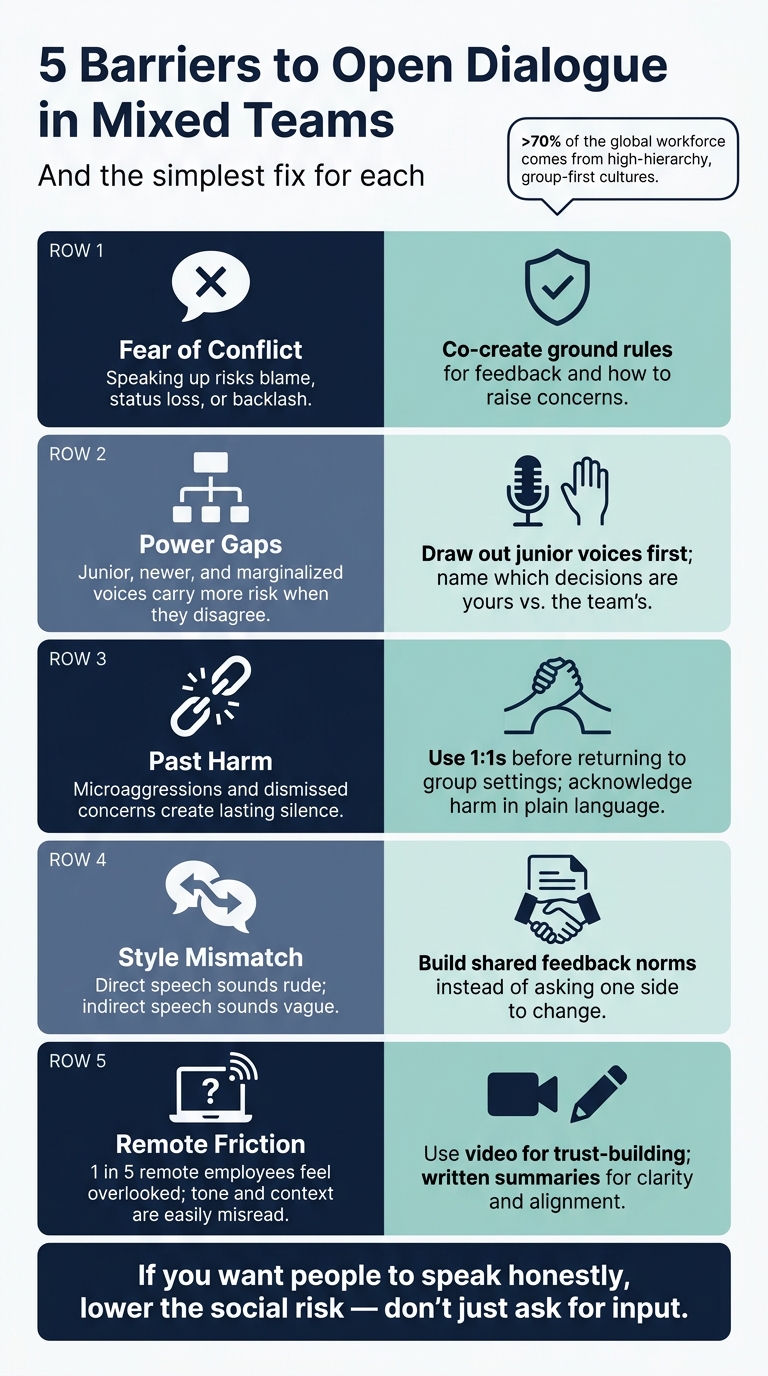
5 Barriers to Open Dialogue in Mixed Teams (And How to Fix Them)
4 Communication Traps of Multicultural Teams
Understanding these dynamics is the first step toward solving team conflicts with personality insights to bridge cultural gaps.
Fear of conflict and low psychological safety
In mixed teams, norms around authority, status, and disagreement often don't match. That means fear of conflict doesn't just slow decisions. It can stop them cold. When people expect backlash for speaking up, tension doesn't go away. It sits there, builds, and later shows up as a much bigger problem [6]. In mixed teams, those different norms around conflict can also make the fear easy to miss.
It helps to separate two very different kinds of conflict. Healthy, idea-focused disagreement tests ideas and helps the work move forward [6]. Harmful conflict is something else. It shows up as blame, social undermining, dismissiveness, or personal disrespect [8][7]. Teams that blur those lines often avoid all disagreement just to avoid the harmful kind. Then even useful debate starts to feel unsafe.
What makes people afraid to speak up
This fear usually has a reason behind it. People stay quiet because they've seen what can happen when someone pushes back. They may worry about retaliation, losing status, or being tagged as difficult or disrespectful [8][1]. That pressure tends to fall hardest on people with less power in the organization, like junior employees, people from marginalized backgrounds, or anyone uneasy about challenging someone with formal authority [8].
Norms around hierarchy can make this worse. In high-hierarchy cultures, questioning a manager may feel like more than a tense moment. It can come across as disrespect. As communication consultant Archana Parmar puts it:
"People speak up only when leaders make disagreement safe." [7]
When that safety isn't there, silence becomes the rational choice, not a passive one.
How leaders can make disagreement safer
Leaders can lower this fear by making disagreement structured instead of improvised. Telling people to "speak up anytime" sounds nice, but it often falls flat. What helps more is building clear moments into team routines where dissent is expected, not just allowed.
One simple shift can make a big difference. Instead of ending meetings with any questions?, give people 24 hours to reflect, then ask them to share anything that feels different after they've had time to sit with it [1]. That takes away the pressure of challenging someone on the spot and gives people room to process before they respond.
The table below shows where leaders often miss the mark and what tends to work better:
| Unhelpful Leader Behavior | Helpful Leader Behavior |
|---|---|
| Closing meetings with a generic open-ended question | Using a structured round-robin where everyone must contribute [1] |
| Treating disagreement as a personal attack | Separating ideas from identity and focusing on shared goals [8] |
| Responding to mistakes with blame | Normalizing mistakes as opportunities for learning and growth [8] |
| Assuming participative leadership is universally valued | Explicitly naming the decision-making style being used [1] |
Leaders also need to go first. When leaders openly admit mistakes or say they're unsure, they show that it's safe for other people to be imperfect too [8]. Even then, quieter teams may still hold back when hierarchy is strong or past harm is still in the room.
Power gaps and unresolved past harm
Teams can improve emotional intelligence to handle conflict and still miss a big problem: power gaps can keep people quiet. And those gaps aren't only about org charts. Age, gender, and tenure shape who talks, who gets heard, and who feels safe enough to push back. When nobody names that dynamic, honest conversation gets harder [8].
How hierarchy shapes what people are willing to say
Formal titles matter, but they aren't the whole story. Even when people sit at the same level on paper, age, gender, and tenure still affect who feels they have the right to speak. A simple prompt like "What do you think?" can even land the wrong way if people hear it as uncertainty instead of openness [1].
One common sign is softened feedback. Someone spots a real issue, then sands down the rough edges until the concern sounds small, vague, or easy to ignore. Sometimes they stay silent altogether [1][5]. In teams where seniority carries a lot of weight, that means key issues may never reach the people who need to act.
Informal power can do damage too. If someone gets interrupted again and again, or spoken to in a patronizing way, they may pull back [8]. Then a lot of their time goes into dealing with the hit in private. That takes mental and emotional energy. And when people have to deal with harm on their own, they're less likely to speak up the next time.
How to repair trust after harm
Repair starts by saying clearly what happened. Don't shrink it. Don't explain it away. If a leader ignores a microaggression or brushes off a concern as overblown, the person who was harmed can feel alone. It also tells the rest of the team that they shouldn't expect protection next time [8]. Left alone, one incident can turn into a long pattern of silence.
As Gustavo Razzetti, CEO of Fearless Culture, puts it:
"If you want to change your culture, you need to start by changing your conversations." [6]
Repair also has to show up in the way feedback works. An apology matters, but structure matters too. At Pixar town halls, Steve Jobs asked two direct questions: what's working and what's not working. That gave employees clear permission to name problems out loud [6].
The table below shows the gap between responses that make harm worse and responses that help repair it:
| Response that Deepens Harm | Response that Supports Repair |
|---|---|
| Reading silence as alignment or agreement [1] | Naming the trust asymmetry or power gap explicitly to the team [11] |
| Dismissing microaggressions as insignificant [8] | Acknowledging the harm immediately, without defensiveness [8] |
| Using participative leadership without explaining the intent [1] | Explicitly naming the decision-making style being used [1] |
| Expecting immediate public dissent in meetings [1] | Creating private channels and a 24-hour delay for feedback [1] |
After harm, say what happened in plain language, apologize without qualifiers, and ask what support is needed before the next meeting.
Even when a team does that work, personality differences and remote work can still make repair harder.
Personality differences and remote work friction
Even after a team works through harm, day-to-day style gaps can still get in the way of honest talk. People often read how something is said as proof of why it was said. That’s where trouble starts.
When different styles are mistaken for bad intent
Direct communicators often see indirect language as evasive. Indirect communicators often hear direct language as rude. The gap is about style, not intent, often influenced by how personality impacts cultural intelligence. [2]
For people who care a lot about harmony, blunt criticism can land like public humiliation. When that happens, they may pull back instead of speaking openly the next time. [2][3]
In person, people can often smooth over this kind of mismatch in the moment. A facial expression, a quick follow-up, or a short chat after the meeting can clear the air. Remote work makes that much harder, so the same misunderstanding can stick around longer.
Why remote and hybrid teams miss chances to repair
Text and video remove tone, timing, and context. A slow reply can look like disinterest, even when it’s just a busy day. That adds a remote-specific layer to a common problem: silence gets misread. On video calls, 1 in 5 remote employees report feeling overlooked, while nearly half of female business leaders say they struggle to speak up. [9]
"Hybrid teams get the worst of both: an in-office group with full context and a remote group watching through a window they cannot open." [9]
Remote coworkers can see the meeting, but they miss the side conversations and hallway context around it. So a misunderstanding that might have been cleared up in two minutes face-to-face can turn into a lasting assumption online.
Here’s where remote teams tend to get stuck, and what helps:
| Remote Blocker | Structural Fix |
|---|---|
| Reduced nonverbal cues | Proactive check-ins and explicit expressions of empathy [10][12] |
| Uneven airtime on video calls | Round-robin input rounds before open discussion [3][9] |
| Tone misread in text | Explicit norms for feedback and written decision summaries [2] |
| False alignment ("Are we aligned?") | Replace with action questions: "What are your next steps?" [2] |
| Async remote dissent | Written feedback channels with structured response windows [1][3] |
These friction points call for clear team norms, not just good intentions.
Leader responses that combine care and structure
When dialogue stalls, leaders need responses that lower risk without lowering standards, helping to resolve conflict and strengthen teams. That means using care and structure at the same time.
Care is about paying attention to identity, stress, and cultural context. Structure is about clear norms, steady facilitation, and actual follow-through. One without the other usually falls flat. If you lead with care but no structure, people may feel heard but still stay quiet. If you lead with structure but no care, the room can feel stiff and unsafe.
Tsedal Neeley's SPLIT framework gives leaders a repeatable lens for this work. [4]
What to put in place this week
Start with a leadership expectations conversation and a private dissent channel.
Ask each team member directly: "If you disagree with me, how would you want to raise it?" That question does two things at once. It shows you expect disagreement, and it gives people a safer way to bring it up.
Then set up a standing private check-in after major decisions. This gives people space to share concerns they may not want to bring up in a group setting.
In meetings, hear quieter and junior voices first. Swap vague confirmation questions for action-focused ones. And after major decisions, give the team 24 hours to respond privately. That extra window matters. Some people need time to think before they speak, especially when pressure is high. [2][1]
The main blockers and the simplest fixes
These fixes line up with the five blockers already covered:
| Blocker | Simplest Fix |
|---|---|
| Fear of conflict | Co-create ground rules for feedback and how to raise concerns |
| Power gaps | Draw out junior voices first; name which decisions are yours vs. the team's |
| Past harm | Use 1:1s before returning to group settings |
| Style differences | Build shared feedback norms instead of asking one side to change |
| Remote friction | Use video for trust-building; written summaries for clarity and alignment |
The idea is simple: name the barrier, lower the risk, and make dissent routine.
FAQs
How can I tell if silence means fear rather than agreement?
Silence in meetings often acts as self-protection, not agreement. When people feel uneasy or checked out, their body language can give them away: avoiding eye contact, crossing their arms, looking down, tightening their jaw, pursing their lips, or pausing before they say yes.
If you spot those signals, don't force an answer on the spot. Ease the pressure. Make the setting feel safer to speak in, or talk through concerns one-on-one in private.
What should a leader do first after trust has been damaged?
First, rebuild psychological safety by showing a bit of vulnerability and courage yourself. Own your mistakes. Take responsibility. That sends a clear message to the team: it’s okay to be imperfect.
Then ask specific, low-stakes questions about what’s working and what isn’t. Small, direct questions make it easier for people to speak honestly without feeling exposed.
How can remote teams make disagreement feel safer?
Remote teams can make disagreement feel safer when leaders focus on relationships and run meetings with a clear structure. That means using everyone-on-screen setups, going around the room for structured input, and adding a short silent pause so people can think before they speak. Small shifts like these make it easier for every voice to be heard without people fighting for airtime.
Leaders can also move part of the discussion outside the meeting. Asynchronous discussion gives people space to think, and in some cases, it helps to allow 24 to 48 hours for processing before asking for a response. Just as important, leaders need to show some courage themselves. Admitting mistakes sets the tone. It builds psychological safety and makes it clear that dissent won’t be punished.