Managing Introverts vs Extroverts on Teams
Lead the person, not the style: adapt communication, conflict handling, decisions, and recognition to support both introverts and extroverts.
Rachel Johnson

Managing Introverts vs Extroverts on Teams
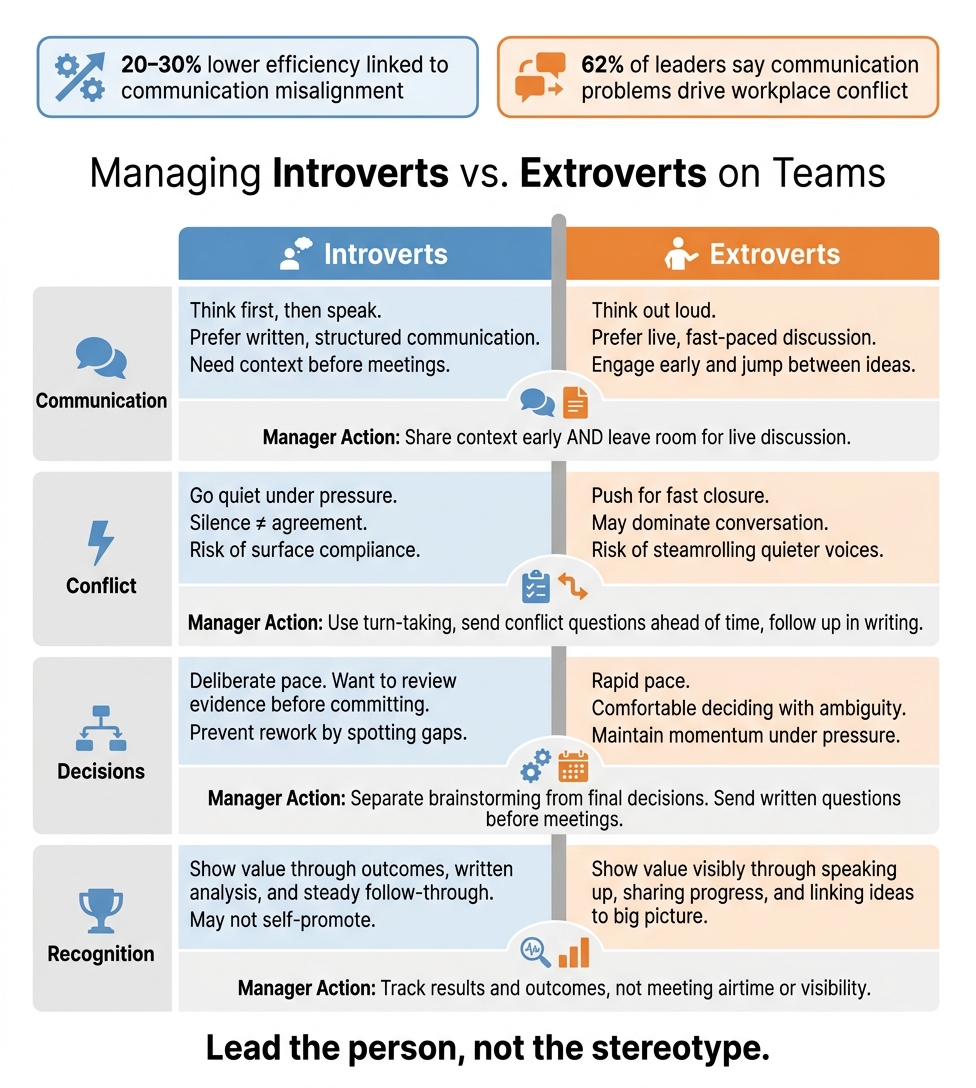
Most team issues here come down to one thing: managers often reward the style they like best. That creates gaps in communication, conflict, decisions, and recognition. The cost can be high, with misalignment in communication linked to 20% to 30% lower efficiency, and 62% of leaders saying communication problems drive workplace conflict.
If I want to lead both introverts and extroverts well, I need to do four things:
- Match communication to the person
- Treat silence and talk time with care
- Balance reflection with momentum in decisions
- Give credit based on results, not visibility
This is not about picking one style over the other. It is about making sure quiet people are not ignored and talkative people are not misread.
Introverts vs Extroverts at Work: How to Manage Both Effectively
The Introverts on My Team Seem Disengaged (Maxwell Leadership Executive Podcast)
Quick Comparison
| Area | Introverts | Extroverts | What I should do |
|---|---|---|---|
| Communication | Think first, then speak | Think by talking | Share context early and leave room for live discussion |
| Conflict | May go quiet under pressure | May push for closure fast | Use turn-taking, prep notes, and written follow-up |
| Decisions | Want time to review | Want to move fast | Split brainstorming from final decisions |
| Recognition | Often show value through output | Often show value out loud | Track outcomes, not meeting airtime |
The core idea is simple: lead the person in front of me. When I do that, I get better input, fewer bad assumptions, and a team that works better day to day.
Communication: Managing Reflective vs. Talk-Through Styles
How Introverted Team Members Prefer to Communicate
Introverted team members tend to think first and speak second. They often do best with written, structured communication. Managers can help by sharing context before meetings, giving them time to respond, and setting a clear structure. When that setup is missing, live discussion can get lopsided fast.
How Extroverted Team Members Prefer to Communicate
Extroverted team members often think out loud. They may jump between ideas and sort things out through live discussion. The main risk is talk time. Without some structure, extroverted communicators can take over a conversation without trying to.
"If someone processes by talking, don't mistake unfinished thoughts for confusion. They may be thinking in real time." [1]
The answer isn't picking one style over the other. It's building a process that gives both styles enough room to work. Many leaders are now using AI to analyze personality to build these balanced workflows.
Communication Routines That Work for Mixed-Personality Teams
The table below shows the main differences between each style:
| Reflective Style | Talk-Through Style | |
|---|---|---|
| Preferred channel | Written, structured communication | Live, fast-paced discussion |
| Meeting behavior | Listens, reflects, speaks when ready | Engages early, thinks out loud |
| Response style | Considered, detailed, logical | Fast, conversational, big-picture |
A few small adjustments can make a big difference. Match the level of detail to the person you're speaking with. Don't overload a talk-through communicator with too much context, and don't leave a reflective one without enough to work with.
It also helps to be clear and respectful. Set direct expectations, but say them in a way that people can hear without shutting down. And when you need alignment, ask, "What's your read on the next step?" That question makes it easier to spot where two people heard the same message but came away with different takes.
Those same habits also affect how fast tension builds or how you resolve team conflicts with personality insights.
Conflict: Preventing Silent Withdrawal and Verbal Steamrolling
How Introverts Tend to Handle Conflict
When pressure hits, these differences get sharper. One of the biggest mistakes managers make with introverted team members is reading silence as agreement. It often isn't.
In a tense conversation, an introvert may go quiet to lower the pressure, not because the issue is settled. A manager can leave that meeting thinking the problem is fixed, while the team member only agreed to end the discomfort. They may nod, say the right things, and then pull back later. That leads to surface compliance: the work gets done, but real buy-in never shows up.
An introvert who feels corrected too bluntly or pushed too hard will often hold that tension in instead of saying it out loud.
How Extroverts Tend to Handle Conflict
Extroverted team members often move in the other direction. They usually want to deal with tension right away and get to closure fast. That pace can help, but it can also drown out quieter voices.
The leadership mistake here is rewarding speed and volume over listening. If a manager keeps siding with the person who speaks first or sounds most sure, quieter team members get the message fast: speaking up doesn't pay. Over time, that shapes who gets heard and who stops trying.
Conflict Practices That Work Better for Both Styles
The table below shows the main differences side by side:
| Introverts | Extroverts | |
|---|---|---|
| Default conflict style | Withdrawal, pausing, private follow-up | Immediate address, verbal processing, pushing for closure |
| Common triggers | Blunt corrections, fuzzy thinking, lack of logical structure | Slow decisions, rigid communication, lack of momentum |
| How stress shows up | Silence, disengagement, hidden emotional load | Rushed or dismissive tone, jumping to new ideas before resolving current ones |
| Leadership mistake | Assuming silence means agreement or resolution | Rewarding intensity and speed over listening and reflection |
A few simple habits can help both groups.
- Before a sensitive meeting, send the conflict question ahead of time.
- In the meeting, use a neutral facilitator or set firm turn limits so one person doesn't take over.
- Afterward, send a short written recap with the decision and next steps.
The same mix of speed and reflection shows up again in decision-making.
Decision Speed: Balancing Reflection and Momentum
The same gap that shapes conflict also shapes how teams make decisions. Conflict shows who needs space. Decisions show who needs time.
Where Introverts Add Depth to Team Decisions
Introverted team members often move with care. They want to look at the evidence, follow the sequence, and think through the impact before they commit. That's caution, not delay.
They don't resist action. They resist unclear thinking.
When people are pushed to answer on the spot, careful analysis can turn into shallow agreement. If a manager presses an introverted team member to decide before they're ready, the result is often a surface-level answer that misses key gaps. A slower response often means deeper analysis, and that kind of thinking can help the team avoid rework later.
Where Extroverts Add Speed to Team Decisions
Extroverted team members are often comfortable making a decision before every detail is nailed down. They'd rather make the call, then adjust as they go, than wait for perfect clarity. In a crisis or under a tight deadline, that can matter a lot. It keeps the team from getting stuck.
The leadership mistake here is putting too much weight on decisiveness, often overlooking the need for personality-driven empathy in the process. If the first answer keeps getting rewarded, the team learns that speed matters more than being right. When a manager keeps siding with the person who speaks first and decides fastest, everyone else gets the message. Move fast, speak first, don't slow things down. Over time, that pushes out the careful review that helps prevent costly rework.
How Managers Can Build a Decision Process That Uses Both Strengths
The goal isn't to slow extroverts down or force introverts to rush. It's to set up a process where both styles can do their best work. This balance is a key part of personality-driven growth within high-performing teams.
| Introverts | Extroverts | |
|---|---|---|
| Decision pace | Deliberate; prefers to process before acting | Rapid; prefers to decide and adjust as they go |
| Strengths | Prevents rework; identifies logical gaps; spots unresolved concerns | Maintains momentum; comfortable with ambiguity; lifts team energy |
| Blind spots | May be mislabeled as slow or resistant to change | May be perceived as rushed, dismissive, or impulsive |
| Meeting behavior | Asks for evidence, proof, and impact on people | Wants the bottom line first; thinks out loud; jumps between ideas |
| Manager adjustment | Provide structure, specifics, and time to review details | Lead with the bottom line; assign next steps and one owner |
A few practical habits can make this work better.
- Send written decision questions before meetings so introverts have time to think before the discussion starts.
- In the meeting, give extroverts space to think out loud in live discussion.
- Afterward, send a written recap with the decision and next steps for everyone.
Separate brainstorming from the final choice. Close the loop with a clear decision owner and deadline. Instead of asking "Does everyone agree?", try "What's your read on the next step?" That question checks whether the decision actually landed, not whether the room just stayed quiet.
For urgent calls, name one owner and decide. For decisions with longer-term effects, build in a short window for written input before the choice becomes final. That keeps momentum without setting the team up for rework.
Once decisions are made, the next question is who gets visible credit for the work.
Visibility and Recognition: Fairly Rewarding Quiet Impact and Visible Energy
How Introverts and Extroverts Differ in Visibility Needs
Once decisions are made, the next test for a manager is simple: who gets credit for the work.
Extroverts often make their work easy to see. They speak up in meetings, share progress out loud, and tie their ideas to the big picture. That kind of visibility can be useful. But it is not the same as performance.
Introverts often show their value in different ways. You see it in outcomes, written analysis, and steady follow-through. That's where managers can get into trouble. If you reward visibility instead of results, you miss the people doing some of the strongest work.
Common Recognition Mistakes Managers Make
The biggest mistake is treating visibility as value.
When managers keep rewarding the most vocal person in the room, steady, high-impact contributors get passed over. Not because their work is weak, but because it doesn't come with a spotlight.
A few other patterns are worth watching:
- Assuming introverts don't want higher-responsibility roles. They often do. They just may not self-promote.
- Rewarding talk time over results. Praising whoever speaks the most in a meeting trains the team to value noise over output.
- Skipping private praise. Public praise doesn't fit everyone. Many introverted employees would rather get direct, private acknowledgment tied to a specific contribution.
Base recognition on outcomes, not talk time. When you're deciding who is ready for a promotion, document results instead of relying on who was loudest in the last quarter.
Conclusion: Lead the Person, Not the Stereotype
Across communication, conflict, decision-making, and recognition, introverts and extroverts don't need opposite management styles. They need adjusted ones.
Neither style is better. Both come with blind spots. Both bring strengths the other can miss.
Strong managers use AI to analyze personality for team success and build systems that make room for reflection and momentum, written input and live discussion, quiet impact and public presence. The goal is a process where no one has to change who they are to be seen as valuable.
Lead the person, not the stereotype.
FAQs
How do I avoid mistaking silence for agreement?
Skip closed-ended questions like “Do you understand?” They usually get a quick nod and not much else.
Ask open questions instead, like: “What is your read on the next step?” That gives you a better sense of whether you’re actually aligned.
If you’re not sure whether someone is taking it in or quietly pushing back, Personos can help. It offers personality-aware guidance, real-time coaching, and prompts matched to their decision-making style and preferred pace.
What’s the best way to run meetings for both introverts and extroverts?
Set team norms that make room for different ways of working. That can mean blocking off quiet time for reflection, then setting aside time for group discussion so people can think first and speak when they're ready.
Managers can also use tools like Personos to spot communication preferences and encourage more balanced participation. The result is a more inclusive meeting, where different strengths help the team work better together.
How can I fairly recognize quiet high performers?
Recognize quiet high performers by looking at how they think, communicate, and follow through, not just how often they speak. Visibility alone is a shaky measure.
Instead, look at a mix of signals: notes, deliverables, feedback, and collaboration patterns, especially in the questions they ask and how they follow through. If it helps, personality-aware guidance like Personos reports can help reduce bias.