Low Trust at Work: Personality Clues and Fixes
Fix missed follow-through, guarded talk, and stress-driven conflict with clear ownership, small commitments, and personality-aware habits.
Rachel Johnson

Low Trust at Work: Personality Clues and Fixes
Low trust at work often starts small, then gets expensive fast. If people go quiet in meetings, miss follow-up, or move hard feedback into side chats, trust is already slipping. And solving team conflicts with personality insights costs U.S. employers about $359 billion a year in lost work hours.
Here’s the short version: I’d look for three patterns first and fix them with simple habits.
- Missed follow-up often points to unclear ownership, overload, or a style mismatch around structure.
- Guarded communication often shows up when people fear blame, need more time to think, or do not feel safe speaking up.
- Stress conflict tends to spike when roles are fuzzy, deadlines tighten, and people misread tone or intent.
What helps most:
- Set clear “what, by when” commitments
- Give each task one owner
- Use pre-reads or written input for quieter teammates
- Talk about the behavior, not the person
- Review trust problems through both stress and personality before judging intent
| Pattern | What I’d check first | What usually helps |
|---|---|---|
| Missed follow-up | Clear owner, clear deadline, workload | Smaller steps, written deadlines |
| Silence in meetings | Fear, caution, thinking style | Pre-reads, written feedback, direct prompts |
| Sharp tone or blame | Stress, low patience, urgency | Clear conflict rules, task-focused feedback |
| Weak handoffs | No tracking, fuzzy ownership | Shared tracker, one owner, async updates |
This article makes one main point: low trust is often a behavior pattern before it becomes a people problem. If you read those patterns early, you can fix them with plain habits instead of letting them turn personal.
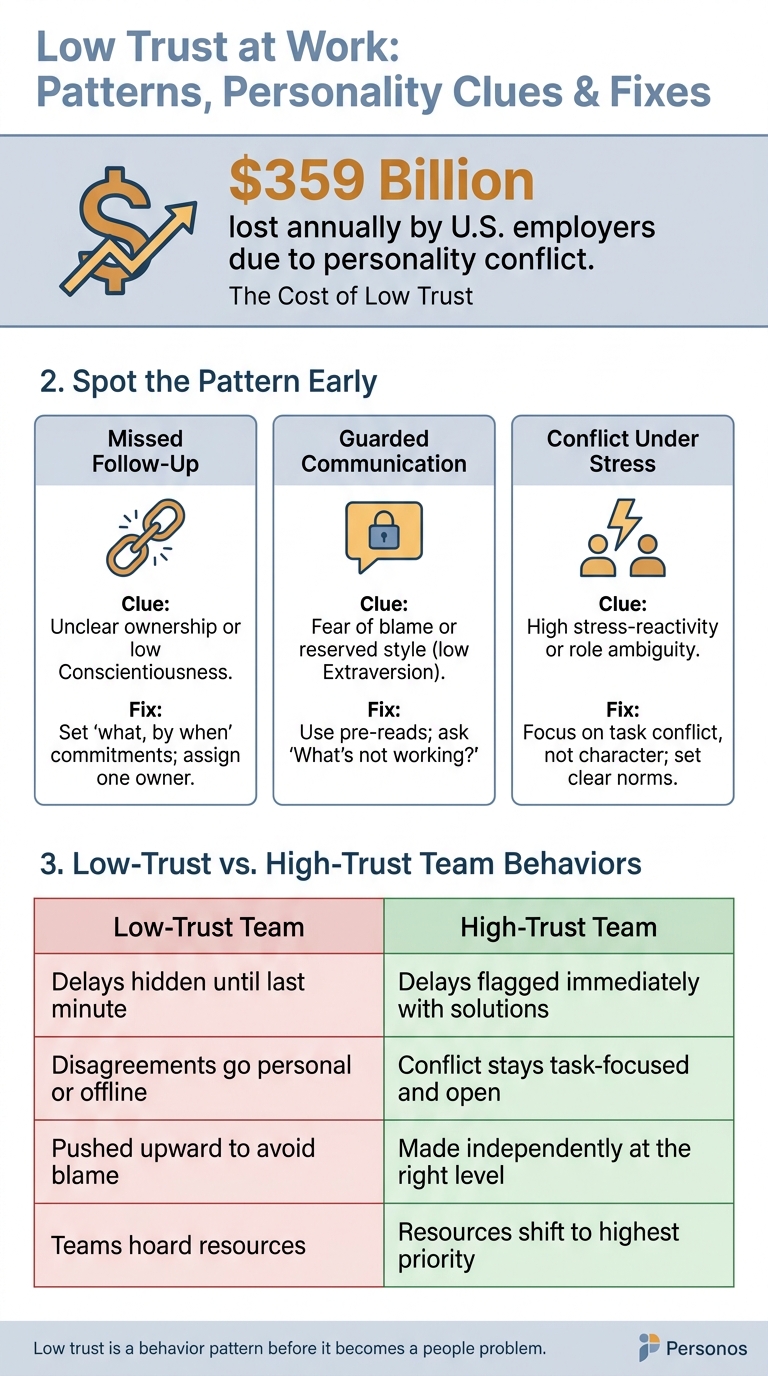
Low-Trust vs. High-Trust Team Behaviors: Key Patterns & Fixes
The Art of Building Trust at Work with Charles Feltman
Signs Your Team Is Running on Low Trust
Low trust usually shows up in a few clear ways: missed follow-through, guarded communication, and conflict that flares when pressure hits. These patterns matter because personality often shapes how people respond. Some people over-explain, some go quiet, and some get sharp when stress builds.
Missed Follow-Up, Weak Handoffs, and Broken Commitments
One of the first signs is unreliable follow-through [6]. Work gets dropped, updates slip, and people stop feeling sure that someone will do what they said they’d do.
That’s when teams start piling on extra check-ins. Not because the work is hard, but because ownership feels fuzzy and follow-through feels shaky. Handoffs get weaker too. When no one is quite sure who owns what, accountability starts to blur.
Another warning sign is filtered updates. People hold back information before sharing it, or treat it like leverage instead of something the team should use together [6]. It’s a bit like playing a game with half the cards hidden. Nobody can make a solid move.
Guarded Talk, Silence in Meetings, and Side Conversations
When trust slips, candor usually goes with it. In meetings, people give vague updates, nod along, and agree to move on without being fully aligned. Concerns that feel risky stay unsaid. Over time, unresolved conflict piles up and gets worse the longer it sits [5].
"The more we avoid [unresolved conflict], the worse it's going to become." - Gustavo Razzetti, CEO and founder, Fearless Culture [5]
The hard feedback doesn’t disappear. It just moves offline into private messages or after-meeting conversations. That shift matters. Once the real conversation leaves the room, the team loses its chance to deal with problems together.
There’s also a quieter sign: resignation. People stop asking questions. They stop pushing back. Not because they agree, but because they think nothing will change [5].
What sounds like silence may actually be a high-caution response to risk.
Conflict Spikes During Stress, Mistakes, and Resource Pressure
Stress tends to expose trust problems fast. Teams fall into blame language and spend more time on who caused the problem than on how to fix it [5]. Mistakes get hidden until the last possible moment. Departments start guarding their resources instead of sharing them [6].
Decisions often get pushed upward too, because no one wants to own the blame if things go wrong [6]. And instead of solving problems, teams keep reopening the same arguments.
"Trust is the foundation of all effective teams. Without it, individuals hesitate to be their true selves, share ideas, or admit mistakes." - Lisa Dunbar, CEO, Paradigm Personality Labs [2]
The next question is whether these reactions come from habits, stress load, or trait differences.
In practice, low-trust and high-trust teams often look like this:
| Scenario | Low-Trust Team Behavior | High-Trust Team Behavior |
|---|---|---|
| Project delays | Delays hidden until the last minute | Delays flagged immediately with solutions |
| Conflict | Disagreements turn personal or go offline | Conflict focuses on the problem in open channels |
| Decision making | Decisions pushed up to avoid blame | Decisions made independently at the right level |
| Resource sharing | Teams hoard resources | Resources shift to the highest team priority |
These patterns often tie back to personality differences in caution, directness, and stress response, not just workload.
How Personality Clues Explain Trust Problems
These patterns start to click when you look at the personality traits underneath them. A quiet teammate might be thinking things through, trying to dodge conflict, or doubting that speaking up will change much. A missed deadline might come from disorganization, lower structure, or a stronger pull toward flexibility than routine. If a team skips that personality lens, it's easy to read the wrong intent and chip away at trust.
A Plain-English Five Factor Model Primer for Team Trust
The Five Factor Model, or Big Five, breaks personality into five core traits that shape how people talk, follow through, deal with conflict, and react under pressure. The key idea is simple: each trait sits on a spectrum, not in a box.
| Trait | More of This Trait | Less of This Trait | Where It Shows Up |
|---|---|---|---|
| Conscientiousness | Precise, deadline-driven | Flexible, spontaneous | Follow-through |
| Agreeableness | Cooperative, harmony-seeking | Direct, competitive | Conflict style |
| Extraversion | Vocal, collaborative | Reflective, reserved | Participation |
| Openness | Idea-driven, change-ready | Practical, routine-preferring | Change response |
| Emotional Stability | Calm under pressure | Reactive to stress | Stress response |
No spot on any trait spectrum is "bad." Trouble starts when two people on opposite ends assume the other person is being difficult on purpose. The Big Five gives teams a plain way to read behavior without rushing to blame. It also helps explain why the same trust issue may need a different fix depending on who is involved.
Traits That Can Drive Missed Follow-Up and Guarded Communication
Lower Conscientiousness doesn't mean someone doesn't care. More often, it means they're less driven by process and more at ease changing plans than sticking to routines. Lower Extraversion can seem like withdrawal in a fast meeting, when that person may just need a little more time to think before speaking. High Agreeableness can bury disagreement because keeping the peace feels safer than saying the hard thing. Lower Agreeableness can lead to blunt replies that sound hostile, even when the person is just being efficient. Context matters here. A lot.
Why Misreading Personality Makes Trust Worse
When teams skip the "why" and jump straight to motive, the problem grows. If a cautious coworker gets tagged as resistant, or a quiet one gets seen as checked out, that can trigger a threat response. Then the person who feels misread pulls back even more, and the tension keeps building. U.S. employers lose an estimated $359 billion in lost work hours annually to personality conflict [7]. A style mismatch can turn into distrust and repeat conflict fast.
"Personality context helps with understanding and intervention, it's not a pass." - NeuroLaunch Editorial Team [7]
Start by spotting the trait pattern, then match the response to the person and the problem. This isn't about putting labels on people. It's about picking the right move to repair trust.
Fixes That Rebuild Trust Using Personality-Aware Responses
Spotting the personality pattern is only half the job. The next part is choosing a response that fits the person and the moment. Start with reliability, because missed follow-through is often the first sign that trust has started to slip.
Build Reliability with Clearer Commitments and Better Task Design
The fastest way to keep missed follow-up from wearing down trust is to make the commitment smaller. Instead of saying, "get me an update by end of month", say, "send me one paragraph by Friday at 3 p.m." Smaller milestones give highly conscientious teammates the structure they need. And each task should have one owner, not a group. When everyone owns it, no one owns it.
Overcommitment chips away at trust, too. A direct workload check like, "What's on your plate right now?" brings blockers into the open before they turn into broken promises. Skip that talk, and small issues can snowball into bigger conflict.
Once ownership is clear, the next move is making it easier for people to speak plainly.
Make Communication Safer for Quiet, Blunt, and Stress-Sensitive Teammates
Not everyone thinks out loud. Quiet or internally focused teammates often need a beat to process before they respond. Silence or guarded comments in meetings are often the result, not disengagement. A pre-read or a request for written feedback before the meeting can pull in their input without putting them on the spot. For stress-sensitive teammates, it helps to frame ideas around what might go wrong and how the team will handle it, instead of leading with upside alone.
With blunt or direct communicators, be direct and skip the extra cushioning. The key is to name the behavior, not the person. "When the handoff was delayed, the team lost two hours" works better than "you're unreliable." One points to something that can change. The other feels like a personal hit.
One simple habit helps across styles: open meetings with two questions.
- "What's working?"
- "What's not working?"
That gives people room to surface issues early, before they harden into bigger problems.
Behavior Map: Low-Trust Patterns and Better Responses
| Low-Trust Pattern | Personality Clue | Likely Non-Personality Contributor | Targeted Trust-Repair Response |
|---|---|---|---|
| Missed follow-up | Low Conscientiousness; high openness (pulled toward new ideas) | Overloaded capacity; unclear priorities | Set smaller milestones; confirm one owner and deadline in writing |
| Guarded updates | High caution; reserved style | Fear of blame; lack of psychological safety | Use pre-reads; ask "What's not working?"; give supportive feedback after errors |
| Blunt or harsh tone | Low Agreeableness; direct style | High stress; urgent deadlines | Set clear norms for disagreement; focus on task conflict, not character |
| Weak handoffs | Low Extraversion; Low Conscientiousness | Information silos; no shared tracking | Define single owners; use shared dashboards; try async standups for updates |
| Conflict spikes under pressure | High stress-reactivity; assertive style | Resource pressure; role ambiguity | Use straightforward honesty; frame solutions around risk mitigation |
These response patterns work best when teams track them over time and adjust them by person, not just by policy.
Using Personality Tools and AI Support Without Losing the Human Element
The behavior map in the previous section gives teams a solid starting point. But when these issues show up in the moment, tools can help teams respond with more consistency. That matters when missed follow-up, guarded talk, and conflict under stress keep showing up.
Where Tools Like Personos Fit in Trust Repair
Static assessments can point out a pattern, but they often stop there. They may help during a workshop, then fade into the background once daily pressure takes over.
Personos is built for helping professionals who deal with hard human dynamics every day. Instead of handing over a one-time report, it turns personality insight into real-time guidance tied to the situation in front of the user. That matters because the same problem does not always need the same response. A tense exchange with a peer is not the same as a hard conversation with a supervisor. Personos is designed to respond to that difference, rather than give broad scripts that sound fine on paper but fall flat in practice.
Privacy, Consent, and Avoiding Labels
Participation should always be voluntary. If staff are pushed to share personality profiles without consent, a trust-building tool can start to feel like surveillance.
Personos uses a privacy-first design, and individual scores are not shared with managers or teammates unless the person explicitly consents to a coaching relationship [4]. That means consent and privacy are part of trust repair itself, not just a compliance box to check.
The other trap is labeling people instead of trying to understand them. Calling someone "unreliable" based on a personality score is the kind of shortcut that damages trust fast. Personality insight should help guide supervision and conversation, not replace them. It is one input among others, including clinical judgment and direct conversation.
Assessment and AI Options for Trust Support
For teams comparing tools, the split is pretty simple: static insight, broad AI advice, or guidance tied to the person and situation. Traditional assessments give a fixed snapshot. Generic AI gives broad input. Personos combines Five Factor insight with situation-specific guidance.
The main takeaway is to pick tools that help teams respond in a timely, person-specific way, not just hand them a report that sits in a folder.
Conclusion: Turn Personality Clues into Repeatable Trust Habits
Low trust in helping teams usually doesn’t come from bad intent. More often, it shows up in small patterns: missed follow-up, guarded talk, and conflict under stress. The first step is to name what’s happening. Personality clues can help explain the pattern.
The tricky part is that the same behavior can mean different things. It might point to conscientiousness, agreeableness, extraversion, or stress reactivity. A teammate who goes quiet in meetings may be processing, not checking out. A colleague who misses a follow-up may need clearer expectations and more concrete commitments, not a character judgment. That’s why the fix should start with specific, observable commitments. Trust cues vary by person, so one fix will not fit every teammate [1].
Trust grows through consistent, positive interactions, not one-time interventions [3]. Start with specific “what, by when” commitments [1].
Use personality insight as a guide for better conversations, not a label you stick on people. A conscientious teammate needs clear expectations, timelines, and competence signals, not a rigid label. Personality can help shape your response, but it shouldn’t become an excuse for repeated behavior. For teams that need help in the moment, Personos can turn trait insight into real-time guidance for the situation at hand.
FAQs
How can I tell if low trust is a stress issue or a personality clash?
Look at the pattern. Stress tends to show up as temporary, reactive shifts in how someone communicates or performs when pressure builds or expectations aren’t met. A personality clash is more recurring. It usually comes from different work styles, priorities, or ways of reading communication.
Personos can help teams spot those differences and figure out whether they’re dealing with a fixable communication mismatch or a deeper interpersonal misalignment.
What should a manager do first when follow-through keeps slipping?
Start with open, direct communication to get to the root cause. Ask what’s working and what isn’t instead of skirting around the issue.
Address the breakdown head-on, and own your part in it. That helps build psychological safety and makes it easier for the other person to speak plainly too. Then use personality-based insights to adjust your approach and make expectations clear.
How can quieter teammates share honest feedback without pressure?
Acknowledge that people communicate in different ways instead of pushing the same approach on everyone. Some teammates need a little time to think before they speak, so don’t rely only on group meetings. Written feedback or private one-on-one chats can work much better.
Ask what helps them feel at ease when they contribute. Also ask whether they want feedback right away or if they’d rather have time to process it first. Personos can help here with personality-based insights and tailored ways to reduce communication gaps.